
Type & Discipline
Schema Therapy is an integrative psychotherapy model within clinical psychology, situated among the third-wave and integrative cognitive therapies 4. It was developed primarily for chronic, characterological, and treatment-resistant presentations rather than acute, circumscribed symptoms 6. Methodologically it blends cognitive-behavioral technique with concepts and methods drawn from attachment theory, psychodynamic, object-relations, and Gestalt traditions, integrating them into a single coherent framework 7. Treatment is typically longer-term and emotionally focused, with the therapeutic relationship itself serving as an active change agent 6. Clinicians most often describe it as a structured, schema-and-mode-driven model that retains CBT’s emphasis on assessment, formulation, and homework while adding experiential and relational depth 4.
Creators & Lineage
Schema Therapy was developed by Jeffrey Young, originally a cognitive therapist who trained in Aaron Beck’s tradition, in response to the limitations he observed when standard cognitive therapy was applied to patients with personality disorders and entrenched life patterns 7. Young, together with Janet Klosko and Marjorie Weishaar, codified the model in the foundational text Schema Therapy: A Practitioner’s Guide 6. The approach deliberately integrates several lineages: the cognitive-behavioral therapy from which Young emerged, attachment theory’s account of early caregiving and unmet needs, psychodynamic and object-relations thinking about internalized self-and-other representations, and Gestalt experiential methods such as chairwork and imagery 7. This integrative parentage is what distinguishes Schema Therapy from a purely cognitive or purely psychodynamic treatment 4. The model is now stewarded internationally by the International Society of Schema Therapy (ISST) and associated training bodies 5.
Core Principles
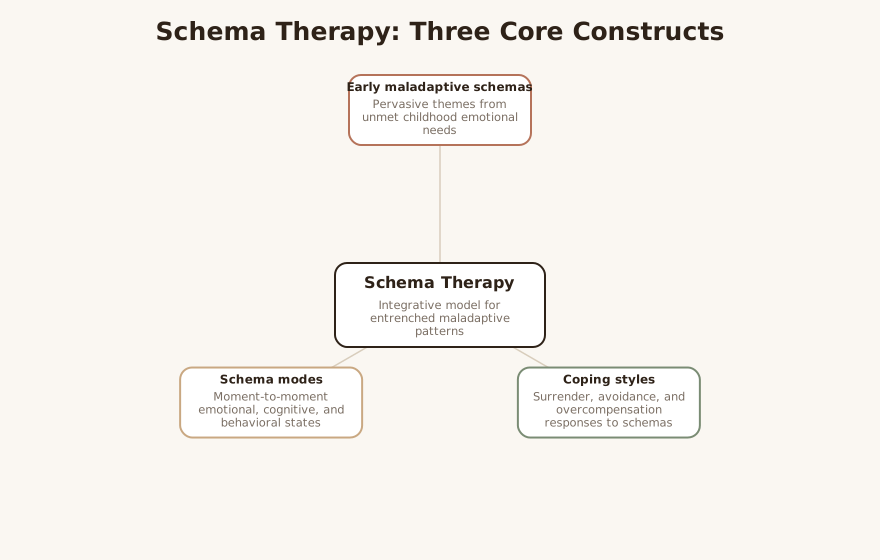
The central construct is the early maladaptive schema: a broad, pervasive theme or pattern of memories, emotions, cognitions, and bodily sensations regarding oneself and one’s relationships, developed in childhood or adolescence and elaborated across the lifespan 7. Schemas are theorized to arise when core emotional needs in childhood — secure attachment, autonomy, freedom to express needs and emotions, spontaneity and play, and realistic limits — go unmet 6. Young’s model groups identified schemas into broad domains (for example, disconnection and rejection, impaired autonomy, impaired limits, other-directedness, and overvigilance/inhibition) 7.
A second pillar is the concept of schema coping styles — characteristic ways people respond to activated schemas. These are typically organized as surrender (giving in to the schema), avoidance (escaping triggers and emotions), and overcompensation (acting as though the opposite of the schema were true) 4. Over time the model added the construct of schema modes: the moment-to-moment emotional, cognitive, and behavioral states a person shifts into, such as the Vulnerable Child, Angry Child, Detached Protector, Punitive Parent, and Healthy Adult modes 7. Mode work proved especially useful for patients, such as those with borderline presentations, whose states shift rapidly and who do not map neatly onto a small set of stable schemas 6.
The therapeutic stance of limited reparenting is a defining principle: within professional and ethical boundaries, the therapist meets some of the patient’s unmet childhood needs in the relationship, providing the safety, validation, and guidance that allow the Healthy Adult mode to strengthen 6. This relational mechanism, paired with cognitive and experiential techniques, is held to be how schemas are gradually weakened and healthy modes built 4.
Interventions & Techniques
Schema Therapy is technically eclectic and deploys four broad categories of intervention 4. Cognitive techniques include psychoeducation about schemas, examining the evidence for and against a schema, schema flashcards, and dialogues that pit the schema against the healthy side 4. Experiential techniques are central and include imagery rescripting — revisiting distressing childhood memories and reworking them so the child’s unmet needs are met — and chairwork dialogues, in which the patient externalizes and confronts modes such as the Punitive Parent 7. Behavioral pattern-breaking helps the patient act against schema-driven habits in real life, often through homework and rehearsal 4. The therapeutic relationship, via limited reparenting and empathic confrontation, is used both to soothe the Vulnerable Child and to challenge maladaptive coping modes in vivo 6.
Assessment typically begins with a structured history, life-pattern review, and standardized inventories such as the Young Schema Questionnaire to identify dominant schemas and modes, feeding a shared case conceptualization 4. The conceptualization links presenting problems to specific schemas, coping styles, and modes, and that map guides which techniques are emphasized 6.
LLM-generated illustrative example (not a guideline): A clinician working with a client who oscillates between numbed withdrawal and sudden self-criticism might formulate a Detached Protector mode shielding a Vulnerable Child, with a Punitive Parent mode driving the self-attack. Sessions could alternate chairwork to give the Punitive Parent voice less authority and imagery rescripting to address the original scenes of criticism LLM.
Evidence Base
Schema Therapy’s evidence base is best characterized as established but uneven — strong and replicated for borderline personality disorder, and more preliminary for other conditions 3. The pivotal study is the Giesen-Bloo et al. (2006) multicenter randomized trial, which compared schema-focused therapy with transference-focused psychotherapy for outpatients with borderline personality disorder and found schema-focused therapy produced significant clinical improvement, with a substantial proportion of patients achieving recovery and lower dropout 1. On the strength of this and related work, the Society of Clinical Psychology (APA Division 12) lists schema-focused therapy for borderline personality disorder among its catalogued psychological treatments, reflecting recognized research support for that indication 2.
A comprehensive review by Sempertegui and colleagues synthesized the empirical foundations, effectiveness, and implementation of schema therapy for borderline personality disorder, concluding that the approach has promising support while also noting methodological limitations and the need for further high-quality trials 3. The honest summary for practitioners is that the BPD evidence is genuinely robust by the standards of personality-disorder research, whereas applications to chronic depression, eating disorders, PTSD, and other personality disorders rest on a thinner, still-developing literature 3. Clinicians should present the model to clients accordingly, neither overstating breadth of support nor dismissing the well-supported core 2.
Populations & Indications
Schema Therapy was designed for, and is most strongly indicated in, adults with personality disorders, with borderline personality disorder being the prototypical and best-studied indication 1. It is also applied to narcissistic personality disorder, where mode-based formulation is often used to map grandiose and vulnerable states 7. Beyond personality disorders, the model is used with people who have chronic or persistent depressive disorder, trauma survivors, individuals with eating disorders, and more broadly with patients whose conditions have proven treatment-resistant within shorter-term modalities 4. The unifying feature across these populations is chronicity and a developmental, characterological component rather than a single recent stressor 6. For acute, single-episode anxiety or depression that responds to first-line short-term treatment, Schema Therapy is generally not the initial choice 4.
Problems-for-Work
The model is organized around persistent, self-defeating life patterns rather than discrete symptoms, which makes it well suited to several recurring clinical problems 6.
- Emotional dysregulation and rapidly shifting states, as in borderline presentations, are addressed through mode work that names and stabilizes states such as the Vulnerable and Angry Child 7.
- Low self-esteem and harsh self-criticism are formulated as defectiveness/shame schemas and Punitive Parent modes, targeted through chairwork and limited reparenting 4.
- Interpersonal and relationship difficulties — repeated mistrust, subjugation, or abandonment dynamics — are traced to disconnection and other-directedness schemas 7.
- Perfectionism and unrelenting standards are addressed as overcompensatory coping for underlying inadequacy schemas 4.
- Childhood emotional neglect and its downstream emotional-deprivation schema are reworked through imagery rescripting that meets the unmet need in the remembered scene 6.
LLM-generated illustrative example (not a guideline): For a client whose perfectionism repeatedly drives burnout, a clinician might frame the unrelenting-standards pattern as overcompensation protecting against a defectiveness schema, then use behavioral experiments to tolerate “good enough” work while strengthening the Healthy Adult’s voice LLM.
Contraindications, Cautions & Cultural Humility
Schema Therapy is an intensive, longer-term, emotionally activating treatment, and experiential techniques such as imagery rescripting can transiently heighten distress; they require pacing, stabilization, and a sound therapeutic alliance before deeper trauma material is approached 6. Limited reparenting must be practiced strictly within professional and ethical boundaries — it is a deliberate clinical stance, not an invitation to dependency or boundary diffusion, and supervision is advisable when learning it 6. The model’s depth and duration may be poorly matched to clients who need brief, problem-focused work or whose presenting issue is acute and first-line treatable 4. As with any structured Western psychotherapy, the schema constructs and assumptions about “core childhood needs” carry cultural framing; clinicians should hold them with humility, check whether a labeled “schema” reflects pathology or a reasonable adaptation to the client’s social and cultural context, and adapt language and examples accordingly LLM. Because much of the strongest evidence concerns borderline personality disorder in specific trial populations, generalization to other groups should be made cautiously and transparently 3.
Treatment-Plan Suggestions & SMART Objectives
| Goal | SMART objective (example) | Mechanism |
|---|---|---|
| Build schema awareness | Within 6 sessions, client will identify and name their two dominant early maladaptive schemas using the case conceptualization, in 3 of 4 consecutive sessions | Cognitive psychoeducation and assessment 4 |
| Reduce harsh self-criticism | Within 12 weeks, client will reduce self-reported Punitive Parent-mode statements during sessions by half, tracked via session logs | Chairwork to disempower the punitive mode 7 |
| Strengthen the Healthy Adult mode | Over 16 weeks, client will independently generate a Healthy Adult response to a schema-triggering situation in 4 of 5 logged instances | Limited reparenting and rehearsal 6 |
| Rework emotional-deprivation memories | Within 10 sessions, client will complete 3 imagery-rescripting exercises and report reduced distress (e.g., 8/10 to 4/10) on the target memory | Experiential imagery rescripting 7 |
| Break a self-defeating behavioral pattern | Within 8 weeks, client will complete weekly behavioral experiments acting against the identified coping style, documented in homework, in at least 6 of 8 weeks | Behavioral pattern-breaking 4 |
| Stabilize affective states (BPD) | Within 12 weeks, client will use a mode-management plan to de-escalate a Vulnerable/Angry Child episode without crisis behavior in 3 of 4 occurrences | Mode work and limited reparenting 1 |
| Improve relational functioning | Over the course of treatment, client will report applying a non-schema-driven response in one significant relationship interaction per week, reviewed in session | Cognitive-behavioral and relational integration 6 |
Common Misconceptions
A frequent misconception is that “schema” in Schema Therapy is interchangeable with Beck’s cognitive schemas; in Young’s model the construct is broader, encompassing emotions, memories, and bodily sensations, and is explicitly developmental in origin 7. Another is that the approach is simply repackaged CBT — in fact it deliberately integrates attachment, psychodynamic, and Gestalt elements alongside cognitive technique 4. Clinicians new to the model sometimes assume limited reparenting means relaxing boundaries or becoming a surrogate parent; it is instead a bounded, intentional relational stance aimed at meeting specific unmet needs within ethical limits 6. Finally, the strength of the borderline personality disorder evidence is sometimes generalized to imply equally strong support across all indications, which the literature does not yet justify 3.
Training & Certification
Formal training and certification in Schema Therapy are coordinated internationally through the International Society of Schema Therapy (ISST) and affiliated associations, which set standards for accredited training programs and therapist certification 5. Practitioners typically pursue structured coursework, supervised clinical work, and competency review to achieve certified status 5. The foundational practitioner text by Young, Klosko, and Weishaar remains the primary reference for learning the model’s concepts and methods 6. Introductory overviews from professional resources and educational media can orient clinicians before they commit to formal training 48.
Key Terms
- Early maladaptive schema — a pervasive, self-defeating pattern of memories, emotions, cognitions, and sensations about oneself and relationships, originating in unmet childhood needs 7.
- Schema domains — the broad categories (e.g., disconnection/rejection, impaired autonomy, impaired limits, other-directedness, overvigilance/inhibition) under which schemas are grouped 7.
- Coping styles — surrender, avoidance, and overcompensation; the characteristic ways a person responds to an activated schema 4.
- Schema modes — moment-to-moment states such as Vulnerable Child, Angry Child, Detached Protector, Punitive Parent, and Healthy Adult 7.
- Limited reparenting — the bounded therapeutic stance of partially meeting the patient’s unmet childhood needs within ethical limits 6.
- Imagery rescripting — an experiential technique that revisits and reworks distressing early memories so unmet needs are met 7.
Resources & Further Reading
▶ Watch — a video introduction to this concept:
- Young, J. E., Klosko, J. S. & Weishaar, M. E. — Schema Therapy: A Practitioner’s Guide (Guilford)
- Giesen-Bloo et al. (2006) — RCT of schema-focused therapy vs. transference-focused psychotherapy for BPD
- Society of Clinical Psychology (APA Division 12) — Schema-Focused Therapy for BPD
- Sempertegui et al. — Schema therapy for BPD: comprehensive review (PubMed)
- Schema Therapy — Psychology Tools
- International Society of Schema Therapy / Jeffrey Young Schema Therapy Association
- Schema therapy — Wikipedia
- Schema Therapy — An Introduction (YouTube)
Reflective / Supervision Questions
- When you formulate a client’s difficulties, are you mapping them onto specific schemas and modes, or defaulting to symptom-level description that loses the developmental story? LLM
- How do you maintain limited reparenting as a bounded clinical stance rather than drifting toward boundary diffusion or fostering dependency? 6
- Before introducing imagery rescripting or chairwork, how do you assess whether the client is stabilized enough to tolerate the activation these techniques produce? 6
- Are you communicating the evidence base honestly — distinguishing the strong BPD support from the more preliminary support for other indications? 3
- Where might a construct you have labeled a “maladaptive schema” actually be a reasonable adaptation to your client’s cultural or social context? LLM
- For treatment-resistant cases referred to you, what tells you that a longer-term schema-focused approach is indicated rather than another course of brief, problem-focused therapy? 4