
Type & Discipline
The Transtheoretical Model (TTM) is an integrative framework of intentional behavior change drawn from clinical and health psychology rather than a single treatment modality. 1 Its central premise is that behavior change is not a discrete event but a process that unfolds over time through a sequence of stages, each defined by a period of time and a set of tasks. 4 Because it was built by comparing more than 400 psychotherapy systems and distilling their common change mechanisms, it is “transtheoretical” — meant to cut across orientations rather than belong to one. 4 In practice it functions less as a standalone therapy and more as a meta-organizing scaffold that helps clinicians decide what to do when, and it pairs naturally with method-rich approaches such as cognitive behavioral therapy and motivational interviewing. LLM
The model sits squarely in the health-behavior-change tradition and has been applied most heavily to addictive and health behaviors — smoking, alcohol misuse, weight control, exercise, and screening adherence. 3 Clinicians should understand it primarily as a way of conceptualizing readiness, not as a manualized protocol. LLM
Creators & Lineage
TTM was developed by James O. Prochaska of the University of Rhode Island, together with Carlo C. DiClemente and colleagues, beginning around 1977, out of comparative analysis of major systems of psychotherapy and empirical study of how smokers quit. 6 The foundational work on stages and processes of self-change in smoking (Prochaska & DiClemente) seeded a research program that expanded across dozens of behaviors over the following decades. 4 Wayne F. Velicer contributed substantially to the model’s measurement and decisional-balance work, and John C. Norcross later led influential meta-analytic and clinical-application reviews. 4
Conceptually the model shares lineage with the broader family of social-cognitive and health-behavior theories — the Health Belief Model and Social Cognitive Theory among them — and it is closely intertwined with Motivational Interviewing, which absorbed many of TTM’s lessons about meeting precontemplative clients without confrontation. 4 It is worth noting that TTM and Motivational Interviewing are distinct: TTM is a model of change (a map of where a client is), while Motivational Interviewing is a method (a way of talking). LLM The processes of change borrow techniques traditionally associated with experiential, cognitive, psychoanalytic, existential, and behavioral traditions, which is precisely what makes the model integrative. 4
Core Principles
TTM rests on four interlocking constructs. 1
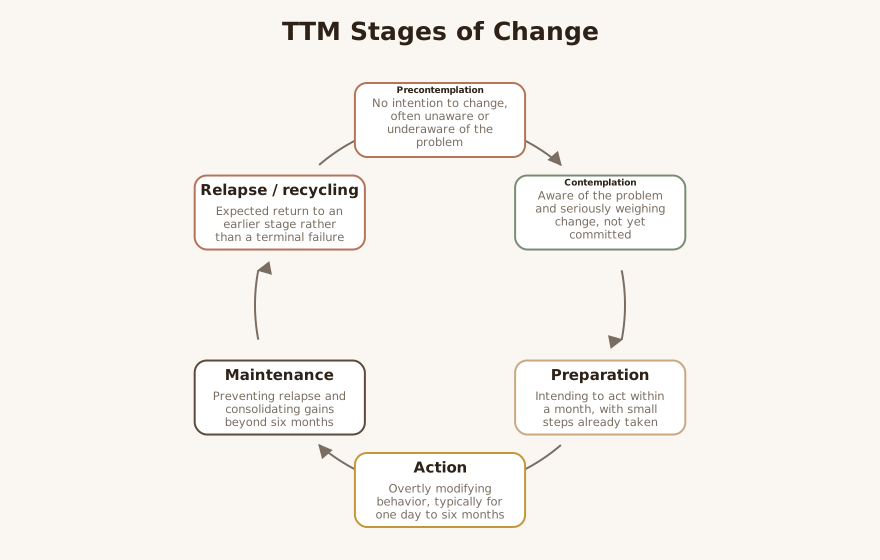
Stages of change. The model specifies five core stages — precontemplation, contemplation, preparation, action, and maintenance — with relapse/recycling treated as an expected feature rather than a separate terminal stage, and a rarely achieved “termination” representing complete confidence without temptation. 6 3 Precontemplation is having no intention to change in the foreseeable future, often with the client unaware or underaware of the problem even when those around them are not. 4 Contemplation is awareness of the problem and serious thought about overcoming it, without yet committing to act. 4 Preparation is intending to act within the next month, usually with some small “baby steps” already taken. 4 Action is overtly modifying behavior, experiences, or environment, conventionally for one day to six months. 4 Maintenance is working to prevent relapse and consolidate gains, generally beyond six months. 4
Processes of change. These are the covert and overt activities people use to move between stages — the how of change as opposed to the when. 4 Principal-components work distilled roughly eight to ten common processes, including consciousness-raising, dramatic relief (emotional arousal), self-reevaluation, environmental reevaluation, social liberation, self-liberation, helping relationships, counterconditioning, reinforcement management, and stimulus control. 6 4
Decisional balance. This is the client’s relative weighing of the pros and cons of changing; across virtually every behavior studied, the perceived benefits rise and the perceived costs fall as a person advances through the stages. 6 3
Self-efficacy and temptation. Self-efficacy is the situation-specific confidence that one can cope with high-risk situations without relapsing, and it tends to increase across stages as temptation declines. 6 3
The clinically actionable insight that ties these together is that different processes are differentially effective at different stages: experiential and cognitive processes drive early movement, while behavioral processes drive later movement. 4
Interventions & Techniques
TTM does not prescribe a fixed set of sessions; it prescribes stage-appropriate selection of processes and relational stances. 4 In the earlier stages — precontemplation and contemplation — the indicated processes are consciousness-raising (increasing awareness of the costs of the behavior and benefits of change), dramatic relief/emotional arousal (anticipatory grieving, facing fear, guilt, or regret), and self-reevaluation (envisioning the self after change). 4 As clients move from preparation into action and maintenance, the model shifts toward counterconditioning (substituting healthier responses — relaxation for anxiety, assertion for passivity, exposure for avoidance), stimulus control (restructuring cues), and reinforcement management (self-reward schedules). 4
Norcross, Krebs, and Prochaska summarize the matched relational stances vividly: a nurturing-parent stance with a precontemplator, a Socratic-teacher stance with a contemplator, an experienced-coach stance in preparation, and a consultant stance in action and maintenance. 4 Equally important is the model’s proscriptive guidance — what not to do. Two classic mismatches are using awareness-only processes (consciousness-raising, self-reevaluation) while a client is already in action, and using action processes (reinforcement management, stimulus control) before the requisite awareness and decision-making have been built. 4 Assessment is itself an intervention here: clinically, stage is most often captured with a brief categorical question (“Are you not ready to change in the next 6 months, thinking about it in the next 6 months, planning to in the next month, or already making progress?”), or with validated instruments such as the University of Rhode Island Change Assessment (URICA) or, for drinking, the SOCRATES. 4
LLM-generated illustrative example (not a guideline): A clinician meeting a mandated client who insists “I only drink like everyone else” recognizes precontemplation and, rather than prescribing abstinence goals, uses consciousness-raising and a nurturing-parent stance to gently surface discrepancies — aiming only to move the client toward contemplation. LLM
Evidence Base
Maturity is best described as established as a framework but contested as an efficacy claim. LLM On the supportive side, the predictive validity of stage is robust. In an original meta-analysis of 39 psychotherapy studies (8,238 patients), pretreatment stage of change reliably predicted outcome with a medium effect of d = .46; the amount of progress clients made tended to be a function of where they started. 4 Diagnostic breakdowns ranged from d = .37 for addictions to d = .99 for eating disorders and d = .45 for mood disorders. 4 An illustrative cardiac smoking-cessation program achieved six-month quit rates of 22% for precontemplators, 43% for contemplators, and 76% for those in or prepared for action. 4 The stage-by-process structure is also well supported: an earlier meta-analysis of 47 cross-sectional studies found effect sizes of roughly d = .70 for variation in cognitive-affective processes by stage and d = .80 for behavioral processes by stage. 4 A meta-analysis of physical-activity applications likewise confirmed that stage membership is associated with differing levels of activity, self-efficacy, pros and cons, and processes of change. 2
The contested side is just as important to convey honestly. The strongest claim — that matching treatment to stage outperforms non-matched treatment — is not well established in psychotherapy: Norcross and colleagues located no controlled trials meeting their criteria that matched face-to-face psychotherapy to stage, so the matching analysis could not be performed. 4 The physical-activity meta-analysis cautioned that it could not confirm whether change occurs in discrete stages or along a continuum, and that higher-order process constructs and stage-by-process interactions were not evident in that domain. 2 In addiction specifically, the evidence base is nearly all smoking cessation, where tailored interventions have shown, at best, benefits below the usual threshold for a small effect. 5 A 2003 systematic review concluded that stage-based interventions were no more effective than non-stage-based ones, and critics (notably West) argue the stage boundaries are arbitrary and that people’s plans are often neither coherent nor stable. 6 In short: use TTM to understand and predict, but be skeptical of strong claims that matching alone drives outcomes. LLM
Populations & Indications
TTM has been applied most extensively to addictive and health behaviors: people with substance use disorders, smokers, people with obesity or weight concerns, individuals with addictive behaviors broadly, and patients across a range of health-behavior-change targets such as exercise, diet, condom use, and preventive screening. 3 It has been used with adolescents as well as adults; six of the studies in the Norcross meta-analysis concerned adolescents aged 13–17, and the predictive effect did not differ significantly between adolescent and adult samples. 4 Beyond classic health behaviors, the model has been applied to eating disorders, mood and anxiety disorders, domestic-abuse intervention, gambling, and general psychotherapy populations. 4
The most useful indication is any clinical situation marked by ambivalence or low readiness — where treating the client as though they are already in the action stage would be premature. LLM A core epidemiological fact drives this: aggregating across populations, roughly 40% of people with a problem behavior are in precontemplation, 40% in contemplation, and only about 20% prepared for action — so action-only programs structurally underserve the majority. 4
Problems-for-Work
TTM lends itself to framing a range of clinical problems-for-work in terms of readiness and stage movement rather than symptom elimination alone. LLM
- Treatment ambivalence / motivation deficits. The model reframes a “resistant” client as a precontemplator or contemplator and makes movement to the next stage a legitimate, measurable goal. 4
- Substance use disorders, alcohol use disorder, nicotine dependence. Stage assessment guides whether to build awareness or support active behavior change, and the SOCRATES and URICA give problem-specific readiness scores. 4
- Relapse / maladaptive habits. The model normalizes recycling, anticipates it, and folds relapse prevention into maintenance work to reduce client shame and clinician guilt. 4
- Health behavior nonadherence, sedentary behavior, obesity-related behaviors. Decisional-balance and self-efficacy work targets the specific cognitions that keep a client stuck. 2 3
LLM-generated illustrative example (not a guideline): For a client with sedentary behavior who “knows” they should exercise but never starts, the clinician identifies contemplation, works the decisional balance to tip the pros/cons crossover, then shifts to stimulus control and reinforcement management as the client enters preparation and action. LLM
Contraindications, Cautions & Cultural Humility
There are no formal contraindications to using a stage lens, but there are meaningful cautions about over-relying on it. LLM The principal risk is staging a client incorrectly: under the model’s own logic, the wrong stage implies the wrong intervention and a lower probability of change. 5 Because the stage boundaries (e.g., the six-month and one-month thresholds) are partly arbitrary and people’s intentions are often unstable, clinicians should hold a client’s “stage” loosely and re-assess, treating it as a working hypothesis rather than a fixed trait. 6 The model can also oversimplify the nonlinear reality of change; some clients change abruptly and “out of the blue” without passing through tidy stages, and others succeed without any TTM-informed scaffolding at all. 5
Culturally, two issues warrant humility. First, much of the supporting literature is drawn from predominantly White samples — in the Norcross meta-analysis the majority of samples were over 60% White — so generalizing process-stage matching across cultural contexts should be done cautiously. 4 Second, the very notion that change is individually “intended” and planned reflects particular cultural assumptions about agency; for clients whose health decisions are embedded in family or community systems, the clinician should adapt the framing rather than impose it. LLM Stage-matched relational stances (the “nurturing parent,” for instance) should also be deployed with sensitivity to power, mandate status, and the client’s own preferences. LLM
Treatment-Plan Suggestions & SMART Objectives
| Goal | SMART objective (example) | Mechanism |
|---|---|---|
| Move from precontemplation toward contemplation | Within 4 sessions, client will verbalize at least two personally relevant costs of the target behavior | Consciousness-raising; raising awareness of pros of change 4 |
| Resolve ambivalence in contemplation | Within 6 weeks, client will complete a decisional-balance exercise listing pros and cons of change | Decisional balance / pros-cons crossover 3 |
| Build readiness toward preparation | Within 30 days, client will identify one concrete “baby step” and a target start date | Self-liberation; commitment-building 4 |
| Increase confidence to act | Within 8 weeks, client will report a measurable rise in situational coping confidence (e.g., URICA/self-efficacy rating) | Self-efficacy enhancement 4 |
| Initiate behavior change in action | Within 90 days, client will substitute a healthier response in 3 of 5 identified high-risk situations | Counterconditioning; stimulus control 4 |
| Sustain change in maintenance | Over 6 months, client will follow a written relapse-prevention plan and review it at each session | Reinforcement management; relapse prevention 4 |
| Normalize and recover from recycling | Within 2 sessions of any lapse, client will re-engage the plan without dropping out of treatment | Anticipating recycling; reducing shame 4 |
Common Misconceptions
“The stages are linear and a client passes through each once.” In reality, most clients recycle through the stages several times before achieving durable maintenance, and the model explicitly builds recycling/relapse in as expected. 4
“TTM is the same as Motivational Interviewing.” They are complementary but distinct — TTM maps readiness; Motivational Interviewing is a conversational method, and it incorporated TTM’s lessons (such as “rolling with resistance”) without being identical to it. 4
“Matching treatment to stage is proven to work better.” This is the model’s least supported claim: in psychotherapy, no controlled trials matching treatment to stage met inclusion criteria in the major review, and a systematic review found stage-based interventions no more effective than non-stage-based ones. 4 6
“Everyone in treatment is ready to take action.” Roughly 80% of people with a problem behavior are not in the action stage, which is why action-only programs underserve most clients. 4
Training & Certification
There is no formal credential or certification required to apply the Transtheoretical Model; it is a conceptual framework rather than a proprietary, manualized therapy. LLM Competent use rests on familiarity with the constructs (stages, processes, decisional balance, self-efficacy) and with stage-assessment tools such as the URICA and SOCRATES, both of which are described in the clinical literature and freely usable in practice. 4 Clinicians seeking structured skill-building typically pair TTM with training in Motivational Interviewing, which operationalizes the relational stances the model recommends for earlier stages. 4 Foundational reading includes Prochaska and Velicer’s overview and the Norcross, Krebs, and Prochaska clinical review. 1 4
Key Terms
- Precontemplation — no intention to change in the foreseeable future; often unaware or underaware of the problem. 4
- Contemplation — aware of the problem and seriously considering change, without commitment. 4
- Preparation — intending to act within a month, with small steps already begun. 4
- Action — overtly modifying behavior, conventionally for up to six months. 4
- Maintenance — working to prevent relapse and consolidate gains beyond six months. 4
- Processes of change — the covert/overt activities (e.g., consciousness-raising, counterconditioning) that move people between stages. 4
- Decisional balance — the client’s weighing of the pros and cons of changing. 3
- Self-efficacy / temptation — situational confidence to cope without relapse versus the urge to engage in the problem behavior. 6
- Recycling — the expected return to earlier stages before durable change. 4
- URICA / SOCRATES — validated measures of stage and readiness. 4
Resources & Further Reading
▶ Watch — a video introduction to this concept:
- Prochaska, J.O. & Velicer, W.F. (1997). The Transtheoretical Model of Health Behavior Change
- Marshall & Biddle (2001) — TTM meta-analysis for physical activity and exercise (PubMed)
- Stages of Change Theory — StatPearls (NCBI Bookshelf)
- Norcross, Krebs & Prochaska (2011). Stages of Change — review PDF
- Does the Transtheoretical Model of Change Work for Addiction? — PsychCentral (Pro)
- Transtheoretical model — Wikipedia
Reflective / Supervision Questions
- For a recent “resistant” client, were they actually in precontemplation or contemplation — and was I inadvertently delivering an action-stage intervention? 4
- How am I assessing stage of change, and would a brief categorical question or a measure like the URICA sharpen my formulation? 4
- Given that matching efficacy is not well established, am I using stage as a useful hypothesis or treating it as a fixed fact about the client? 4 6
- Where in my caseload am I expecting linear progress and feeling disappointed by recycling that the model would call normal? 4
- How do my relational stances shift (or fail to shift) as a client moves across stages, and am I adapting those stances with cultural humility? 4