
Type & Discipline
Assimilative integration is a framework within the field of psychotherapy integration, itself a subdiscipline of clinical psychology concerned with combining elements of different therapeutic systems rather than practicing any single school in pure form 5. Psychotherapy integration is conventionally described as having four main routes: technical eclecticism, theoretical integration, the common factors approach, and assimilative integration 5. Assimilative integration is the most recently articulated of these and is explicitly positioned as a bridge between technical eclecticism and theoretical integration 1. It is not itself a brand-name therapy with a manual; it is a meta-strategy for how to be integrative responsibly while retaining a coherent clinical identity 6.
The defining commitment is that the therapist operates from a single, firmly held “home” or host theory and assimilates specific techniques drawn from other approaches into that home base 1. Crucially, an imported technique does not arrive theory-neutral. Once it is used inside the host framework, it is understood, timed, and given meaning according to the host theory rather than according to the school that originated it 3. A behavioral exposure exercise delivered by an assimilatively integrative psychodynamic clinician is therefore not “the same” intervention it would be in a manualized CBT protocol, because its rationale, its interpretation, and the relational meaning attached to it are reframed 3.
Creators & Lineage
The model is most closely associated with George Stricker and Jerry Gold, who developed the best-known version: an assimilative, psychodynamic approach in which relational and psychodynamic theory serves as the host and techniques from cognitive, behavioral, experiential, and systemic traditions are imported into it 3. Stanley Messer is the other central figure, having named and championed assimilative integration as a distinct route and edited foundational discussion of it, including its clinical challenges 2. The lineage of the idea runs directly through the broader project of psychotherapy integration, which sought to move past sterile turf wars between schools 5.
Assimilative integration sits between two older integration strategies. Technical eclecticism (associated with figures such as Arnold Lazarus) selects interventions empirically based on what works for a given problem, without requiring theoretical consistency among them 1. Theoretical integration attempts to weld two or more theories into a genuinely new, unified superordinate theory 1. The common factors tradition emphasizes the curative ingredients shared across all therapies, such as the alliance and expectancy 5. Assimilative integration borrows the technical flexibility of eclecticism but insists, like theoretical integration, on conceptual coherence anchored in one host model 1. A relational psychodynamic reading further situates the approach within contemporary relational theory, where the therapeutic relationship itself becomes the integrating medium through which imported techniques are metabolized 4.
Core Principles
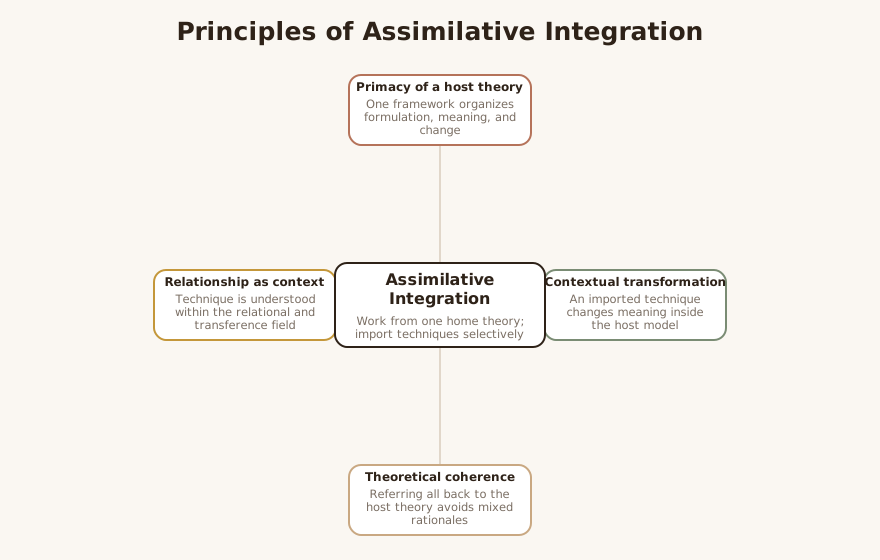
The first principle is the primacy of a host theory. The clinician chooses one organizing framework and stays inside it, so that case formulation, the meaning of symptoms, and the understanding of change all flow from that single source 1. This is what distinguishes the approach from eclecticism, where the absence of a unifying theory can leave technique selection ad hoc 1.
The second principle is contextual transformation of technique. Stricker and Gold’s central claim is that a technique imported from another approach changes its nature when it enters the host model; the same procedure carries a new rationale and is woven into a different understanding of the patient 3. The third principle is theoretical coherence as a clinical safeguard: because everything is referred back to the host theory, the therapist avoids the incoherence that can come from mixing incompatible rationales 1. The fourth, especially in the relational psychodynamic version, is that the relationship is the organizing context; technique is delivered and understood within an ongoing relational and transference field rather than as a free-standing procedure 4.
LLM-generated illustrative example (not a guideline): A psychodynamically grounded clinician notices a depressed client paralyzed by morning inertia. Rather than abandoning her host theory, she introduces a behavioral-activation scheduling task. Within her frame she also tracks what the avoidance defends against and what the act of scheduling stirs up in the transference, so the “homework” becomes a window onto conflict, not merely a behavioral lever LLM.
Interventions & Techniques
Assimilative integration does not prescribe a fixed technique list; it prescribes a method for incorporating techniques 6. In the assimilative psychodynamic version, the host is relational/psychodynamic work, and commonly assimilated techniques include cognitive restructuring, behavioral exposure and activation, two-chair and other experiential/Gestalt methods, relaxation and skills training, and systemic or family interventions 3. These are introduced when the dynamic formulation indicates that a more active or skills-oriented intervention will advance the work, after which the clinician returns to and reinterprets the experience within the host frame 3.
The mechanics typically follow a sequence: the clinician maintains an ongoing case formulation in the host theory, identifies a point where an imported technique is indicated, delivers it, and then processes its meaning and aftermath inside the host model 3. The relational version stresses that the act of introducing a technique is itself a relational event with transference-countertransference implications that must be attended to, not bypassed 4. Messer cautions that this layered use of technique is clinically demanding and raises real challenges around timing, theoretical fit, and the risk of the imported method disrupting the host frame 2.
Evidence Base
The maturity of assimilative integration is best described as established as a conceptual and clinical model rather than as an empirically validated treatment package LLM. It is well-developed theoretically, with a recognized literature, dedicated journal discussion, and a settled place among the four canonical routes to integration 56. Its foundational articulation, illustrative case material, and clinical-challenge analyses are documented in the peer-reviewed psychotherapy-integration literature 32.
Honesty requires noting the limits. The evidence is predominantly theoretical, conceptual, and case-based rather than built on randomized controlled trials of assimilative integration as such LLM. Because the model is a meta-strategy rather than a single manualized protocol, it is intrinsically hard to test as one intervention, and much of its empirical support is indirect, leaning on the established efficacy of the individual techniques being assimilated and on the broad evidence that integrative practice is common and clinically reasonable 5LLM. Surveys consistently show that a large share of practicing clinicians describe themselves as integrative or eclectic rather than purist, which gives the broader integration project ecological validity even where head-to-head outcome data for a specific model are thin 5.
Populations & Indications
The model was designed for adults in individual psychotherapy and is framed as applicable to psychotherapy clients broadly rather than to a narrow diagnostic niche 3. It is particularly attractive for clients with complex or comorbid presentations, where a single modality may address one problem while leaving interpersonal, characterological, or affect-regulation difficulties untouched 2LLM. Assimilative integration gives such cases a coherent home theory for the whole person while permitting targeted importation of techniques for circumscribed symptoms 1LLM.
It is also indicated for clients who have not responded to single-modality therapy, where adding an assimilated technique within the existing frame can unstick treatment without forcing a disruptive wholesale change of approach LLM. Beyond clients, the framework speaks directly to therapists and clinicians who already practice flexibly and to trainees learning psychotherapy integration, for whom it offers a disciplined alternative to unprincipled eclecticism 6.
Problems-for-Work
Assimilative integration is well suited to mood and anxiety presentations layered onto deeper relational or personality difficulties LLM. In major depressive disorder, a psychodynamic host formulation of loss, self-criticism, or anger turned inward can be paired with assimilated behavioral activation, so the activation is both symptomatic relief and grist for the dynamic work 3LLM. In anxiety disorders, exposure or relaxation methods can be imported and then understood within the host model as encounters with warded-off affect or conflict 3LLM.
For comorbid presentations and personality-related problems, the host theory holds the case together while different techniques address different facets 2LLM. With interpersonal difficulties, the relational psychodynamic host is especially apt, because the relationship is the working surface and any imported skills training is processed through what it activates between therapist and client 4LLM. For treatment nonresponse to single-modality therapy and for poor treatment fit, the model offers a structured way to broaden the toolkit without abandoning a coherent rationale 1LLM.
LLM-generated illustrative example (not a guideline): A client with panic and a long history of unstable relationships plateaus in supportive-expressive work. The clinician assimilates interoceptive exposure for the panic, then explores how tolerating bodily fear echoes the client’s fear of being overwhelmed in intimacy, linking symptom relief to the central relational theme LLM.
Contraindications, Cautions & Cultural Humility
The principal caution is that assimilative integration is clinically demanding and presupposes genuine competence in both the host theory and the techniques being imported 2. Borrowing a procedure one does not actually understand, or deploying it with poor timing, can disrupt the host frame and the alliance rather than enrich them 2. Messer’s analysis of the clinical challenges underscores that the very flexibility that makes the model attractive also creates risk when theoretical fit is ignored 2.
A further caution is that, because the model is a meta-strategy rather than a tested protocol, clinicians should not assume that combining techniques inherits the empirical support of each technique used in isolation LLM. Importing an evidence-based procedure into a different theoretical context may alter how, and whether, it works, which argues for ongoing outcome monitoring 3LLM. With respect to cultural humility, the host theory carries its own cultural assumptions; a psychodynamic host, for instance, embeds particular views of self, family, and distress, so clinicians should hold the host model lightly enough to adapt formulation and imported techniques to the client’s cultural frame rather than imposing them LLM.
Treatment-Plan Suggestions & SMART Objectives
| Goal | SMART objective (example) | Mechanism |
|---|---|---|
| Reduce depressive inertia while preserving dynamic work | Client will complete a daily activity-scheduling log for 2 weeks and review each entry’s emotional meaning in session | Behavioral activation assimilated into a psychodynamic host and reinterpreted as conflict/affect data 3 |
| Lower panic frequency within a relational frame | Client will practice interoceptive exposure twice weekly for 4 weeks and report linked relational fears | Imported exposure recontextualized through the host’s relational meaning 34 |
| Improve coherence of treatment for comorbid presentation | Therapist will maintain one host-theory formulation and document the rationale for each assimilated technique across 6 sessions | Theoretical coherence as safeguard against eclectic incoherence 1 |
| Address interpersonal difficulty | Client will identify, in 4 of 6 sessions, one in-session relational reaction triggered by a newly introduced skills task | Relationship-as-context processing of assimilated technique 4 |
| Restart stalled single-modality treatment | Within 3 sessions, introduce one indicated assimilated technique and re-evaluate progress against baseline measure at 4 weeks | Targeted importation to resolve nonresponse without changing host model 2 |
| Build client insight into avoidance | Client will articulate, by session 8, what an avoided behavioral task defends against | Technique used as a window onto warded-off material within host theory 3 |
| Strengthen affect tolerance | Client will use an assimilated grounding/relaxation skill during 3 affectively intense sessions and reflect on its dynamic meaning | Skills training metabolized through host formulation 3 |
Common Misconceptions
A frequent misconception is that assimilative integration is just eclecticism with a friendlier name LLM. It is not: eclecticism selects techniques without requiring theoretical consistency, whereas assimilative integration insists on a single host theory that governs meaning and coherence 1. A second misconception is that an imported technique works the same way regardless of context; the model’s core claim is precisely the opposite, that the technique is transformed by the host frame 3.
A third is that the approach requires a psychodynamic host. The best-developed version is psychodynamic, but the model in principle allows any firmly held theory to serve as the home base, with techniques assimilated into it 1LLM. A fourth is that “integrative” implies “lower standards”; in fact, doing it well demands competence in multiple traditions and careful attention to timing and fit, which is harder, not easier, than single-school practice 2.
Training & Certification
There is no single licensing credential or required certification specific to assimilative integration; it is practiced by licensed psychotherapists within their existing scope rather than gated behind a proprietary certificate LLM. The relevant scholarly and professional home is the psychotherapy-integration community, whose journal literature (including dedicated treatments of assimilative integration and its clinical challenges) constitutes the primary training material 62. Competence is developed through grounding in a host theory, supplementary training in the techniques one intends to assimilate, and supervised practice in moving between them coherently 3LLM. The Society for the Exploration of Psychotherapy Integration and its journal are the field’s conventional reference points for clinicians seeking deeper study 5LLM.
Key Terms
- Host theory (home theory): The single organizing framework the clinician works from and into which techniques are assimilated 1.
- Assimilation: Importing a technique from another approach into the host model, where it takes on new meaning 3.
- Technical eclecticism: Selecting techniques empirically across schools without requiring theoretical consistency 1.
- Theoretical integration: Combining theories into a new, unified superordinate theory 1.
- Common factors: The curative elements (e.g., alliance, expectancy) shared across therapies 5.
- Contextual transformation: The principle that a technique’s meaning and effect change once placed inside the host frame 3.
- Relational context: In the relational psychodynamic version, the therapeutic relationship as the medium through which technique is delivered and understood 4.
Resources & Further Reading
▶ Watch — a video introduction to this concept:
- Bridging Technical Eclecticism and Theoretical Integration: Assimilative Integration
- The Clinical Challenges of Assimilative Integration (Messer)
- Psychotherapy Integration: An Assimilative, Psychodynamic Approach (Stricker & Gold, 1996)
- A Relational Psychodynamic Perspective on Assimilative Integration
- An Introduction to Psychotherapy Integration (Psychiatric Times)
- Introduction to the Special Issue on Assimilative Integration (ResearchGate)
Reflective / Supervision Questions
- What is my actual host theory in this case, and can I state how it accounts for the whole person rather than just the presenting symptom? 1
- When I introduce a technique from another tradition, can I articulate how its meaning shifts inside my host frame, or am I using it as a free-standing procedure? 3
- Do I have genuine competence in both the host model and the techniques I am importing, or am I borrowing something I do not fully understand? 2
- How does the act of introducing a new technique affect the therapeutic relationship and what it activates between us? 4
- Am I assuming an imported, evidence-based technique retains its efficacy in this new context, and how am I monitoring whether it actually helps? 3
- Does my host theory’s cultural framing fit this client, or do I need to adapt my formulation and technique selection? LLM
- Could a critic reasonably call my work eclecticism rather than assimilative integration, and what would I point to as the unifying theory? 1