
Type & Discipline
The law of effect is a foundational theory of learning within behavioral psychology, specifically the study of instrumental learning 3. It is not a treatment protocol or a therapy in its own right; it is a mechanistic principle describing how the consequences of a behavior alter the future probability of that behavior 1. Clinically, it sits one layer beneath the techniques therapists actually deliver: it is the conceptual engine inside contingency management, token economies, habit-change work, and skill-building programs LLM. Understanding it well lets a clinician reason about why a reinforcement plan succeeds or fails rather than merely applying a procedure by rote LLM.
The principle belongs to the family of instrumental learning and is the direct historical precursor to operant conditioning 5. Where classical conditioning concerns involuntary, reflexive associations between stimuli, the law of effect addresses voluntary, active behavior whose recurrence is shaped by what follows it 2. This distinction matters in practice: a clinician working on a client’s avoidance habit is working in the territory of consequences and instrumental learning, not reflexive conditioning LLM.
Creators & Lineage
Edward Thorndike advanced the law of effect beginning in 1898, refining it in his subsequent work 4. He arrived at it empirically rather than theoretically, through his famous puzzle box experiments 1. Thorndike placed a hungry cat inside a box that could be opened only by a specific action, such as pressing a lever, which released the door and gave the animal access to escape and food 1. Initially the cats scratched, clawed, and behaved more or less randomly; over successive trials they gradually became more efficient at performing the operative response 4. The resulting learning curve showed gradual, incremental improvement rather than a sudden flash of insight, a finding that contradicted the prevailing assumption that animals reason their way to solutions 2.
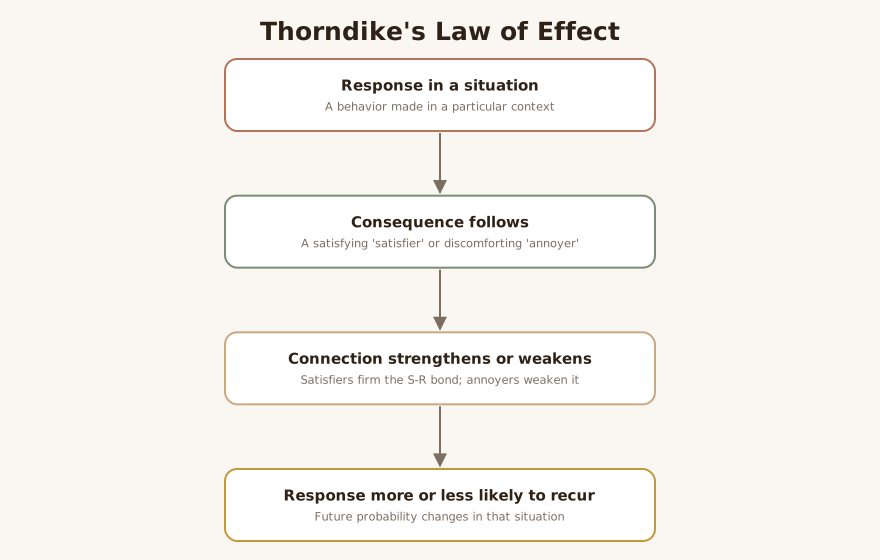
From these observations Thorndike formulated his theory of connectionism: learning consists of forming and strengthening bonds between a stimulus situation and a response, with satisfying consequences strengthening the bond and annoying consequences weakening it 4. He framed learning as the strengthening of stimulus-response (S-R) associations, not merely as an increased tendency to repeat a response 3. This is a subtle but important point that later accounts often lost 3.
The lineage runs forward from Thorndike to B.F. Skinner, who built directly on the law of effect to develop operant conditioning, adopting the core premise that consequences control behavior 2. Skinner modernized Thorndike’s puzzle box into the operant chamber, or “Skinner box,” a controlled environment in which behaviors such as bar-pressing could be reinforced and studied systematically 4. Skinner then went beyond Thorndike by analyzing how different types and schedules of reinforcement precisely shape behavior over time 1. Operant conditioning, behaviorism more broadly, and the later clinical discipline of applied behavior analysis all trace their conceptual roots through this line 5.
Core Principles
The central claim is straightforward: responses that produce a satisfying effect in a particular situation become more likely to recur in that situation, and responses that produce a discomforting effect become less likely to recur 4. Thorndike used the language of “satisfiers” and “annoyers” — a satisfying state of affairs strengthens the association, an annoying state weakens it 4.
Several principles follow from this core claim and remain clinically useful LLM:
- Consequences are selective. Behavior is not shaped in the abstract but by what specifically follows it in a given context 1. The probability that a stimulus will elicit a learned response depends on the perceived consequences of that response 1.
- Learning is associative, not insightful. In Thorndike’s account the organism forms an S-R bond; it does not necessarily understand or reason about the contingency 3. The gradual learning curve reflects mechanical strengthening rather than deliberation 2.
- Practice alone is insufficient. Thorndike originally proposed a separate “law of exercise” — that repetition by itself strengthens connections — but he later concluded this was wrong 2. When subjects repeated a task without feedback, no meaningful learning occurred; repetition matters only because it gives the law of effect more opportunities to operate 2. For clinicians, this is a caution against assuming that rehearsal of a skill, without reinforcing feedback, will produce durable change LLM.
- Both halves once mattered. Thorndike’s original formulation included a negative component: discomfort weakens associations 3. As discussed below, the field’s later treatment of this negative half is one of the most consequential revisions in the theory’s history 3.
Interventions & Techniques
The law of effect is a principle, not a packaged intervention, but it is the operative mechanism inside a recognizable family of techniques LLM. In each, the clinician arranges consequences so that adaptive behavior is followed by satisfying outcomes and maladaptive behavior is not 5.
- Reinforcement of desired behavior. Adding a desired reward (positive reinforcement) or removing an aversive condition (negative reinforcement) strengthens the behavior it follows 5. This is the workhorse of consequence-based intervention LLM.
- Punishment and extinction. Adding an undesired consequence (positive punishment) or removing a valued privilege (negative punishment) weakens behavior, while extinction occurs when a previously reinforced behavior is no longer reinforced and gradually disappears 5. A rat that had pressed a lever for food will stop pressing it once shocked, illustrating the weakening side of the principle 1.
- Shaping. Skinner’s extension of Thorndike’s logic reinforces successive approximations toward a target behavior, building complex skills from simpler reinforced steps 5.
- Schedules of reinforcement. Reinforcement delivered on interval (time-based) or ratio (response-count) schedules produces different patterns of behavior, a refinement Skinner added to the basic law 5.
In educational and behavioral settings, the same principle shows up as structured drills, progression from simple to complex material, and immediate reward or feedback systems for behavior management 2.
LLM-generated illustrative example (not a guideline): A clinician helping an adult build a morning medication-adherence habit pairs each completed dose with an immediate, self-selected satisfier (a brief enjoyable activity) and uses a visible streak tracker. Over weeks the situation (waking up) becomes reliably connected with the response (taking the medication), consistent with strengthening an S-R association through satisfying consequences LLM.
Evidence Base
The maturity of the law of effect is best described as established: it is a foundational, historically validated principle of learning that has shaped behavioral science for more than a century 4. Despite documented limitations, the theory profoundly influenced behaviorism and Skinner’s development of operant conditioning, which remains one of the most empirically supported frameworks in psychology 1. The principle’s core observation — that consequences shape the future probability of voluntary behavior — is not seriously in dispute and informs animal training, education, parenting, and psychotherapy practice 5.
Honesty about the evidence requires three caveats LLM. First, acceptance of the law in its strong original form declined over time because it became unclear whether an animal’s responses were always modified by their consequences, since other factors could be present in any given situation 1. Second, the theory has been criticized for a circularity problem: “satisfying” conditions are defined behaviorally and cannot be reliably predicted in advance, since different animals — and different clients — interpret the same condition differently 4. This is precisely why operant terminology replaced “satisfiers” and “annoyers” with “reinforcers” and “punishers,” terms defined by their measured effect on behavior rather than by inferred internal states 4. Third, the law as commonly taught is a simplified descendant of what Thorndike actually proposed, a point that affects how clinicians should interpret it 3.
Populations & Indications
Because the law of effect describes a general learning mechanism, it applies broadly across populations rather than to a narrow diagnostic group LLM. It has been applied with children and adults, with students and learners, with individuals in structured behavioral programs, with individuals with developmental disabilities, and with clients pursuing habit change 2. Educational applications — drills, structured progression, and immediate feedback — are direct extensions of the principle for learners 2.
The principle is most clearly indicated where a behavior is voluntary and its frequency is sensitive to consequences 5. Operant behaviors are voluntary and reversible, depending on whether reinforcing or aversive stimuli are present or absent, which is exactly the kind of behavior consequence-based work targets 5. It is correspondingly less applicable to involuntary, reflexive responses, which fall under classical conditioning 2.
Problems-for-Work
The law of effect maps naturally onto several common clinical targets LLM:
- Behavioral excesses and deficits. Excesses can be reduced through extinction or punishment of the behavior; deficits can be increased through reinforcement of approximations toward the target 5.
- Habit formation and change. Building a new habit means repeatedly pairing a situation with a response followed by a satisfier so the connection strengthens; changing an old one means removing the satisfier that currently maintains it 4.
- Maladaptive behaviors. A maladaptive behavior persists because it is followed, in that context, by a satisfying consequence; identifying and altering that consequence is the lever for change 4.
- Skill acquisition deficits. Skills are best built through structured progression with immediate reinforcing feedback, since practice without feedback yields little learning 2.
- Noncompliance and disruptive behavior. Reinforcing compliant or prosocial alternatives while withholding reinforcement from disruptive responses shifts the relative strength of the competing S-R bonds 5.
- Avoidance behaviors. Avoidance is frequently maintained by negative reinforcement — the removal of an aversive state — which the law explains directly 5.
LLM-generated illustrative example (not a guideline): A student with a skill-acquisition deficit in reading fluency practices in short structured blocks where each accurate passage is immediately acknowledged with specific praise. The clinician avoids long unguided practice, reasoning that repetition only helps insofar as it creates more opportunities for reinforcing feedback to operate, consistent with Thorndike’s revised view of exercise LLM.
Contraindications, Cautions & Cultural Humility
There are no formal contraindications to a principle, but there are clear cautions in how it is applied LLM. The most important is the circularity and unpredictability of “satisfying” states: what reinforces one person may be neutral or aversive to another, and reinforcers cannot be assumed in advance 4. A clinician who selects a reinforcer without verifying that it actually functions as one for this client risks designing a plan that does nothing LLM. This is also a point of cultural humility — preferences, valued activities, and what counts as a satisfier are shaped by individual, family, and cultural context, and must be assessed collaboratively rather than imposed LLM.
A second caution concerns the weakening side of the law. While punishment and extinction are genuine mechanisms within the theory, the same evidence base that built operant practice also documents reinforcement-based approaches as a primary strategy; over-reliance on aversive consequences is both clinically and ethically fraught LLM. A third caution is mechanistic overreach: the law describes association strengthening but does not capture insight, language, cognition, or meaning, and treating every clinical problem as a pure S-R contingency oversimplifies human behavior 3. Finally, because acceptance of the strong original law declined once it was clear that other factors can influence responding, clinicians should hold the principle as a powerful but partial account rather than a complete theory of why people do what they do 1.
Treatment-Plan Suggestions & SMART Objectives
| Goal | SMART objective (example) | Mechanism |
|---|---|---|
| Increase an adaptive behavioral deficit | Client will complete the target behavior on at least 4 of 7 days for 3 consecutive weeks, with each completion immediately followed by a self-selected reinforcer | Positive reinforcement strengthens the situation-response association 5 |
| Reduce a behavioral excess | Client will reduce the identified excess behavior to no more than 2 occurrences per week within 6 weeks by removing the consequence currently maintaining it | Extinction of a previously reinforced response 5 |
| Establish a new daily habit | Client will perform the new routine immediately after a fixed daily cue on at least 5 of 7 days for 4 weeks | Repeated pairing of situation and satisfying response strengthens the S-R bond 4 |
| Build a complex skill from approximations | Client will demonstrate 3 successive approximations toward the target skill across 8 sessions, each reinforced on mastery | Shaping by reinforcing successive approximations 5 |
| Replace avoidance with approach | Client will engage the avoided situation for a graded duration in 6 of 8 sessions, with relief and praise following each engagement | Reinforcing approach competes with negatively reinforced avoidance 5 |
| Improve a skill-acquisition deficit with feedback | Client will complete short structured practice blocks 4 times weekly, each block ending with immediate corrective and reinforcing feedback, for 4 weeks | Practice plus feedback gives the law of effect opportunities to operate 2 |
| Increase compliance / reduce disruption | Client will follow the agreed routine in at least 70% of opportunities over 4 weeks, with prosocial responses reinforced and disruptive ones not | Differential reinforcement shifts relative S-R strength 5 |
Common Misconceptions
A surprising amount of what is repeated about the law of effect departs from what Thorndike actually wrote 3. Three misconceptions recur LLM:
- “The law just says reinforced responses recur.” Most modern textbooks describe the law as simply stating that reinforced responses become more likely, omitting Thorndike’s central mechanistic claim that learning is the formation and strengthening of stimulus-response associations 3. The law is about bond formation, not merely response frequency 3.
- “The law of effect equals positive reinforcement.” Contemporary accounts often treat the law as synonymous with the principle of positive reinforcement, conflating a theory of association formation with one specific procedure 3. Later scholars also tended to drop Thorndike’s negative component — the claim that discomfort weakens associations — keeping only the positive half 3.
- “It’s the same as ‘stamping in’ behavior.” Skinner’s influential 1953 account characterized the law as behavior being “stamped in” by consequences, which describes a different mechanism than the associative learning Thorndike intended 3. The distinction is not pedantic: modern research on habitual versus goal-directed behavior tests whether S-R associations operate independently of how much the reinforcer is currently valued — precisely Thorndike’s original insight 3.
For clinicians, the practical upshot is to remember that you are usually strengthening a connection between a situation and a response, not just rewarding an isolated act, which is why context and cueing matter as much as the reward itself LLM.
Training & Certification
There is no certification in “the law of effect”; it is a principle absorbed within broader behavioral training LLM. Clinicians most often encounter it formally through coursework in learning theory and behaviorism, and apply it through operant frameworks such as applied behavior analysis 5. The lineage from Thorndike through Skinner to applied behavior analysis is the standard route by which the principle is taught and operationalized 2. Practitioners seeking competence in consequence-based intervention typically pursue supervised training in operant methods — reinforcement, shaping, extinction, and schedules — rather than in the law as an isolated topic 5.
Key Terms
- Law of effect — Responses followed by satisfaction in a situation are strengthened and more likely to recur; those followed by discomfort are weakened 4.
- Satisfiers and annoyers — Thorndike’s original terms for satisfying states that strengthen associations and annoying states that weaken them, later replaced by “reinforcers” and “punishers” 4.
- Connectionism — Thorndike’s theory that learning consists of forming and strengthening stimulus-response bonds 4.
- Stimulus-response (S-R) association — The connection between a situation and a response that the law of effect strengthens or weakens; the true unit of learning in Thorndike’s account 3.
- Law of exercise — Thorndike’s later-rejected idea that repetition alone strengthens connections; he concluded repetition helps only by enabling the law of effect to operate 2.
- Trial-and-error learning — Gradual, mechanical learning in which successful responses are stamped in and unsuccessful ones eliminated, shown by the puzzle-box learning curve 2.
- Operant conditioning — Skinner’s framework, built on the law of effect, in which voluntary behavior is shaped by reinforcement and punishment 5.
- Extinction — The gradual disappearance of a behavior when it is no longer reinforced 5.
Resources & Further Reading
▶ Watch — a video introduction to this concept:
- Thorndike’s law of effect | Definition & Examples (Britannica)
- Edward Thorndike: The Law of Effect (Simply Psychology)
- Thorndike’s law of effect and its inconsistent description over the years (PMC)
- Law of effect (Wikipedia)
- Operant conditioning (Britannica)
Reflective / Supervision Questions
- For a current client, can you name the specific consequence that is currently maintaining the maladaptive behavior you want to change, and have you verified it actually functions as a satisfier for this person 4?
- Where in your treatment plans are you assuming that practice or repetition alone will produce change, when the evidence suggests repetition helps only by creating opportunities for reinforcing feedback 2?
- When you describe a behavior plan to a client or family, are you framing it as strengthening a situation-response connection, or merely as rewarding an isolated act — and does that framing change how you arrange cues and context 3?
- How do individual and cultural differences in what counts as “satisfying” show up in your reinforcement choices, and how are you assessing them collaboratively rather than assuming them 4?
- Are you over-relying on the weakening side of the law (punishment, extinction) where reinforcement of an adaptive alternative would be more effective and ethically sound 5?
- Where does a pure consequence-based account fall short for your client, and what cognitive, relational, or meaning-based factors does the law of effect leave unexplained 3?