
Type & Discipline
Schedules of reinforcement are a theoretical and empirical framework within behavioral psychology, specifically the experimental analysis of behavior and operant conditioning.1 A reinforcement schedule is the rule that specifies which instances of a behavior, and under what conditions of number or time, will be followed by a reinforcer.3 The construct is descriptive rather than a standalone treatment: it does not tell a clinician what to reinforce, but rather how often and on what basis reinforcement is delivered, and that delivery rule turns out to exert powerful, lawful control over the rate, pattern, and persistence of behavior.1 Clinically, schedules of reinforcement form the engine underneath every behavior-based intervention, from token economies to contingency management, even when the schedule is never named explicitly.LLM
The framework is foundational rather than peripheral; it sits at the root of applied behavior analysis and behavior modification and continues to inform how reinforcement is programmed in contemporary practice.3 Understanding schedules helps a clinician predict not only whether a target behavior will increase, but how durable it will be once formal reinforcement is faded.LLM
Creators & Lineage
The systematic study of reinforcement schedules was established by B.F. Skinner and Charles (C.B.) Ferster in their 1957 book Schedules of Reinforcement, which catalogued how different schedules produce characteristically different and reliable patterns of responding.2 Skinner’s earlier operant conditioning work demonstrated that consequences shape behavior; Ferster and Skinner’s collaboration extended this by showing that the scheduling of those consequences was itself a controlling variable.1 Their work demonstrated that organisms reinforced on different schedules show varied behavioral outcomes, a finding that anchored decades of subsequent basic and applied research.2
The lineage runs from operant conditioning into applied behavior analysis, behavior modification, and the token economy, each of which operationalizes schedule principles for clinical and educational settings.3 Contemporary research continues to probe schedule effects, including how training schedule shapes later motivation and effort.5 The intellectual through-line is consistent: behavior is governed not just by whether it is reinforced, but by the temporal and numerical structure of that reinforcement.LLM
Core Principles
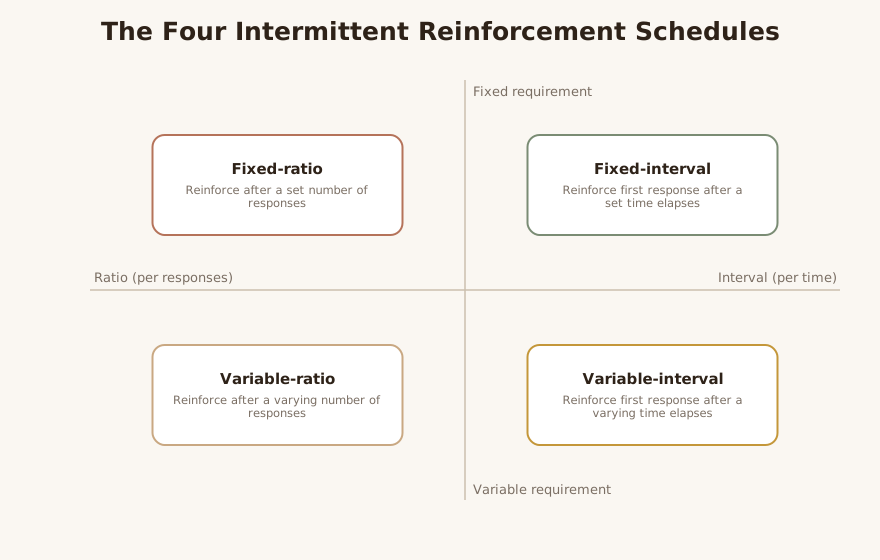
Schedules are organized along two crossed dimensions, producing the four canonical intermittent schedules.4 The first dimension is the basis for reinforcement: ratio schedules deliver reinforcement after a number of responses, while interval schedules deliver it for the first response after a period of time has elapsed.4 The second dimension is predictability: fixed schedules hold the requirement constant, while variable schedules vary the requirement around an average.4 Crossing these yields fixed-ratio, variable-ratio, fixed-interval, and variable-interval schedules.2
A logically prior distinction is between continuous and partial (intermittent) reinforcement.2 Continuous reinforcement delivers a reinforcer after every occurrence of the target behavior, which produces rapid acquisition but also rapid extinction once reinforcement stops, much like a vending machine that you abandon quickly when it fails.2 Partial reinforcement delivers reinforcement only some of the time, which slows initial learning but markedly increases resistance to extinction.2
That last property is the partial reinforcement extinction effect: behavior maintained on an intermittent schedule persists far longer without reinforcement than behavior maintained on a continuous schedule, because the organism has learned that reinforcement does not follow every response and so continues responding in anticipation that reinforcement will eventually come.2 Each schedule also generates a characteristic response signature.4 Fixed-ratio schedules produce a high steady rate broken by a post-reinforcement pause after each reinforcer.2 Variable-ratio schedules produce the highest and most consistent rates and the greatest resistance to extinction, which is the behavioral basis of persistent gambling.2 Fixed-interval schedules produce a “scalloped” pattern in which responding accelerates as the reinforcement time approaches.2 Variable-interval schedules produce low, steady, durable responding.2
A central applied lesson is that ratio schedules generally generate higher response rates than interval schedules, because under ratio schedules the reinforcer depends directly on how much the organism responds, whereas under interval schedules extra responding within the interval does not hasten reinforcement.4 Variable schedules generally generate steadier responding and greater extinction resistance than their fixed counterparts because the next reinforcer is unpredictable.2
Interventions & Techniques
Although schedules of reinforcement are a theory rather than a packaged protocol, they translate directly into procedural choices that clinicians make whenever they program reinforcement.LLM A foundational technique is to begin shaping a new or weak behavior on a rich, near-continuous schedule to drive acquisition, then deliberately thin the schedule toward intermittent reinforcement to build durability and reduce reliance on constant reinforcer delivery.2 This acquisition-then-thinning sequence is the practical reconciliation of the trade-off between fast learning and resistance to extinction.LLM
Selecting a schedule type is itself an intervention decision.LLM When a clinician or caregiver wants high, sustained output of an already-acquired behavior, a ratio schedule is indicated, since reinforcement scales with responding.4 When the goal is steady, evenly distributed behavior that is hard to extinguish, a variable-interval arrangement is well suited.4 When predictability and clear contingencies aid a learner, fixed schedules make the “rule” transparent, at the cost of post-reinforcement pausing and time-bound bursts of effort.2
LLM-generated illustrative example (not a guideline): A parent training program teaches a caregiver to praise an inattentive child for every instance of staying seated during homework in the first week (near-continuous reinforcement) to establish the behavior, then move to praising roughly every third or fourth instance on a variable basis once the behavior is reliable, so that staying seated persists even on days the parent forgets to attend closely.LLM
Schedule logic also underwrites the token economy and contingency management: tokens or vouchers are dispensed on a defined schedule, and the schedule is thinned as target behaviors consolidate.3 Variable-ratio arrangements such as draw-from-a-bowl or prize-bowl procedures are sometimes used precisely because variable-ratio reinforcement sustains high rates of the target behavior.2
Evidence Base
The evidence base for schedules of reinforcement is established and mature, among the most replicated findings in experimental psychology.1 Ferster and Skinner’s original work and the half-century of operant research that followed demonstrated that the four basic schedules reliably produce their characteristic response patterns across species and settings.2 These regularities are robust enough to be treated as basic behavioral laws rather than tentative findings.LLM
Honesty about the boundaries of the evidence is warranted, however.LLM The clean, lawful response patterns are clearest in tightly controlled operant settings, and human behavior in applied contexts is influenced by verbal rules, history, and competing reinforcers that can blunt or distort idealized schedule effects.LLM Contemporary work also complicates simple “variable schedules build more motivation” assumptions.5 One study training mice on fixed-ratio versus variable-ratio schedules found no differential effect of schedule type on later effort-based motivation as measured by progressive-ratio breakpoint, and found that response rate during training did not correspond to effort-based motivation, indicating that response rate and motivation are dissociable dimensions.5 That same study found that training history substantially shaped later motivation measurements, underscoring that schedule effects are real but interact with experience in ways that resist oversimplified clinical claims.5
The practical takeaway for clinicians is that schedule principles are dependable for predicting rate, pattern, and extinction resistance, but should not be over-read as a direct lever on internal “motivation” without attention to the individual’s learning history.5
Populations & Indications
Schedule-based reinforcement is applied across the populations served by behavior-analytic practice.3 These include children and adolescents in clinical, home, and school settings; people with developmental disabilities and autism spectrum disorder, for whom systematic reinforcement supports skill acquisition; and caregivers and parents, who are trained to deliver reinforcement on appropriate schedules.3 People with substance use disorders are also served, most visibly through contingency-management arrangements that schedule tangible reinforcers for verified abstinence.LLM
Indications are broadest wherever the clinical goal is to increase, strengthen, or durably maintain a specific, observable behavior, or to fade prompting and external reinforcement without losing the gain.LLM Schedule thinning is specifically indicated when a behavior has been acquired under rich reinforcement and now needs to generalize and persist under the leaner reinforcement available in the natural environment.2
Problems-for-Work
Schedule principles apply to a range of problems-for-work in behavior-based treatment.LLM For disruptive behavior disorders and oppositional defiant disorder, clinicians and caregivers reinforce prosocial and compliant behavior on a schedule rich enough to establish it, then thin to maintain it against the intermittent natural reinforcement that often sustains defiance.LLM For attention-deficit/hyperactivity disorder, dense reinforcement of on-task behavior supports acquisition, with planned thinning to sustain engagement.LLM
For habit disorders and behavioral skill deficits, continuous reinforcement during early acquisition gives way to intermittent reinforcement to lock in durability.2 For substance use disorders and treatment nonadherence, scheduled reinforcement of verified target behaviors, including variable-ratio prize procedures, sustains the target at high rates.2 For problem behaviors in intellectual disability, schedule analysis helps identify that an undesired behavior may itself be on a powerful intermittent schedule, which both explains its persistence and points toward intervention.LLM
LLM-generated illustrative example (not a guideline): A clinician notes that an adolescent’s escape-maintained outbursts are reinforced only occasionally by being sent out of class, an intermittent (variable) schedule that predicts exactly the high persistence and extinction-resistance the team is seeing; the plan shifts to reinforcing an alternative request-for-break behavior densely while ensuring outbursts no longer intermittently produce escape.LLM
Contraindications, Cautions & Cultural Humility
The framework itself has no contraindication, but its misuse does carry risk.LLM The same laws that strengthen desirable behavior can inadvertently strengthen undesirable behavior: a problem behavior that is reinforced only intermittently becomes highly resistant to extinction, so caregivers who give in “only sometimes” may unintentionally create the most durable version of the behavior they are trying to reduce.2 Clinicians should also anticipate extinction bursts and increased variability when reinforcement is withdrawn, and plan for them rather than be surprised by them.LLM
A reductionist application that treats people as response-emitting organisms is both clinically and ethically inadequate.LLM Reinforcers are not universal: what functions as a reinforcer is defined by its effect on behavior for a specific individual within a specific cultural and relational context, so clinicians must assess preference and meaning rather than assume.3 Cultural humility requires that schedule-based plans be co-constructed with clients, families, and caregivers, respecting their values around reward, autonomy, and what behaviors are even appropriate targets.LLM Reinforcement programming should support self-determination and dignity, not coerce compliance, and clinicians should remain alert to power imbalances when one party controls another’s access to valued reinforcers.LLM
Treatment-Plan Suggestions & SMART Objectives
| Goal | SMART objective (example) | Mechanism |
|---|---|---|
| Establish a new skill quickly | Within 2 weeks, client emits the target skill in 80% of opportunities under dense (near-continuous) reinforcement | Continuous reinforcement maximizes acquisition speed2 |
| Build durability of an acquired behavior | Over 4 weeks, thin reinforcement from continuous to a variable schedule while maintaining ≥80% performance | Intermittent reinforcement increases resistance to extinction2 |
| Increase rate of a desired behavior | Within 3 weeks, client completes ≥10 target responses per session under a ratio schedule | Ratio schedules tie reinforcement to amount of responding, raising rates4 |
| Sustain steady engagement | Across 4 weeks, client maintains on-task behavior for 80% of intervals under a variable-interval check-in | Variable-interval schedules produce low, steady, durable responding2 |
| Reduce an intermittently reinforced problem behavior | Within 6 weeks, reduce target behavior by 50% by removing intermittent reinforcement and reinforcing a replacement | Extinction plus differential reinforcement of an alternative behavior2 |
| Generalize behavior to the natural setting | Over 6 weeks, behavior persists at ≥75% under the leaner reinforcement available at home/school | Schedule thinning bridges trained to natural contingencies2 |
| Sustain abstinence or adherence | Across 8 weeks, ≥80% of verified samples meet the target under a scheduled (variable-ratio prize) reinforcement plan | Variable-ratio reinforcement sustains high target rates2 |
| Transfer reinforcement delivery to caregiver | Within 4 weeks, caregiver delivers reinforcement on the planned schedule with ≥90% fidelity | Caregiver-mediated scheduling maintains gains across settings3 |
Common Misconceptions
A frequent error is conflating “reinforcement schedule” with “reward type”; the schedule is the rule for delivery, not the reinforcer itself, and the same reinforcer behaves very differently under different schedules.4 Another misconception is that more reinforcement is always better: continuous reinforcement actually produces the least durable behavior because it extinguishes quickly once reinforcement stops.2
Clinicians sometimes assume variable-ratio schedules are inherently “more motivating”; the more precise statement is that they produce high, persistent response rates, and recent work indicates that response rate and effort-based motivation are dissociable, so high rates do not automatically equal high motivation.5 It is also a misconception that interval schedules reward responding harder; under interval schedules only the first response after the interval elapses is reinforced, so additional responses within the interval do nothing, which is why interval schedules yield lower rates than ratio schedules.4 Finally, the intuition that giving in “just sometimes” is harmless is wrong, because intermittent reinforcement of an unwanted behavior is exactly the arrangement that makes it most resistant to extinction.2
Training & Certification
There is no certification in “schedules of reinforcement” as such; the topic is foundational coursework within the broader training pathway in behavior analysis.LLM Practitioners who program reinforcement schedules clinically are typically credentialed in applied behavior analysis or work under such supervision, and schedule concepts are core content in that training along with operant conditioning and behavior modification.3 Foundational understanding is also conveyed in introductory psychology curricula, which present the four schedules and their characteristic effects.4 Clinicians outside behavior analysis who use reinforcement in parent training, contingency management, or token economies should seek consultation or supervision from a behavior-analytically trained colleague when designing and thinning schedules.LLM
Key Terms
- Reinforcement schedule: the rule specifying which responses, by number or time, are followed by a reinforcer.3
- Continuous reinforcement: reinforcement after every target response; fast acquisition, fast extinction.2
- Partial (intermittent) reinforcement: reinforcement after only some responses; slower acquisition, greater extinction resistance.2
- Fixed-ratio (FR): reinforcement after a set number of responses; high rate with post-reinforcement pause.2
- Variable-ratio (VR): reinforcement after a varying number of responses; highest rate, most extinction-resistant.2
- Fixed-interval (FI): reinforcement for the first response after a set time; scalloped responding.2
- Variable-interval (VI): reinforcement for the first response after a varying time; low, steady responding.2
- Partial reinforcement extinction effect: intermittently reinforced behavior persists longer under extinction than continuously reinforced behavior.2
- Schedule thinning: gradually moving from rich to leaner reinforcement to build durability.2
- Post-reinforcement pause: the brief pause in responding after a reinforcer, characteristic of fixed-ratio schedules.2
Resources & Further Reading
▶ Watch — a video introduction to this concept:
- Ferster, C. B., & Skinner, B. F. (1957). Schedules of Reinforcement — the foundational text.
- Schedules of Reinforcement in Psychology (Examples) — Simply Psychology — accessible overview with everyday examples.
- Schedule of Reinforcement — overview, ScienceDirect Topics — academic summaries and definitions.
- Reinforcement Schedules — Lumen Learning — introductory-psychology treatment of the four schedules.
- The influence of reinforcement schedule on experience-dependent changes in motivation (PMC) — contemporary research complicating schedule-motivation assumptions.
- The 4 Schedules of Reinforcement Explained (YouTube) — visual walkthrough of the four schedules.
Reflective / Supervision Questions
- For a current case, what schedule is currently maintaining the target behavior, and is it the schedule you intend?LLM
- Where in the acquisition-to-maintenance arc is this behavior, and does the schedule match that stage?LLM
- Could an undesired behavior on your caseload be persisting because it is intermittently reinforced, and who is delivering that reinforcement?LLM
- When you fade reinforcement, how will you anticipate and respond to an extinction burst?LLM
- Are the reinforcers you are scheduling genuinely reinforcing for this client within their cultural and relational context?LLM
- Are you over-reading high response rates as “motivation,” and how would you distinguish the two in practice?5