
Type & Discipline
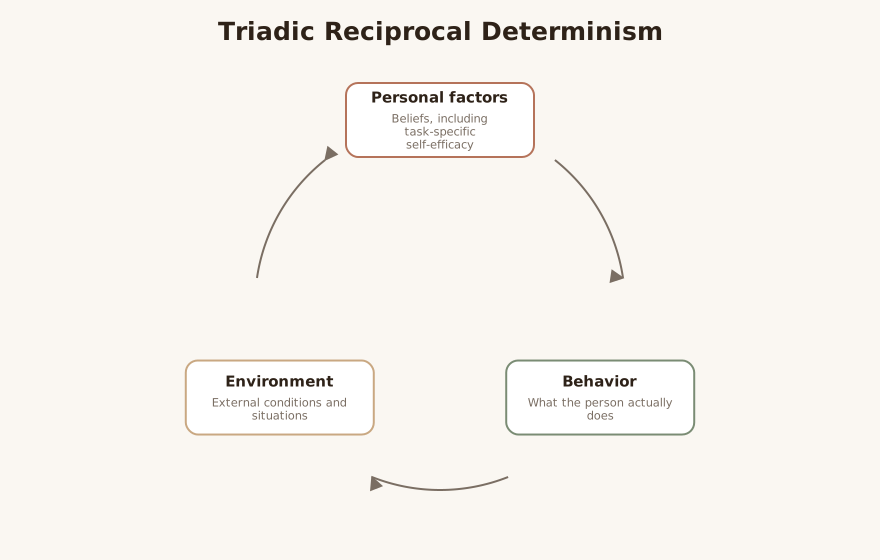
Social cognitive theory (SCT) is a broad theory of human behavior and motivation within psychology, not a manualized treatment package LLM. Its central organizing principle is triadic reciprocal determinism — the proposition that personal factors (cognition, beliefs, emotion), behavior, and the environment continuously and mutually influence one another rather than operating in a one-way stimulus-response chain 2. Self-efficacy — a person’s belief in their capability to execute the behaviors required to manage a given situation — sits at the motivational core of the theory 4. For clinicians, the practical value of SCT is less as a standalone modality and more as a transtheoretical engine: its constructs are embedded inside cognitive behavioral therapy, motivational interviewing, exposure-based work, and health-behavior coaching LLM. Understanding the theory therefore clarifies why many established interventions work, which lets you target the active ingredient more deliberately LLM.
Creators & Lineage
The theory is overwhelmingly the work of Albert Bandura (1925-2021), a Canadian-American psychologist who spent his career at Stanford University 6. His early research, including the 1961 Bobo doll experiments, demonstrated that children acquire behaviors simply by observing models, without direct reinforcement — a direct challenge to the strict behaviorism of the era 4. This work matured into social learning theory, formalized in his 1977 book of that name, which retained reinforcement language while foregrounding observation and cognition 4. In 1977 he also published the landmark paper “Self-efficacy: Toward a unifying theory of behavioral change” in Psychological Review, introducing self-efficacy as the common pathway through which diverse therapeutic procedures produce change 1.
By the mid-1980s Bandura had renamed and expanded the framework to social cognitive theory, marked by his 1986 Social Foundations of Thought and Action, which reconceived people as self-organizing, proactive, self-reflecting, and self-regulating agents 6. His 1997 Self-Efficacy: The Exercise of Control gave the construct its comprehensive treatment 6. The intellectual lineage runs from behaviorism, through Bandura’s own social learning theory and self-efficacy theory, and is conceptually adjacent to locus-of-control theory LLM. Bandura’s influence is hard to overstate: a 2002 survey ranked him fourth among the most-cited psychologists of all time, behind only Skinner, Freud, and Piaget 6.
Core Principles
Triadic reciprocal determinism. Behavior is neither driven solely by the environment nor by the person; the three vertices — personal, behavioral, environmental — each influence and are influenced by the others 2. The clinical implication is that change can be initiated at any vertex, and that interventions targeting multiple vertices simultaneously are typically more durable 2.
Self-efficacy is task-specific. Efficacy beliefs are not a global trait but a judgment about a particular domain or task; a client may feel highly efficacious about parenting yet helpless about managing panic 4. This specificity is what makes self-efficacy clinically actionable — it can be assessed and built one concrete behavior at a time 5.
Efficacy expectations versus outcome expectations. Bandura distinguished the belief that one can perform a behavior (efficacy expectation) from the belief that the behavior will produce a given outcome (outcome expectation) 12. A client may believe that exposure would reduce their anxiety (outcome expectation) yet doubt they can tolerate the exposure (efficacy expectation); the second belief, not the first, more often gates whether they begin 1.
Self-efficacy governs initiation, effort, and persistence. Efficacy beliefs influence whether a person attempts a coping behavior at all, how much effort they invest, and how long they persist in the face of obstacles and aversive experiences 1. People with stronger efficacy beliefs set more challenging goals, sustain motivation, and recover faster from setbacks, whereas low efficacy predicts reduced effort and premature abandonment 45.
Observational learning and modeling. People acquire new behaviors and standards by watching credible models, mediated by attention, retention, motor reproduction, and motivation 4. Models who are perceived as similar to the observer exert stronger influence 2.
Human agency. SCT casts people as active agents who exercise intentionality, forethought, self-reactiveness, and self-reflection, rather than as passive products of conditioning 5. This agentic stance contrasts with a strict disease model and emphasizes that people can exert control over their own functioning 5.
Interventions & Techniques
SCT identifies four sources from which efficacy beliefs are built, and each maps onto a family of clinical techniques 1.
Mastery experiences (performance accomplishments). Direct success at a task is the most powerful source of efficacy; failures, especially early, erode it 15. Clinically this argues for graded, achievable tasks — breaking change into small steps where the client can recognize progress — which is precisely the logic of behavioral activation, graded task assignment, and successful exposure hierarchies 24.
Vicarious experience (social modeling). Watching similar others succeed raises the observer’s belief that they too can succeed 1. Therapist modeling, peer-led groups, recovery-community sponsors, and similar-patient testimonials all leverage this source 5.
Verbal/social persuasion. Credible encouragement that a person possesses the capability increases the likelihood they will mobilize effort, and self-talk operates similarly 5. This underlies affirmations in motivational interviewing and the collaborative confidence-building of CBT, though persuasion alone is the weakest source if not followed by mastery 1.
Physiological and affective states. People read their own arousal, fatigue, and mood as evidence about capability; high anxiety can be misinterpreted as inability 15. Interventions that reduce or reframe arousal — paced breathing, interoceptive exposure, cognitive reappraisal of bodily sensations — therefore raise efficacy by changing the somatic evidence the client is reading 5.
Self-regulation. SCT operationalizes change through goal-setting, self-monitoring, feedback, and self-reward 2. Structured self-monitoring logs, realistic proximal goals, and reflection opportunities are SCT-consistent self-regulatory tools 2.
Evidence Base
It is important to be precise about what “established” means here LLM. Self-efficacy is among the most empirically validated constructs in all of psychology — a robust predictor of motivation, behavior change, persistence, and outcomes across health, education, athletic, and clinical domains 54. Bandura’s broader corpus is correspondingly influential, and his observational-learning findings are foundational to learning theory 46.
The honest caveat is that social cognitive theory is a meta-framework, not a single protocolized treatment with its own randomized trials LLM. Its constructs are validated and its mechanisms are well supported, but in practice they are delivered through established therapies — CBT, motivational interviewing, exposure, health coaching — rather than as a discrete branded modality you would deploy on its own LLM. When you read “SCT is evidence-based,” the accurate parsing is that the construct of self-efficacy and the four sources of efficacy information are well supported, and that interventions built on them have strong empirical backing 15. The maturity level is best labeled established for the construct, with the understanding that it functions as an active ingredient inside other treatments LLM.
Populations & Indications
The framework is broadly indicated wherever motivation, behavior change, and self-regulation are in question LLM. People with chronic illness benefit from efficacy-building around self-management behaviors such as medication adherence and activity pacing 2. Adults pursuing behavior change — diet, exercise, sleep — are a paradigm case, since outcome and efficacy expectations jointly predict whether they attempt and sustain change 52. Students show academic gains when mastery-based learning and credible peer models raise scholastic self-efficacy 45. People in recovery from substance use are well served by efficacy work, since confidence in one’s ability to resist or quit predicts success, sometimes more than biological factors 5. Athletes rely on performance accomplishments and arousal regulation to sustain efficacy under pressure 5. Caregivers facing sustained demands benefit from realistic proximal goals and self-regulatory structure that counter helplessness LLM.
Problems-for-Work
Low self-efficacy is the core target — addressed by sequencing genuinely achievable mastery tasks so the client accumulates disconfirming success experiences 14. Avoidance behavior is reframed as an efficacy problem: the client often believes the feared outcome is manageable but doubts they can tolerate approaching it, so graded approach plus arousal management rebuilds the efficacy expectation 1. Low motivation and procrastination respond to proximal goal-setting and self-monitoring, which make effort feel consequential and progress visible 25. Self-regulation difficulties are met directly with goal-setting, feedback, and self-reward loops 2. Performance anxiety is approached by reattributing physiological arousal away from “I can’t” toward “I’m activated,” lowering the somatic evidence against capability 15. Substance use disorder work centers on abstinence or refusal self-efficacy, often built through similar-peer modeling and incremental success 5. Helplessness and the behavioral inertia seen in major depressive disorder are countered through small, scheduled mastery experiences that reconnect action with outcome 45.
LLM-generated illustrative example (not a guideline): A client avoiding driving after a collision believes that driving is safe in the abstract (outcome expectation intact) but is certain they cannot stay calm behind the wheel (low efficacy expectation). The clinician builds a graded hierarchy — sitting in a parked car, idling in the driveway, a short loop on a quiet street — pairing each successful step with explicit review of “you did that,” so accumulating mastery experiences rebuild driving self-efficacy. LLM
Contraindications, Cautions & Cultural Humility
A theory has no contraindications in the pharmacological sense, but its application carries real cautions LLM. The most serious is over-attribution: framing every outcome as a function of the client’s self-efficacy can slide into victim-blaming and erase genuine structural, economic, and systemic barriers that no amount of belief will overcome LLM. Efficacy work should sit alongside, not replace, honest acknowledgment of environmental constraint — which is itself faithful to the theory, since the environment is one of the three reciprocal vertices 2.
The agentic, individual-control emphasis of SCT also reflects a partly individualist cultural lens LLM. In collectivist contexts, the more apt construct is often collective efficacy — a group’s shared confidence that it can accomplish a goal together — which Bandura’s framework explicitly accommodates 2. Cultural humility means assessing whether a client locates agency in the self, the family, or the community, and selecting interventions accordingly LLM. Finally, persuasion-only approaches that promise capability without delivering real mastery can backfire, because unmet encouragement followed by failure damages efficacy more than no encouragement at all 1.
Treatment-Plan Suggestions & SMART Objectives
| Goal | SMART objective (example) | Mechanism |
|---|---|---|
| Raise task-specific self-efficacy | Within 4 weeks, client completes all 3 steps of an agreed graded task and rates confidence 0-10 after each | Mastery experiences 1 |
| Reduce avoidance of a feared situation | Over 6 sessions, client ascends a 5-rung exposure hierarchy, attempting the next rung within 7 days of mastering the prior | Mastery + arousal reduction 1 |
| Build refusal/abstinence efficacy in recovery | For 3 weeks, client identifies 2 high-risk cues weekly and rehearses a refusal response, logging confidence each time | Self-regulation + modeling 5 |
| Increase activation in low mood | Client schedules and completes 1 small mastery activity daily for 2 weeks, recording completion | Mastery + outcome reattribution 4 |
| Strengthen self-regulation | Client maintains a daily self-monitoring log for 14 days and reviews patterns with clinician each session | Goal-setting + feedback 2 |
| Manage performance-related arousal | Before each performance, client applies a paced-breathing routine and reappraises arousal as readiness, 4 trials over 4 weeks | Physiological/affective regulation 1 |
| Leverage credible modeling | Client attends 3 peer-led group sessions in 1 month and names 1 modeled behavior to try | Vicarious experience 5 |
Common Misconceptions
“Self-efficacy is the same as self-esteem or general confidence.” It is not; self-efficacy is task- and situation-specific and therefore measurable, whereas self-esteem is global self-worth 5. “More encouragement is the main lever.” Verbal persuasion is the weakest of the four sources; mastery experiences dominate, and persuasion without follow-through can harm efficacy 1. “Believe in yourself and the environment doesn’t matter.” SCT is explicitly triadic — the environment is a co-determinant, and self-efficacy guards against adversity rather than abolishing it 25. “SCT is just behaviorism.” Bandura’s work helped move psychology from pure behaviorism toward cognition, foregrounding mediating beliefs that strict behaviorism omitted 6. “It is a standalone therapy you bill as SCT.” It is a theory whose mechanisms are delivered through established treatments, not a discrete protocol LLM.
Training & Certification
There is no certification in social cognitive theory, and none is needed LLM. The theory is foundational psychology coursework, typically covered in graduate developmental, learning, and personality sequences LLM. For clinicians, SCT competencies are acquired implicitly through training in the modalities that operationalize it — cognitive behavioral therapy, motivational interviewing, exposure-based protocols, and health-behavior or chronic-disease self-management coaching, all of which build efficacy through the four sources LLM. Primary-source reading remains valuable: Bandura’s 1977 Psychological Review paper and his 1997 Self-Efficacy: The Exercise of Control are the canonical texts 16. Supervised practice in sequencing graded mastery tasks and in arousal-reframing is the most direct way to develop applied skill LLM.
Key Terms
Self-efficacy — belief in one’s capability to execute the behaviors needed to manage a specific situation 4. Efficacy expectation — the belief that one can perform a behavior 1. Outcome expectation — the belief that a behavior will produce a given result 1. Triadic reciprocal determinism — the mutual, ongoing influence among person, behavior, and environment 2. Mastery experience — efficacy built through direct success at a task; the strongest source 1. Vicarious experience — efficacy built by observing similar others succeed 1. Verbal persuasion — efficacy influenced by credible encouragement 5. Physiological/affective state — bodily and emotional cues read as evidence of capability 1. Observational learning — acquiring behavior by watching models, via attention, retention, reproduction, and motivation 4. Collective efficacy — a group’s shared belief in its capacity to achieve a goal 2. Human agency — the capacity for intentional, forethoughtful, self-regulating, self-reflective action 5.
Resources & Further Reading
▶ Watch — a video introduction to this concept:
- Bandura, A. (1977). Self-efficacy: Toward a unifying theory of behavioral change. Psychological Review, 84(2), 191-215
- Pajares, F. — Overview of Social Cognitive Theory and of Self-Efficacy
- Key Constructs (Bandura) — Health Behavior and Health Education, Ch. 8 (University of Pennsylvania)
- Albert Bandura’s Social Cognitive Theory (Simply Psychology)
- Albert Bandura: Self-Efficacy & Agentic Positive Psychology (PositivePsychology.com)
- Albert Bandura (Wikipedia)
Reflective / Supervision Questions
- For this client’s presenting problem, is the barrier primarily an efficacy expectation or an outcome expectation, and how would my intervention differ depending on the answer? LLM
- Which of the four sources of efficacy am I actually using, and am I over-relying on verbal persuasion when a graded mastery task would do more? LLM
- Where am I at risk of over-attributing this client’s difficulty to low self-efficacy and under-weighting real structural or environmental barriers? LLM
- Does this client locate agency in the self, the family, or the community, and should I be working with collective rather than individual efficacy? LLM
- How am I sequencing tasks so that the client experiences genuine, recognizable success rather than a step that risks early failure? LLM
- Am I helping the client reinterpret their physiological arousal, or letting it stand as uncontested evidence of incapability? LLM