
Type & Discipline
Parent Management Training (PMT) is a behavioral, manualized family intervention in which the clinician works primarily with caregivers rather than directly with the child, teaching parents to alter the everyday contingencies that maintain disruptive behavior 3. It sits within the broader family of behavioral parent training and is grounded in operant conditioning and social learning principles 4. The defining structural feature is that the parent, not the child, is the proximal agent of change: the therapist coaches the adult, and the adult delivers the intervention at home 3. PMT is used across developmental and dyadic contexts and is most often applied with children roughly ages 2-13 presenting with oppositional, aggressive, or antisocial behavior 31.
It is worth distinguishing PMT as a general approach from the named programs that operationalize it. “PMT” can refer both to Kazdin’s specific protocol and to a class of related programs that share the same behavioral logic 6. That distinction matters clinically because the evidence base is strongest at the level of the shared mechanism, not any single brand LLM.
Creators & Lineage
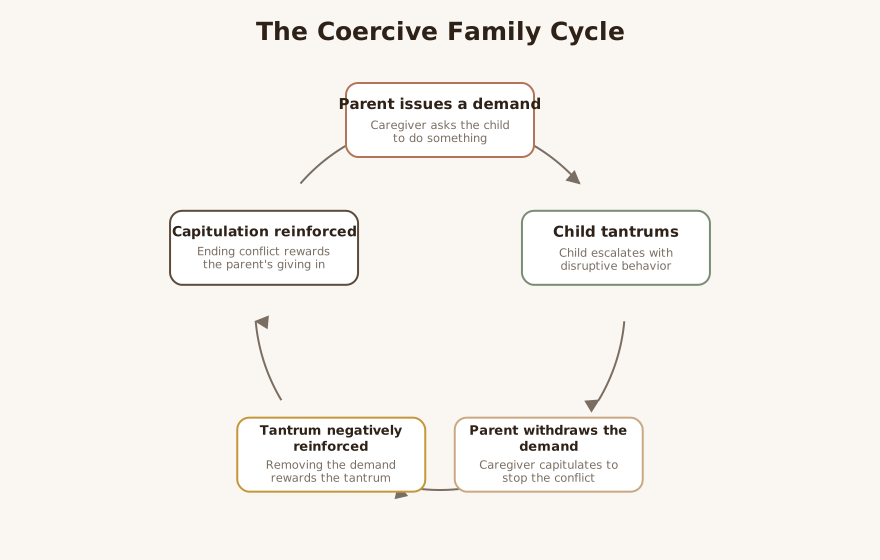
The intellectual lineage runs through behavior therapy and operant conditioning into social learning theory 4. Gerald Patterson and colleagues at the Oregon Social Learning Center developed the foundational work, articulating coercion theory: the observation that parent and child inadvertently train one another through cycles of escalating aversive behavior that are reinforced when one party backs down 6. Alan Kazdin subsequently developed and disseminated an influential PMT protocol for oppositional, aggressive, and antisocial behavior and authored the principal clinical text 3.
PMT is the parent of, and sibling to, several widely studied programs. Parent-Child Interaction Therapy (PCIT), the Incredible Years series, and the Triple P Positive Parenting Program all descend from the same behavioral and social-learning roots and share PMT’s emphasis on shifting reinforcement contingencies 64. These programs differ in format, dosing, and the degree of live coaching, but they are best understood as variations on a common evidence-based core rather than competing schools LLM.
Core Principles
PMT rests on a small set of behavioral premises. First, much disruptive behavior is learned and maintained by its consequences, so changing the consequences changes the behavior 4. Second, coercive family interaction patterns are a central engine of escalation: when a parent withdraws a demand in the face of a child’s tantrum, the tantrum is negatively reinforced and the parent’s capitulation is reinforced by the cessation of conflict 6. Third, because parents control most of the child’s reinforcement environment, training the parent is the most efficient lever for change 3.
From these premises follow the working principles clinicians actually teach: increase positive reinforcement for prosocial behavior, deliver clear and developmentally appropriate commands, use consistent and non-escalating consequences for misbehavior, and reduce inadvertent reinforcement of problem behavior 4. A recurring clinical theme is shifting the parent’s attention from a near-exclusive focus on misbehavior toward systematic attention to and praise for desired behavior 3. Skills are taught experientially, with modeling, role-play, and review of home practice rather than didactic instruction alone 3.
Interventions & Techniques
Core techniques map onto the principles above. Positive reinforcement is operationalized through labeled praise, attention, and often token or point systems for younger children 4. Parents are taught to give effective commands that are specific, single-step, and stated rather than phrased as questions 3. For undesired behavior, PMT teaches planned ignoring of attention-seeking misbehavior and time-out from positive reinforcement delivered calmly and consistently 4. Therapists emphasize consistency and follow-through so that consequences are predictable rather than contingent on parental mood or fatigue 3.
Sessions are structured: the clinician introduces one skill, models it, has the parent role-play it, assigns home practice, and reviews the data at the next session 3. Enhancements to the basic package have been studied to improve engagement and durability, including attention to the therapeutic relationship, parent cognitions and stress, and barriers to attendance 5. Some protocols involve the child directly in sessions, though meta-analytic data suggest adding child-focused CBT to PMT does not reliably outperform PMT alone for disruptive behavior 1.
LLM-generated illustrative example (not a guideline): A parent reports that morning routines collapse into shouting. The clinician helps the parent replace a vague “get ready” with a single concrete command, pre-arranges a brief reward for completing the routine, and rehearses a calm, non-negotiating response to refusal, then reviews a simple tally sheet the following week LLM.
Evidence Base
The evidence base for PMT is mature and well-replicated; its maturity is best described as established 31. A 2022 meta-analysis of 25 randomized controlled trials (2,023 children, ages 2-13, 69% boys) found that PMT outperformed waiting-list control in reducing parent-rated disruptive behavior, with a moderate pooled effect (Hedges g ≈ 0.64), alongside improvements in parenting practices and child social skills 1. In the same analysis, PCIT showed a substantially larger effect (g ≈ 1.22), particularly for younger children, while adding child-focused CBT to PMT did not yield significant added benefit for disruptive behavior 1.
Critically, the effects are not confined to tightly controlled university settings. A systematic review of 28 RCTs (2,239 children) examining real-world delivery concluded that PMT “appeared to be an effective treatment for children with disruptive behaviour problems,” with significant reductions on standard measures (for example, a weighted mean difference of about -20.9 on the ECBI Intensity scale) and no clear relationship between a study’s real-world “practice” score and its effect size 2. Heterogeneity across trials was substantial and not fully explained, which is the main caveat on an otherwise robust literature 2. Active work continues on enhancing PMT to improve engagement, retention, and the magnitude and durability of change 5.
Populations & Indications
PMT is indicated for children and, with adaptation, adolescents presenting with disruptive behavior, and is delivered to parents and caregivers and the wider family system 34. The primary indications are oppositional defiant disorder, conduct disorder, and subclinical but impairing disruptive behavior 3. It is also commonly used to address the behavioral and noncompliance components of ADHD, where parent training is a recommended adjunct alongside other treatments 4.
The approach extends to foster and adoptive families and other caregiving arrangements, where teaching consistent, non-coercive parenting can be especially valuable given children’s histories LLM. The trial evidence is strongest for younger children, with effect sizes generally larger in early childhood than in adolescence 1.
Problems-for-Work
PMT targets a coherent cluster of presenting problems. For oppositional defiant disorder and noncompliance, the work centers on effective commands and consistent consequences to interrupt argument-and-capitulation cycles 4. For conduct disorder, aggression, and antisocial behavior, PMT addresses the coercive reinforcement patterns that sustain escalation and is the behavioral approach with the most direct empirical support 36.
For tantrums and emotional dysregulation, parents learn planned ignoring of attention-maintained outbursts paired with reinforcement of regulated behavior 4. For ADHD-related behavioral problems, structured routines, token systems, and predictable consequences reduce the everyday friction that medication alone may not resolve 4. For parent-child relational problems and coercive family interaction patterns, the explicit reframing of who-reinforces-what gives families a shared, non-blaming model of their conflict 6.
LLM-generated illustrative example (not a guideline): A 7-year-old escalates at bedtime; the parent has been alternating between yielding and harsh threats. The clinician maps the sequence as a coercive cycle, installs a brief reward for staying in bed, and coaches a flat, consistent return-to-bed routine, targeting both the tantrums and the relational strain LLM.
Contraindications, Cautions & Cultural Humility
PMT has no absolute contraindications in the way a medication does, but several cautions apply. Where there is active child maltreatment or coercive parenting that shades into abuse, behavioral techniques such as time-out must be taught carefully and may require a child-protection lens before or alongside training LLM. Parental factors that interfere with delivery, such as severe untreated parental depression, substance use, or high family stress, can blunt outcomes and are themselves targets for enhancement strategies or concurrent treatment 5.
Cultural humility is essential because parenting norms around praise, discipline, and authority vary widely across families and communities, and a technique framed as universally “correct” can rupture engagement LLM. Clinicians should present skills as adjustable tools, elicit the family’s own values and goals, and adapt language and examples accordingly rather than imposing a single template 5. Engagement and dropout are persistent practical challenges, and attending to the therapeutic alliance and concrete attendance barriers is part of competent delivery, not an optional extra 5.
Treatment-Plan Suggestions & SMART Objectives
| Goal | SMART objective (example) | Mechanism |
|---|---|---|
| Reduce noncompliance | Within 6 weeks, caregiver issues clear single-step commands in 80% of observed requests, per session role-play and home log | Effective commands reduce ambiguity and the opening for argument 4 |
| Increase prosocial behavior | Within 4 weeks, caregiver delivers >=5 labeled praises per target behavior daily, tracked on a tally sheet | Positive reinforcement strengthens desired behavior 3 |
| Interrupt coercive cycles | Within 8 weeks, caregiver responds to tantrums with planned ignoring/consistent consequence in >=75% of episodes | Removes negative reinforcement maintaining escalation 6 |
| Reduce aggression | Over 10 weeks, parent-rated aggression on a standardized scale decreases by a clinically meaningful margin | Contingency change reduces reinforced aggressive behavior 1 |
| Establish consistency | Within 4 weeks, both caregivers apply the same consequence for a target behavior in >=80% of instances | Predictable consequences improve learning and reduce testing 3 |
| Improve routines (ADHD) | Within 6 weeks, child completes a morning/bedtime routine using a token system on 5 of 7 days | Structure and reinforcement reduce everyday friction 4 |
| Strengthen the relationship | Within 8 weeks, caregiver completes daily child-led “special time,” reported each session | Rebuilds positive interaction and parental attention 3 |
| Sustain gains | By session 12, caregiver independently designs a contingency plan for a new behavior with minimal coaching | Generalization of skills supports durability 5 |
Common Misconceptions
A frequent misconception is that PMT “blames the parents.” In fact the model is explicitly non-blaming: coercion theory frames problem behavior as a mutual learning process, and the parent is positioned as the most powerful resource for change, not its cause 63. A second misconception is that PMT is just “tougher discipline”; the package weights positive reinforcement and relationship-building at least as heavily as consequences, and harsh, inconsistent discipline is precisely what it aims to replace 4.
A third is that the child must be the one in therapy. PMT deliberately works through the caregiver, and meta-analytic evidence indicates that adding direct child-focused CBT does not reliably improve disruptive-behavior outcomes over PMT alone 1. Finally, some assume the approach only suits young children; while effects are larger in early childhood, the principles extend to older children and adolescents with developmentally appropriate adaptation 13.
Training & Certification
Clinicians typically learn PMT through Kazdin’s clinical text and associated training materials, which lay out the session-by-session structure, techniques, and troubleshooting 3. Because “PMT” denotes both a general approach and specific manualized programs, formal certification is generally tied to the branded variants rather than to PMT as a category: programs such as PCIT, the Incredible Years, and Triple P maintain their own structured trainer/therapist certification pathways 64. Competent practice combines knowledge of the behavioral principles with supervised, coached experience delivering the skills, since much of the difficulty lies in execution and engagement rather than concept 53.
Key Terms
Coercion theory — Patterson’s account of how parent and child reciprocally reinforce escalating aversive behavior, with capitulation negatively reinforcing the very behavior the parent wants to stop 6. Negative reinforcement — strengthening of a behavior by removal of an aversive stimulus (e.g., a tantrum ends when the parent gives in) 6. Labeled praise — specific praise naming the desired behavior, used to strengthen prosocial conduct 3. Time-out from positive reinforcement — brief, calm removal of access to reinforcement contingent on target misbehavior 4. Effective commands — clear, specific, single-step directives stated rather than asked 3. Contingency — the relationship between a behavior and its consequence that PMT systematically restructures 4.
Resources & Further Reading
▶ Watch — a video introduction to this concept:
- The Efficacy of Parent Management Training With or Without Involving the Child: A Meta-analysis (Child Psychiatry & Human Development, 2022)
- Do evidence-based interventions work in the “real world?” A systematic review and meta-analysis of PMT (NBK127649)
- Kazdin AE. Parent Management Training: Treatment for Oppositional, Aggressive, and Antisocial Behavior (Oxford University Press)
- Parent Management Training — an overview (ScienceDirect Topics)
- Parent management training for conduct problems: Enhancing treatment to improve therapeutic change (PMC)
- Parent management training (Wikipedia)
Reflective / Supervision Questions
- When this family describes their conflict, can I map the specific coercive sequence, and have I shared that map with them in non-blaming language? LLM
- Am I weighting positive reinforcement and relationship work at least as heavily as consequences, or has the plan drifted toward discipline alone? 4
- What concrete barriers (parental stress, attendance, mistrust) are threatening engagement, and what am I doing about them rather than attributing dropout to “low motivation”? 5
- Whose parenting values am I privileging, and have I adapted the techniques to this family’s cultural context rather than imposing a default template? LLM
- Am I using standardized parent-report measures to track change, and do the data justify continuing, modifying, or stepping up the plan? 2
- Have I considered whether this presentation needs more than PMT (e.g., child safety concerns, comorbidity) and arranged appropriate concurrent care? 5