
Contingency management (CM) is one of the most reliably effective behavioral interventions in addiction medicine, and one of the least used 2LLM. The premise is almost embarrassingly simple: give people a tangible reward, immediately, every time they produce objective proof of a target behavior such as a drug-negative urine sample, and that behavior increases 2. The intervention does not depend on insight, motivation, or the therapeutic relationship in the way most psychotherapies do; it works by arranging consequences, and it works even when the clinician and client have not yet built much of an alliance LLM. For practicing therapists, CM is worth understanding precisely because its mechanism is so different from the talk-based work that fills most caseloads, and because for stimulant use disorder it is, in the absence of any approved medication, often the single most effective option available 2.
Type & Discipline
Contingency management is a behavioral technique rather than a freestanding school of therapy, grounded in operant conditioning and the broader tradition of clinical behavior analysis 2LLM. Its defining feature is the contingent delivery of a reinforcer: a tangible incentive is given to a participant “contingent on objective evidence of change in a specific, incentivized behavior” 2. The word contingent is doing all the work here; the reward is never unconditional encouragement but a consequence delivered only when verified behavior occurs, and withheld or reduced when it does not 2.
Because it is a technique rather than a complete treatment, CM is “most often provided in conjunction with other treatment approaches,” layered onto counseling, case management, or medication for opioid use disorder rather than offered alone 2. This matters for how a clinician holds it: CM is a procedure that can be inserted into many treatment frames, not a stand-alone modality that replaces them LLM. It is recognized as an evidence-based intervention by major clinical and governmental bodies, including its listing among research-supported treatments for substance use disorder by the American Psychological Association’s Society of Clinical Psychology (Division 12) 1.
Creators & Lineage
CM descends directly from B. F. Skinner’s operant conditioning and from the applied behavior analysis that translated laboratory reinforcement principles into clinical practice LLM. The most visible lineage runs through the token economy, the structured reinforcement systems pioneered by Teodoro Ayllon and Nathan Azrin in psychiatric institutions, in which tokens earned for target behaviors could be exchanged for goods and privileges LLM. CM is, in essence, a token economy reorganized around a single, objectively measurable behavior and exported from the inpatient ward to outpatient addiction treatment LLM.
The intervention’s modern form in substance use treatment is most associated with Stephen Higgins, whose voucher-based work at the University of Vermont demonstrated that cocaine abstinence could be reinforced with escalating vouchers exchanged for goods, embedded within a broader Community Reinforcement Approach 2. The voucher model “is represented in the work of Higgins and colleagues” and of Silverman and colleagues, who showed that escalating monetary-value vouchers tied to drug-negative urine samples produced sustained abstinence 2. The second major lineage is the prize-based or “fishbowl” model developed by Nancy Petry, which substituted intermittent, chance-based draws for guaranteed vouchers and thereby lowered average cost while preserving outcomes 2. Nathan Azrin’s Community Reinforcement Approach supplied the surrounding framework into which Higgins’s vouchers were placed, linking reinforcement of abstinence to broader changes in the client’s social and occupational environment LLM.
Core Principles
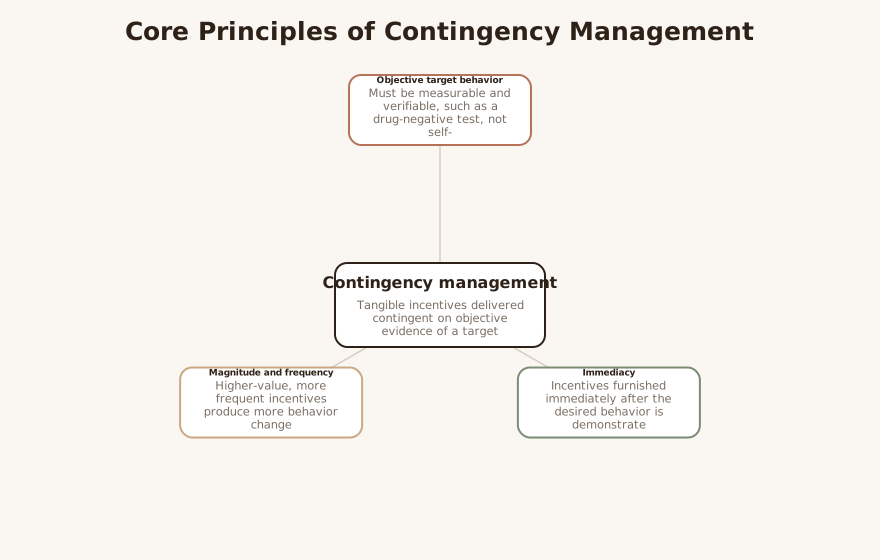
The first principle is that the target behavior must be objective and verifiable. CM reinforces “objective evidence of change in a specific, incentivized behavior,” which in practice means a biochemical result such as a drug-negative urine test, a breath sample, or a documented clinic attendance, not a self-report 2. If a behavior cannot be measured cleanly, it cannot anchor a CM protocol LLM.
The second principle is immediacy. SAMHSA states plainly that “incentives must be furnished to patients immediately after they demonstrate the desired behavior” and that “the immediacy of rewards is central to promoting the behavior of focus” 2. A reward delivered days later loses much of its reinforcing power, which is why CM for abstinence is typically run with rapid point-of-care testing so the result and the reward arrive in the same visit 2.
The third principle is magnitude and frequency. The evidence indicates that “higher-value, more frequent incentives generally lead to more positive behavior changes (such as abstinence) than lower-value, less frequent incentives” 2. Underpowered programs that offer trivial rewards tend to fail, and chronic underfunding of CM is one reason its real-world impact has lagged its research promise 4LLM.
The fourth principle is escalation with reset. Incentives are disbursed “on an escalating schedule, with the incentive gradually increasing every time the behavior of focus is achieved,” and “if a specific behavior is not achieved, the incentive value should ‘reset’ back to the original value, and the escalating schedule begins again” 2. Escalation rewards sustained streaks of the target behavior; the reset creates a real cost to a single lapse, since it returns the client to the lowest reinforcement value 2.
The fifth principle is schedule of reinforcement, which distinguishes the two main models. Voucher CM uses a fixed schedule, paying a set escalating amount for each negative sample; prize-based CM uses a variable, intermittent schedule, in which each demonstration of the behavior earns draws from a “fishbowl” of slips, most of small or no value with a rare “jumbo” prize 2. The intermittent schedule is what allows prize-based CM to achieve comparable outcomes “with the possibility of a smaller average outlay for incentives” 2.
Interventions & Techniques
The two dominant protocols are voucher-based and prize-based CM, and SAMHSA notes that both “have moderate impacts on treatment outcomes,” with “no differences in outcomes noted in head-to-head comparison” of the two methods 2.
In the voucher-based model, the client earns a defined monetary value for each verified target behavior, escalating with consecutive success. In Higgins and Silverman’s University of Vermont cocaine protocol, patients gave urine three times weekly; each point was worth a quarter, the first negative specimen earned 10 points, each consecutive negative specimen gained value, bonuses rewarded longer streaks, and a single cocaine-positive sample reset the voucher value back ten points 2. Accumulated vouchers were exchanged by staff for retail goods the patient chose, since allowing client-selected reinforcers “helps to increase the power of the incentives” 2.
In the prize-based (fishbowl) model, each verified behavior earns draws from a bowl of roughly 500 slips, about half of which have monetary value ranging from one dollar to a single hundred-dollar “jumbo,” with the rest carrying only encouragement such as a “good job” chit and verbal praise from the therapist 2. Draws escalate with consecutive success, slips are replaced after each draw so the jumbo always remains possible, and “experts believe that the presence of a jumbo prize… sustains motivation” 2. Typical maximum per-patient incentive totals in prize-based studies have run between $250 and $450 over twelve weeks, with the VA’s national fishbowl program costing roughly $250 per participant over twelve weeks 2.
A critical design constraint is what behavior to reinforce. Abstinence is the classic target, but it depends on testing that can actually detect recent use; for that reason CM can also reinforce treatment attendance or medication adherence, including adherence to long-acting injectable medications for opioid and alcohol use disorder 2. Attendance-based CM “may be delivered via telemedicine,” provided attendance can be verified and reinforcement delivered immediately and remotely 2.
LLM-generated illustrative example (not a guideline): A clinic running a twelve-week fishbowl protocol for methamphetamine use tests urine each Monday, Wednesday, and Friday with a rapid point-of-care cup. A negative Monday sample earns one draw; a negative Wednesday earns two; a negative Friday earns three. The client pulls slips on the spot, today winning a five-dollar slip and two “good job” chits, and the clinician hands over a gift card immediately. A positive sample the following week resets the draw count to one, and the streak rebuilds from there LLM.
Evidence Base
The maturity of CM’s evidence base is best described as established LLM. It is “widely studied and has been successful in treating a variety of SUDs in diverse populations,” and both the voucher and prize models carry replicated support 2. The HHS Report to Congress synthesizing this literature documents efficacy across stimulants, opioids, alcohol, tobacco, and cannabis, and across both reinforcement models 3. A structured review of CM’s transportability concluded that, despite robust efficacy, moving CM from research settings into routine community care remains an unfinished project facing real implementation barriers 4.
Honesty about magnitude matters. SAMHSA characterizes the two models as having “moderate impacts on treatment outcomes,” not transformative ones, citing the Benishek and Dutra meta-analyses 2. The most important durability finding is that CM shows “demonstrated long-term benefit (a median of 24 weeks after reinforcement ended) beyond other active, evidence-based treatments such as cognitive behavioral therapy, 12-Step facilitation, as well as community-based intensive outpatient treatment” 2. The strongest single indication is stimulant use disorder: CM “is particularly effective in treating people with stimulant use disorders,” and because there are no FDA-approved medications for those disorders, it “is considered a primary and potentially life-saving intervention” for the more than four million Americans who meet criteria 2. CM also produces “significantly better adherence to prevention, diagnosis, and medical interventions for hepatitis, HIV, and tuberculosis” than comparison approaches, underscoring that the technique reinforces health behaviors broadly, not only abstinence 2.
Populations & Indications
CM has been tested and applied across a wide range of populations, but its indications track the principle that the target behavior must be objectively verifiable LLM. People with substance use disorders are the core population, with the clearest indication being stimulant use disorder, where CM is a first-line behavioral intervention 2. People with co-occurring disorders, specifically concurrent stimulant and opioid use, are well served: CM “is equally effective among those with concurrent stimulant and opioid use disorder,” where it may target stimulant use directly or reinforce adherence among those receiving medications for opioid use disorder 2.
Adolescents and justice-involved populations appear across the broader CM literature as groups for whom reinforcement of attendance and abstinence has been studied 3LLM. People with serious mental illness are an established CM population, and the lineage through Ayllon and Azrin’s token economies in psychiatric settings makes the extension natural LLM. Children with developmental disabilities sit within the same applied-behavior-analytic tradition, where contingent reinforcement of target behaviors is a foundational technique, although that work is distinct from the addiction protocols that define CM in substance use treatment LLM. There is also evidence for CM as an adjunct within American Indian and Alaska Native communities, with the explicit expectation that community leaders and clients shape protocols to local cultural norms 2.
Problems-for-Work
CM gives clinicians a precise tool for a defined set of problems, but the honest framing requires distinguishing which behavior is being reinforced for each 2LLM.
- Stimulant use disorder (cocaine, methamphetamine, prescription stimulants) is the flagship indication, where abstinence is reinforced directly with thrice-weekly point-of-care testing, since rapid tests detect stimulant use for two to three days 2.
- Cannabis use disorder can also use abstinence as the target, though SAMHSA cautions that the long detection window of cannabis “potentially complicates the use of abstinence as an incentivized behavior early in the course” of treatment 2.
- Opioid use disorder should not use opioid abstinence as the CM target under current guidance, both because rapid tests do not reliably detect fentanyl or distinguish treatment agonists, and because rising overdose risk during abstinence makes it unsafe; instead CM reinforces attendance and medication adherence, with medication for opioid use disorder remaining the gold standard 2.
- Alcohol use disorder and tobacco use disorder are typically approached through reinforcing attendance or medication adherence rather than abstinence, since the brief detection window of breath alcohol limits abstinence-based protocols 2.
- Medication nonadherence, treatment nonattendance, and behavioral noncompliance are themselves valid CM targets; even “an initial, low magnitude voucher-based intervention is effective in promoting attendance at weekly counseling sessions” in opioid treatment programs 2.
LLM-generated illustrative example (not a guideline): A client on long-acting injectable buprenorphine keeps missing appointments. Rather than reinforcing opioid-negative urines, which would be both technically unreliable and clinically risky, the clinic builds a CM protocol around verified appointment attendance, escalating the incentive for each consecutive kept visit and resetting after a no-show LLM.
Contraindications, Cautions & Cultural Humility
The principal technical contraindications concern the target behavior, not the person. SAMHSA “will only permit abstinence as an incentivized behavior for stimulant use disorders or cannabis use disorders,” and explicitly directs that CM “should not be used to promote abstinence from opioids” given testing limitations and overdose risk during diminishing tolerance 2. A clinician who reinforces a target the available test cannot verify, or who rewards opioid abstinence in a way that raises overdose vulnerability, is misapplying the technique 2.
There are also program-design cautions. People “must not be recruited into the clinical environment specifically for such treatment or with the promise of incentives,” and CM “should not be used to advertise a practice,” a safeguard against improperly steering clients toward services 2. Equity is a stated requirement: every participant in a CM intervention must “have equal opportunity to receive the same incentive amounts,” which prevents arbitrary or biased allocation of rewards 2.
A persistent cultural and philosophical objection is that paying people to stop using drugs amounts to bribery, an attitude documented in roughly half of the treatment community and one of the larger barriers to adoption 4LLM. Clinicians should recognize this as a values stance, not an empirical finding, since the data show the technique works; but they should also hold the objection seriously when designing programs in communities where it resonates LLM. Cultural humility is built into responsible CM: SAMHSA notes that implementation “should allow community leaders and clients the opportunity to design protocols that are consistent with cultural and community norms and values,” and acknowledges that a variety of community methods can reinforce recovery behaviors on their own 2.
Treatment-Plan Suggestions & SMART Objectives
| Goal | SMART objective (example) | Mechanism |
|---|---|---|
| Establish stimulant abstinence | Over 12 weeks, client will submit thrice-weekly point-of-care urine samples and earn escalating incentives for each consecutive stimulant-negative result | Contingent reinforcement of objectively verified abstinence 2 |
| Reinforce the abstinence streak | Within 8 weeks, client will accumulate 4 consecutive weeks of negative samples under an escalating-with-reset schedule | Escalation rewards sustained behavior; reset penalizes lapse 2 |
| Improve treatment attendance | Over 6 weeks, client will attend 2 scheduled sessions per week, with verified attendance earning a fishbowl draw each visit | Reinforcement of an objectively verifiable recovery behavior 2 |
| Support medication adherence | Within 12 weeks, client receiving long-acting injectable medication will earn an incentive for each on-time injection | Contingent reinforcement of adherence rather than abstinence 2 |
| Ensure immediacy of reinforcement | Each session, client will receive the earned incentive at the same visit the negative sample is produced | Immediacy is central to reinforcing the target behavior 2 |
| Use client-selected reinforcers | Within 1 session, client will identify a menu of preferred goods toward which accumulated value can be applied | Client-chosen reinforcers increase incentive power 2 |
| Maintain gains after incentives end | Over the 24 weeks following the protocol, client will sustain target behavior with tapered, then discontinued, incentives | CM shows benefit a median of 24 weeks after reinforcement ends 2 |
| Pair CM with broader treatment | Throughout the protocol, client will engage in concurrent counseling or case management alongside the CM schedule | CM is most effective delivered in conjunction with other treatment 2 |
Common Misconceptions
The most damaging misconception is that CM’s effects vanish the moment the incentives stop. The synthesized evidence shows “demonstrated long-term benefit (a median of 24 weeks after reinforcement ended)” relative to other active treatments, so gains routinely outlast the reward schedule 2. A second misconception is that CM is bribery or a moral compromise; this is a values judgment, common in nearly half the treatment field, that the outcome data simply do not support, since contingent reinforcement of verified behavior is a well-established learning mechanism 4LLM. A third is that bigger guaranteed rewards are always required; the prize-based fishbowl achieves outcomes comparable to vouchers with a smaller average outlay by using intermittent, chance-based reinforcement 2. A fourth is that CM reinforces only abstinence; it is equally a tool for reinforcing attendance and medication adherence, which are often the appropriate targets for opioid, alcohol, and tobacco use disorders 2. A fifth is that CM is a stand-alone cure; it is a technique embedded within broader, comprehensive care, and works best “in conjunction with other treatment approaches” 2. A final misconception is that CM is a transformatively large effect; the honest characterization is “moderate impacts on treatment outcomes,” which is nonetheless clinically meaningful where no medication exists 2.
Training & Certification
There is no single license to “do contingency management”; it is a technique practiced by licensed clinicians and trained program staff within addiction treatment settings LLM. Because “the evidence-based manner in which CM is delivered is central to outcomes,” SAMHSA stresses that “training and ongoing supervision” are important, and recommends that staff receive protected time for training, coaching, and continuing education, including regular review and feedback on implementation with a trained colleague 2. Successful implementation is described as depending on two forces, leadership support and clinic-level “idea champions” who carry the protocol forward 2.
Concrete training resources named by SAMHSA include the Addiction Technology Transfer Center Network’s online course “Contingency Management for Healthcare Settings,” the Motivational Incentives Suite of implementation tools, NIDA’s research-based guidance on motivational incentives, UCLA’s Recovery Incentives Program materials, and Yale’s Psychotherapy Development Center resources on using motivational incentives 2. The transportability literature underscores why this training emphasis matters: fidelity to the model’s parameters, magnitude, immediacy, schedule, and reset, is exactly what tends to erode when CM is moved into under-resourced community settings 4LLM.
Key Terms
- Contingency management (CM): a health care intervention in which tangible reinforcers are given “contingent on objective evidence of change in a specific, incentivized behavior” 2.
- Voucher-based CM: a fixed-schedule model offering a set, escalating monetary value for each verified target behavior, exchanged for client-selected goods 2.
- Prize-based (fishbowl) CM: a variable-schedule model in which each verified behavior earns draws from a bowl of slips, most of small or no value with a rare jumbo prize 2.
- Escalation: the practice of “gradually increasing” the incentive with each consecutive demonstration of the target behavior 2.
- Reset: returning the incentive value “back to the original value” when the target behavior is not achieved, so the escalating schedule restarts 2.
- Immediacy: the requirement that incentives be “furnished to patients immediately after they demonstrate the desired behavior” 2.
- Incentivized (target) behavior: the specific, objectively verifiable behavior reinforced, such as a drug-negative sample, attendance, or medication adherence 2.
- Magnitude: the value of the incentive, where “higher-value, more frequent incentives” generally produce better outcomes 2.
- Point-of-care (POC) testing: rapid, CLIA-waived testing used in-session so abstinence can be verified and reinforced immediately 2.
- Token economy: the antecedent inpatient reinforcement system, associated with Ayllon and Azrin, from which CM descends LLM.
Resources & Further Reading
- Contingency Management for Substance Use Disorder — APA Society of Clinical Psychology (Division 12)
- SAMHSA Advisory: Using SAMHSA Funds to Implement Evidence-Based Contingency Management Services (PDF)
- Contingency Management for the Treatment of Substance Use Disorders: Enhancing Access, Quality, and Program Integrity (HHS Report to Congress) — NCBI Bookshelf
- Contingency management in substance abuse treatment: a structured review of the evidence for its transportability — PMC
- What Is Contingency Management in Addiction Treatment? — Oxford Treatment Center
- Contingency Management — Addiction Policy Forum (video explainer)
Reflective / Supervision Questions
- For this client, is the behavior I want to reinforce truly objective and verifiable with the testing I have, or am I reaching for a target (such as opioid abstinence) the technology cannot reliably confirm? 2
- Are my incentives large enough and frequent enough to actually shift behavior, or am I running an underpowered protocol that will fail and then be blamed on the client? 2
- Am I delivering the reward immediately, in the same visit as the verified behavior, or has logistics introduced a delay that quietly drains the reinforcement of its power? 2
- When I notice my own discomfort with “paying people to stop using,” am I treating that as clinical evidence, or recognizing it as a values stance the outcome data do not support? 4LLM
- Have I designed the protocol so every participant has equal opportunity to receive the same incentive amounts, and so no one is being steered into services by the promise of rewards? 2
- How have I involved the client and, where relevant, their community in shaping a protocol that fits their cultural norms, rather than imposing a generic schedule? 2