
Type & Discipline
Applied Behavior Analysis (ABA) is a modality within behavioral psychology that uses the principles of operant conditioning to change socially significant behavior 4. It is best understood not as a single, manualized therapy but as a set of intervention practices grounded in the science of learning 1. ABA sits in the operant / behavior-analysis family alongside its experimental parent (the experimental analysis of behavior) and is conceptually adjacent to cognitive-behavioral therapy, which shares the behavioral lineage but adds explicit cognitive mediation 4. For practicing therapists, the most useful framing is that ABA is a measurement-driven, function-based approach: behavior is treated as observable, quantifiable, and lawfully related to its environmental antecedents and consequences 4.
The field formalized itself through Baer, Wolf, and Risley’s 1968 definition of seven dimensions that distinguish ABA from behaviorism in general: it must be Applied (targeting socially significant behavior), Behavioral (observable and measurable), Analytic (demonstrating functional control), Technological (procedures described clearly enough to replicate), Conceptually Systematic (tied to established principles), Effective (producing meaningful change), and capable of Generality (skills transferring across settings, people, and time) 4. These dimensions remain the discipline’s working definition and its quality-control checklist 4.
Creators & Lineage
ABA’s intellectual roots run through behaviorism. John B. Watson established behaviorism in 1913, and B. F. Skinner subsequently developed radical behaviorism and the operant conditioning framework on which the modality rests 4. Skinner’s central insight, that behavior is controlled by its consequences, is the engine of the entire approach 4. The first study employing what would become ABA’s dimensions was Ayllon and Michael’s 1959 work in psychiatric nursing, and the discipline was institutionalized when Donald Baer, Sidney Bijou, Todd Risley, Montrose Wolf, and colleagues at the University of Kansas founded the Journal of Applied Behavior Analysis in 1968 4.
Ivar Lovaas (active from 1960 to 1997) pioneered the application of behavioral principles to autism and is the figure most associated with intensive early intervention 4. His 1987 study famously reported that 47% of participants achieved “normal” functioning, a claim that shaped both the field’s ambitions and the case for intensive programming 4. Lovaas’s early work also employed aversive procedures, including electric shock, and this history is central to contemporary ethical debate: in 2022 the Association for Behavior Analysis International condemned the use of electric-shock aversives 4. The lineage thus carries both a robust technology of learning and a contested ethical inheritance that clinicians should know explicitly 4.
The canonical training text is Cooper, Heron, and Heward’s Applied Behavior Analysis, now in its third edition 2. A review of the second edition described it as a watershed text for the field, expanded to 1,538 references and explicitly aligned with the Behavior Analyst Certification Board (BACB) task list, making it the de facto foundational resource for credentialing 3.
Core Principles
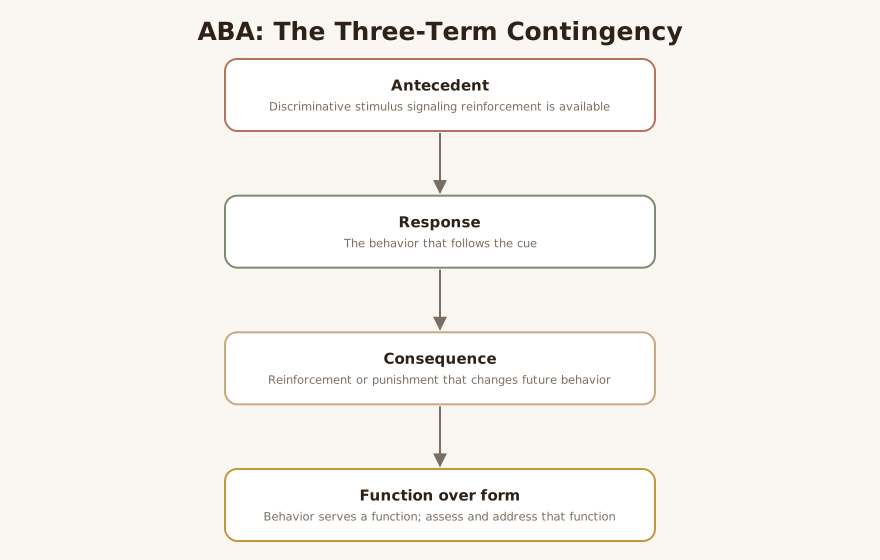
The conceptual core is the three-term contingency: a discriminative stimulus (the antecedent cue signaling that reinforcement is available), the response (the behavior), and the consequence 4. Reinforcement is any consequence that makes a behavior more likely to recur; it can be positive (adding a preferred stimulus) or negative (removing an aversive one) 4. Punishment decreases behavior frequency through aversive presentation, response cost, or restriction, and modern ethics codes now severely restrict its use 4. Extinction is the withholding of reinforcement that previously maintained a behavior, leading to its decline 4.
A second pillar is function over form: behavior analysts assume that even maladaptive behavior serves a function (escape, attention, access to tangibles, or automatic/sensory reinforcement) and that intervention should address that function rather than the topography alone 4. This is why functional behavior assessment, identifying the environmental variables and reinforcement contingencies that maintain a target behavior, is foundational rather than optional 4. A teaching plan that ignores function risks reinforcing the very behavior it intends to reduce LLM.
The third pillar is measurement. Because behavior is defined as observable and measurable, progress is tracked continuously through direct data collection rather than retrospective impression, and decisions are revised against that data 4. Generality is treated as an active design goal, not an afterthought: skills are deliberately programmed to transfer across people, places, and materials 4.
Interventions & Techniques
Discrete Trial Training (DTT) is structured, often table-based teaching with a clear antecedent-behavior-consequence sequence and massed learning opportunities; it is the technique most associated with Lovaas-model intensive programming 4. Naturalistic and Pivotal Response approaches invert this structure, embedding learning in child-initiated play and targeting motivational “pivotal” skills that promote broader development 4.
Shaping reinforces successive approximations toward a target behavior, for example reinforcing a “bu” sound before requiring the full word 4. Prompting and fading provide verbal, model, or physical cues that are systematically reduced as competence grows, and task analysis breaks a multi-step skill into teachable components 4. Reinforcement scheduling, including thinning the schedule so more responses are required per reinforcer, supports durability and approximates natural contingencies 4. Functional behavior assessment precedes and informs the selection of these procedures 4.
LLM-generated illustrative example (not a guideline): A clinician working with a nonspeaking child who hits when a tablet is removed runs a functional assessment, finds the hitting is maintained by access to the tablet, and replaces it by teaching a picture-exchange request through prompting and fading, reinforcing the request on a dense schedule before thinning it. The maladaptive behavior is not punished; a functionally equivalent skill is built LLM.
Evidence Base
The evidence base for ABA is best labeled established but contested on methodology. A National Academies review conducted for the Comprehensive Autism Care Demonstration concluded that ABA meets the standard for reliable evidence of efficacy, citing a substantial body of literature supported by multiple meta-analyses showing strong evidence of efficacy and effectiveness 1. For comprehensive ABA programs, effect sizes were moderate to large for cognitive ability/IQ (standardized mean differences of .50 to above .80) and moderate to large for adaptive behavior (.20 to .80), described as clinically meaningful 1.
Honesty about limits matters. Effects on communication, expressive and receptive language, and daily-living skills were more modest, and effects on social skills and autism characteristics were not considered clinically significant 1. The review noted small sample sizes, lack of randomization in some trials, and single-blind design limitations, while observing these issues are not unique to ABA 1. A representative replication study at a Michigan center tracked 98 autistic clients and found statistically significant gains in mastered target behaviors over one month (mean rising from 5.3 to 11.3, p < 0.001), but the authors acknowledged convenience sampling, no control group, an inability to separate the contributions of the bundled components, and a brief timeframe 5. Clinicians should also weigh the wider critique that much published ABA research carries undisclosed conflicts of interest and that methodological rigor remains a pressing concern 4. The fair summary: real, measurable skill and adaptive gains, with weaker evidence for changing core social/autistic features and legitimate questions about study quality 14.
Populations & Indications
ABA’s largest and best-studied indication is autism spectrum disorder, particularly early comprehensive intervention for children 1. It is widely applied with people who have intellectual and developmental disabilities, children with behavioral disorders, and individuals presenting self-injurious behavior, where functional assessment and replacement-behavior teaching are central 4. It has also been used with people who have severe mental illness, reflecting its origins in psychiatric settings 4.
By presenting problem, the modality is applied to autism, intellectual disability, self-injurious behavior, disruptive behavior disorders, skill deficits and adaptive-functioning needs, attention-deficit/hyperactivity disorder, general problem-behavior reduction, communication deficits, and phobias (the latter through respondent and exposure-based behavioral procedures) 4. A standing caution from within the field is that the published literature disproportionately concerns developmental disabilities and severe behavior, the “tail” of the population, so the evidence is thinner for everyday behavioral concerns in typical populations 3.
Problems-for-Work
- Communication deficits. A nonspeaking or minimally verbal learner can be taught functional requesting (manding) through prompting, shaping, and dense reinforcement 4.
- Self-injurious and problem behavior. Functional behavior assessment identifies the maintaining contingency, and a functionally equivalent replacement behavior is reinforced while the problem behavior is placed on extinction 4.
- Skill / adaptive-functioning deficits. Task analysis breaks daily-living routines (dressing, toileting, hygiene) into chained steps taught with fading prompts 4.
- Disruptive behavior disorders. Antecedent modification plus differential reinforcement of alternative behavior reduces classroom or home escalation 4.
LLM-generated illustrative example (not a guideline): For a child whose tantrums function to escape demands, a clinician might reduce task difficulty initially, teach a tolerable break request, and reinforce compliance, then gradually re-introduce demands as the break request stabilizes LLM.
Contraindications, Cautions & Cultural Humility
The most significant cautions are ethical and historical rather than medical. ABA’s heritage includes aversive procedures, including electric shock in Lovaas’s early autism work, and although ABA International condemned shock aversives in 2022, the broader debate over aversives and restrictive procedures remains live 4. Practitioners must work within current ethics codes that severely restrict punishment and prioritize the least restrictive, function-based intervention 4.
Cultural humility here means taking the neurodiversity critique seriously. Autistic self-advocates argue that ABA can aim to suppress or eliminate autistic behaviors and can promote masking of authentic traits, and the Autistic Self Advocacy Network campaigns against ABA as autism therapy 4. A 2023 study linked ABA to increased masking and mental-health challenges, and some researchers argue ABA can increase PTSD-type symptoms 4. Critics also note that ABA’s ethics framework has been faulted for prioritizing parental over individual consent 4. Clinically, this argues for goals that build the client’s own quality of life and self-determination rather than enforcing neurotypical appearance, for genuine assent from the learner, and for retiring compliance-for-its-own-sake targets LLM. The field’s evidence likewise shows ABA is weaker at altering core autism characteristics, which should temper any claim that it makes autism “go away” 1.
Treatment-Plan Suggestions & SMART Objectives
| Goal | SMART objective (example) | Mechanism |
|---|---|---|
| Functional communication | Within 8 weeks, learner will independently request a preferred item using a picture/AAC exchange in 80% of opportunities across 3 sessions | Manding taught via prompting + fading, dense reinforcement 4 |
| Reduce self-injury | Within 12 weeks, reduce rate of head-hitting by 50% from baseline while a replacement request is reinforced | FBA-driven differential reinforcement + extinction of the maintaining contingency 4 |
| Adaptive daily-living skill | Within 6 weeks, complete a 5-step handwashing chain with no more than 1 prompt across 4 consecutive sessions | Task analysis + chaining with prompt fading 4 |
| Increase on-task tolerance | Within 10 weeks, sustain a demand task for 5 minutes before requesting a break in 75% of trials | Antecedent modification + differential reinforcement of alternative behavior 4 |
| Generalize a learned skill | Within 4 weeks of mastery, demonstrate target skill with 2 new people and 1 new setting at criterion | Programmed generality across people/places/materials 4 |
| Expand expressive language | Within 12 weeks, increase mastered receptive/expressive targets per session from baseline (data-tracked) | Massed/naturalistic trials with continuous measurement 5 |
| Build social initiation | Within 12 weeks, initiate a peer interaction 3 times per play session in 70% of sessions | Naturalistic/pivotal-response reinforcement of child-initiated behavior 4 |
Common Misconceptions
- “ABA is one fixed treatment.” It is a family of practices grounded in learning science, and dosage and procedures should be individualized, not uniform 1.
- “More hours are always better.” The National Academies review explicitly rejected a single dosage rule, noting 10–20 hours per week can produce positive outcomes for many learners, with higher intensity reserved for profound support needs based on individual assessment 1.
- “ABA cures autism.” The evidence shows meaningful gains in cognition and adaptive behavior but not clinically significant change in core autism characteristics 1.
- “ABA equals punishment / electric shock.” Modern codes severely restrict punishment, and the field’s leading body condemned shock aversives; contemporary practice emphasizes reinforcement and function-based teaching 4.
- “The research is settled and clean.” Methodological rigor and conflict-of-interest concerns remain genuine limitations clinicians should disclose 4.
Training & Certification
The leading credential is the Board Certified Behavior Analyst (BCBA), administered by the Behavior Analyst Certification Board (BACB) 6. Requirements include a graduate degree (master’s or higher), completion of verified ABA coursework (the UCSB pathway lists 315 coursework hours within a 10-year window), accrual of supervised fieldwork (commonly cited as 2,000 hours), and passing the BACB examination 6. Related credentials in the tiered system include the Board Certified Assistant Behavior Analyst (BCaBA) and the Registered Behavior Technician (RBT) who delivers direct services under supervision 46. The Cooper, Heron, and Heward textbook is explicitly aligned with the BACB task list and is the standard preparation resource, though mastering it does not by itself guarantee exam success 3. Non-behavior-analyst clinicians who want to use behavioral methods responsibly should pursue training within their own scope rather than presenting themselves as behavior analysts LLM.
Key Terms
- Three-term contingency — antecedent (discriminative stimulus) → behavior → consequence, the basic unit of analysis 4.
- Discriminative stimulus — an environmental cue signaling that reinforcement is available 4.
- Reinforcement / punishment — consequences that increase or decrease future behavior frequency, respectively 4.
- Extinction — withholding the reinforcement that previously maintained a behavior 4.
- Functional behavior assessment — identifying the environmental variables and contingencies maintaining a behavior 4.
- Shaping — reinforcing successive approximations toward a target 4.
- Prompting & fading — providing then systematically reducing cues 4.
- Task analysis — breaking a multi-step skill into teachable components 4.
- Generalization — transfer of skills across people, places, and materials beyond training 4.
- Seven dimensions — Applied, Behavioral, Analytic, Technological, Conceptually Systematic, Effective, Generality 4.
Resources & Further Reading
▶ Watch — a video introduction to this concept:
- Evidence Base for Applied Behavior Analysis — National Academies review (NCBI Bookshelf) 1
- Applied Behavior Analysis, 3rd ed. — Cooper, Heron & Heward 2
- Review of Cooper, Heron, and Heward’s Applied Behavior Analysis (PMC) 3
- Applied Behavior Analysis (Wikipedia) 4
- Impact of ABA on Autistic Children’s Target Behaviors (PMC) 5
- BCBA Certificate Overview — UC Santa Barbara PaCE 6
Reflective / Supervision Questions
- For a given target, have I conducted or reviewed a functional behavior assessment before selecting a procedure, or am I treating topography in isolation? 4
- Are my goals oriented toward the client’s quality of life and self-determination, or toward making the client appear neurotypical, and have I sought the learner’s assent? 4
- How am I weighing the neurodiversity critique and the masking/mental-health findings against the documented adaptive and cognitive gains in my treatment rationale? 14
- Is the intensity of services I am recommending individualized to this client’s needs, rather than driven by a default hour count? 1
- When I describe outcomes to families, am I honest that ABA shows weaker effects on core social and autistic characteristics? 1
- Am I operating within my own credentialed scope, and do I need to coordinate with a BCBA for full behavior-analytic programming? 6