
Preparedness is the theory that evolution has tilted the learning machinery of organisms so that some associations are acquired with extraordinary ease while others are acquired only with difficulty or not at all 5. It is the formal answer to a question behaviorism could not handle: why do humans so readily develop fears of snakes, spiders, and heights—ancestral dangers—yet rarely develop equivalent fears of electrical outlets, cars, or hammers, which injure far more people today 4. For the practicing clinician the value of preparedness is not as a treatment but as an explanatory lens: it reframes a client’s “irrational” phobia as the predictable output of an evolved learning bias, and it sets reasonable expectations about which fears acquire fast, generalize widely, and resist extinction LLM.
Type & Discipline
Preparedness is a theory within evolutionary behavioral psychology, sitting at the intersection of classical conditioning and evolutionary learning 5. It is not a diagnosis, a modality, or a protocol; it is an account of the constraints on associative learning—a description of how the conditioning system is biased rather than a technique to be delivered LLM. Its core claim directly contradicts the principle of equipotentiality that dominated early behaviorism, the assumption that any neutral stimulus could be conditioned to any response with roughly equal facility 7.
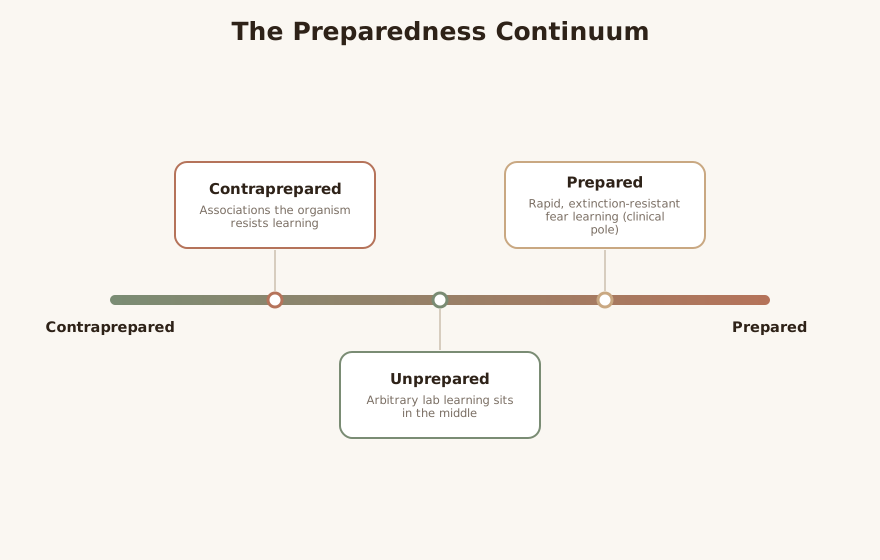
The theory belongs to the broader literature on biological constraints on learning, which documents that the laws of conditioning are not uniform across stimuli, responses, and species but are shaped by each organism’s evolutionary history 6. Within this family, preparedness is the dimensional version of the idea: Seligman arranged learnable associations along a continuum from prepared (acquired rapidly, often in a single trial, resistant to extinction) through unprepared (the standard laboratory case requiring many pairings) to contraprepared (extremely difficult to establish even with repeated pairings) 5. Because it is a construct rather than an intervention, its clinical utility lies in shaping case formulation and in setting expectations for exposure work, not in being “applied” to a client directly LLM.
Creators & Lineage
The empirical foundation came from John Garcia, whose taste-aversion research in the 1960s produced findings so heterodox that they were initially rejected by mainstream journals 7. Garcia showed that rats readily learned to avoid a novel taste paired with later nausea—even when the illness followed the taste by hours—but did not learn to associate that same taste with footshock, nor to associate audiovisual cues with illness 4. This selectivity, the Garcia effect or conditioned taste aversion, violated two cherished assumptions at once: that contiguity in time was necessary for conditioning, and that any stimulus could be linked to any consequence 7. The phenomenon migrated, in Gradowski’s phrase, “from fringe to mainstream,” becoming one of the most replicated effects in the conditioning literature 7.
Martin Seligman generalized Garcia’s insight to human clinical fears in his 1971 paper “Phobias and Preparedness,” arguing that the non-arbitrary, evolutionarily relevant content of common phobias was exactly what a preparedness account predicted 1. Seligman proposed that prepared phobic associations should be easily acquired, often after a single experience, irrational in the sense of being resistant to cognitive correction, and notably resistant to extinction 2. Arne Öhman extended this into an experimental program, reporting that conditioned skin-conductance responses to fear-relevant pictures (snakes, spiders) extinguished more slowly than responses to fear-irrelevant pictures (flowers, mushrooms) 4. Richard McNally later authored a measured retrospective on the theory’s legacy, cataloguing both its enduring influence and the experimental challenges it has accumulated 3.
Core Principles
The first principle is the rejection of equipotentiality: organisms are predisposed to form certain stimulus–response–outcome associations far more readily than others, and the pattern of these predispositions tracks ancestral selection pressures rather than the contingencies of modern life 5. A taste-illness link was adaptive for a foraging ancestor who needed to avoid poisons after a single bad meal; a snake-fear link was adaptive in environments where venomous reptiles were a recurring threat 4.
The second principle is the continuum of preparedness, with prepared associations at one pole and contraprepared at the other, and the bulk of arbitrary laboratory learning sitting in the unprepared middle 5. The clinical interest lives at the prepared pole, where Seligman predicted four signature features: rapid (often one-trial) acquisition, ease of acquisition relative to the threat’s actual modern danger, a degree of cognitive impenetrability, and resistance to extinction 2.
The third principle is selectivity: preparedness is not a global readiness to fear everything but a tuned bias toward specific, recurrent, fitness-relevant categories of stimulus 7. Garcia’s rats did not become fearful in general; they became aversive to taste specifically, because taste was the evolutionarily appropriate cue for internal illness 4. This selectivity is what distinguishes a biological-constraints account from a generic “stress makes you learn faster” claim LLM.
Interventions & Techniques
Preparedness is not a treatment, but it carries implications for how clinicians design and pace existing interventions, and it offers a powerful psychoeducational frame LLM.
Normalizing psychoeducation. Telling a snake-phobic client that their fear is not a personal defect but the output of an evolved, species-wide learning bias can reduce shame and self-pathologizing LLM. The frame says the fear is understandable given human evolutionary history, even when it is not useful in the client’s actual environment 4.
Informing exposure design—cautiously. The intuitive clinical inference is that because prepared fears were said to resist extinction, exposure for snake or spider phobia should be more graded, more prolonged, or more intensive LLM. This is a reasonable working hypothesis, but it must be held as exactly that: the claim that prepared fears are uniquely extinction-resistant is one of the theory’s most contested predictions, and the contemporary evidence is mixed (see Evidence Base) 3. Clinically, preparedness is better used to anticipate that certain phobias may generalize broadly and feel disproportionate, not to justify a fixed prescription of “more exposure” LLM.
Accounting for non-associative acquisition. Preparedness predicts that some phobias may arise without any direct conditioning event—a client who has never been bitten can still develop an intense, “ready-made” snake fear 1. This frees the clinician from hunting for a missing traumatic origin and validates fears that have no identifiable learning history LLM.
Attending to disgust and taste-aversion analogues. The Garcia effect explains conditioned aversions seen in practice—most concretely the chemotherapy patient who develops lasting disgust toward a food eaten before nausea-inducing treatment 4. Recognizing the mechanism lets clinicians coach pre-emptive strategies (e.g., a “scapegoat” novel flavor) and normalize the aversion as a hardwired, non-volitional response LLM.
Evidence Base
The maturity of this area is best described as established but internally split, and honesty requires holding the two halves apart 3.
The core biological-constraints phenomenon is robust. Conditioned taste aversion—the Garcia effect—is one of the best-replicated findings in experimental psychology, and the general principle that conditioning is constrained by evolved predispositions is now textbook consensus rather than fringe claim 7. The broader literature on biological constraints documents reliable selectivity in what different species learn easily, establishing beyond serious dispute that equipotentiality is false 6.
The preparedness-of-phobias theory specifically has fared less well. McNally’s retrospective concludes that experimental support for Seligman’s signature predictions in humans is mixed 3. The most cited prediction—that prepared fears resist extinction—has been directly challenged: reviews of the laboratory work find that fears conditioned to fear-relevant stimuli are frequently deconditioned, with one tally noting that a large majority of the relevant spider-fear experiments successfully extinguished the conditioned response 4. Öhman’s slower-extinction findings, foundational to the experimental case, were weakened by subsequent work and by alternative explanations such as Gray’s proposal that selective sensitization rather than evolved preparedness produced the results 4.
The cautious clinical reading is therefore stratified: the content observation that phobias cluster non-randomly around ancestral threats is real and well-described, the mechanism claim that this reflects an evolved associative bias remains plausible and influential, and the specific therapeutic prediction that prepared fears are uniquely treatment-resistant is the weakest link and should not be treated as settled fact 3. Competing accounts emphasizing cognitive expectancy, prior knowledge, and culturally transmitted information can account for much of the same clustering without invoking inherited associations 5.
Populations & Indications
Preparedness is most directly relevant to adults presenting with specific phobias, particularly the animal subtype—snake and spider phobia—and the natural-environment subtype, such as height phobia, because these are the textbook examples of prepared fears 4. It is a useful conceptual frame across anxiety disorders more broadly, where the question of why certain feared stimuli acquire such rapid, generalized salience recurs 5.
Clients with conditioned aversions are a distinct indication: the taste-aversion paradigm speaks directly to people who have developed food, smell, or situational aversions, especially in oncology and other illness contexts 4. Trauma survivors and people with PTSD are a more tentative application—the theory invites the hypothesis that threat-relevant cues may condition with particular ease—but the clinician should treat this as a heuristic, not an established mechanism, given the contested evidence on prepared learning in humans 3.
Problems-for-Work
Specific phobias and snake/spider phobia. Preparedness reframes these as predictable, non-pathological outputs of an evolved bias, reducing client shame and guiding the clinician to expect broad generalization and possibly stubborn fear, while keeping exposure as the evidence-based treatment 4.
Height phobia. As a natural-environment prepared fear, height phobia fits the model of a fear that may arise without a discrete conditioning event, which can validate clients who cannot identify an originating fall or fright 1.
Taste aversions and disgust-based avoidance. The Garcia effect provides a clean mechanistic story for conditioned food and odor aversions, including the disgust-driven avoidance that maintains some restrictive eating and contamination concerns 4.
Conditioned fear responses, anxiety disorders, and PTSD. Here preparedness functions as a formulation aid—why did this cue acquire such power so fast?—while the clinician stays anchored to exposure-based and trauma-focused treatments rather than to any preparedness-specific technique 3.
LLM-generated illustrative example (not a guideline): A 34-year-old client reports a lifelong, intense snake phobia despite never having encountered a snake outside a zoo. Rather than searching for a “missing trauma,” the clinician explains preparedness—that humans appear primed to acquire snake fear readily, so a vivid fear can exist with no conditioning event at all. This normalizes the presentation, lowers the client’s self-criticism (“there’s nothing wrong with me for fearing something I’ve never been hurt by”), and frames graded in-vivo and imaginal exposure as the route forward, with the clinician privately holding the question of extinction pace as an empirical one to monitor rather than a foregone “this will be unusually hard” LLM.
Contraindications, Cautions & Cultural Humility
The central caution is epistemic: preparedness is an influential theory with a contested evidence base, and it must not be presented to clients as established fact, especially the prediction that prepared fears are uniquely resistant to treatment 3. Telling an anxious client that their fear is “hardwired and hard to extinguish” risks instilling therapeutic pessimism that the data do not support and that could undermine engagement with exposure LLM.
A second caution is against using evolutionary explanation as a conversation-stopper. “It’s evolutionary” can sound like “it’s fixed,” when in fact specific phobias are among the most treatable conditions in the field; the frame should reduce shame, not reduce hope LLM. The theory explains ease of acquisition, not impossibility of change 5.
Culturally, the claim that some fears are universal, evolved, and content-specific should be held alongside strong evidence that prior knowledge and culturally transmitted information shape what people come to fear 5. What counts as a salient threat, how fear is expressed, and which animals or situations carry danger or symbolic meaning vary across communities, so clinicians should not assume the Western laboratory’s snake-and-spider canon maps onto every client’s world LLM. Treating preparedness as a flexible heuristic—one input among cognitive, social, and cultural factors—rather than a deterministic law keeps the formulation humble and individualized LLM.
Treatment-Plan Suggestions & SMART Objectives
| Goal | SMART objective (example) | Mechanism |
|---|---|---|
| Reduce shame around a “prepared” phobia | Within 2 sessions, the client will articulate in their own words why their fear is an understandable evolved response rather than a personal defect | Normalizing psychoeducation reframes the fear’s origin 4 |
| Build an exposure hierarchy for snake/spider phobia | By session 4, the client will co-construct a 10-step graded in-vivo and imaginal exposure hierarchy and complete the first two steps | Exposure remains first-line; preparedness informs pacing expectations 1 |
| Reduce avoidance driven by height phobia | Over 6 weeks, the client will complete 4 graded height-exposure tasks and log anxiety ratings before and after each | Behavioral testing of the fear regardless of its evolved origin 5 |
| Address a chemotherapy-related taste aversion | Before the next infusion, the client will trial a novel “scapegoat” flavor and report whether the aversion attached to it instead of a preferred food | Applies the Garcia-effect mechanism to protect valued foods 4 |
| Distinguish present fear from inherited bias | Within 4 weeks, the client will identify, in writing, 3 situations where the fear’s intensity exceeds the actual modern danger | Separates evolved salience from realistic risk appraisal 4 |
| Counter therapeutic pessimism about a phobia | By session 3, the client will state the realistic, evidence-based prognosis for specific phobia treatment | Corrects the “hardwired = unchangeable” misconception 3 |
| Monitor extinction progress empirically | Across exposure sessions, the client and clinician will track whether fear ratings decline as expected rather than assuming unusual resistance | Treats extinction pace as an open question, not a fixed prediction 3 |
Common Misconceptions
“Preparedness means the fear is hardwired and can’t be unlearned.” No—the theory concerns the ease of acquisition, and even Seligman’s contested prediction of extinction-resistance is weakly supported; specific phobias are highly treatable 3.
“Garcia’s taste aversion and Seligman’s phobia theory are equally well established.” They are not; the taste-aversion phenomenon is robust and replicated, while the human preparedness-of-phobias theory has mixed experimental support 7.
“Conditioning works the same way for any stimulus.” This is precisely the equipotentiality assumption that preparedness overturned—organisms learn some pairings far more readily than others 7.
“A phobia must have a conditioning event behind it.” Preparedness predicts that some fears arise non-associatively, with no discrete learning experience to find 1.
“If it’s evolutionary, it’s beyond culture.” Evidence indicates that prior knowledge and culturally transmitted information shape fear acquisition, so the evolved bias is one input among many, not a deterministic override 5.
Training & Certification
There is no certification in preparedness; it is a research theory, not a credentialed therapy LLM. Competence consists of understanding the construct well enough to use it accurately in formulation and psychoeducation, and—critically—of representing its evidence honestly rather than overstating the phobia-specific claims LLM. Clinicians can ground themselves in Seligman’s original 1971 paper for the theory’s logic and predictions, in McNally’s retrospective for a balanced account of what has and has not held up, and in the Garcia-effect literature for the robust experimental core 137. The applied skills that actually treat the relevant problems—graded exposure, interoceptive and in-vivo techniques, and behavioral experiments—are trained within standard cognitive-behavioral and exposure-therapy pathways, with preparedness serving as conceptual background rather than a separately credentialed competency LLM.
Key Terms
- Preparedness — an evolved bias making some stimulus–outcome associations far easier to learn than others 5.
- Equipotentiality — the (now-rejected) behaviorist assumption that any stimulus can be conditioned to any response with equal ease 7.
- Garcia effect / conditioned taste aversion — rapid, often single-trial learning of an aversion to a taste paired with later illness, even across long delays 4.
- Prepared association — one acquired rapidly, easily, and (per the theory) resistant to extinction, typically involving ancestral threats 2.
- Contraprepared association — one extremely difficult to establish even with repeated pairings 5.
- Biological constraints on learning — the broader principle that conditioning is shaped and limited by each organism’s evolutionary history 6.
- Fear-relevant stimuli — evolutionarily salient cues (snakes, spiders, heights) hypothesized to condition fear especially readily 4.
- Non-associative fear acquisition — the emergence of a phobia without any direct conditioning event 1.
Resources & Further Reading
▶ Watch — a video introduction to this concept:
- Seligman, M. E. P. (1971). Phobias and Preparedness. Behavior Therapy, 2(3), 307-320.
- Seligman (1971), “Phobias and Preparedness” — republished article (PubMed record)
- McNally, R. J. (2016). The Legacy of Seligman’s “Phobias and Preparedness” (1971) (PubMed record)
- Biological Preparedness Theory in Psychology — Simply Psychology
- Preparedness (learning) — Wikipedia
- Biological Constraints — overview (ScienceDirect Topics)
- Gradowski, L. — From Fringe to Mainstream: The Garcia Effect (PhilArchive)
Reflective / Supervision Questions
- When I use an evolutionary frame to normalize a client’s phobia, am I careful to separate “easy to acquire” from “hard to treat,” so I reduce shame without instilling pessimism? LLM
- Do I represent the evidence honestly—distinguishing the robust Garcia effect from the contested human preparedness-of-phobias claims—when I teach a client about their fear? 3
- Where in my caseload am I assuming a phobia “must” have a conditioning event, and is that assumption sending me on an unproductive search for a missing trauma? 1
- How might a client’s cultural background shape which stimuli are fear-relevant for them, and am I imposing the laboratory’s snake-and-spider canon onto a different world? 5
- When exposure progresses slowly, do I attribute it to “prepared, extinction-resistant fear” prematurely—and what alternative, modifiable factors am I overlooking? 3
- Am I treating preparedness as one heuristic input to formulation, or have I let an evolutionary story harden into a deterministic explanation? LLM