
Type & Discipline
A token economy is a behavioral technique rather than a freestanding therapy: it is a structured contingency-management system in which specified target behaviors earn tokens that are later exchanged for backup reinforcers 4. It belongs to applied behavior analysis and rests squarely on the operant-conditioning tradition, where behavior is understood to be controlled by its consequences 2. Conceptually it is one member of a broader family of contingency-management and behavior-modification procedures, and in everyday clinical use it is best thought of as a delivery system for reinforcement rather than as a stand-alone treatment 5.
The defining feature is the token itself. A token is an object of no intrinsic value whose function is established entirely through its relation to other reinforcers; when a token is paired with several different terminal rewards it becomes a generalized conditioned reinforcer 2. This is the same logic that makes money work, and the analogy is deliberate: a token system creates a small, controlled economy in which behavior is the labor and backup reinforcers are the goods 2. For the practicing clinician, the most useful framing is that a token economy bridges the gap between a behavior and a delayed reward, allowing immediate reinforcement of a target response even when the meaningful reward must wait 2.
Creators & Lineage
The intellectual parent is B. F. Skinner’s analysis of operant conditioning and his concept of the generalized conditioned reinforcer, which supplies the theoretical account of why a valueless token can come to control behavior 2. Laboratory precursors reach back further still: Wolfe (1936) and Cowles (1937) demonstrated with chimpanzees at the Yerkes Laboratories that poker-chip tokens could establish and maintain behavior in a manner comparable to food, if somewhat less powerfully 2.
The applied technique as we know it was created by Teodoro Ayllon and Nathan Azrin, who established the first system explicitly called a token economy at Anna State Hospital in Illinois in the early 1960s 4. Their work with long-stay psychiatric patients is widely regarded as among the most successful behaviorally based applications in the history of psychology, and it converted Skinner’s laboratory principles into a ward-level intervention 2. The approach peaked in the 1970s, buoyed by a landmark 1977 randomized controlled trial reporting superiority over standard psychiatric care, and then declined from the 1980s onward as healthcare policy shifted toward shorter hospital stays and community-based care 4. The lineage thus runs from Skinner’s operant theory, through Ayllon and Azrin’s institutional application, into contemporary contingency-management and behavior-modification practice across classrooms, developmental-disability services, and substance-use treatment 4. More recent translational work, notably Timothy Hackenberg’s reviews, has reconnected the applied technique to its experimental roots and to behavioral-economic analysis 26.
Core Principles
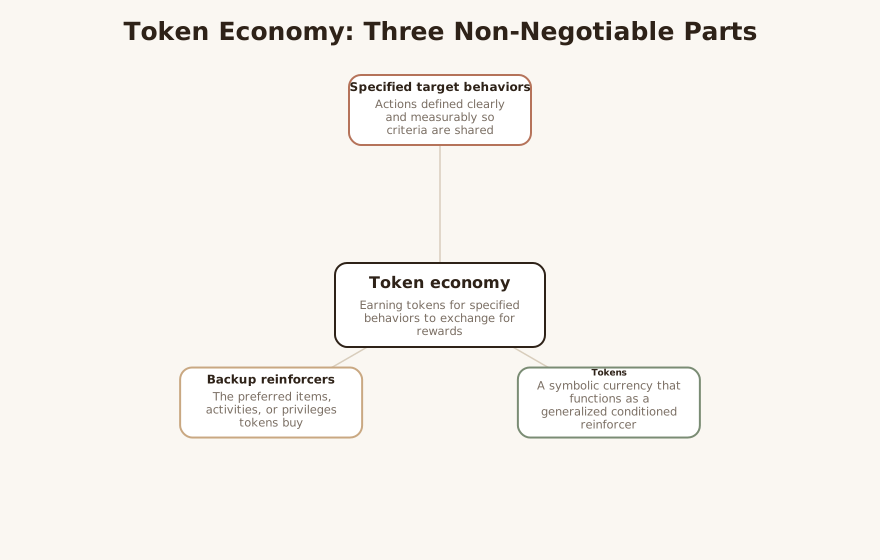
Three components are non-negotiable, and a system missing any one of them is not a true token economy 4. First are specified target behaviors: the actions to be reinforced must be defined clearly and measurably so that staff and clients share the same criteria for earning a token 4. Second is the token itself, a tangible or symbolic currency such as a chip, sticker, point, or checkmark that has no intrinsic value but functions as a secondary, learned reinforcer 4. Third are the backup reinforcers, the actual preferred items, activities, or privileges for which tokens are exchanged 4.
The mechanism that makes the system work is generalized conditioned reinforcement. Because a token is paired with many different backup reinforcers, it acquires reinforcing value that does not depend on any single state of deprivation or satiation, which is precisely what gives money its stability and what gives tokens their durability across moods and contexts 2. Tokens also do several jobs at once: they reinforce the behavior that produced them, they help organize extended sequences of behavior toward a later exchange, they serve a discriminative function by signaling proximity to reinforcement, and, when removed contingently, they can function as a punisher in the form of response cost 2.
Two scheduling relations govern any token economy and deserve explicit attention. The token-production schedule specifies how target behavior earns tokens, while the exchange-production schedule specifies when and how tokens can be cashed in for backup reinforcers; manipulating these two schedules independently changes how the whole system performs 2. A practical corollary is the use of reinforcement schedule thinning: more responses are gradually required per token, and exchange is made less frequent, to build durability and approximate the leaner contingencies of natural environments 5.
Interventions & Techniques
Designing a token economy is a sequence of concrete decisions 5. The clinician first identifies the specific behaviors to address, selects an appropriate token, and pairs that token with backup reinforcers that are genuinely meaningful to the individual 5. Clear, transparent rules about how tokens are earned and exchanged are then established, the learner is taught how the system operates, and the system is monitored continuously and adjusted as needed 5.
Several standard adjuncts sit alongside the basic exchange mechanism. Social reinforcement is typically delivered with each token so that praise eventually carries some of the reinforcing load 4. Behavioral shaping is used to build complex skills by reinforcing successive approximations, and immediate token delivery bridges the delay to a later, larger reward 4. Saving mechanisms let an individual accumulate tokens toward a higher-value backup reinforcer, which introduces self-control and delay tolerance into the system 4. Response cost, the contingent removal of previously earned tokens following a specified misbehavior, is an optional punishment component that must be used cautiously 4.
LLM-generated illustrative example (not a guideline): In a special-education classroom, a teacher defines three target behaviors (staying in seat during instruction, raising a hand before speaking, completing a worksheet), awards a laminated star for each on a dense schedule, pairs each star with brief praise, and lets students exchange ten stars for a Friday activity. Over weeks the teacher raises the response requirement and moves exchange from daily to weekly, thinning the system as on-task behavior stabilizes LLM.
Evidence Base
The honest summary is that the token economy is an established, mature technique whose controlled evidence base is thinner and older than its widespread use implies. Decades of applied work and a strong basic-research foundation support the underlying principle of token reinforcement, and the technique is considered one of the historically successful behavioral applications 2. Translational research continues to connect those laboratory findings to applied practice 6.
For schizophrenia specifically, the controlled evidence is limited. A Cochrane systematic review identified only three randomized controlled trials with a combined 110 participants; one small study of 40 patients showed improvement in negative symptoms at three months (SANS-CV weighted mean difference -12.7, 95% CI -21.44 to -3.96), but there were no usable data on target or non-target behavior across the included trials 1. The reviewers concluded that the token economy remains worthy of careful evaluation in well-designed, well-reported trials, while acknowledging genuine uncertainty about whether the results are reproducible, clinically meaningful, or maintained after the program ends 1. A broader review of 13 controlled studies found that the evidence overall supported the token economy’s effectiveness in increasing adaptive behaviors in patients with schizophrenia, but the authors flagged methodological shortcomings and the dated historical context of the trials, and called for new research on how the technique combines with contemporary psychosocial and pharmacological treatment 3. Much of the most influential work predates modern care, and the technique fell out of favor in psychiatric settings even as its applied use continued elsewhere 34. In classrooms, developmental-disability programs, and substance-use treatment, the technique shows effectiveness in reducing disruptive behavior, though the strongest claims rest on applied and translational literature rather than large modern RCTs 4.
Populations & Indications
The token economy was born in inpatient psychiatric settings with long-stay patients, and that remains a recognized, if historically situated, application 4. It is now most commonly used with students in classroom settings, people with intellectual and developmental disabilities, and children with behavioral problems, where a clear, immediate, tangible signal of “you did the right thing” can scaffold skills that natural contingencies are not yet reinforcing 5. It also appears in substance-use treatment as a form of contingency management and has a long history in forensic and correctional environments, where structured privilege systems share the same operant logic 4.
By presenting concern, token systems are applied to skill deficits in communication, self-help, and social behavior, to noncompliance and disruptive behavior, and to self-care deficits in institutional populations including individuals with schizophrenia 45. The technique facilitates skill acquisition across multiple settings such as home, school, and therapy, and helps the individual grasp the connection between their actions and consequences 5. The strongest indication is any situation where a meaningful behavior occurs but the natural reward for it is delayed, weak, or absent, and an immediate bridging reinforcer is needed 2.
Problems-for-Work
- Noncompliance and disruptive behavior disorders. Define a small set of replacement behaviors (in-seat, on-task, following a one-step direction), reinforce each with a token on a dense schedule, and exchange for a preferred activity; the immediate token closes the gap between compliance and a delayed reward 45.
- Self-care deficits in institutional or developmental-disability settings. Target discrete self-care steps (grooming, hygiene, ward chores) and award tokens contingent on completion, which is the original Ayllon-and-Azrin application 24.
- Behavioral skill deficits. Use shaping within the token system, reinforcing successive approximations of communication or social skills until the full skill is established 4.
- Schizophrenia (negative symptoms and adaptive behavior). Tokens contingent on self-care, participation, and ward activities can increase adaptive behavior, with the caveat that controlled evidence is limited and dated 13.
- ADHD, oppositional defiant disorder, and conduct problems in children. A home or classroom token chart delivers the frequent, predictable feedback these presentations often need 5.
LLM-generated illustrative example (not a guideline): For a child with oppositional behavior who rarely completes morning routines, a clinician might coach caregivers to set up a five-step token chart, award a magnet for each completed step, deliver praise with each magnet, and let the child trade five magnets for ten minutes of a preferred game, then gradually expand the routine before thinning the exchange LLM.
Contraindications, Cautions & Cultural Humility
The most consistent caution is generalization and maintenance: behaviors reinforced by tokens may disappear when the program stops, so the system should be designed from the outset to fade toward natural reinforcers rather than to run indefinitely 4. Schedule thinning and the deliberate pairing of tokens with social reinforcement are the primary tools for fostering durable, intrinsically supported behavior rather than dependence on external rewards 5. A related and longstanding criticism is that heavy reliance on extrinsic rewards can undermine intrinsic motivation, which argues for using the technique as a temporary scaffold rather than a permanent structure 4.
Ethical cautions are real and historically grounded. Institutional token economies have drawn criticism over patient-rights violations, particularly where access to basic goods, comforts, or freedoms was made contingent on behavior 4. Backup reinforcers should never include entitlements a person is owed regardless of behavior, and response cost should be used sparingly and transparently because removing earned tokens is a punishment procedure 4. Cultural humility requires that target behaviors and reinforcers be individualized: what counts as a “desired” behavior can carry cultural assumptions, and a reinforcer that is meaningful and respectful for one person may be irrelevant or even demeaning for another, so systems must match each individual’s preferences and needs rather than impose a generic template 5. The technique is also not a substitute for addressing the function of a behavior; pairing a token economy with proper functional assessment is sound practice LLM.
Treatment-Plan Suggestions & SMART Objectives
| Goal | SMART objective (example) | Mechanism |
|---|---|---|
| Increase classroom on-task behavior | Within 6 weeks, remain on-task during 80% of 5-minute intervals across 4 of 5 school days, earning a token per interval | Token reinforcement of a clearly specified target behavior with dense delivery 4 |
| Improve self-care completion | Within 8 weeks, independently complete a 5-step hygiene routine, earning a token per step, on 4 of 5 days | Generalized conditioned reinforcement bridging the delay to a backup reward 2 |
| Reduce noncompliance | Within 4 weeks, follow one-step directions within 10 seconds in 75% of opportunities, reinforced with tokens | Immediate token closes the antecedent-compliance-reward gap 5 |
| Build a communication skill | Within 12 weeks, use a taught request form in 70% of opportunities, shaped via token reinforcement of approximations | Shaping of successive approximations within the token system 4 |
| Increase delay tolerance | Within 8 weeks, save tokens across 3 days to exchange for a higher-value backup reinforcer in 3 of 4 weeks | Saving mechanism plus exchange-production scheduling 24 |
| Increase ward/group participation (adult psychiatric) | Within 8 weeks, attend and participate in 80% of scheduled groups, earning tokens per session | Token reinforcement of adaptive behavior 13 |
| Fade external reinforcement | Over 12 weeks, sustain target behavior at criterion while the response requirement per token is doubled and exchange moves from daily to weekly | Reinforcement schedule thinning toward natural contingencies 5 |
| Reduce disruptive episodes | Within 6 weeks, reduce specified disruptive episodes by 50% from baseline, with optional response cost for defined misbehavior | Differential reinforcement plus cautious response cost 4 |
Common Misconceptions
- “A token economy is a complete therapy.” It is a technique for delivering reinforcement and is most appropriately embedded within a broader behavior-analytic plan, not used as a stand-alone treatment 5.
- “The token is the reward.” The token has no intrinsic value; its power comes entirely from its relation to backup reinforcers, which is exactly why varied backups make it a robust generalized reinforcer 2.
- “Bribery and reinforcement are the same thing.” Reinforcement follows a clearly specified target behavior under transparent rules, whereas bribery typically precedes and tries to stop misbehavior; the distinction lives in the contingency and the timing LLM.
- “The evidence for schizophrenia is strong and settled.” Controlled trials are few, small, dated, and methodologically limited; the technique is established in use but the modern RCT base is thin 13.
- “Gains will persist automatically.” Without deliberate thinning and a plan to transfer control to natural reinforcers, behaviors may not generalize beyond the program 4.
- “Response cost is just part of the game.” Removing earned tokens is a punishment procedure with ethical weight and should be used sparingly and transparently 4.
Training & Certification
There is no certification specific to the token economy; competence is acquired as part of broader training in applied behavior analysis and behavior modification 5. The technique is a standard tool in the behavior-analytic repertoire, so the relevant credential pathway is the one for behavior analysis generally, and non-behavior-analyst clinicians who wish to use token systems responsibly should do so within their own scope and ideally in coordination with someone trained in functional assessment and reinforcement scheduling LLM. Practitioners benefit from grounding their applied work in the translational literature that links basic token-reinforcement research to practice, which clarifies how token-production and exchange-production schedules can be engineered for a given setting 26. Practical fluency is built through supervised implementation: specifying behaviors, selecting and pairing reinforcers, teaching the system to participants, monitoring data, and thinning schedules toward maintenance 5.
Key Terms
- Token — an object of no intrinsic value whose reinforcing function is established through its relation to other reinforcers 2.
- Generalized conditioned reinforcer — a reinforcer (like a token or money) paired with many backups, so its value does not depend on a single deprivation state 2.
- Backup reinforcer — the preferred item, activity, or privilege for which tokens are exchanged 4.
- Target behavior — the clearly specified, measurable behavior that earns tokens 4.
- Token-production schedule — the rule governing how target behavior earns tokens 2.
- Exchange-production schedule — the rule governing when and how tokens are exchanged for backups 2.
- Response cost — contingent removal of earned tokens as a punishment procedure 4.
- Schedule thinning — gradually increasing the response requirement per token and reducing exchange frequency to build durability 5.
- Shaping — reinforcing successive approximations toward a target behavior 4.
Resources & Further Reading
▶ Watch — a video introduction to this concept:
- Token economy for schizophrenia — Cochrane systematic review (McMonagle & Sweeney, 2000) 1
- Token reinforcement: a review and analysis (Hackenberg, 2009) — PMC 2
- The token economy for schizophrenia: review of the literature and recommendations (Dickerson et al., 2005) — PubMed 3
- Token economy — Wikipedia 4
- The Role of Token Economies in ABA Therapy — Magnet ABA 5
- Token reinforcement: translational research and application (Hackenberg, 2018) — JABA 6
Reflective / Supervision Questions
- Have I specified the target behaviors clearly and measurably enough that the client and every staff member would agree on when a token is earned? 4
- Are my backup reinforcers genuinely individualized to this person’s preferences, and do any of them improperly make a basic entitlement contingent on behavior? 45
- What is my plan to thin the schedule and transfer control to natural reinforcers, so gains do not vanish when the program ends? 45
- Am I pairing tokens with social reinforcement so that praise and natural consequences gradually carry the reinforcing load? 4
- If I am using response cost, can I justify it as the least restrictive option, and is it applied transparently rather than punitively? 4
- For a psychiatric or schizophrenia application, am I being honest with the team that the controlled evidence is limited and dated, and have I integrated the system with current psychosocial and pharmacological care? 13
- Have I situated this token economy within a function-based plan rather than treating it as a stand-alone fix? LLM