
Type & Discipline
Reflective practice is a framework from professional education rather than a discrete psychotherapy. LLM It describes how professionals develop and refine competence by examining their own thoughts, emotions, actions, decisions, and assumptions as a route to continuous learning. 5 Its central move is to treat practice itself—the messy, real-time work of a session, a ward round, or a consultation—as a primary source of knowledge, not merely a place where pre-existing knowledge is applied. 1 For mental health clinicians it sits in the family of professional-learning models alongside clinical supervision and experiential learning theory, and it is the implicit scaffolding behind case formulation, supervision, and the disciplined use of self in the therapeutic relationship. LLM It is best understood as a meta-skill that improves how other skills are learned and deployed, not as a treatment delivered to a patient. LLM
Creators & Lineage
The framework is most closely identified with Donald Schön, whose 1983 book The Reflective Practitioner: How Professionals Think in Action argued that competent professionals draw on a tacit “knowing-in-action” that exceeds what they can articulate in propositional terms. 1 Schön’s account was in part a critique of “technical rationality”—the assumption that professional work is simply the application of scientific theory and technique to instrumental problems—which he argued fails to capture how skilled practitioners actually handle the indeterminate, conflicting, and surprising situations of real practice. 1 His contribution is treated as foundational in the educational-theory literature on reflective practice. 2
The conceptual roots reach back further. 5 John Dewey’s early work on experience, interaction, and reflective thought is widely regarded as a precursor, and the broader lineage is often traced through Immanuel Kant’s “reflective judgments,” Kurt Lewin’s action research, and Jean Piaget’s theories of learning and development. 5 In adult and professional education, Schön’s ideas connect to David Kolb’s experiential learning cycle, which frames learning as the transformation of experience into knowledge through reflection and subsequent testing in new situations. 5 Chris Argyris and Schön together developed the related idea of single- versus double-loop learning, distinguishing between adjusting strategies within fixed goals and questioning the goals and governing assumptions themselves. 5 For clinicians, these threads converge in clinical supervision and andragogy, where reflection is the engine that turns accumulated caseload experience into refined judgment. LLM
Core Principles
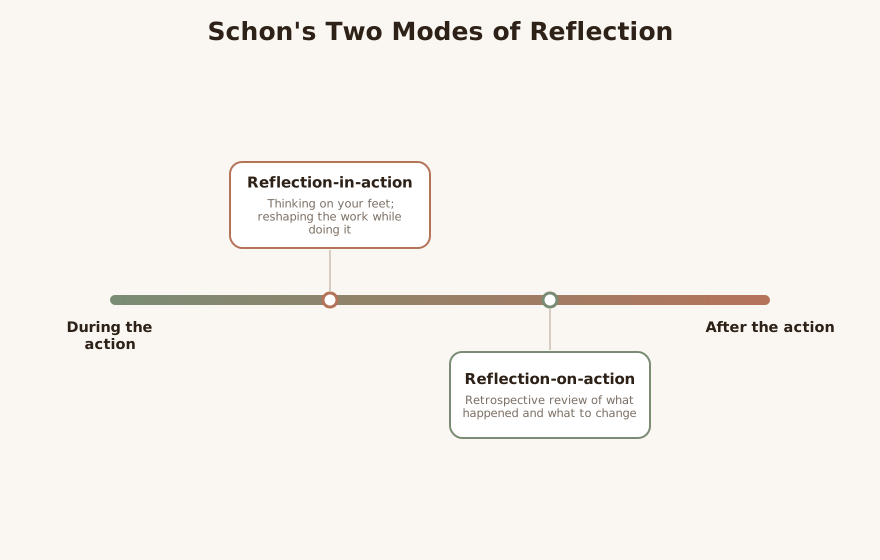
Schön’s framework rests on two complementary modes of reflection. 1 Reflection-in-action is thinking on your feet: the practitioner reshapes what they are doing while they are doing it, typically triggered by surprise, and conducts small “experiments” that generate both a new understanding of the situation and a change in it. 4 Reflection-on-action is the retrospective mode: after an encounter, the practitioner examines what happened, how they responded, and what might have been done differently, frequently using written reflection to surface better practice. 4 Underlying both is the premise that much professional skill is tacit—we know more than we can say—and that reflection is how that tacit knowing is made partially visible and improvable. 1
A second principle is that reflection is generative rather than merely evaluative. LLM Reflection-in-action does not pause the work to consult a rulebook; it improvises a reframing of the problem that opens new options in the moment. 1 A third principle, drawn from the wider literature, is that reflection is not self-sufficient: because human judgment is vulnerable to cognitive bias, reflection becomes reliable only when combined with critical analysis, external feedback, and evidence-based knowledge. 5 For therapists this is the difference between rumination about a hard session and structured reflection that actually changes the next session. LLM
Interventions & Techniques
Although reflective practice is a framework rather than a protocol, it is operationalized through several recognizable techniques. LLM Structured reflective models give the activity a shape: Gibbs’ Reflective Cycle moves through six stages—description, feelings, evaluation, analysis, conclusions, and action plan—providing a scaffold for debriefing a difficult encounter. 5 Kolb’s experiential learning cycle offers a parallel structure, cycling from concrete experience through reflective observation, abstract conceptualization, and active experimentation. 5
In day-to-day clinical work the most common vehicles are the reflective journal or process notes, clinical supervision (individual and group), and case review. LLM Written reflection-on-action is explicitly part of the model and is the easiest to schedule deliberately. 4 Reflection-in-action is harder to teach directly but can be cultivated by deliberately noticing moments of surprise in session—when a client’s reaction violates your expectation—and treating that surprise as data to be tested rather than an error to be suppressed. 1 Double-loop questioning is a higher-order technique: when the same kind of clinical problem keeps recurring, the practitioner interrogates not just their technique but the governing assumptions and goals behind it. 5
LLM-generated illustrative example (not a guideline): A therapist notices mid-session that a client has gone flat and compliant immediately after the therapist offered reassurance. Reflection-in-action: rather than pressing on, the therapist names the shift aloud and asks what the reassurance landed like, discovering it felt dismissive. Reflection-on-action that evening, structured by Gibbs’ cycle, traces the pattern across three clients and yields an action plan to slow down before reassuring. Double-loop reflection in supervision the following week surfaces the governing assumption—“a good therapist relieves distress quickly”—that drove the premature reassurance in the first place. LLM
Evidence Base
The maturity of reflective practice as a framework is best described as established: it is deeply embedded in professional education, licensing, and continuing professional development across healthcare and the helping professions, and is treated as a foundational concept in the educational-theory literature. 2 3 Its standing as a normative model of how professionals learn is not seriously contested. 5
Honesty requires distinguishing that institutional adoption from hard outcome evidence. LLM The literature on reflective practice in healthcare professions positions it as supporting professional competence and continuing development, but the field as a whole leans more on conceptual and educational rationale than on robust controlled trials linking reflection to improved patient outcomes. 3 Commentators note real limitations: reflection alone is unreliable because of cognitive bias, the term itself carries diverse and not-fully-agreed meanings, learners are often given opportunities to reflect without being taught how, and time pressure plus the emotional cost of examining failures act as practical barriers. 5 The reasonable clinical stance is therefore to treat reflective practice as a well-justified professional discipline whose value is strongest when it is structured, supervised, and paired with evidence and feedback—not as an intervention with a trial-grade effect size. LLM
Populations & Indications
The “population” for reflective practice is the practitioner, not the patient. LLM It is indicated for clinicians and therapists at every career stage, but it is especially central for supervisees and trainees, where it is the mechanism by which supervision converts experience into competence. 5 It applies broadly across healthcare professionals and is increasingly built into pharmacy and other health-profession education and continuing development. 3 Counselors in formal supervision, educators, and helping professionals more generally are core users. 5
It is particularly relevant for helping professionals at risk of burnout and compassion fatigue, where the disciplined examination of one’s emotional responses to the work can interrupt the slide into depersonalized, habitualized care. LLM In nursing and similar fields, reflective practice is explicitly framed as a guard against the “habitualization” of care. 5 Across these groups the common indication is the same: work that is high in interpersonal complexity, emotional load, and indeterminacy, where technique alone cannot tell you what to do. 1
Problems-for-Work
Reflective practice is the framework most clinicians actually use—often without naming it—to work on the following professional problems. LLM
- Professional competence and skill development. Structured reflection-on-action after sessions, supported by supervision, is how raw caseload experience is metabolized into refined judgment. 1 3
- Clinical decision-making errors. Noticing surprise in real time (reflection-in-action) and reviewing decisions afterward exposes the reasoning shortcuts and premature closures that drive errors. 1 Double-loop questioning targets the recurring ones. 5
- Countertransference management. Reflective journaling and supervision give the clinician a disciplined channel for examining their own emotional reactions to clients, turning a potential blind spot into clinical information. LLM
- Ethical decision-making. Reflecting on the assumptions and values embedded in a difficult case, rather than reaching reflexively for a rule, is a core application. 5
- Self-awareness deficits. Reflection is, definitionally, the practice of examining one’s own thoughts, emotions, and assumptions, making it the primary tool for building practitioner self-awareness. 5
- Burnout and compassion fatigue. Naming and processing the emotional residue of the work, ideally in group reflective space, addresses a known driver of attrition in the helping professions. LLM
LLM-generated illustrative example (not a guideline): A trainee repeatedly runs over time with one client and feels resentful afterward. Used as a problem-for-work, structured reflection reveals a countertransference pull to “rescue,” reframes the resentment as data, and—through double-loop reflection—surfaces a personal rule about being needed that is fueling both the boundary slippage and early burnout. LLM
Contraindications, Cautions & Cultural Humility
Reflective practice has no medical contraindications because it is not administered to patients, but it carries genuine cautions for practitioners. LLM The most important is that reflection can curdle into unproductive rumination or harsh self-criticism, particularly when it dwells on negative events without structure or support—a recognized emotional barrier in the literature. 5 This risk is highest for distressed or perfectionistic clinicians and is mitigated by structured models and supervisory containment rather than solitary brooding. LLM
A second caution is over-reliance: because reflection is biased by the same cognitive distortions it aims to correct, it must be paired with external feedback, peer input, and evidence rather than treated as a self-validating practice. 5 A third is that institutional reflection can become performative—reflective logs completed to satisfy a regulator rather than to change practice—which hollows out the activity. LLM
On cultural humility, the framing of reflective practice as introspective self-examination carries assumptions about the self that are not universal, and the “correct” way to reflect is itself culturally shaped. LLM Critically, the practitioner’s assumptions that reflection is meant to surface include culturally embedded biases about clients; reflective practice is therefore one of the better vehicles for examining how a clinician’s own positionality shapes the work, provided it is directed outward at those assumptions and not only inward at technique. 1 5
Treatment-Plan Suggestions & SMART Objectives
Because reflective practice is a practitioner-development framework, the “treatment plan” below is a professional-development / supervision plan, not a client care plan. LLM
| Goal | SMART objective (example) | Mechanism |
|---|---|---|
| Build reflection-on-action habit | Clinician completes a structured (Gibbs-cycle) written reflection on one challenging session within 24 hours, for 8 consecutive weeks | Retrospective written reflection surfaces tacit reasoning 4 5 |
| Strengthen reflection-in-action | In each of the next 6 supervision sessions, clinician identifies one in-session “moment of surprise” and the on-the-spot adjustment made | Treating surprise as data drives real-time reframing 1 |
| Improve countertransference awareness | Over 12 weeks, clinician logs emotional reactions to a recurring case type and reviews patterns monthly in supervision | Journaling converts affect into examinable clinical data LLM |
| Reduce recurring decision errors | Clinician applies double-loop questioning to one repeating clinical problem and revises a governing assumption within one quarter | Single- vs double-loop distinction targets root assumptions 5 |
| Pair reflection with feedback | Clinician obtains structured peer or supervisor feedback on 4 reflected-upon cases per quarter | External input corrects reflection’s own biases 5 |
| Mitigate burnout | Clinician attends a monthly group reflective-practice session for 6 months and rates emotional load before/after | Shared reflection interrupts habitualization and isolation 5 |
| Demonstrate CPD competence | Clinician assembles a reflective portfolio evidencing changed practice across 10 cases over the licensing cycle | Reflection underpins continuing professional development 3 |
Common Misconceptions
A frequent misconception is that reflection means simply thinking about a session afterward; in Schön’s framework it is a disciplined activity with a defined retrospective mode and a distinct in-the-moment mode, both aimed at changing practice. 1 4 A second is that reflective practice is “soft” or atheoretical, when in fact it arose as a rigorous critique of the dominant technical-rationality model of expertise. 1 A third is that more reflection is always better; the literature is explicit that unstructured reflection is unreliable and can entrench bias without external feedback. 5 A fourth, common among trainees, is that reflection-in-action is just intuition—whereas Schön frames it as on-the-spot experimentation triggered by surprise, which is testable and revisable. 1 Finally, completing reflective paperwork is sometimes mistaken for reflective practice; documentation is evidence of reflection at best, not the practice itself. LLM
Training & Certification
Reflective practice is not a credentialed therapy with its own certifying body; there is no licensure in “reflective practitioner.” LLM Instead it is acquired through professional training programs, clinical supervision, and continuing professional development, where it is increasingly an explicit expected competency. 3 In several health professions, including pharmacy education and practice, reflective practice is being built more deliberately into curricula and CPD requirements. 3 Many regulators and professional bodies require reflective accounts or portfolios as part of revalidation or continuing-competence schemes. LLM For clinicians, the practical pathway is supervision plus structured models (such as Gibbs’ or Kolb’s cycles) and reading Schön’s foundational text rather than pursuing a standalone certificate. 1 5
Key Terms
- Reflection-in-action — Reshaping practice while it is happening, typically triggered by surprise, through on-the-spot experimentation. 1 4
- Reflection-on-action — Retrospective examination of an encounter, often in writing, to identify what could be done differently. 4
- Knowing-in-action — The tacit, often inarticulate know-how embedded in skilled performance. 1
- Technical rationality — The model Schön critiqued, in which professional work is treated as the instrumental application of theory and technique. 1
- Single- vs double-loop learning — Adjusting strategy within fixed goals (single) versus questioning the goals and governing assumptions (double). 5
- Experiential learning cycle (Kolb) — Learning as transformation of experience into knowledge through reflection and testing. 5
- Gibbs’ Reflective Cycle — Six-stage structured debrief: description, feelings, evaluation, analysis, conclusions, action plan. 5
Resources & Further Reading
▶ Watch — a video introduction to this concept:
- Schön, D. A. (1983). The Reflective Practitioner: How Professionals Think in Action — the foundational text.
- Reflective Practice: Donald Schön — SAGE Encyclopedia of Educational Theory and Philosophy — concise scholarly overview.
- The role of reflective practice in healthcare professions: next steps for pharmacy education and practice (ScienceDirect) — healthcare/CPD application.
- The Reflective Practitioner — IRISS reflective practice resource — accessible summary for the helping professions.
- Reflective practice — Wikipedia — models, lineage, and critiques.
Reflective / Supervision Questions
- Where in your last difficult session did you notice surprise, and what did that surprise tell you about an assumption you were holding? 1
- When you reflect on your work, are you mostly evaluating technique (single-loop) or also questioning your governing goals and beliefs (double-loop)? 5
- What feedback loop corrects your reflection—or is your reflection currently self-validating? 5
- Has your reflective practice lately shaded into rumination or self-criticism, and what structure or supervision would convert it back into learning? 5
- Which of your recurring clinical reactions deserves to become a deliberate problem-for-work in supervision this quarter? LLM