
Type & Discipline
Liminality is an anthropological construct, not a treatment, diagnosis, or therapeutic modality 6. It originates in symbolic and cultural anthropology, within the study of rites of passage, and it names a phase of experience rather than prescribing any intervention 1. The word derives from the Latin limen, meaning “threshold,” and it points to the transitional middle of a passage from one social state to another — the doorway one is standing in rather than either room 1. A liminal state is the “betwixt-and-between” condition in which a person has been detached from an old status or identity but has not yet acquired the new one, so that they are, for a time, structurally ambiguous and socially invisible 12. The construct describes this in-between as a real and patterned stage of human transition, with its own characteristic disorientation, ambiguity, and potential, rather than as a mere gap or an error to be corrected 6.
For a clinician, the value of liminality is not that it is something one delivers in session, but that it supplies a precise vocabulary and a developmental map for a recognizable class of presenting problems: the disorientation, suspended identity, and existential unease that accompany major life transitions LLM. Because it is a descriptive frame rather than a modality, it travels across treatment approaches and informs how a therapist reads a divorce, a bereavement, a migration, an adolescence, or a recovery, rather than constituting a therapy in itself LLM. The central claim that makes the construct generalizable is that transitions as different in content as initiation, marriage, mourning, and migration share an underlying threshold structure, so that the ambiguity of the liminal phase is a common feature of passage itself rather than a peculiarity of any one event 1.
Creators & Lineage
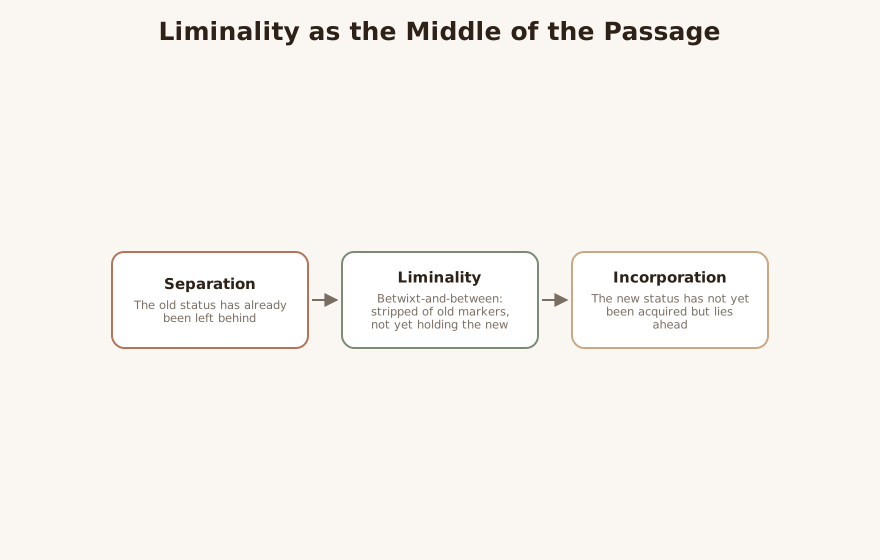
The concept was first formulated by the French-born ethnographer and folklorist Arnold van Gennep in his 1909 work Les rites de passage, where he identified a recurring three-part pattern across the rituals that move people from one social status to another 1. Van Gennep divided every rite of passage into three phases: rites of separation (preliminal), in which the person is detached from a prior state in something like a symbolic death; transition or margin rites (liminal), the ambiguous middle in which the person belongs to neither the old status nor the new; and rites of incorporation (postliminal), in which the person is reintegrated into society bearing a new identity 1. It is the middle phase — the limen or threshold — that van Gennep named liminal, and it is this stage that later became the center of theoretical attention 1.
The construct was substantially developed and popularized by the British cultural anthropologist Victor Turner, whose essay “Betwixt and Between: The Liminal Period in Rites de Passage” took up van Gennep’s neglected middle phase and made it the heart of a theory of ritual and society 3. Turner described the attributes of liminal personae — “threshold people” — as necessarily ambiguous, since the ritual subject in this phase slips through the network of classifications that normally locate a person in social structure 1. Drawing on his fieldwork among the Ndembu of Zambia, Turner argued that rites of passage are antithetical to existing social structure and “subjunctive” in mood, because they suspend ordinary status and invite participants to imagine new possibilities and relations 2. He illustrated the stripping of status with the Ndembu installation rite, in which the chief-elect is first humbled and given a lowly status before being exalted, a degradation that reminds the future leader that office exists to serve the community 2.
Turner’s lineage extends beyond anthropology into clinical and psychological thought, where the construct has been imported by adjacent traditions rather than invented by them LLM. Liminality has been linked to Jungian individuation, to identity formation, and to contemporary life passages such as adolescence, migration, and university transitions, which is why narrative, existential, and analytical-psychological approaches have all found it useful 1. Turner himself later distinguished the obligatory, ritually marked liminal of traditional societies from the optional, playful liminoid of modern leisure and the arts, sharpening the concept for application to contemporary life where formal rites of passage have thinned 1.
Core Principles
The first principle is that liminality is a phase within a structured process, not a freestanding event: it is the margin between a separation that has already occurred and an incorporation that has not yet happened 1. This places the construct inside van Gennep’s tripartite arc, so that the liminal disorientation a person feels is legible as the expectable middle of a passage rather than as evidence of breakdown 1. The clinical force of this principle is that it reframes “stuckness” as transit: the client is not nowhere, but on the way between somewhere and somewhere else LLM.
The second principle is ambiguity and the suspension of status 2. In the liminal phase the person is stripped of the markers that ordinarily define them and does not yet hold the markers of the state to come, so they become, in Turner’s terms, structurally invisible — neither the person they were nor the person they will be 1. Turner located this phase outside ordinary social structure altogether, in a zone he called anti-structure, where the usual hierarchies and roles are loosened or inverted 2. This is why liminal experience so often feels formless and exposed: the ordinary scaffolding of identity has been temporarily removed LLM.
The third principle is that the liminal is generative as well as disorienting LLM. Because liminality is “subjunctive” — a space of the as-if, of what might be rather than what is — it is precisely the loosening of fixed structure that opens room for new identities, relations, and meanings to be tried out 2. Turner paired liminality with communitas, the intense, egalitarian bond that arises among people who pass through the same threshold together and meet one another stripped of rank, as direct equals 2. For the clinician, this dual character is the heart of the construct: the same ambiguity that produces suffering is also the condition under which genuine change becomes possible LLM.
Interventions & Techniques
Because liminality is an anthropological construct rather than a therapy, there are no “liminality techniques”; the concept works by shaping formulation and is then operationalized through recognized modalities LLM. The first practical move is naming the threshold: locating a client’s distress on van Gennep’s arc and saying plainly that they are in the in-between, having left an old state before the new one has formed 1. Naming the liminal phase explicitly can convert a client’s panic into something legible, reframing “I am falling apart” as “I am between,” which is an expectable feature of passage rather than a sign of collapse LLM.
A second move is holding and structuring the threshold rather than rushing to close it LLM. Because the construct treats ambiguity as a stage with its own work, the clinician’s task is often to make the in-between bearable — through ritual, routine, containment, and meaning-making — rather than to force a premature return to a settled identity 1. A third move is working with the generative face of liminality: using the suspension of old roles as an opening to try on new identities, values, and relationships, which maps closely onto the re-authoring work of narrative therapy and the meaning-focused work of existential and analytical approaches LLM. Where a passage has stalled, the clinician can also borrow the logic of rites of incorporation, helping the client mark and ritualize a transition so that the new identity is recognized rather than left indefinitely unincorporated 1. These moves are delivered through the clinician’s primary modality; the construct supplies the why and when, while the modality supplies the how LLM.
LLM-generated illustrative example (not a guideline): A client who has recently emigrated says, “I’m not who I was at home, but I’m not really one of the people here either.” Using the liminality frame, the clinician names this as the expectable margin between leaving an old social world and being incorporated into a new one, normalizes the disorientation as a feature of the threshold rather than a deficit, and shifts the work toward bearing the in-between while deliberately trying on elements of a new, bicultural identity LLM.
Evidence Base
The honest appraisal is that liminality is an established and durably influential anthropological construct, continuously taught and cited since van Gennep coined it in 1909 and Turner reframed it mid-century, but it is a conceptual and ethnographic framework, not an intervention with its own outcome trials LLM. Its standing rests on explanatory reach and conceptual fertility — its ability to make sense of a vast range of transitions across cultures — rather than on randomized efficacy data, because that is the form “evidence” takes for a construct of this kind 6. Its empirical base is comparative ethnography: van Gennep’s cross-cultural survey of rites of passage and Turner’s fieldwork among the Ndembu, which are rich sources for theory-building but are observational and interpretive rather than experimental 2.
For the clinician, two implications follow LLM. First, liminality should be offered to clients as a useful map of a common human experience, not as a validated treatment for a specific disorder LLM. Second, the construct’s reliability is greatest as a formulation heuristic — a way to widen attention to the staged, identity-suspending nature of transition — and weakest if it is treated as a precise predictive mechanism that forecasts how any individual’s passage must unfold, or as a therapy one “does” LLM. Used within that limit, it adds explanatory value precisely where symptom-focused frameworks fall silent, by giving language to the formlessness of being between identities; used beyond it, it risks dressing ordinary clinical reasoning in borrowed authority LLM.
Populations & Indications
The construct’s natural population is people undergoing a transition in which an old status or identity has ended and a new one has not yet consolidated 1. This maps directly onto common clinical presentations: people in major life transitions of every kind, adolescents moving between childhood and adulthood, bereaved individuals between an old life with the deceased and a life without them, immigrants and refugees between cultures, clients in recovery building a sober identity, people facing divorce, career changers, and patients with chronic illness whose sense of self has been suspended by diagnosis 1. Turner observed that adolescence in particular can be read as a near-permanent liminal condition in modern societies, where the threshold between child and adult is prolonged and poorly marked 1.
The construct is especially indicated when the presenting distress is organized around suspended identity and transition rather than around a discrete symptom cluster — when a client’s difficulty is less “I feel anxious” than “I no longer know who I am, and I don’t yet know who I’m becoming” LLM. It is well matched to passages in which the social role itself has dissolved, because it gives clinician and client a shared language for an experience that otherwise feels formless and shameful 1. It is also useful when a person is stuck in a protracted or unmarked transition — a passage begun but never incorporated — since the model legitimizes the in-between as a real stage with its own tasks rather than as failure to move on LLM.
Problems-for-Work
Liminality maps onto a recognizable cluster of problems centered on the suspension of identity and meaning that accompanies transition 1. Role transition difficulties are a core target: the construct treats the disorientation of moving between social roles as the expectable work of the threshold rather than as a peripheral complaint, which reframes it as developmental rather than purely pathological 1. Adjustment disorder is read here as distress concentrated in the liminal margin, when a person has been separated from an old equilibrium before a new one has formed LLM.
Grief and acculturation stress are paradigmatic applications, because both involve a passage in which an old world has receded and a new one has not yet been entered — the bereaved between presence and absence, the migrant between cultures 1. Identity disturbance often intensifies in the liminal phase, when the ordinary markers of self have been stripped and the person is, in Turner’s sense, structurally invisible 1. Existential crisis, loss of meaning, and uncertainty intolerance cluster here as well, because the threshold is by definition a place of ambiguity, and a client who cannot tolerate not-knowing will suffer acutely in the very phase the construct describes LLM.
LLM-generated illustrative example (not a guideline): A client newly retired after thirty years in one profession reports feeling “unreal,” as though life is on hold. Formulated through liminality, the clinician hypothesizes that the client has completed the separation from the work role but has not yet been incorporated into a new post-career identity, normalizes the suspended, unreal feeling as the texture of the threshold, and orients the work toward bearing the margin while building rituals and relationships that mark a new beginning LLM.
Contraindications, Cautions & Cultural Humility
The foremost caution is conceptual restraint: liminality is an anthropological heuristic, not a validated clinical law, so a clinician should not present “you are in a liminal state” as a diagnostic verdict or imply that the threshold will resolve on a schedule LLM. People do not move through separation, margin, and incorporation in tidy order, and imposing the map can romanticize suffering or pressure a client who is grieving in their own time LLM. The construct is a lens for understanding, not a timeline for compliance LLM.
A second caution is clinical triage: the disorientation, derealization, and identity confusion of a transition can co-occur with major depression, acute suicidality, trauma, or the identity instability seen in some personality disorders, and the liminality frame must never displace risk assessment and indicated evidence-based care LLM. The “structurally invisible” feeling of being between identities can be ennobling language for what is, clinically, a dangerous episode, and where a client’s distress is acute the priority is stabilization and safety, with the liminal narrative resumed only when it is safe to do so LLM.
A third caution concerns cultural humility about transition itself LLM. The meaning, pacing, and proper marking of passages — how long one “should” grieve, whether leaving a faith or a homeland is liberation or loss, what counts as a completed adulthood — are deeply shaped by culture, religion, and community, and the construct can smuggle in an individualistic, Western assumption that the goal of every threshold is an autonomous, self-authored new identity LLM. For a client embedded in a collectivist or faith tradition, incorporation may require communal and ritual recognition that the therapy room cannot supply, and the absence of such rites — not the client’s coping — may be the real source of a stalled passage LLM. Cultural humility requires interpreting the threshold against the client’s own values and community, attending to who is permitted to mark a transition as complete, and remaining alert to the power the therapist holds in framing which version of the new self counts as “incorporation” LLM.
Treatment-Plan Suggestions & SMART Objectives
| Goal | SMART objective (example) | Mechanism |
|---|---|---|
| Name and locate the threshold | Within 3 sessions, client will identify where they sit on the separation–margin–incorporation arc and describe their transition in their own words | Locates distress on van Gennep’s process map so the work fits the phase 1 |
| Normalize the in-between | Over 6 weeks, client will reframe the disorientation of being “betwixt and between” as an expectable feature of transition rather than as breakdown | Converts panic about formlessness into a legible, time-limited stage 1 |
| Make the margin bearable | Over 4 weeks, client will establish 2 daily routines or containing rituals that provide structure during the ambiguous middle | Provides scaffolding where the ordinary markers of identity have been stripped 1 |
| Reduce identity disturbance | Within 10 sessions, client will draft a written self-statement that holds both who they were and who they are becoming | Works the suspended identity of the liminal phase rather than forcing premature closure 1 |
| Build tolerance for uncertainty | Over 8 weeks, client will practice a values-based action while explicitly not-knowing the outcome, and review it in session | Targets the uncertainty intolerance that makes the threshold acutely painful LLM |
| Mark and ritualize incorporation | Within 12 sessions, client will design and enact one personal ritual that marks the completion of a transition | Borrows the logic of incorporation rites to recognize a new identity left unincorporated 1 |
| Process transition-linked grief | Over 8 weeks, client will name 3 specific losses tied to the old state and one thing they wish to carry forward | Works the grief of separation that the liminal phase suspends 1 |
Common Misconceptions
A frequent error is treating liminality as a synonym for any unpleasant feeling of being stuck, when the construct names a specific structural position — the margin between a completed separation and a not-yet-achieved incorporation — rather than generic distress 1. A second misconception is reading van Gennep’s three phases as a rigid, lockstep timeline that every person must traverse in order, when lived transitions loop, stall, and skip rather than marching cleanly from separation to incorporation 1. A third is romanticizing the liminal as inherently transformative or sacred, when Turner’s account holds both faces together: the threshold is generative and exposing, and for many clients the dominant experience is suffering, not epiphany 2.
A fourth misconception is conflating the obligatory, ritually marked liminal of traditional rites with the optional, playful liminoid of modern leisure, a distinction Turner drew precisely because contemporary transitions often lack the formal ritual structure that once contained them 1. A fifth is treating liminality as a therapy one “does,” when it is a descriptive construct from anthropology that informs interventions delivered through other modalities LLM. Finally, the concept is sometimes treated as a precise predictive mechanism rather than an explanatory heuristic, overstating how much it can forecast about any individual’s passage LLM.
Training & Certification
There is no certification in “liminality”; the concept is foundational theory studied within cultural and symbolic anthropology, ritual studies, and the sociology of religion rather than a credentialed clinical technique LLM. Clinicians typically encounter it through graduate coursework in anthropology, the study of ritual and life transitions, or interdisciplinary reading, where van Gennep’s Les rites de passage and Turner’s essay “Betwixt and Between” are the standard primary texts 3. Reading those primary sources remains the most direct route to understanding the construct in its original terms, and accessible reference entries situate the concept and its three phases for quick orientation 7.
For applied clinical competence, the relevant training lives in the recognized modalities that operationalize the frame — narrative therapy for re-authoring identity across a transition, existential approaches for working with meaning and uncertainty, and analytical-psychological work on individuation — where supervised practice teaches clinicians to help a client bear and move through a threshold rather than merely mourn an old self LLM. Generalist therapists can legitimately use liminality for formulation provided they represent its evidentiary status honestly and deliver care through modalities in which they are trained LLM.
Key Terms
Liminality — the “betwixt-and-between” threshold phase of a transition, in which a person has left an old status but not yet acquired a new one, and is therefore ambiguous and structurally invisible 12. Limen — the Latin word for “threshold,” the root from which the construct takes its name and image 1. Rite of passage — a ritual that moves a person from one social status to another, which van Gennep showed unfolds in three phases 1. Separation (preliminal) — the first phase, a symbolic detachment from a prior status, sometimes figured as a kind of death 1. Liminal / margin — the ambiguous middle phase, the threshold proper, where the person belongs to neither the old state nor the new 1. Incorporation (postliminal) — the final phase, in which the person is reintegrated into society bearing a new identity 1. Communitas — the intense, egalitarian bond that arises among people passing through the same threshold together, stripped of rank and meeting as equals 2. Anti-structure — Turner’s term for the zone outside ordinary social hierarchy that the liminal phase opens, where roles are loosened or inverted 2. Liminoid — Turner’s term for the optional, playful, modern analogues of liminal experience found in leisure and the arts, distinguished from the obligatory liminal of traditional ritual 1.
Resources & Further Reading
▶ Watch — a video introduction to this concept:
- Liminality — Wikipedia
- Rite of passage: Victor Turner and Anti-Structure — Britannica
- Turner, V. — “Betwixt and Between: The Liminal Period in Rites de Passage” (PDF)
- Victor Turner and liminality: An introduction (ResearchGate)
- Victor Turner — New World Encyclopedia
- Liminality — Encyclopedia of Critical Psychology (Springer)
- Liminality — Encyclopedia of Educational Philosophy and Theory (Springer)
Reflective / Supervision Questions
- When a client describes feeling “lost” or “unreal” during a transition, have I located where they sit on the separation–margin–incorporation arc, or am I treating the whole passage as one undifferentiated problem 1?
- Am I helping this client bear and structure the in-between, or am I implicitly pressuring them to close the threshold and settle into a new identity before they are ready LLM?
- Whose cultural and ritual frame am I using to judge when a transition is “complete,” and have I checked it against the client’s own community and values rather than defaulting to autonomous self-authorship as the goal LLM?
- When the language of liminality feels ennobling, have I confirmed that I am not narrating a clinically dangerous episode — acute depression, suicidality, or destabilization — as a meaningful threshold LLM?
- Am I attending to the generative as well as the painful face of this client’s liminal phase, using the loosening of old roles as an opening for new identity rather than only managing distress 2?
- Am I presenting liminality to this client as a useful map of a common experience, or am I overstating it as a validated treatment that predicts how their transition must unfold LLM?