
Type & Discipline
Communitas is a theoretical construct, not a treatment modality. It originates in symbolic anthropology and belongs to what is usually called Turnerian ritual theory 3. The term names a specific quality of human relationship: the spontaneous, direct, and egalitarian way that people experience one another when they are passing together through a threshold or transitional state 3. Clinicians encounter communitas not as a manual to follow but as a lens — a way of naming the leveling, mutually recognizing fellowship that often does the heavy lifting in group-based and ritual-based healing LLM.
It is essential to be honest about register at the outset. Communitas is an anthropological concept with a mature theoretical literature, not a clinical intervention with its own outcome trials LLM. When this article speaks of “evidence,” it refers to the conceptual maturity and influence of Turner’s framework, plus its resonance with established group-therapeutic mechanisms — not to randomized data on “communitas therapy,” which does not exist as such LLM. Used carefully, it sharpens how we think about why groups heal; used loosely, it becomes a mystical gloss on ordinary cohesion LLM.
Creators & Lineage
The concept is the work of Victor Turner (1920–1983), a British anthropologist who, from the 1960s through the early 1980s, led a revision of the older structural-functionalist understanding of ritual 63. Turner’s signature book, The Ritual Process: Structure and Anti-Structure (1969), is where the construct received its fullest statement, and its central chapter is titled “Liminality and Communitas” 12. Much of his thinking grew out of fieldwork among the Ndembu of Zambia (then Northern Rhodesia) and his close attention to ritual symbols and the tensions they encode 6.
Turner built directly on Arnold van Gennep, whose rites of passage model divides ritual transition into three phases: separation (preliminal), the liminal or threshold phase (transition), and reincorporation (postliminal) 4. Van Gennep gave Turner the architecture; Turner supplied the social texture of the middle phase. Where van Gennep described the threshold structurally, Turner asked what people feel and become while suspended there — and his answer was communitas 43.
The lineage that matters for clinicians runs in two directions. Upstream sits van Gennep’s rite-of-passage schema and Turner’s broader symbolic anthropology, including his notion of social drama 46. Downstream, the concept has been continually revisited, reinterpreted, and extended well beyond its ritual origins, a transformation traced in recent scholarship 5. For mental-health work, the natural cousin is Irvin Yalom’s account of group therapeutic factors; the two were developed independently but illuminate the same phenomena from anthropological and clinical angles respectively LLM.
Core Principles
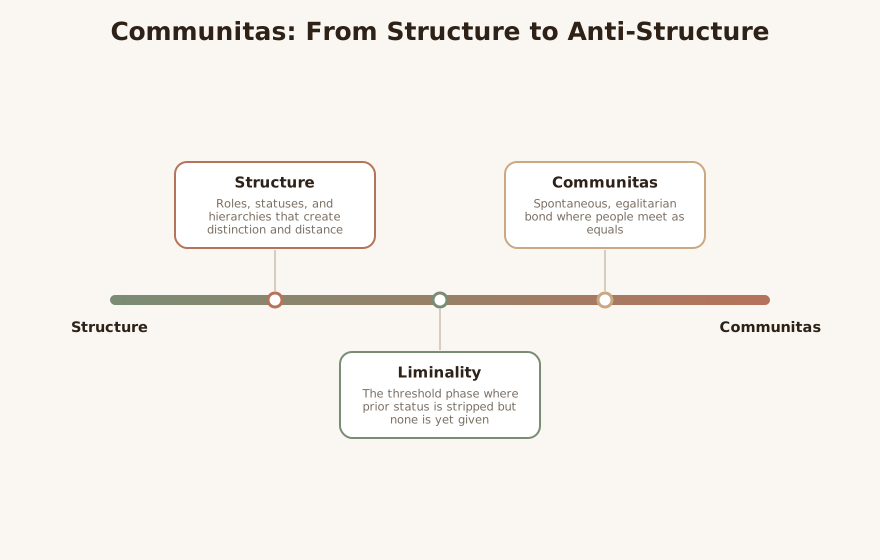
The foundational move is Turner’s distinction between structure and anti-structure 3. Ordinary social life is structured: it organizes people into roles, statuses, and hierarchies that meet material needs but also generate distinctions, distance, and inequality 3. Against this, Turner set communitas — a modality of relationship in which those distinctions briefly fall away and people meet “as equals,” in spontaneous and direct ways 3. Communitas is not the absence of society; it is society experienced in a different key.
Communitas is bound to liminality. It arises most powerfully in the threshold phase, when participants have been stripped of their prior status but not yet given a new one 4. Turner called such people liminal personae — “threshold people” whose attributes are necessarily ambiguous, who are “betwixt and between” the positions assigned by law, custom, and ceremony 4. Because they share the same stripped, in-between condition, they recognize one another as fellows rather than as superiors and subordinates 43.
Turner also insisted the relationship between structure and communitas is dialectical, not oppositional in a simple sense 3. Communitas does not abolish structure; it counterbalances and replenishes it. Roles can be “infused with communitas,” putting them back in the service of human community and the common good — as when a king-elect is reminded, through ritual humbling, of his obligation to serve rather than dominate 3. Ritual, in this reading, is subjunctive: it invites new possibilities and permits experimentation with alternative arrangements, including role reversals 3.
Finally, Turner distinguished kinds of communitas. The raw, immediate form he variously called existential or spontaneous communitas; this is the direct human connection that erupts in the moment 4. Because such intensity cannot last, it tends to be organized into normative communitas, the durable group relationships that preserve the original feeling, and ideological communitas, the utopian or programmatic attempt to build a whole society on its model 4. This typology matters clinically because therapy lives mostly in the normative register — trying to hold the spark of spontaneous fellowship inside a sustainable structure LLM.
Interventions & Techniques
Communitas is a construct, so it has no proprietary techniques; instead, it tells clinicians what conditions tend to generate the bond and how to protect it once it appears LLM. The first family of methods is status-leveling. Anything that temporarily suspends ordinary hierarchy — first-name circles, shared seating, the clinician disclosing their own fallibility, rituals that put everyone in the same plain role — recreates the liminal flattening Turner described 3LLM. The point is not informality for its own sake but the felt experience of meeting as equals 3.
A second family is threshold marking. Clear separation and reincorporation rituals — an opening that sets the group apart from ordinary life and a closing that returns members to it — borrow van Gennep’s three-phase scaffolding to make the liminal middle safe enough for communitas to emerge 4LLM. Grief rituals, recovery ceremonies, and structured group openings all do this work LLM.
A third family is shared ordeal and witnessed disclosure. Communitas intensifies when people undergo something demanding together and are seen in it; the mutual recognition of vulnerability is precisely what dissolves status distance 3LLM.
LLM-generated illustrative example (not a guideline): In a closed bereavement group, the facilitator opens each session with a brief shared ritual — lighting a candle, naming who is held in mind that week — that visibly separates the room from the outside world. Over time members stop addressing the clinician as the authority and begin turning to one another, a shift from structure toward communitas the clinician names aloud and protects rather than directs LLM.
Evidence Base
Honesty about maturity is important here. As anthropological theory, communitas is established: it is a durable, widely taught, and continuously debated concept that reshaped how rites of passage are understood, and it remains the subject of active scholarly revisitation more than half a century after The Ritual Process 15. Its place in the canon of symbolic anthropology is secure 6.
As a clinical construct, however, it is borrowed rather than tested. There is no body of controlled trials on “communitas” as a therapeutic agent, and clinicians should not present it as an evidence-based intervention LLM. What can be said responsibly is that communitas describes the same terrain that established group-process research addresses through constructs like cohesion, universality, and altruism — so the mechanism it points to is empirically respectable even though the term itself comes from outside the clinical literature LLM. Recent scholarship also cautions that the concept has been stretched and romanticized as it traveled, which is a reason for clinical modesty rather than enthusiasm 5.
The defensible clinical claim is therefore narrow: communitas is a generative explanatory frame for phenomena we already treat as therapeutic, not an independently validated treatment LLM.
Populations & Indications
The construct is most useful wherever healing is communal and transitional. Group therapy participants are the obvious case: the whole apparatus of the therapy group is an engineered liminal space in which strangers meet as equals 3LLM. Bereaved people in grief support groups occupy a culturally liminal status — no longer spouse or child in the old way, not yet reintegrated — and communitas among the similarly bereaved counters that isolation 4LLM.
People in recovery, especially in 12-step communities, exemplify normative communitas: a durable fellowship of equals, anonymous and de-statused, that institutionalizes the spontaneous bond 4LLM. Ritual and ceremony participants of all kinds are the original population Turner studied 1. Refugees and displaced persons and veterans are populations defined by enforced transition and the rupture of prior status; both frequently report that the deepest repair comes from fellow-travelers who share the threshold rather than from outside helpers 4LLM.
Problems-for-Work
Communitas speaks most directly to relational and existential suffering. Social isolation and loneliness are, in Turner’s terms, an excess of structure with no replenishing fellowship; group formats that generate communitas address them at the root 3LLM. Alienation and demoralization — the sense of being outside the human community and beyond help — are countered by the lived experience of being met as an equal 3LLM.
Grief and identity disruption/transition are liminal conditions almost by definition; naming the client’s “betwixt and between” status can itself be relieving, and connecting them to others in the same phase supplies the communitas the transition requires 4LLM. Existential distress responds to the universality that communitas delivers: the discovery that one’s predicament is shared LLM. In trauma recovery, the witnessed, de-hierarchized fellowship of fellow survivors can restore a sense of belonging that individual work alone may not reach 3LLM.
LLM-generated illustrative example (not a guideline): A veteran reporting profound alienation makes little progress framing his distress as a personal deficit in individual sessions. Placed in a peer group of other veterans, he experiences — for the first time since service — being understood without translation. The clinician frames the shift not as “finally opening up” but as re-entering a community of equals after years of structural isolation LLM.
Contraindications, Cautions & Cultural Humility
The first caution is conceptual honesty: communitas is a description, not a prescription, and it should never be sold to clients as a technique or a guaranteed outcome LLM. The intense, spontaneous form cannot be manufactured on demand, and trying to force it can produce performative pseudo-intimacy that some clients experience as coercive LLM.
Second, leveling is not always safe. Suspending hierarchy can be destabilizing for clients who rely on clear structure — acutely psychotic, severely dysregulated, or early-trauma presentations may need more structure, not anti-structure LLM. The clinician’s authority and the frame’s predictability are themselves containing functions that should not be casually dissolved LLM.
Third, Turner’s claim that communitas erases distinction deserves cultural scrutiny. The experience of being “stripped” of status is not neutral across people; what feels liberating to one member may feel like erasure of a hard-won or protective identity to another, particularly for clients from marginalized groups whose difference is not a barrier to be dissolved but a reality to be respected 4LLM. Recent scholarship’s caution against romanticizing the concept applies directly here: the egalitarian glow can mask real power differences that persist in the room 5LLM. Cultural humility means treating any given ritual structure as one culture’s form, not a universal template, and inviting clients to shape the threshold practices that will hold them LLM.
Treatment-Plan Suggestions & SMART Objectives
| Goal | SMART objective (example) | Mechanism |
|---|---|---|
| Reduce social isolation | Client will attend 6 consecutive weekly group sessions and contribute verbally in at least 4 of them within 8 weeks | Status-leveled fellowship of equals (communitas) counters structural isolation 3 |
| Counter demoralization/alienation | Client will identify, in session, two moments of feeling “understood by an equal” in group within 4 weeks | Mutual recognition of shared predicament dissolves felt distance 3 |
| Metabolize grief in a liminal transition | Client will name their current “betwixt and between” status and connect with one similarly bereaved peer within 6 weeks | Liminal framing plus communitas normalizes threshold experience 4 |
| Support identity transition | Client will participate in a structured opening/closing ritual each session for 8 weeks and describe its effect | Van Gennep separation–reincorporation scaffolding stabilizes transition 4 |
| Strengthen recovery belonging | Client will attend 8 peer-fellowship meetings and obtain one ongoing peer contact within 8 weeks | Normative communitas institutionalizes the spontaneous bond durably 4 |
| Reduce existential distress | Client will articulate one universalizing insight (“I am not alone in this”) drawn from group within 6 weeks | Universality experienced through communitas LLM |
| Restore belonging after trauma | Client will tolerate being witnessed disclosing one difficult memory to peers within 10 weeks | Witnessed, de-hierarchized fellowship rebuilds belonging 3 |
Common Misconceptions
A first misconception is that communitas simply means “group cohesion” or “good vibes.” Turner’s term is more specific: it denotes the anti-structural experience of meeting as equals once ordinary status has been suspended, which is a particular mechanism rather than a general warmth 3LLM. A cohesive but still-hierarchical group has not necessarily achieved communitas LLM.
A second is that communitas is permanent or self-sustaining. Turner held that the spontaneous form is inherently fleeting and must be channeled into normative or ideological forms to endure — so a clinician who expects the first electric session to simply continue will be disappointed 4LLM.
A third is that anti-structure means no structure. Communitas and structure are dialectical partners; the threshold has to be bounded by separation and reincorporation for the in-between to be safe, and roles are meant to be re-infused with communitas, not abolished 34LLM.
A fourth is that the concept is value-neutral and universally benign. Its egalitarian framing can obscure persistent power differences and can pathologize the wish to retain a distinct identity; the construct’s modern reception explicitly warns against this romanticization 5LLM.
Training & Certification
There is no certification in communitas, and clinicians should be wary of anyone offering one LLM. The construct is acquired by reading rather than credentialing: the primary text is Turner’s The Ritual Process: Structure and Anti-Structure (1969), and especially its “Liminality and Communitas” chapter 12. Familiarity with van Gennep’s rite-of-passage model provides the necessary scaffolding 4.
Clinically, the relevant competencies are the ordinary ones of group and ritual-informed practice — group facilitation training, supervised group hours, and grounding in group-process theory — into which communitas is best integrated as an interpretive frame LLM. Reading the contemporary scholarship on how the concept has been transformed and critiqued is valuable inoculation against over-applying it 5.
Key Terms
- Communitas — the spontaneous, direct, egalitarian bond among people who meet as equals once ordinary status is suspended 3.
- Structure — the ordered system of roles, statuses, and hierarchies of everyday social life 3.
- Anti-structure — the modality, including communitas, that counterbalances and replenishes structure rather than replacing it 3.
- Liminality — the threshold or transitional phase of a rite of passage, between separation and reincorporation 4.
- Liminal personae — “threshold people,” betwixt and between, whose status is ambiguous during the transition 4.
- Rites of passage (van Gennep) — ritual transitions in three phases: separation, liminal/transition, reincorporation 4.
- Spontaneous (existential) communitas — the immediate, fleeting eruption of fellowship 4.
- Normative communitas — durable group relationships that preserve the spontaneous feeling over time 4.
- Ideological communitas — the utopian attempt to model a whole society on communitas 4.
Resources & Further Reading
▶ Watch — a video introduction to this concept:
- Turner, V. (1969). The Ritual Process: Structure and Anti-Structure
- “Liminality and Communitas” — chapter PDF (Trinity University)
- Britannica: Rite of passage — Victor Turner and anti-structure
- Britannica: Victor Turner (biography)
- Wikipedia: Liminality
- Haggar, E. (2025). Communitas revisited: Victor Turner and the transformation of a concept
Reflective / Supervision Questions
- In my groups, can I point to specific moments of communitas — members meeting as equals — or am I labeling ordinary cohesion with a more romantic word? LLM
- Where does my own status as clinician usefully contain the group, and where does it block the leveling that some clients need? LLM
- For a client in a liminal transition (grief, displacement, role loss), have I named the “betwixt and between” status explicitly, and have I connected them to fellow-travelers in the same phase? LLM
- Whose distinctions am I asking to dissolve when I encourage anti-structure, and for whom might that erasure feel unsafe rather than freeing? 4LLM
- Am I trying to manufacture spontaneous communitas, and if so, what performative pressure might that place on vulnerable members? LLM
- How do my opening and closing rituals function as separation and reincorporation, and do they make the liminal middle safe enough? 4LLM