
Type & Discipline
Rites of Passage is a theoretical framework from cultural anthropology and folklore, not a psychotherapy modality 2. Arnold van Gennep proposed it in 1909 to describe how societies move individuals between social roles without disruption 2. He defined these rites as the means by which individuals are eased through the difficulties of transition from one social role to another 2. The central claim is structural and cross-cultural: ceremonies marking birth, puberty, marriage, parenthood, and death share a common three-part sequence 5. For clinicians, the value of the framework is interpretive — it offers a map for understanding why transitions destabilize people and what a completed transition requires LLM. It belongs to the broader family of ritual theory, alongside the work of Victor Turner 4.
Creators & Lineage
Arnold van Gennep, a French folklorist and ethnographer, introduced the term rite de passage in his 1909 work Les rites de passage 1. He conceptualized society as a kind of house divided into rooms and corridors, with individuals passing ceremonially between distinct social groups 5. Van Gennep emphasized that these rites are primarily sociocultural rather than biological in significance, even though they cluster around life crises such as birth, maturity, reproduction, and death 2.
The framework’s most influential extension came from anthropologist Victor Turner, who developed the concept of liminality 4. Turner described liminal persons as having necessarily ambiguous attributes — neither in their old status nor yet in the new one 5. He also introduced communitas, the spontaneous camaraderie among those sharing a liminal experience, and the liminoid, optional leisure experiences that mimic liminal qualities without resolving a genuine life crisis 4. Within clinical thought, this lineage connects to narrative approaches to re-authoring identity and to Eriksonian developmental staging, both of which treat identity as something restructured across transitions LLM.
Core Principles
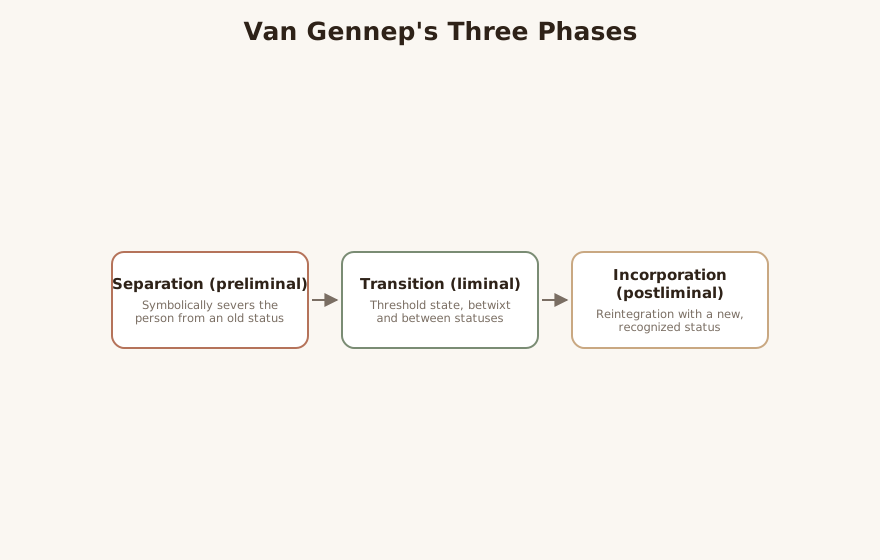
The framework rests on a tripartite sequence 2. Separation (preliminal) symbolically severs the person from an old status — through removal, renaming, or stripping of markers, such as a recruit cutting their hair to shed civilian identity 5. Transition (liminal) is the threshold period: the person has left one position but not yet entered the next, occupying an ambiguous, disoriented, betwixt-and-between state 4. Incorporation (postliminal) reintegrates the person into society with a new, publicly acknowledged status, often marked by ceremony and symbolic objects like rings, belts, or crowns 5.
Three principles follow for clinical use. First, transition is a process, not a moment — distress often reflects an incomplete sequence rather than individual pathology LLM. Second, the liminal phase is inherently destabilizing; ambiguity and high vulnerability are features of the structure, not signs of disorder 4. Third, transformation is not finished until it is socially recognized — incorporation requires witnesses 6.
Interventions & Techniques
Rites of Passage is a conceptual lens, so its clinical “techniques” are adaptations of existing methods organized around the three phases LLM. In the separation phase, clinicians help clients name and mark what is ending — the lost role, relationship, or self-image — rather than rushing past it LLM. Mapping the client’s position within the sequence (“you have left, but not yet arrived”) can normalize disorientation and reduce the sense that something is wrong with the person 4.
In the liminal phase, the work is containment and meaning-making. The therapeutic space can function as a structured container where chaotic experience can be narrated and integrated 6. Techniques include narrative re-authoring of the in-between identity, psychoeducation about the normal turbulence of thresholds, and tolerating ambiguity rather than prematurely resolving it LLM. In the incorporation phase, clinicians support the client in consolidating and publicly affirming the new role — through symbolic acts, ceremony, or reconnection with community 6. One contemporary critique notes that modern transition programs often deliver separation and liminality but neglect reincorporation, which diminishes lasting change 5.
LLM-generated illustrative example (not a guideline): A client retiring after thirty years describes feeling “invisible.” The clinician frames the loss of the work identity as separation, validates the present disorientation as a liminal threshold, and over subsequent sessions helps the client design small incorporation rituals — a farewell gathering, a new weekly role — to consolidate an identity beyond the job LLM.
Evidence Base
Honesty about maturity matters here. The Rites of Passage framework is established — but established as a foundational, century-old anthropological model, not as an empirically validated treatment 1. Its descriptive reach across cultures is well documented and widely taught 2. There is robust observational evidence within anthropology, including findings that severe initiations produce cognitive dissonance that heightens group attachment and conformity 5.
What does not exist is a body of randomized or controlled clinical trials testing “rites-of-passage therapy” as a discrete intervention with outcome data LLM. Clinical application rests on conceptual fit, practice wisdom, and analogy rather than efficacy research LLM. Specific clinical claims drawn from this tradition — for example, that PTSD can be understood as a person stuck in the liminal phase, or that the therapist functions as a “ritual elder” facilitating the crossing — come from interpretive clinical writing, not trials, and should be held as heuristics 6. Used as an organizing metaphor adjunctive to an evidence-based modality, the framework is reasonable; presented as a standalone validated treatment, it overstates the evidence LLM.
Populations & Indications
The framework is indicated wherever the presenting problem centers on a transition of status, place, or identity 2. Adolescents map naturally onto coming-of-age rites, and the absence of clear cultural markers can leave developmental crises unstructured 5. People in life transitions — retirement, divorce, empty nest, career change — occupy textbook liminal territory 4. Bereaved individuals move through death rites that are, structurally, rites of passage for both the deceased and the mourner 2.
Immigrants and refugees experience a literal territorial passage compounded by acculturation, often suspended in a prolonged liminal state between cultures 4. Couples entering marriage move through one of the canonical rites van Gennep catalogued 2. Veterans returning to civilian life illustrate the incorporation problem vividly: separation (enlistment, boot camp) and liminality (deployment) are heavily ritualized, while reincorporation is frequently neglected 5.
Problems-for-Work
The framework lends itself to several problems-for-work. Life transition distress is the clearest application: locating the client on the separation–liminal–incorporation arc clarifies where they are stuck 4. Identity disturbance and role confusion respond to the liminal lens, which reframes a destabilized sense of self as a threshold to be crossed rather than a fixed deficit LLM.
Grief and bereavement can be organized around incomplete incorporation — a mourner who cannot move forward may lack the social recognition that ritual provides 6. Acculturation stress maps onto a stalled territorial passage 4. Developmental crises in adolescents reflect missing or distorted coming-of-age structure 5. Existential distress, liminality and loss of meaning, and difficulty individuating all describe forms of being suspended in the in-between without a path to the new status 4. Adjustment disorder, structurally, is distress at the threshold of a change not yet integrated LLM.
Contraindications, Cautions & Cultural Humility
This framework carries specific cultural cautions, and they are load-bearing. Van Gennep’s model emerged from early-twentieth-century, colonial-era ethnography, and applying a single universal template risks flattening genuine cultural difference 1. Clinicians should not import, prescribe, or stage rituals drawn from a culture that is not the client’s own — doing so risks appropriation and can feel coercive LLM. The goal is to recognize and support the client’s own meaningful markers, not to author exotic ceremonies on their behalf LLM.
Equally important: do not pathologize culturally normative rites. Practices that look unusual through a clinical lens may be healthy, expected passages within the client’s community 2. The framework can also be misused to imply that anyone struggling with transition is simply “doing it wrong” — a moralizing trap that ignores material stressors like immigration policy, poverty, or discrimination LLM. The framing of trauma as a “failed passage” is one clinical interpretation, not established doctrine, and should not displace evidence-based trauma treatment 6. As a metaphor it is most safely used alongside, not instead of, validated interventions LLM.
Treatment-Plan Suggestions & SMART Objectives
| Goal | SMART objective (example) | Mechanism |
|---|---|---|
| Reduce life-transition distress | Within 8 weeks, client will identify their current phase (separation/liminal/incorporation) in 3 of 4 sessions and name one task per phase | Externalizing the transition normalizes distress and orients action 4 |
| Stabilize identity disturbance | Over 6 weeks, client will articulate two continuities of self that persist across the transition, rated weekly | Re-authoring identity reduces threshold disorientation LLM |
| Process grief through incorporation | Within 60 days, client will design and complete one personally meaningful remembrance act and debrief it | Social/symbolic recognition supports integration of loss 6 |
| Ease acculturation stress | Over 10 sessions, client will name two values from each culture they wish to carry forward | Holding both reduces being stuck between statuses 4 |
| Support veteran reincorporation | Within 12 weeks, client will reconnect with two civilian-community roles and report on each | Completing the neglected incorporation phase consolidates new status 5 |
| Reduce adolescent role confusion | Over a semester, client will identify one mentor and one age-graded milestone to pursue | Substituting structure for absent coming-of-age markers 5 |
| Tolerate liminal ambiguity | Within 6 weeks, client will use a grounding skill during in-between uncertainty 4 of 7 days | Containment during the destabilizing threshold phase 4 |
Common Misconceptions
A first misconception is that a rite of passage is only a single ceremony; in van Gennep’s model it is a three-phase sequence, and the ceremony is just one marker within it 2. A second is that the liminal phase is a problem to be eliminated — Turner’s work treats liminality as a generative, necessary space of anti-structure, not merely a symptom 4. A third is that completing a transition is a private matter; incorporation is social by definition and requires recognition 6.
A fourth misconception is that the framework only describes “primitive” or exotic societies — graduations, white coat ceremonies, and military promotions are contemporary rites of passage 5. A fifth, and most consequential clinically, is treating the model as a validated therapy with proven outcomes rather than a descriptive lens; it has no trial evidence as a standalone treatment LLM.
Training & Certification
There is no recognized credential, license, or certification in “rites-of-passage therapy,” because it is an anthropological framework rather than a clinical modality LLM. Clinicians typically encounter it through coursework in cultural anthropology, ritual studies, or the writings of van Gennep and Victor Turner 1. The primary literacy required is conceptual fluency with the three phases and with Turner’s elaborations of liminality and communitas 4.
For clinical use, the appropriate training is in an established modality into which the framework can be embedded — for example, narrative therapy for identity re-authoring, or grief-focused work for bereavement — supplemented by cultural-responsiveness training LLM. Practitioners adopting the lens should ground it in anthropological primary sources rather than secondary clinical reinterpretations alone 1.
Key Terms
- Separation (preliminal): the first phase, symbolically detaching the person from an old status 5.
- Liminal phase (transition): the ambiguous threshold between statuses, marked by disorientation and high vulnerability 4.
- Incorporation (postliminal): reintegration into society with a publicly recognized new status 5.
- Communitas: the spontaneous solidarity among those sharing a liminal experience 4.
- Liminoid: optional, leisure-based experiences that mimic liminal qualities without resolving a real crisis 4.
- Anti-structure: Turner’s term for the temporary suspension of normal social order during liminality 4.
Resources & Further Reading
▶ Watch — a video introduction to this concept:
- Van Gennep, A. — The Rites of Passage (University of Chicago Press, course intro PDF)
- Rite of passage — Encyclopaedia Britannica
- Rite of Passage — Cultural Anthropology (Social Sci LibreTexts)
- Liminality — Wikipedia
- Rite of passage — Wikipedia
- Arnold van Gennep and the Rites of Passage (Get Therapy Birmingham / Taproot Therapy)
Reflective / Supervision Questions
- For a client stuck in distress, can you locate where they are on the separation–liminal–incorporation arc, and which phase is unfinished? LLM
- Are you using this framework as an organizing metaphor alongside an evidence-based modality, or are you letting it substitute for one? LLM
- Whose rituals are you drawing on — the client’s own cultural and personal markers, or templates you are importing onto them? 1
- Have you confused a culturally normative passage with pathology, or vice versa? 2
- When a transition feels incomplete, what form of social recognition or incorporation is missing for this client, and how might it be supported safely? 6