
Type & Discipline
Anti-structure is a construct from symbolic anthropology, not a treatment modality, technique, or school of psychotherapy 4. It names ritual’s capacity to function not merely as a means to everyday social ends but as a space that suspends the conventional patterning of social life altogether, enabling people to create novel forms of interaction outside ordinary constraints 5. Victor Turner introduced the term in The Ritual Process: Structure and Anti-Structure (1969), where it stands as the dialectical counterpart to “structure” — the differentiated, hierarchical system of politico-legal-economic positions that orders normal society 2. For clinicians, anti-structure is best understood as a lens: a way of reading what happens when the therapy frame, a group, or a treatment milieu temporarily relaxes the roles and rankings that govern the outside world 6. It belongs to the family of ideas surrounding liminality and the ritual process, and any therapeutic application is by conceptual borrowing rather than by an established evidence-based protocol LLM.
Creators & Lineage
The concept is principally the work of Victor Turner (1920–1983), a British anthropologist who taught at Manchester, Cornell, Chicago, and Virginia and whose theory grew out of fieldwork among the Ndembu of Zambia 2. Turner built directly on Arnold van Gennep’s tripartite model of rites of passage — separation, a liminal margin, and reaggregation — adapting it to show that ritual is a process rather than a static state 4. Van Gennep’s middle phase, the liminal “betwixt and between,” became the seedbed for Turner’s two signature ideas: liminality and communitas 4. Turner credited the theologian Martin Buber as a kind of “gifted native informant” on communitas, borrowing Buber’s image of community as a “flowing from I to Thou” to describe its spontaneous, person-to-person quality 2. The intellectual line that matters for clinicians runs from van Gennep’s rites of passage, through Turner’s liminality and communitas, into the practice traditions of group therapy and the therapeutic community, which share anti-structure’s wager that temporarily suspending ordinary hierarchy can heal 6.
Core Principles
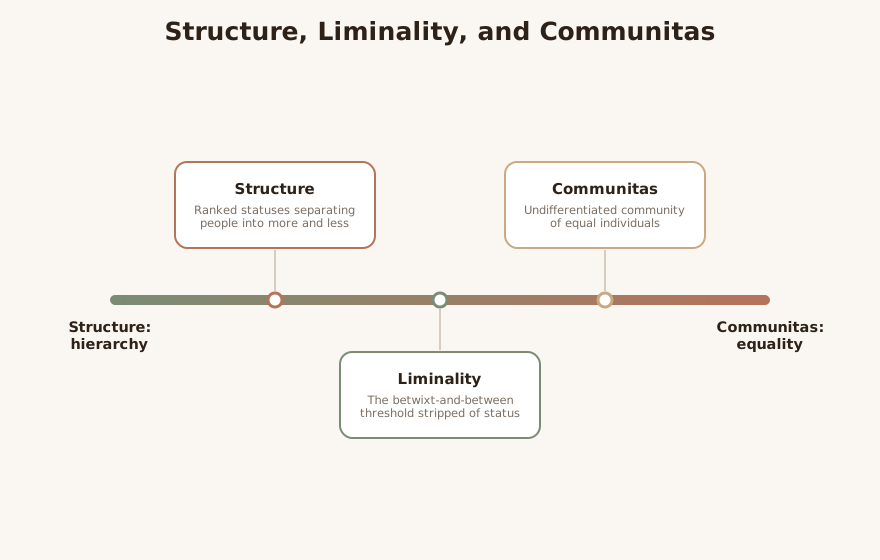
Turner proposed that human society oscillates between two models of relatedness: structure, a hierarchical system of named statuses separating people into “more” and “less”; and communitas, a relatively undifferentiated community of equal individuals that emerges in the liminal phase 2. Anti-structure is the umbrella term for this second pole — liminality plus communitas — and for ritual’s capacity to generate it 4. The liminal person is “betwixt and between,” stripped of the attributes of their prior and future status, often marked by anonymity, the absence of rank or property, humility, and uniform dress 2. Turner laid out the contrast as a series of binary oppositions: transition versus state, equality versus inequality, anonymity versus systems of nomenclature, absence of property versus property, humility versus pride of position, and communitas versus structure 2.
A central and clinically suggestive idea is what Turner called “the powers of the weak”: in the liminal moment, the underling can come uppermost, and the structurally inferior are revealed as ritually potent 2. In the Ndembu installation of a chief, the chief-elect is first humiliated and dressed in a ragged cloth, sharing the same name as initiates, before being elevated — a reminder that office serves the people rather than personal ambition 21. Crucially, communitas is not a free-floating utopia; Turner insisted it can be grasped only in relation to structure, the way figure needs ground, or the way the empty hub at the center of Lao-tse’s wheel is useless without the spokes yet indispensable to them 2. Anti-structure does not abolish structure — it refreshes and re-legitimizes it 4.
Interventions & Techniques
Anti-structure prescribes no techniques of its own; it is a construct, and what follows are clinical extrapolations rather than validated procedures LLM. Read therapeutically, the frame itself is the primary anti-structural device: the consulting room, like an airport or a waiting room, is a liminal space where ordinary behavioral norms relax, time feels suspended, and people occupy no fixed social role 5. Clinicians can think of several practices as deliberately cultivating liminality and communitas: establishing confidentiality and a bounded ritual time that separate the session from outside life; flattening hierarchy enough that the client can speak as an equal “whole person” to another “whole person,” in Turner’s I-Thou sense 2; and using group formats where status distinctions are intentionally homogenized so that members meet as comrades rather than as their outside-world ranks 2.
LLM-generated illustrative example (not a guideline): In a residential program, a clinician opens each community meeting with a brief ritual — a shared check-in circle where staff and residents speak in the same order and to the same prompt — to soften the staff/resident hierarchy and let a temporary communitas form before the day’s structured work resumes LLM.
The “social drama” sequence that Turner derived from the same body of work — breach, crisis, redress, and reintegration or schism — offers a parallel template for understanding how a relational rupture can move through a redressive (liminal) phase toward repair 6. In trauma-informed practice, some clinicians note that ritual’s mobilization of breath, synchronized movement, and multivocal symbols resonates with body-based approaches, though this is an analogy, not an established mechanism 6.
Evidence Base
Honesty about maturity requires a distinction. As an anthropological construct, anti-structure is well established: it is a canonical contribution of twentieth-century symbolic anthropology, foundational to studies of initiation, pilgrimage, healing, political installation, and “all forms of movement in society” 2. It has been debated and refined for decades rather than discarded 4.
Its clinical standing is entirely different. There are no randomized trials of “anti-structure as therapy,” no manualized protocol, and no outcome literature treating it as an intervention LLM. The therapeutic bridge rests on conceptual borrowing — practitioners mapping Turner’s ideas onto the therapy frame, the alliance, and group process — exemplified by clinician-authored commentary rather than empirical validation 6. Even within anthropology, scholars have cautioned that Turner may overestimate communitas’s power to challenge social order and underestimate how readily structures neutralize anti-structural forces 4. Turner himself observed that authorities invested in the status quo routinely attempt to control and circumscribe ritual’s innovative potential 1. For clinicians, the responsible framing is: a robust idea for thinking about what therapeutic spaces do, not a proven means of producing change LLM.
Populations & Indications
Anti-structure is most illuminating where the clinical problem is itself about belonging, role, and hierarchy LLM. Therapy groups and recovery communities are natural fits: their power lies precisely in the communitas Turner described — members meeting “in spontaneous and direct ways as equals,” secular distinctions of rank temporarily homogenized 42. Adolescents are a developmentally liminal population; Turner explicitly read the “beat generation” and the hippies as modern bearers of communitas, “betwixt and between” the statuses society offered them 2. People in residential or milieu treatment inhabit a literal liminal institution, separated from ordinary life and awaiting reaggregation 2.
The construct speaks with particular force to marginalized and oppressed groups, through the “powers of the weak”: liminality reveals the structurally inferior as carriers of value and potency, a reframe with obvious resonance for people whose social position has been one of subordination 2. Communities in crisis map onto the social-drama sequence, where a breach moves into a redressive phase before reintegration 6. These are indications for thinking with the construct, not prescriptions for a specific treatment LLM.
Problems-for-Work
Several common clinical targets can be reframed productively through anti-structure LLM. Social isolation and loss of community/belonging are, in Turner’s terms, a deficit of communitas; the group or milieu is designed to supply the “generalized social bond” that structure alone cannot 2.
LLM-generated illustrative example (not a guideline): A socially isolated client who has never felt “part of anything” is referred to a process group; over weeks, the experience of speaking and being received as an equal — communitas — begins to loosen the belief that connection requires earning a higher rank LLM.
Alienation and stigma can be understood as being trapped in a structural position of “less”; the liminal leveling of the group temporarily dissolves that hierarchy and lets a different self-experience emerge 2. Hierarchy and power conflicts — in families, teams, or the therapy dyad itself — are the explicit content of anti-structure, which models how temporary inversion (the underling uppermost) can re-legitimize rather than destroy structure 2. Rigid maladaptive schemas can be approached through liminality’s capacity to expose the arbitrariness of social norms, creating a space to experiment with new identities outside habitual constraints 15. Group cohesion problems and existential distress point back to communitas as the “quick of human interrelatedness,” the relational ground that gives structured life its meaning 2.
Contraindications, Cautions & Cultural Humility
Because anti-structure is a borrowed construct rather than a treatment, the main cautions are interpretive LLM. First, do not romanticize communitas. Anthropologists have warned that its capacity to transform social order is easily overstated and that anti-structural energy is frequently reabsorbed and neutralized by existing structures 4. Turner noted that communitas movements often harden into just another institution — sometimes a more fanatical one — as their initial momentum is exhausted 2. Clinically, this is a reminder that a powerful group “high” is not durable change LLM.
Second, liminal states are described in the source material as carrying mystical danger and ambiguity: what falls between classificatory boundaries is widely regarded as both potent and polluting 2. The clinical analogue is that destabilizing a client’s roles and certainties without containment can be harmful; liminality always needs the boundary, the prescriptions, and the eventual reaggregation that make it safe 2. For clients whose stability is fragile — acute psychosis, severe dissociation, or those for whom the loss of structure is itself the threat — deliberately loosening structure is contraindicated, and the work is to provide structure first LLM.
Cultural humility is non-negotiable here. The construct was abstracted from specific Ndembu and other African ritual contexts, and Turner already drew analogies across cultures with caution about over-generalizing 2. Critics have flagged the risk of treating all ritual as essentially the same and of importing tribal-society frameworks wholesale into modern Western settings 4. Clinicians should treat anti-structure as a heuristic, not a universal law, and remain alert to whose “structure” is being suspended and on whose terms LLM.
Treatment-Plan Suggestions & SMART Objectives
The following are illustrative planning aids for clinicians who find the construct useful; they are not validated protocols LLM.
| Goal | SMART objective (example) | Mechanism |
|---|---|---|
| Reduce social isolation | Client will attend 8 consecutive weekly process-group sessions and contribute verbally in at least 6 of them within 10 weeks | Communitas / shared-humanity bond in a leveled group 2 |
| Loosen rigid maladaptive schema | Client will identify, in session, 3 instances where a “fixed” self-rule did not hold, within 6 weeks | Liminality exposes the arbitrariness of social norms 15 |
| Resolve a hierarchy/power conflict | Client will rehearse and enact one “role-flattened” conversation with a supervisor or family member within 8 weeks | Temporary inversion / powers of the weak re-legitimizes structure 2 |
| Restore sense of belonging | Client will name 2 specific peers from a recovery community they can contact between sessions, within 4 weeks | Communitas as a generalized social bond 2 |
| Reduce alienation/stigma | Client will report a 2-point decrease on a self-rated alienation scale across 12 weeks of group participation | Homogenization of secular rank in the liminal group 4 |
| Navigate a relational rupture | Client and clinician will map one current conflict onto breach–crisis–redress–reintegration and identify the current phase within 3 sessions | Social-drama redressive process toward repair 6 |
| Tolerate existential/transitional distress | Client will use a brief grounding ritual to bound 3 high-distress transitions per week, logged for 6 weeks | Containing the liminal “betwixt and between” with frame and ritual 2 |
Common Misconceptions
A first misconception is that anti-structure means no structure or pure chaos; in fact Turner insisted communitas exists only in relation to structure, like the empty hub that makes the wheel turn, and that ritual’s purpose is to infuse ordinary statuses with communitas, not to abolish them 21. A second is that communitas is permanent or self-sustaining; Turner treats it as a fleeting “moment in and out of time” that, left to itself, either dissipates or congeals back into structure 2. A third is that anti-structure is inherently subversive in a one-directional, liberating sense; while it can expose the arbitrariness of norms, it is just as often redressive — it reinforces and renews the existing order by reminding office-holders that their status serves the community 1. A fourth, especially relevant to clinicians, is to read anti-structure as a validated therapy; it is a construct used by analogy, and treating it as an evidence-based intervention overstates its clinical maturity 6LLM.
Training & Certification
There is no certification in anti-structure, and none should be claimed; it is an academic construct, not a credentialed modality LLM. Clinical fluency comes from primary and secondary reading in symbolic anthropology — Turner’s “Liminality and Communitas” is the foundational text — paired with the established trainings that actually carry anti-structural ideas into practice, such as group psychotherapy training and therapeutic-community or milieu-treatment supervision 26. Clinicians wanting to apply the lens responsibly are best served by grounding it in their existing modality competencies and by reading critical commentary so they understand the construct’s contested edges 4LLM.
Key Terms
- Anti-structure — Ritual’s capacity to suspend ordinary social structure and generate liminality and communitas 4.
- Liminality — The “betwixt and between” transitional phase in which a person occupies no fixed social role 25.
- Communitas — The undifferentiated, egalitarian bond of equal individuals that emerges in liminality, contrasted with structure 2.
- Structure — The differentiated, hierarchical system of named statuses that orders normal social life 2.
- Powers of the weak — Turner’s term for the ritual potency and authority granted to the structurally inferior in liminal moments 2.
- Rites of passage — Van Gennep’s three-phase model (separation, liminal margin, reaggregation) that Turner extended 4.
- Social drama — The breach–crisis–redress–reintegration/schism sequence describing how conflict moves toward repair 6.
Resources & Further Reading
▶ Watch — a video introduction to this concept:
- Victor Turner, “Liminality and Communitas,” The Ritual Process (1969) — excerpt
- Britannica — “Rite of passage: Victor Turner and anti-structure”
- Deflem (1991), “Ritual, Anti-Structure, and Religion: A Discussion of Victor Turner’s Processual Symbolic Analysis”
- Haggar (2025), “Communitas revisited: Victor Turner and the transformation of a concept”
- Court Theatre — “Anthropological Anti-Structure”
- Get Therapy Birmingham — “The Anthropology of Victor Turner: Ritual, Liminality, and Cultural Performance”
Reflective / Supervision Questions
- In my own caseload, where am I unintentionally reinforcing the client’s outside-world hierarchy when a more leveled, communitas-like stance might serve better — and where would flattening structure be unsafe? LLM
- When a group or milieu produces an intense sense of belonging, how do I help clients metabolize that liminal “high” into durable change rather than letting it dissipate or harden? 2LLM
- Whose structure am I asking the client to suspend, and on whose cultural terms — am I treating this anthropological construct as a heuristic or smuggling it in as a universal law? 4LLM
- For a client in acute crisis, can I locate them on the breach–crisis–redress–reintegration sequence, and is the current task to deepen the liminal work or to restore structure and containment? 6LLM