
Type & Discipline
Ritual anti-structure and social drama are theoretical constructs, not a therapy. They come from symbolic anthropology, the strand of cultural anthropology that reads ritual, symbol, and ceremony as systems of meaning enacted in social action rather than as mere functional machinery 4. The framework is associated almost entirely with one figure, Victor Turner, and his processual symbolic analysis of how societies create, suspend, and repair their own order 4. For clinicians, the relevant point is that this is an interpretive lens on how groups handle transition and conflict — a way of seeing — and not a manualized intervention with its own outcome literature LLM.
Turner’s signature move was to study symbols “in social action, in practice,” treating them as “good to manipulate,” not merely “good to think,” a deliberate break from the more static structuralism of Lévi-Strauss 4. That practical, processual emphasis is what makes the work portable into group and community settings LLM.
Creators & Lineage
Victor Witter Turner (1920–1983) was a British anthropologist, born in Glasgow, who trained at University College London and the University of Manchester under Max Gluckman, the mentor who facilitated his fieldwork among the Ndembu people of present-day Zambia 3. He earned his PhD in 1955, became a leading figure of the Manchester School, and later held positions at Stanford, Cornell, the University of Chicago, and the University of Virginia, where he worked until his death 3.
The most direct intellectual debt is to Arnold van Gennep, whose three-phase model of rites of passage — separation, transition, and incorporation — Turner inherited and then expanded 3. Turner concentrated on the middle, transitional phase, the liminal phase, and built much of his theory out of it 3. His core works, including The Ritual Process: Structure and Anti-Structure, develop the claim that the dissolution of ordinary social classifications is not chaos but a generative ground for symbol, art, and religion 1. The lineage runs forward as well: the concepts of liminality and communitas became broadly influential across performance studies and the humanities, where theatre itself is read as a liminal space in which audiences and characters step temporarily outside normal social structure 6.
It is worth noting, even at the lineage stage, that Turner’s own mentor Gluckman challenged the structure/anti-structure distinction as “too rigid,” arguing that communitas operates “within an established structure which is asserted again afterwards” 4. The internal disagreement matters for any clinical borrowing LLM.
Core Principles
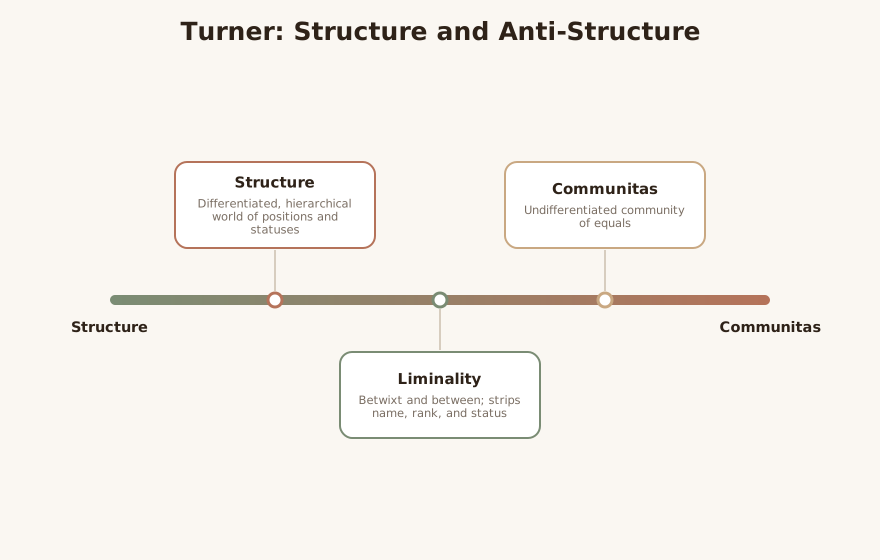
Structure and anti-structure are dialectical. Turner conceived society as oscillating between structure — the differentiated, hierarchical world of social positions and statuses — and communitas, an undifferentiated community of equals 4. Ritual is the mechanism through which a society periodically loosens structure and re-contacts the egalitarian ground beneath it 1.
Liminality is “betwixt and between.” In the liminal phase, participants belong neither to their previous social position nor yet to their new one; the phase strips away name, rank, and status distinction and involves humility, seclusion, and ambiguity 23. Turner described this as the “liberation of human capacities of cognition, affect, volition, creativity, etc., from the normative constraints incumbent upon occupying a sequence of social statuses” 3.
Communitas is direct, equal human connection. Turner coined communitas for “an unstructured state in which all members of a community are equal,” a bond of intense solidarity often forged through a shared rite of passage 3. He characterized it as an I-Thou relation, “the whole man in his relation to other whole men,” and located its emergence not at the center but at the edges: “Communitas breaks in through the interstices of structure, in liminality; at the edges of structure, in marginality; and from beneath structure, in inferiority” 1.
Communitas decays into structure. Turner traced a melancholy trajectory across three types — spontaneous (or existential), normative, and ideological communitas — in which the raw, spontaneous experience is institutionalized and then rationalized into a utopian blueprint 4. He warned that “every spontaneous communitas in history” undergoes a “decline and fall” into structure 1.
Social drama is how conflict gets processed. Turner offered the social drama as a device for surfacing hidden conflict, unfolding in four phases: breach of a norm, crisis as the conflict widens, redressive action (often ritual), and either reintegration or recognition of schism 34.
Interventions & Techniques
Turner did not design therapeutic techniques; what follows are clinical translations of his constructs, offered as a framework rather than an evidence-based protocol LLM. The unit of intervention is usually a group, family, or community rather than an individual, because the theory is fundamentally about collective process LLM.
A clinician working in this lens might deliberately mark transition with ritualized structure — a defined beginning, a bounded “in-between” middle, and a defined re-entry — mirroring van Gennep’s separation–transition–incorporation arc that Turner inherited 3. Within group work, the therapist can cultivate temporary anti-structure: practices that level ordinary hierarchy and status so members meet as equals, which Turner saw as the soil of communitas 1. The “ludic deconstruction” Turner described — distorting familiar cultural forms to provoke reflection — has an obvious cousin in expressive, dramatic, and play-based methods 4.
Mapping a group’s conflict onto the four phases of social drama is itself a technique: naming where a rupture sits (breach, crisis, redress, or reintegration/schism) gives a shared, de-shaming language for what is happening 3. Turner located transformative potential at the margins — “the structurally weak carry cultures’ regenerative capacity” — which translates into deliberately centering marginalized or low-status members during repair work 1.
LLM-generated illustrative example (not a guideline): In a long-running adult process group, a member discloses they have been excluded from after-session contact. The facilitator names this as a breach, lets the crisis surface rather than smoothing it over, then introduces a brief structured ritual — each member speaks one sentence as an equal, hierarchy suspended — to open a redressive, communitas-like space before moving toward reintegration LLM.
Evidence Base
Be precise here, because the word “established” cuts two ways. As a theory within symbolic anthropology, Turner’s framework is firmly established and durably influential; it transgressed static structural-functionalism and reframed ritual as meaningful processual performance, and it spread well beyond anthropology into the humanities and performance studies 46. In that sense the construct is mature LLM.
As a clinical intervention, it is not established at all: there is no body of randomized trials, no manualized protocol, and no outcome evidence presented in these sources for applying ritual anti-structure or social drama as a treatment LLM. Clinicians should treat it as a conceptual map, not as an empirically validated method LLM.
The theory also carries internal critique that a careful clinician should hold. Turner’s own mentor argued the structure/anti-structure split was “too rigid” 4. Later scholars critiqued the communitas concept as oversimplified and idealized 3. And Deflem observes that Turner’s later work on modern “liminoid” phenomena lacked “ethnographic foundation,” becoming “increasingly philosophical and faith-based rather than analytically rigorous” 4. The romance of egalitarian communitas can obscure real power differences that persist even inside the ritual frame LLM.
Populations & Indications
The framework speaks most directly to collectives and to individuals defined by their position in a social order, which maps onto several populations LLM. Communities in conflict are the native habitat of the social-drama model, which was built to surface and track exactly that kind of hidden conflict 4. Marginalized and liminal groups sit where Turner located communitas — at the interstices, margins, and “beneath structure” — so the lens names their experience rather than pathologizing it 1.
People in life transitions are, in Turner’s terms, liminal subjects, “betwixt and between” an old status and a new one 23. Adolescents are a paradigm case: Turner’s Ndembu material centered on adolescent male initiation, in which youths form “a communitarian bond while they are separated from their tribe” 2. Groups in crisis correspond to the crisis phase of social drama, and cultural and ethnic minorities are populations for whom marginality and status are lived, structural facts the theory takes seriously 34.
Problems-for-Work
- Social conflict and intergroup tension can be reframed through the four-phase social drama, giving a group shared language for breach, crisis, and the work of redress 34.
- Community rupture and repair is the central application: ritualized redressive action is precisely the mechanism Turner identified for moving a breach toward reintegration rather than schism 4.
- Role transition distress and status loss map onto liminality — the disorienting “neither here nor there” of a person between social positions 23.
LLM-generated illustrative example (not a guideline): A client newly retired after thirty years describes feeling “invisible” and “between lives.” Naming this as a liminal phase — a real, bounded passage rather than a failure — and co-designing a small marking ritual for the transition can reduce the shame attached to status loss LLM.
- Marginalization and exclusion and alienation are addressed by centering the structurally weak, whom Turner credited with regenerative capacity, rather than treating them as peripheral 1.
- Group identity crisis and collective grief can be held within a deliberately created communitas space — a temporary leveling of hierarchy in which members meet as “whole” persons 1.
- Liminality itself, when it becomes stuck or prolonged, is a problem-for-work: helping a person or group complete the passage into reincorporation 3.
Contraindications, Cautions & Cultural Humility
The first caution is conceptual honesty: this is anthropological theory, not therapy, and presenting it to clients as a validated treatment would misrepresent it LLM. There is no outcome evidence in these sources to support clinical efficacy LLM.
The second caution concerns power and idealization. Communitas has been critiqued as oversimplified and idealized 3, and even Turner conceded — through Gluckman’s challenge — that structure reasserts itself afterward 4. A facilitator who believes a ritual has dissolved hierarchy may simply be blind to the hierarchy still operating; vulnerable or low-status members can be exposed rather than protected by a premature “we are all equal here” frame LLM.
The third concerns cultural appropriation and humility. Turner’s concepts were abstracted from specific Ndembu, Ashanti, and Zulu ceremonies 1; lifting ritual forms out of their cultural home and importing them into clinical work risks decontextualizing and flattening sacred practice LLM. With cultural and ethnic minority clients especially, the clinician’s task is to invite clients’ own rituals of transition and repair, not to impose an anthropologist’s schema onto them LLM. Turner himself noted that authorities invested in the status quo often try to “circumscribe” the subversive potential of rites — a reminder that the power to define a ritual is itself a structural position 2.
Treatment-Plan Suggestions & SMART Objectives
| Goal | SMART objective (example) | Mechanism |
|---|---|---|
| Reduce role-transition distress | Client will identify their current life passage as a bounded liminal phase and name one prior status and one emerging status within 3 sessions | Externalizes “betwixt and between” disorientation as a normal passage rather than personal failure 23 |
| Repair a group rupture | Group will map a current conflict onto the four phases of social drama (breach, crisis, redress, reintegration/schism) in 1 session | Shared, de-shaming language for collective conflict 34 |
| Restore connection after exclusion | Client will participate in 4 consecutive group rituals of equal-voice check-in over 6 weeks | Cultivates communitas; levels hierarchy so members meet as equals 1 |
| Mark a major life transition | Client will co-design and complete one separation–transition–incorporation ritual within 8 weeks | Uses van Gennep’s three-phase arc to give transition a defined end 3 |
| Address marginalization in a group | Group will center one lower-status member’s perspective in each of 4 sessions | Locates regenerative capacity “at the edges of structure” 1 |
| Process collective grief | Group will hold one bounded communitas-style ceremony to acknowledge a shared loss within 4 weeks | Creates temporary anti-structure for shared mourning 14 |
| Complete a stalled passage | Client will articulate and enact one concrete reincorporation step within 5 sessions | Moves a stuck liminal state toward a new, integrated status 3 |
Common Misconceptions
A frequent error is treating anti-structure as disorder or breakdown. Turner’s point was the opposite: dissolving social classifications is generative, “the crucible where art, ritual, and religious expression emerge,” not chaos 1. A second misconception is conflating communitas with community; communitas names a direct, unmediated bond “unmediated by social norms,” whereas ordinary community still operates within the rules of structure 6. A third is imagining communitas as stable and permanent — Turner explicitly argued the opposite, that spontaneous communitas reliably “declines and falls” into structure over time 1. Finally, some assume social drama always resolves; Turner’s fourth phase is reintegration or recognition of schism, meaning some breaches end in lasting division 4.
Training & Certification
There is no certification in ritual anti-structure or social drama, because it is an anthropological theory rather than a credentialed clinical method LLM. The relevant “training” is scholarly: primary engagement with Turner’s The Ritual Process: Structure and Anti-Structure and the secondary literature, including critical readings such as Deflem’s discussion of his processual symbolic analysis 14. For clinicians, the responsible path is to learn the theory as a conceptual frame and to apply it only within methods one is already credentialed in — group psychotherapy, family work, or expressive and drama-based therapies — rather than presenting “ritual therapy” as a standalone, certified discipline LLM.
Key Terms
- Anti-structure — the condition, generated by ritual, in which everyday social classifications are temporarily suspended or inverted; for Turner, a creative rather than chaotic state 16.
- Liminality — the “betwixt and between” transitional phase in which participants are stripped of name, rank, and status and belong to neither old nor new position 23.
- Communitas — an unstructured state of egalitarian solidarity among participants, a direct I-Thou bond beneath hierarchy; exists in spontaneous, normative, and ideological forms 34.
- Social drama — Turner’s four-phase model for processing conflict: breach, crisis, redressive action, and reintegration or schism 34.
- Rite of passage — van Gennep’s three-phase ritual sequence (separation, transition, incorporation) that Turner extended 3.
- Liminoid — Turner’s later term for individually generated, often socially critical cultural performances in complex modern societies, distinguished from collectively integrated tribal liminality 4.
Resources & Further Reading
▶ Watch — a video introduction to this concept:
- Turner, V. — The Ritual Process: Structure and Anti-Structure (overview, Seba Health Library)
- Rite of passage — Victor Turner and anti-structure (Encyclopaedia Britannica)
- Victor Turner (New World Encyclopedia)
- Deflem, M. (1991). Ritual, Anti-Structure, and Religion: A Discussion of Victor Turner’s Processual Symbolic Analysis
- Anthropological Anti-Structure (Court Theatre)
Reflective / Supervision Questions
- When I introduce a “leveling” or equal-voice ritual into a group, am I actually dissolving hierarchy, or am I overlooking the structure that reasserts itself afterward, as Gluckman warned 4? LLM
- For a client in a prolonged life transition, am I helping them complete the passage toward reincorporation, or unintentionally keeping them in liminality 3? LLM
- Whose ritual is it? When I borrow ceremonial forms, am I honoring the client’s own cultural practices of transition and repair, or importing a framework abstracted from other peoples’ sacred ceremonies 1? LLM
- In a current group conflict, can I locate where we sit in the social drama — breach, crisis, redress, or schism — and does naming that change what I do next 4? LLM
- Am I romanticizing communitas in a way that lets me miss who in this group is being exposed rather than protected by the loss of structure 3? LLM