
Type & Discipline
“Liminoid” is a construct from symbolic anthropology, not a treatment model or a diagnostic category 1. It belongs to the family of ideas built around liminality — the threshold or “betwixt-and-between” phase of a transition — and its relationship to modernity 4. The coinage is Victor Turner’s, who derived “liminoid” from the Greek eidos (“form or shape”) to mark experiences that resemble ritual liminality in feel but differ fundamentally in social structure and function 1.
For practicing therapists the relevant point is conceptual rather than technical. The liminoid gives language for a category of experience your clients pursue voluntarily — art, performance, sport, leisure, self-chosen reinvention — that carries some of the transformative charge of ritual but none of its obligation 1. Nothing in the source literature frames the liminoid as an intervention, and this article treats it accordingly: a heuristic for case formulation, not a manualized therapy LLM.
Creators & Lineage
The lineage begins with Arnold van Gennep, who in The Rites of Passage (1909) identified the middle phase of ritual transitions, using the Latin limen (“threshold”) for the central moment between one life stage and the next 4. Van Gennep’s three-part structure — separation, transition (the liminal margin), and reincorporation — established the grammar that Turner later elaborated 4.
Victor Turner systematized liminality from the 1950s onward, establishing it as a cross-cultural anthropological concept and showing that a kind of sacred power emerges when ordinary structural authority is suspended 4. Turner also named communitas — the fellowship and felt unity that arises among people passing through a shared transition together 4. In 1974 he introduced the “liminoid” to describe how these dynamics reappear, transformed, in industrial and post-industrial societies 1.
The concept’s subsequent reach is wide. Scholars have applied the liminal–liminoid pairing to modern sport 2, to tourism and travel experience 6, and to the historical drift of European Carnival from obligatory ritual toward optional spectacle 7. That breadth is part of why it travels usefully into clinical thinking about play, leisure, and chosen transition LLM.
Core Principles
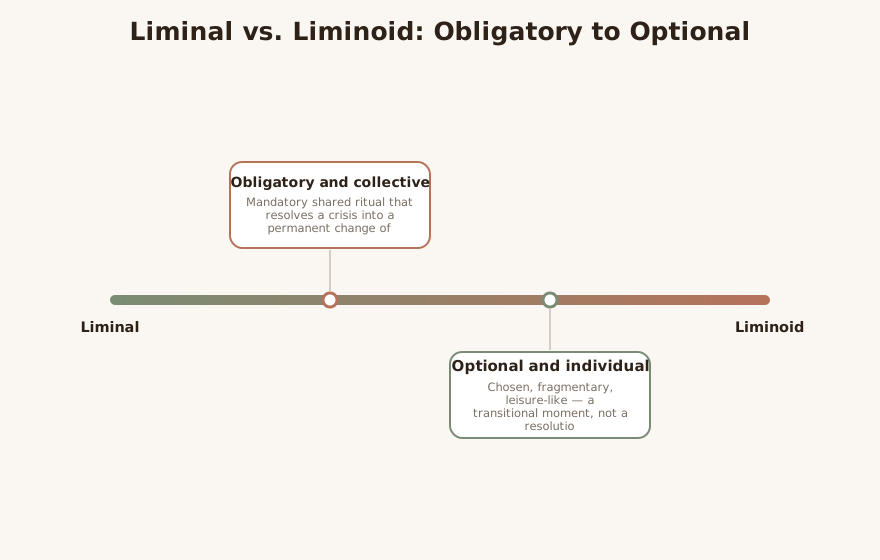
The defining contrast is between the obligatory and the optional. Liminal phases are mandatory, collective rituals embedded in the social or religious order; liminoid phenomena are “optional and do not involve a resolution of a personal crisis” in the binding way ritual does 1. Where the liminal results in a permanent change of status, liminoid experiences “merely serve as transitional moments in time” 1.
A second axis is collective versus individual. Liminal ritual is part of society — a shared rite that everyone of a given status undergoes — whereas the liminoid is “a break from society, part of ‘play’ or ‘playing’” 1. Liminoid genres are “produced by identifiable individuals” rather than authored anonymously by tradition 4. They tend to be “plural and tend to be fragmentary, experimental, idiosyncratic, quirky, subversive, and utopian” 4.
A third axis is the relation of work to play. In tribal and agrarian societies, “work and play are nearly indistinguishable,” interwoven through symbolic gesture and rite; in industrial societies “work and play are entirely separate,” and the liminoid occupies the leisure time that industrialization first made possible 1. Turner located the shift in two movements: society came to emphasize individual choice over collective obligation, and work became “no longer natural, but arbitrary,” divorcing labor from sacred meaning 1. Liminoid genres consequently occur “in leisure time in industrial societies and not within the necessary structures of earning one’s living” 4.
It is worth flagging that this neat binary has been contested. At least one line of scholarship argues the liminal–liminoid distinction is better read as a continuum than as a strict categorical difference 3. For clinical use, the continuum reading is the more honest one: real client experiences sit on a spectrum between obligatory and chosen, collective and solitary LLM.
Interventions & Techniques
There are no liminoid “techniques” in the source literature; the construct supplies a lens, and the clinician supplies the method LLM. In practice the lens does three things. First, it helps you read a client’s voluntary, leisure-like activities — making art, training for a race, traveling, taking a sabbatical — as potentially transformative thresholds rather than as distractions from the “real” work LLM. Second, it reframes self-chosen transitions (a career pivot, gender exploration, leaving a faith community) as liminoid passages the client is authoring, which centers agency LLM. Third, it draws attention to what is missing: a client with no chosen thresholds at all, only obligation, may be describing a leisure or play deficit worth naming LLM.
Operationally, the construct nests inside established modalities rather than replacing them LLM. Within Acceptance and Commitment Therapy, liminoid activities can be framed as values-consistent action and committed behavior the client elects LLM. Within behavioral activation, scheduling chosen, pleasurable, mastery-oriented activity is itself a way of restoring liminoid space for an anhedonic or burned-out client LLM. Within existential and expressive-arts approaches, the liminoid maps onto meaning-making, play, and the deliberate use of the in-between as a site of growth LLM.
LLM-generated illustrative example (not a guideline): A 29-year-old client describes weekend improv classes as “the only time I feel like myself.” Rather than treating this as peripheral, the clinician names it as a liminoid space — chosen, individual, identity-rich — and the pair explore extending its felt freedom into the client’s over-scheduled weekdays LLM.
Evidence Base
Honesty about maturity requires a distinction. The liminoid is an established construct within anthropology and the sociology of leisure — it is durable, widely cited, and applied across sport, tourism, and ritual studies 126. That established status describes its standing as a theoretical concept, not as a clinical method LLM.
There is no body of clinical-trial evidence for “liminoid” as an intervention, because no such intervention exists to test LLM. No randomized or controlled study establishes efficacy for a “liminoid therapy,” and clinicians should not present it to clients or in documentation as an evidence-based treatment LLM. Its legitimate clinical value is heuristic: it organizes case formulation, sharpens questions about play and chosen transition, and informs how you frame interventions drawn from modalities that do have their own evidence bases LLM. Used that way — as a conceptual scaffold layered onto Acceptance and Commitment Therapy, behavioral activation, or existential work — it borrows the evidentiary standing of the host modality and adds interpretive reach, nothing more LLM.
Even within anthropology the framework is not beyond dispute; the categorical binary has been challenged in favor of a continuum model, which is a useful reminder against over-applying a tidy dichotomy to messy clinical lives 3.
Populations & Indications
The construct is most apt with adults living in modern, secular contexts, where obligatory collective ritual is sparse and meaning is more often sought through chosen, individual pursuits 1LLM. It speaks directly to people who pursue meaning through art or leisure, and to creative and performing individuals whose work is their threshold space LLM.
Because the liminoid is defined by choice, it fits people in voluntary therapy and people navigating self-chosen transitions — a deliberate career change, a relocation, a reinvention after divorce or loss LLM. Young adults are a natural population: developmentally engaged in identity work, often outside binding institutional ritual, and frequently constructing their own rites of passage out of travel, subculture, and creative practice LLM. As with any frame, indication is a matter of fit, not of rule — the lens earns its place when a client’s distress clusters around play, meaning, or the management of an in-between LLM.
Problems-for-Work
Loss of meaning and existential distress. When a client reports that life has gone gray and purposeless, the liminoid prompts a specific inquiry: what chosen thresholds, if any, still exist? An absence of self-authored transitional space often co-travels with anomie LLM.
LLM-generated illustrative example (not a guideline): A mid-career engineer says nothing “means anything” since a promotion. Exploring his calendar reveals every hour is obligatory; he has not entered a chosen, liminoid space — a class, a craft, a trip — in three years. The work becomes restoring elective threshold experiences LLM.
Anhedonia and burnout. Burnout collapses the work–play boundary in the wrong direction, letting obligation crowd out chosen leisure entirely; the liminoid names exactly the space that has been lost 1LLM. Behavioral activation that rebuilds elective, pleasurable, identity-affirming activity is, in this frame, the deliberate re-creation of liminoid space LLM.
Identity exploration and self-actualization. Liminoid passages are where modern identity is rehearsed and revised; framing exploration as a chosen threshold normalizes the in-between and centers the client’s authorship 4LLM.
Lack of play / leisure deficits. Some clients present with no vocabulary for non-obligatory activity at all. Naming the liminoid — the legitimacy of chosen, “useless,” playful experience — can itself be the intervention’s pivot LLM.
Contraindications, Cautions & Cultural Humility
The first caution is conceptual overreach. Because the liminoid is intuitive and elastic, it is easy to apply it to everything and thereby explain nothing; the continuum critique is a useful brake on forcing client experience into a clean binary 3LLM. Do not let an elegant frame substitute for an evidence-based method where one is indicated, for example in acute risk, trauma, or severe mood disorder LLM.
The second caution is cultural. Turner’s liminal–liminoid contrast is itself a claim about industrial versus tribal and agrarian societies, and it carries an implicit modernization narrative 1. Clients from communities with living, obligatory collective ritual may experience meaning through the liminal, not the liminoid, and treating chosen individual leisure as the higher or more “evolved” form would be a culturally arrogant error 1LLM. The very distinction has been examined alongside questions of marginal and subaltern space, a reminder that whose thresholds get counted as legitimate is not neutral 7LLM. Hold the construct as one cultural lens among several, and ask rather than assume which kind of threshold carries meaning for this person LLM.
A practical caution: do not pathologize a client who finds meaning in obligation, family, or faith simply because the liminoid valorizes individual choice LLM.
Treatment-Plan Suggestions & SMART Objectives
| Goal | SMART objective (example) | Mechanism |
|---|---|---|
| Restore elective leisure | Client will schedule and attend two self-chosen, non-obligatory activities per week for 6 weeks | Re-establishes liminoid space lost to obligation; behavioral activation LLM |
| Reduce anhedonia | Client will rate enjoyment (0–10) for one chosen creative activity after each session of it, 3x/week for 4 weeks | Reconnects action with felt reward; values-consistent action LLM |
| Support a self-chosen transition | Client will articulate, in writing, the “before / threshold / after” of a current life change by session 4 | Externalizes the liminoid passage and centers agency LLM |
| Address loss of meaning | Client will identify three personal values and one chosen activity expressing each within 3 sessions | Links elective action to meaning; existential and ACT framing LLM |
| Reduce burnout | Client will protect one weekly block of chosen, non-productive time and review adherence weekly for 8 weeks | Rebuilds the work–play boundary the liminoid names LLM |
| Advance identity exploration | Client will sample two new creative or community activities and journal identity reactions across 6 weeks | Uses liminoid space as a low-stakes site for identity rehearsal LLM |
| Build a play repertoire | Client will generate a list of 10 “useless but appealing” activities and try one weekly for 5 weeks | Names and legitimizes play after a leisure deficit LLM |
Common Misconceptions
“Liminoid is just a fancy word for liminal.” No — the whole point of the term is the contrast: liminoid experiences are optional, individual, and a “break from society,” whereas liminal rites are obligatory, collective, and part of the social order 1.
“Liminoid is therapeutically superior to ritual.” The construct describes a historical and structural difference between modern and pre-industrial meaning-making, not a hierarchy of well-being; living collective ritual remains a potent source of meaning for many 1LLM.
“It’s an evidence-based intervention.” It is an established anthropological concept with no clinical-trial base as a treatment; its clinical use is interpretive LLM.
“The line between liminal and liminoid is sharp.” Influential commentary argues the distinction is better understood as a continuum, and client experience routinely sits in between 3.
Training & Certification
There is no certification, credential, or formal training pathway in “the liminoid,” and clinicians should be wary of any program implying otherwise LLM. Competence here means two things: familiarity with the source anthropology — Van Gennep’s rites of passage, Turner’s liminality and communitas, and the liminal–liminoid distinction — and genuine credentialed training in whichever evidence-based modality you nest the lens inside 4LLM. The construct is a reading skill layered on top of established practice, not a separate practice to be certified in LLM.
Key Terms
- Liminal: The obligatory, collective threshold phase of a rite of passage, embedded in the social order and yielding permanent status change 14.
- Liminoid: The optional, individual, leisure- and art-like analogue of the liminal in industrial societies — chosen, fragmentary, and a “break from society” 1.
- Limen: Latin for “threshold,” the root of both terms and the name for the in-between of transition 4.
- Communitas: The felt fellowship and unity arising among those sharing a transitional passage 4.
- Rite of passage: Van Gennep’s three-phase structure of separation, transition, and reincorporation 4.
- Continuum reading: The view that liminal and liminoid mark ends of a spectrum rather than two discrete categories 3.
Resources & Further Reading
▶ Watch — a video introduction to this concept:
- Liminality (Liminoid section) — Wikipedia
- Liminality — Encyclopedia.com
- Modern Sports: Liminal Ritual or Liminoid Leisure? — D. Rowe (chapter PDF)
- Categorical difference versus continuum: Rethinking Turner’s liminal–liminoid distinction
- Limenscape: Operationalizing the Liminoid and the Liminal in Tourism
- The European Carnival from Liminal to Liminoid
Reflective / Supervision Questions
- For this client, which thresholds are chosen and which are obligatory — and which kind seems to carry meaning for them LLM?
- Am I treating individual, leisure-based meaning-making as superior to collective ritual, and is that a cultural bias of mine or a genuine fit for this person 1LLM?
- Where on the liminal–liminoid continuum does this client’s experience actually sit, rather than which box does it fit 3LLM?
- Have I named the liminoid as a lens, or am I drifting into presenting it as an evidence-based treatment LLM?
- If this client has no chosen thresholds at all, is the clinical target a leisure or play deficit — and which established modality should carry that work LLM?