
MDMA-assisted therapy is an investigational treatment in which a small number of supervised MDMA dosing sessions are embedded within a manualized course of psychotherapy, developed and tested primarily for severe and chronic posttraumatic stress disorder 1. The drug is not framed as a daily medication but as a time-limited catalyst delivered across a few all-day sessions, each flanked by preparatory and integrative non-drug sessions 13. Its defining clinical rationale is that MDMA’s acute effects — reduced fear and defensiveness, increased trust, and tolerable access to traumatic material — create a window in which a person can engage emotionally with memories that are otherwise too overwhelming to process 5.
Type & Discipline
This is a psychedelic-assisted therapy modality at the intersection of psychiatry, psychopharmacology, and trauma-focused psychotherapy LLM. MDMA is an entactogen rather than a classic serotonergic psychedelic, and the treatment is conceived as drug-plus-therapy: neither component is offered alone, and the protocol explicitly couples each dosing day to surrounding psychotherapeutic work 13. An honest framing caveat applies throughout: the controlled efficacy evidence concerns the combined drug-and-therapy package as tested in trials, while the specific contributions of the molecule versus the psychotherapy remain difficult to disentangle 5. The treatment is not approved for clinical use; in August 2024 the U.S. Food and Drug Administration declined the New Drug Application and requested an additional Phase 3 trial 45.
Creators & Lineage
The modern protocol was developed chiefly by psychiatrist Michael Mithoefer and his collaborator Annie Mithoefer, who authored the manualized therapy model, with the trial program sponsored and championed by Rick Doblin and the Multidisciplinary Association for Psychedelic Studies (MAPS) 3. The Phase 3 trials were led by Jennifer Mitchell and a multisite team 12. The modality’s clinical lineage draws on trauma-focused psychotherapy and on prolonged exposure therapy’s insight that fear memories must be activated to be modified, while differing in its non-directive, inner-directed stance 5. It also borrows from psychedelic-assisted psychotherapy more broadly and, in its emphasis on parts and self-compassion, resonates with Internal Family Systems approaches to working with trauma LLM. MDMA itself was used in psychotherapy in the late 1970s and early 1980s before its scheduling, and the contemporary program represents a formalized, regulated revival of that earlier practice 5.
Core Principles
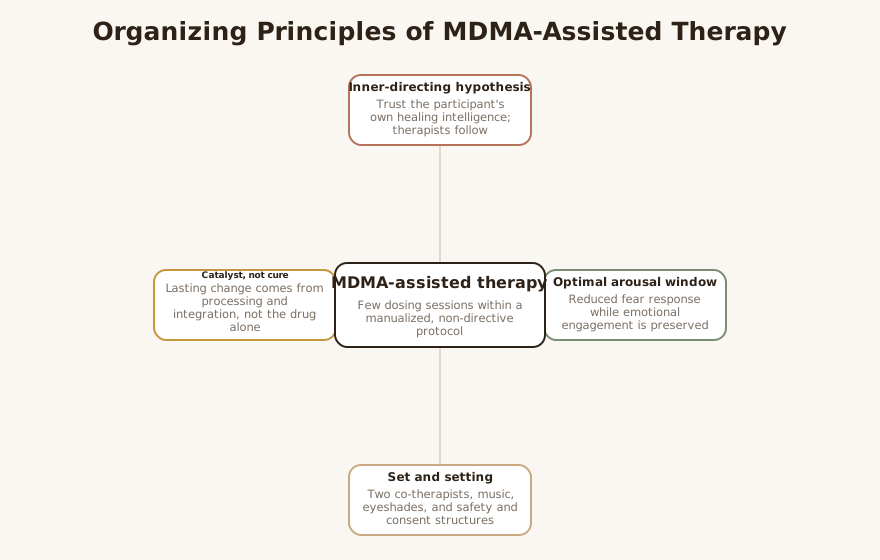
The first organizing principle is the inner-directing hypothesis: under MDMA, the participant’s own healing intelligence is trusted to guide the session, and therapists follow rather than steer the emerging material 3. A second principle is the optimal arousal window — MDMA is thought to reduce amygdala-driven fear responses while preserving emotional engagement, allowing traumatic memories to be revisited without the overwhelming hyperarousal or dissociative shutdown that derails standard trauma work 5. A third principle is set and setting: dosing occurs in a comfortable room with two co-therapists present for the full session, with music, eyeshades available, and explicit safety and consent structures 3. A fourth principle is that the drug is a catalyst, not a cure: durable change is expected to come from the psychotherapeutic processing and integration that the medicine makes possible, not from the medicine alone 1.
Interventions & Techniques
The manualized protocol delivers therapy in three phases across roughly 12 weeks 1. Preparatory non-drug sessions build rapport, establish intention and the therapeutic frame, and orient the participant to the inner-directed approach before any dosing 1. The experimental sessions consist of two or three monthly all-day MDMA sessions (typically about 8 hours each) conducted by a male-female co-therapist pair, alternating periods of inward focus with eyeshades and music and periods of direct dialogue about whatever arises 13. Each dosing day is followed by integrative non-drug sessions — including an overnight stay and a next-morning session — that help the participant make meaning of the experience and consolidate insight into daily life 1. Across the Phase 3 design, participants received three blinded dosing sessions interspersed with these therapy sessions, and outcomes were measured by independent, blinded raters using the Clinician-Administered PTSD Scale (CAPS-5) 12.
Evidence Base
The evidence base is genuinely emerging, and patients should be told so plainly 5. The two most rigorous studies are the MAPP1 and MAPP2 Phase 3 randomized, double-blind, placebo-controlled trials 12. In MAPP1 (severe PTSD, n=90), MDMA-assisted therapy produced significantly greater reductions in CAPS-5 severity than therapy with placebo, with a large between-group effect size, and significantly improved functional impairment 16. The confirmatory MAPP2 trial (moderate to severe PTSD, n=104) replicated the benefit, again showing significantly greater CAPS-5 reduction than placebo with therapy 2. Across both trials a majority of participants no longer met PTSD diagnostic criteria after treatment, and many achieved remission 2. Despite these results, the FDA declined approval in 2024 and requested another trial, citing methodological concerns including the difficulty of maintaining the blind (functional unblinding, since most participants can tell whether they received MDMA), questions about the contribution and standardization of the psychotherapy, expectancy effects, and data-integrity and conduct concerns raised about the program 45. These limitations — functional unblinding, small samples relative to a novel paradigm, and the entanglement of drug and therapy effects — are the core caveats every clinician should hold 5.
Populations & Indications
The studied indication is PTSD, with trials enrolling adults with chronic, often long-standing disorder 12. MAPP1 specifically targeted severe PTSD, and participants commonly had years of symptoms and frequent prior treatment failures, making the program directly relevant to treatment-resistant presentations 16. Enrolled populations spanned trauma arising from combat, sexual assault and abuse, childhood and developmental trauma, and other sources, encompassing survivors with complex trauma histories and high rates of comorbidity such as depression 13. Veterans and first responders are populations of particular interest given high PTSD burden and limited response to existing treatments, and MAPS framed the program around unmet need in exactly these groups 3. No indication outside PTSD has Phase 3 support, and the treatment is not currently available for clinical use in any of these populations 4.
Problems-for-Work
Clinically, the modality is being explored across the symptom clusters of PTSD and its common comorbidities LLM.
- Treatment-resistant PTSD: the lead use case, where standard trauma-focused therapies and pharmacotherapy have not produced remission 16.
LLM-generated illustrative example (not a guideline): A veteran with chronic combat-related PTSD who has not improved after trials of sertraline and prolonged exposure might, in a research setting, use preparatory sessions to build safety and intention, then process previously inaccessible memories during monitored dosing days, with integration work translating those shifts into reengaging avoided activities LLM.
- Trauma-related avoidance and emotional numbing: the reduced fear response during dosing is hypothesized to let participants approach, rather than flee, traumatic material 5.
- Hyperarousal, hypervigilance, and dissociation: the optimal-arousal rationale targets exactly the over- and under-modulated states that obstruct standard trauma processing 5.
- Comorbid depression and trauma-related shame and guilt: improvements in functioning and secondary measures were observed alongside PTSD reduction in trials 12.
- Social and relational withdrawal: functional-impairment gains in MAPP1 point to potential downstream effects on engagement and relationships 1.
Contraindications, Cautions & Cultural Humility
MDMA has sympathomimetic effects that transiently raise heart rate and blood pressure, so cardiovascular screening and medical monitoring during dosing are essential, and uncontrolled hypertension or significant cardiac disease is a relevant exclusion 5. Trial protocols excluded primary psychotic disorders and bipolar I disorder, and these histories warrant the same caution given the intensity of the experience LLM. Serotonergic interactions are a concern, and SSRIs were typically tapered before dosing because they can blunt MDMA’s effects and raise serotonin-toxicity risk; any medication change must be physician-managed LLM. The treatment is not a take-home medication, and the entire model depends on a controlled setting with two trained therapists present, making unsupervised self-treatment a serious hazard 3. The presence of two therapists alone with a disinhibited, suggestible participant for many hours also raises real boundary and safety risks; reports of misconduct in the program underscore the need for robust supervision, consent, and oversight safeguards 4. Cultural humility requires acknowledging that PTSD presents differently across communities, that access to such intensive treatment is inequitable, and that trust in psychiatric research is unevenly distributed across populations harmed by prior research LLM.
Treatment-Plan Suggestions & SMART Objectives
| Goal | SMART objective (example) | Mechanism |
|---|---|---|
| Reduce PTSD symptom severity | Patient reduces CAPS-5 (or PCL-5) score by a clinically meaningful margin over the 12-week protocol | Fear-attenuated reprocessing of trauma memory across dosing and integration 1 |
| Lower trauma-related avoidance | Patient resumes 2 previously avoided activities within 12 weeks of completing the protocol | Reduced acute fear response enabling approach rather than escape 5 |
| Strengthen integration of dosing experiences | Patient completes all integrative non-drug sessions and logs 3 insights applied to daily life | Consolidation of acute insight into durable behavioral change 1 |
| Improve emotional regulation between sessions | Patient tracks arousal, sleep, and triggers daily, reviewed each integration session | Stabilizing gains and managing post-session activation LLM |
| Address trauma-related shame and guilt | Patient identifies and reframes 2 self-blaming trauma appraisals over the protocol | Self-compassion and reduced defensiveness during processing 5 |
| Ensure safety and informed consent | Patient and clinician complete cardiovascular and psychiatric screening and a written safety plan before any dosing | Risk mitigation for sympathomimetic and serotonergic events 5 |
| Reduce comorbid depressive burden | Patient lowers a depression measure by a clinically meaningful margin over 12 weeks | Secondary mood improvement observed alongside PTSD reduction 2 |
| Sustain gains after treatment | Patient develops a written relapse-prevention and maintenance plan before the final integration session | Psychotherapeutic consolidation of a time-limited drug course 1 |
Common Misconceptions
A frequent misconception is that MDMA-assisted therapy is approved or available as standard care; in fact the FDA declined the application in 2024 and the treatment remains investigational pending further study 45. Another is that the drug itself is the treatment, whereas the model is explicitly drug-plus-psychotherapy, with durable change attributed to the surrounding therapeutic processing 13. A third is that “MDMA” in this context equals recreational “ecstasy” — trials use pharmaceutical-grade MDMA at controlled doses in a monitored setting, which differs fundamentally from unregulated street use of unknown purity 5. A fourth is that the positive Phase 3 results settle the question; the difficulty of blinding participants to a drug they can clearly feel, plus conduct and expectancy concerns, were central to the FDA’s request for more data 45.
Training & Certification
There is no licensed, board-recognized certification for delivering MDMA-assisted therapy outside of research, reflecting the drug’s Schedule I status and the lack of FDA approval 4. Within the trial program, therapy was delivered by trained two-person co-therapist teams following a specific treatment manual, with adherence monitoring built into the protocol 13. MAPS developed a structured therapist training program tied to the manualized model, but completion of such training does not confer legal authority to provide the treatment clinically while it remains unapproved 3. Until regulatory approval and a finalized protocol exist, clinicians are best positioned to build competence in evidence-based trauma-focused psychotherapy and in general psychedelic preparation and integration work within their lawful scope, and to refer interested patients only to legitimate, regulated research LLM.
Key Terms
- Entactogen: a class of substances, including MDMA, that increase feelings of emotional openness, trust, and connection, distinct from classic psychedelics 5.
- Inner-directed approach: the non-directive stance in which therapists follow the participant’s own emerging process rather than steering it 3.
- Co-therapist dyad: the male-female pair of therapists present for the entire dosing session 1.
- CAPS-5: the Clinician-Administered PTSD Scale used by blinded independent raters as the primary outcome in the Phase 3 trials 1.
- Functional unblinding: the loss of the double blind that occurs because participants can usually tell whether they received MDMA, a key methodological criticism 5.
- Complete Response Letter: the FDA communication declining the application and specifying what additional data, including a further trial, would be required 4.
Resources & Further Reading
▶ Watch — a video introduction to this concept:
- MDMA-assisted therapy for severe PTSD: Phase 3 study, MAPP1 (Mitchell et al., 2021, Nature Medicine)
- MDMA-assisted therapy for moderate to severe PTSD: Phase 3 trial, MAPP2 (Mitchell et al., 2023, Nature Medicine)
- MDMA-Assisted Therapy for PTSD — Phase 3 program overview (MAPS)
- FDA Releases Complete Response Letter on Declining MDMA-Assisted Therapy for PTSD (Psychiatric Times)
- FDA rejects MDMA-assisted therapy for PTSD — a researcher explains the challenges (The Conversation)
- MDMA-assisted therapy for severe PTSD — PubMed record (Mitchell 2021)
Reflective / Supervision Questions
- How would I explain to an interested patient that two positive Phase 3 trials still did not lead to approval, without either over-selling the treatment or dismissing their hope? 4
- Given that participants can usually tell whether they received MDMA, how do I weigh the trial results against the functional-unblinding critique in my own clinical reasoning? 5
- What screening — cardiovascular, psychiatric, and medication-related — would I consider essential before supporting any research referral? 5
- How do I think about the boundary, consent, and safety risks of long dosing sessions, and what oversight would make me comfortable that they are managed? 4
- Where does my scope of practice end with an investigational, Schedule I treatment, and how do I refer responsibly to legitimate regulated research? LLM
- How does the inner-directed model differ from the directive structure of prolonged exposure, and what does each stance assume about how trauma heals? 5