
Type & Discipline
Cognitive-Behavioral Play Therapy (CBPT) is a modality that sits at the intersection of two traditions: the empirically grounded family of cognitive-behavioral therapies and the developmental craft of play therapy 1. It is best understood not as a wholly new theory but as a developmental adaptation — a translation of cognitive and behavioral techniques into the language young children actually use, which is play 1. The discipline it belongs to is play therapy, but its theoretical spine is cognitive-behavioral 2.
The defining problem CBPT solves is a developmental mismatch. Standard CBT assumes a client who can identify, articulate, and reason about thoughts and feelings in abstract verbal terms — a capacity that does not reliably emerge until later childhood 1. Preschoolers, by contrast, are in what developmental psychology describes as a preoperational stage, where understanding is concrete, symbolic, and expressed through action and pretend rather than through verbal introspection LLM. CBPT was designed to bridge that gap by delivering CBT’s active ingredients — psychoeducation, modeling, exposure, contingency management, and cognitive change — through toys, puppets, stories, and structured play 2.
CBPT is more structured and goal-directed than traditional nondirective play therapy, while remaining more developmentally flexible and play-based than manualized verbal CBT 1. The therapist is an active participant who brings materials, sets up scenarios, and introduces adaptive coping into the play, rather than purely following the child’s lead 2.
Creators & Lineage
CBPT was developed by Susan M. Knell, a clinical psychologist, who first articulated the approach systematically in her 1993 book Cognitive-Behavioral Play Therapy and in subsequent peer-reviewed and handbook publications 3 1. Knell remains the central figure associated with the model and its ongoing dissemination 5.
The lineage is explicitly hybrid. From cognitive-behavioral therapy CBPT inherits its emphasis on the relationship between cognition, emotion, and behavior, and its toolkit of behavioral and cognitive interventions 1. From behavior therapy and social learning theory it draws modeling, shaping, systematic desensitization, and contingency-based reinforcement 2. From the broader play therapy tradition — including its psychodynamic and humanistic roots — it inherits the conviction that play is the natural medium of communication and emotional expression for young children, and that the therapeutic relationship is foundational 1. And from developmental psychology, particularly Piagetian accounts of cognitive development, it takes the constraint that interventions must match the child’s concrete, symbolic mode of thinking rather than presuming adult-style verbal abstraction LLM.
What Knell contributed was the integration itself: a coherent framework in which cognitive-behavioral change strategies are embedded inside developmentally appropriate play, with the child as an active rather than passive participant in their own treatment 1 6.
Core Principles
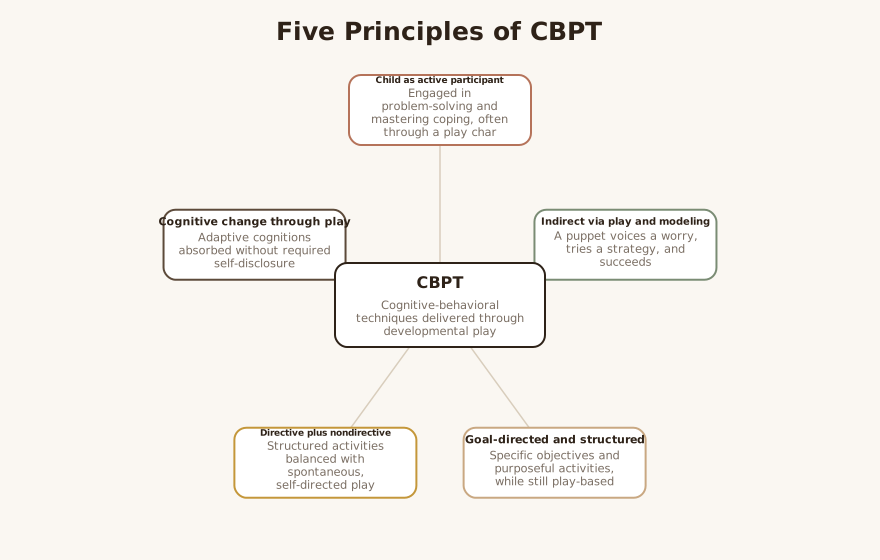
Several principles distinguish CBPT from both generic play therapy and verbal CBT 2.
First, the child is an active participant in change. Rather than being a passive recipient of interpretation, the child is engaged in problem-solving and in mastering coping behaviors, often vicariously through a play character 1.
Second, interventions are delivered indirectly through play and modeling. A puppet or stuffed animal that voices a worry, tries a coping strategy, and succeeds allows the child to absorb adaptive cognitions and behaviors without being asked to perform self-disclosure they are not developmentally ready for 2.
Third, treatment is goal-directed and structured while still being play-based 1. The therapist has specific objectives and brings purposeful activities, distinguishing CBPT from purely nondirective approaches 2.
Fourth, CBPT combines directive and nondirective elements. Knell describes a balance: the therapist introduces structured, goal-oriented activities while also leaving room for the child’s spontaneous, self-directed play, which provides assessment information and preserves the child’s sense of control 6.
Fifth, cognitive change is pitched to the child’s developmental level. Maladaptive beliefs are addressed through concrete, often positive self-statements modeled in play rather than through Socratic verbal disputation 1. The aim is to introduce and reinforce adaptive coping cognitions the child can actually use 2.
Sixth, generalization and relapse prevention are built in, with attention to helping new skills transfer beyond the playroom into home and school settings 2.
Interventions & Techniques
CBPT draws on a recognizable set of cognitive-behavioral techniques, each adapted to play 2.
- Modeling. A puppet, doll, or the therapist demonstrates an adaptive behavior or coping statement so the child can learn vicariously and then imitate it 1.
- Systematic desensitization and graduated exposure. Feared stimuli are introduced gradually within play, paired with relaxation or mastery, to reduce anxiety responses 2.
- Contingency management and positive reinforcement. Desired behaviors are reinforced, and reward systems (often concrete and visual) are used to shape behavior 2.
- Positive self-statements and cognitive change. Adaptive self-talk is voiced by play characters and gradually adopted by the child to counter maladaptive beliefs 1.
- bibliotherapy and storytelling. Books and therapist-created stories present a character facing the child’s problem and resolving it adaptively, supplying a model and a vocabulary 2.
- Role-play and rehearsal. The child practices new responses in a safe, pretend frame before facing the real situation LLM.
LLM-generated illustrative example (not a guideline): With a child who has separation anxiety, a clinician might use a “brave bunny” puppet who feels scared when its mother bunny leaves for work. Over sessions, the bunny rehearses a coping statement (“Mama always comes back, and I can play while I wait”), is praised by the therapist when it copes, and gradually tolerates longer separations in the play scenario — modeling, exposure, reinforcement, and cognitive change folded into a single play sequence LLM.
Assessment in CBPT is typically multimodal and ongoing, combining caregiver report, observation of the child’s spontaneous play, and the child’s responses to structured tasks, with treatment adjusted accordingly 2.
Evidence Base
The maturity of CBPT’s evidence base is best described as established but uneven, and clinicians should hold that distinction honestly LLM. The foundation on which CBPT rests — cognitive-behavioral therapy and its component techniques such as modeling, exposure, and reinforcement — is among the most empirically supported in all of psychotherapy 1. CBPT inherits that empirical pedigree because its active ingredients are well-validated CBT procedures, simply delivered through play 2.
The evidence for CBPT as a discrete, manualized package, however, is considerably thinner than the evidence for CBT in older children and adults 1. Much of the supporting literature consists of conceptual articles, clinical case illustrations, and reviews rather than large randomized controlled trials specific to the CBPT protocol 1 7. Reviews of CBPT describe favorable effects on children’s psychological development and emotional and behavioral functioning, but the dedicated trial base for young children remains modest relative to verbal CBT 7.
The practical implication is that CBPT is a defensible, theory- and evidence-informed choice for young children precisely because it operationalizes evidence-based CBT mechanisms in a developmentally accessible form — while clinicians should avoid overstating the strength of CBPT-specific outcome research LLM. Framing matters in documentation and in conversations with families: CBPT delivers established CBT techniques to a developmental population for whom standard verbal CBT is a poor fit 1.
Populations & Indications
CBPT was designed specifically for young children, roughly ages 2 to 6, including preschoolers whose verbal and abstract-reasoning capacities are not yet adequate for standard verbal CBT 1 2. This developmental targeting is the model’s central rationale and its primary indication 1.
Within that age band, CBPT has been applied to children presenting with anxiety, trauma histories, behavioral and oppositional problems, and selective mutism, among other concerns 2 7. It is indicated when a young child has identifiable target symptoms that lend themselves to behavioral and cognitive intervention, when caregivers can be engaged to support generalization, and when the child’s developmental level makes play the appropriate communicative medium LLM.
CBPT is also well-suited to children whose distress is situational or symptom-focused — for example, a specific phobia or an adjustment reaction — where structured, goal-directed play can target the problem efficiently LLM.
Problems-for-Work
CBPT has been described and applied across a range of early-childhood clinical problems 2. Below are representative problems with brief notes on application.
- Childhood anxiety disorders and phobias. Graduated exposure within play, paired with modeled coping statements, addresses fears at a developmentally appropriate pace 2. Application: a puppet who is afraid of the dark practices increasingly brave bedtime routines LLM.
- Separation anxiety disorder. Play scenarios rehearse separations and reunions while reinforcing the belief that caregivers return LLM.
- Selective mutism. Shaping and reinforcement of incremental verbal and nonverbal communication, often beginning through low-pressure play and characters, gradually expands the child’s speaking 2.
- PTSD and trauma in children. Play provides a titrated, child-controlled medium for processing traumatic material, with adaptive coping and corrective cognitions introduced through characters 2.
- Behavioral problems and oppositional behavior. Contingency management, reinforcement, and modeling of prosocial behavior target disruptive patterns 2.
- Encopresis. CBPT has been applied to elimination problems using behavioral techniques and concrete, play-based psychoeducation about the body and toileting 1.
- Adjustment difficulties. Structured play helps a child make sense of and adapt to stressors such as a move, divorce, or new sibling LLM.
- Emotional dysregulation and low self-esteem. Modeled self-statements and mastery experiences in play build affect-coping skills and a more positive self-view 1.
Contraindications, Cautions & Cultural Humility
CBPT is not a universal solution, and several cautions apply LLM.
The most basic caution is developmental fit in the other direction: older children and adolescents who can engage verbally may be better served by standard CBT or other age-appropriate modalities, and a play-based frame can feel infantilizing to them LLM. Conversely, CBPT presumes the child can engage in symbolic play; profound developmental delay or certain disabilities may require further adaptation LLM.
Acute safety and complex trauma require care. Where there is ongoing abuse, severe neglect, or acute risk, stabilization, safety planning, and coordination with caregivers and systems take precedence, and trauma processing should be paced to avoid retraumatization LLM. CBPT is not a substitute for child-protection action when a child is unsafe LLM.
Caregiver involvement is often essential for generalization; the absence of an engaged caregiver to support skills at home is a practical limitation rather than a contraindication, but it should shape expectations 2.
On cultural humility: play themes, toys, family structures, expressions of emotion, and beliefs about child behavior and mental health vary widely across cultures, and a clinician’s assumptions about “adaptive” cognitions or “normal” play are not culturally neutral LLM. Materials should reflect the child’s world; coping statements and reinforcement systems should be negotiated with families rather than imposed; and the clinician should remain curious about what a behavior or play theme means within the family’s cultural context before pathologizing it LLM.
Treatment-Plan Suggestions & SMART Objectives
| Goal | SMART objective (example) | Mechanism |
|---|---|---|
| Reduce separation anxiety | Within 8 weeks, child will tolerate separation from caregiver at drop-off with crying lasting under 5 minutes on 4 of 5 days, per caregiver log | Graduated exposure + modeled coping statements in play 2 |
| Increase speech in selective mutism | Within 10 sessions, child will speak audibly to the therapist during structured play in 3 consecutive sessions | Shaping and positive reinforcement of incremental communication 2 |
| Decrease specific phobia | Within 6 weeks, child will approach and remain near the feared stimulus for 2 minutes without escape behavior | Systematic desensitization within play 2 |
| Reduce oppositional behavior | Within 4 weeks, child will follow a 2-step caregiver instruction on first ask 70% of opportunities, per home chart | Contingency management and modeling of compliance 2 |
| Build affect-coping skills | Within 8 sessions, child will name a feeling and use one taught coping strategy in play on 3 occasions | Modeled self-statements and rehearsal 1 |
| Improve self-esteem | Over 8 weeks, child will spontaneously voice one positive self-statement per session for 3 consecutive sessions | Adaptive self-talk modeled by play characters 1 |
| Resolve encopresis | Within 6 weeks, child will complete the toileting routine with 0 soiling accidents for 5 consecutive days, per log | Behavioral techniques plus play-based psychoeducation 1 |
| Process a traumatic event | Within 10 sessions, child will represent and resolve the event in play with reduced distress, per observation and caregiver report | Titrated, child-controlled exposure with corrective cognitions 2 |
Common Misconceptions
“It’s just playing with the child.” CBPT is structured, goal-directed, and built around specific cognitive-behavioral techniques; the play is the vehicle, not the absence of method 1 2.
“It’s the same as nondirective play therapy.” CBPT is more directive and treatment-focused than purely child-led approaches, though it deliberately preserves space for the child’s spontaneous play 6 1.
“It’s just CBT with toys.” While it operationalizes CBT mechanisms, CBPT is grounded in the developmental reality that young children process through symbolic action, and it requires genuine play-therapy skill, not a mechanical translation of a verbal protocol 1.
“There’s no role for the relationship because it’s behavioral.” CBPT retains play therapy’s emphasis on the therapeutic relationship as a foundation for change 1.
“The evidence is as strong as adult CBT.” The CBT techniques are well-supported, but CBPT-specific outcome trials in young children are more limited, and clinicians should represent that honestly 1 7.
Training & Certification
There is no single mandatory credential to “practice CBPT,” but competent practice rests on two skill sets that should be developed deliberately: grounding in cognitive-behavioral therapy and its techniques, and training in play therapy and child development LLM. Clinicians typically come to CBPT as licensed mental-health professionals who already work with children and then build CBPT-specific knowledge through Knell’s foundational text and subsequent writings 3 2.
Resources affiliated with the model — including the CBPT homepage and materials associated with Susan Knell — provide orientation, professional information, and continuing education relevant to the approach 4 5. As with any child modality, ongoing supervision and consultation are strongly advisable while developing competence LLM.
Key Terms
- CBPT (Cognitive-Behavioral Play Therapy): Knell’s integration of CBT techniques with developmentally appropriate play for young children 1.
- Modeling: Teaching adaptive behavior or cognition by having a character or therapist demonstrate it for the child to imitate 1.
- Systematic desensitization: Graduated exposure to a feared stimulus paired with a competing relaxation or mastery response 2.
- Contingency management: Systematic use of reinforcement and consequences to shape behavior 2.
- Positive self-statements: Adaptive, concrete coping cognitions modeled and reinforced in play to counter maladaptive beliefs 1.
- Directive vs. nondirective balance: CBPT’s deliberate combination of therapist-structured activities and child-led spontaneous play 6.
- Generalization: Transfer of skills learned in the playroom to home, school, and other settings 2.
- Preoperational stage: The Piagetian developmental period in which young children think concretely and symbolically rather than abstractly, underpinning CBPT’s rationale LLM.
Resources & Further Reading
▶ Watch — a video introduction to this concept:
- Knell, S. M. (1998). Cognitive-behavioral play therapy. Journal of Clinical Child Psychology, 27(1), 28-33.
- Knell, S. M. Cognitive-Behavioral Play Therapy — Handbook of Play Therapy, Ch. 6 (Wiley).
- Knell, S. M. Cognitive-Behavioral Play Therapy — foundational book.
- Cognitive Behavioral Play Therapy (CBPT) homepage.
- Susan M. Knell — CBPT.org profile.
- Q&A with Susan Knell on Cognitive Behavioral Play Therapy — Psychwire.
- General Review on Cognitive Behavior Play Therapy on Children’s Psychological Development (PDF).
Reflective / Supervision Questions
- For a given young client, how do I know that play, rather than verbal CBT or another modality, is the developmentally appropriate medium — and what would change my mind? LLM
- When I introduce a coping statement or “adaptive” cognition through a play character, whose values am I encoding, and have I checked them against the family’s cultural context? LLM
- Am I clear in my own documentation and in conversation with caregivers about the difference between the strong evidence for CBT techniques and the more limited evidence for the CBPT package? LLM
- How am I balancing directive structure with space for the child’s spontaneous play, and what is each contributing to assessment and to change? 6
- What is my plan for generalization beyond the playroom, and how am I engaging caregivers to support it? 2
- Where complex trauma or safety concerns are present, am I confident that stabilization and protection precede processing? LLM