
Type & Discipline
Child-Centered Play Therapy (CCPT), historically called nondirective play therapy, is a manualized modality within the discipline of play therapy 3. It belongs to the humanistic/person-centered family, applying Carl Rogers’s client-centered conditions to the developmental world of the child rather than adapting adult talk therapy downward 3. CCPT treats the therapist-child relationship itself as the primary mechanism of change, not a vehicle for delivering techniques 3. Because most children below roughly age 11 lack the abstract verbal capacity that adult psychotherapy assumes, play is treated as the child’s natural language for expressing feelings, experiences, and conflicts 1. The modality is built for individual work with children, typically ages 3 to 10, conducted in a dedicated playroom 3. It is sometimes confused with generic “play therapy,” but CCPT is a specific theoretical school with defined skills, a defined stance, and an explicit philosophy of non-direction 3.
Creators & Lineage
CCPT originates with Virginia Axline (1947), who applied Rogers’s (1951) person-centered counseling approach to children and trusted their capacity to resolve their own problems through play 3. Axline’s account of treatment in Dibs in Search of Self helped popularize the modality as a credible psychotherapeutic treatment for children 1. The lineage was extended by Clark Moustakas, Haim Ginott, Louise and Bernard Guerney, and most prominently Garry Landreth, whose Play Therapy: The Art of the Relationship codified the contemporary relationship-centered practice 7. Landreth and colleagues at the University of North Texas Center for Play Therapy, including Dee Ray and Sue Bratton, produced the manualization (Ray, 2011) and the meta-analytic research that define the modern evidence base 3. The Guerneys’ development of filial therapy in the early 1960s, teaching parents to conduct child-centered play sessions, is a direct outgrowth of this lineage and later informed Landreth’s 10-session Child-Parent Relationship Therapy (CPRT) 1. CCPT thus sits at the intersection of humanistic psychology, person-centered therapy, and the broader play therapy field 3.
Core Principles
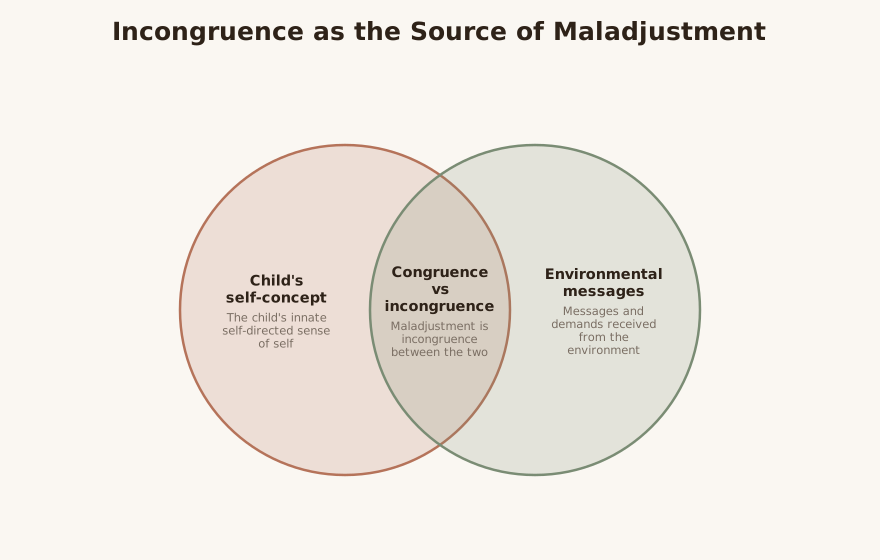
CCPT rests on the person-centered premise that every child carries an innate self-actualizing drive toward independence, maturity, and self-direction 3. Maladjustment is understood as incongruence between the child’s self-concept and the messages or demands received from the environment, not as an internal deficit to be corrected 3. The therapist therefore builds a relationship with the child, not with the diagnosis, and views problem behaviors as the child’s attempt to be seen, heard, and accepted 3. Axline (1947) articulated the operating principles still taught today: primacy of the relationship, genuine acceptance, permissiveness, a sense of safety, attunement to feelings, belief in the child’s capacity to solve problems, allowance of child-directed play, patience with the child’s process, and the judicious use of limits 3. The therapist trusts the child’s inner direction and resists guiding the content or goals of the session 3. The defining feature is that the child leads: the child decides what to play, and the therapist follows empathically rather than instructing, interpreting heavily, or rewarding 3.
Interventions & Techniques
CCPT is delivered in a playroom stocked with deliberately selected materials grouped into real-life, acting-out/aggressive-release, and creative/expressive categories, all kept visible so the child can choose freely 3. Rather than prescribed activities, the therapist uses a defined set of verbal responses that communicate acceptance and understanding 3. These include reflecting feelings (“You feel angry”), reflecting content (“You got in trouble at school”), tracking behavior (“You’re picking that up”), facilitating decision-making (“You can decide”), facilitating creativity (“That can be whatever you want”), encouraging (“You figured it out”), and facilitating relationship (“You want me to know that you like me”) 3. Limit-setting is itself a core skill, used to keep the child, therapist, and playroom safe while preserving the permissive frame 3. Crucially, the therapist does not direct play toward a target, does not pose leading questions, and does not impose interpretations the child has not reached 3.
LLM-generated illustrative example (not a guideline): A 6-year-old buries a baby doll under blocks, then digs it out, repeatedly. The CCPT therapist tracks and reflects (“You covered it up… now you’re getting it back out”) rather than asking “Is that you and your new sibling?” The non-direction lets the child’s own meaning surface at the child’s pace LLM.
The skills are deceptively simple to state and demanding to perform with fidelity, which is why the modality is manualized and supervised 3.
Evidence Base
CCPT is best described as established within play therapy, recognized as a promising evidence-based treatment by the California Evidence-Based Clearinghouse for Child Welfare and APA Division 53, but not at the first-line tier of trauma-focused protocols such as TF-CBT 3. The anchor finding is Bratton, Ray, Rhine, and Jones’s (2005) meta-analysis of 93 controlled outcome studies (1953-2000), which reported an overall play therapy effect size of 0.80 standard deviations, a large effect by Cohen’s conventions 1. Within that review, the humanistic-nondirective subgroup (73 studies) showed a mean effect size of 0.92, larger than the nonhumanistic-directive subgroup (12 studies) at 0.71 1. Effects were equivalent across child age, gender, and presenting problem, and a striking provider gradient emerged: professional-led treatment averaged 0.72, while filial-trained parents averaged 1.15 1. The CCPT-specific meta-analysis by Lin and Bratton (2015), covering 52 controlled studies (1995-2010), estimated a more conservative moderate effect size of 0.47 using hierarchical linear modeling 2. Honesty requires two caveats. First, the meta-analyses, the manual, and the fact-sheet summaries originate largely from one research lineage (the University of North Texas group), which warrants attention to potential allegiance effects 1. Second, the authors themselves acknowledge that the primary literature contains “a relatively small number of well-designed studies” alongside an abundance hindered by flawed design, small samples, and absent control groups 1. The broader field of play therapy is likewise recognized by the Association for Play Therapy as evidence-based while research continues to mature 4.
Populations & Indications
CCPT is indicated for young children, roughly preschool through school-age, for whom verbal psychotherapy is developmentally mismatched 1. It is widely applied with children who have trauma histories, children in foster care or adoption, and children navigating family disruption such as divorce or separation 3. Its relational, acceptance-based stance makes it a common choice for children with anxiety, attachment difficulties, and low self-concept, and the evidence indicates broad applicability rather than problem-specificity 1. Because the modality measures change through instruments assessing externalizing and internalizing behaviors, self-concept, academic functioning, and the parent-child relationship, it generalizes across many referral concerns 3. The relational focus also lends itself to systemic extension through filial therapy, CPRT, and child-teacher relationship training, so caregivers and teachers can be brought into the change process 3.
Problems-for-Work
CCPT is applied across internalizing and externalizing presentations 3. For anxiety, the safe, non-evaluative playroom lets a child rehearse mastery and tolerate distress without performance pressure LLM. For oppositional and disruptive behavior, the modality reframes acting-out as communication and uses limit-setting to model regulation rather than to punish 3. For trauma and PTSD, play offers symbolic distance to process events the child cannot narrate verbally 1. For adjustment disorders and grief/loss, the accepting relationship provides containment during transition 3. For low self-esteem and attachment difficulties, the experience of unconditional acceptance directly targets the incongruent self-concept CCPT theorizes as the root of maladjustment 3. For selective mutism and social withdrawal, the non-demand stance is especially apt because it removes pressure to speak or perform LLM.
LLM-generated illustrative example (not a guideline): A withdrawn 5-year-old who will not speak at school spends early sessions silently arranging figures. The therapist tracks behavior without requiring speech; over weeks the child begins narrating the play aloud, generalizing later to the classroom LLM.
Contraindications, Cautions & Cultural Humility
CCPT is not a stand-alone answer for every presentation, and its non-directive stance has limits LLM. Acute safety concerns, active abuse, severe dysregulation requiring containment, or conditions needing structured behavioral or medical intervention may require directive or multimodal care alongside or instead of CCPT LLM. The provider gradient in the evidence, where filial-trained parents outperformed professionals, is a strong argument for pairing individual CCPT with caregiver involvement rather than treating the child in isolation 1. Dose matters: Bratton and colleagues found the mean number of sessions delivered by professionals was only 16.9, generally below the level associated with full benefit, so under-dosing driven by managed-care or school time limits is a real-world risk 1. Cultural humility is essential because a child’s play themes, expression of distress, and family expectations are shaped by culture; the therapist’s reflections must follow the child’s meaning rather than impose the clinician’s frame 3. Lin and Bratton found child ethnicity among the variables related to effect size, underscoring that delivery should be culturally attuned, not assumed uniform 2.
Treatment-Plan Suggestions & SMART Objectives
A genuine tension must be named: CCPT philosophy holds that externally established treatment goals are “somewhat contradictory” to a modality premised on trusting the child’s own direction 3. The resolution for payer-facing documentation is to frame objectives as clinician-observed and instrument-measured change, tracked through standardized measures of internalizing/externalizing behavior, self-concept, and parent-child relationship, rather than as behavioral targets the child is required to hit 3.
| Goal | SMART objective (example) | Mechanism |
|---|---|---|
| Reduce externalizing behavior | Over 12 weekly sessions, decrease caregiver-reported externalizing T-score on a standardized behavior rating scale by a clinically meaningful margin | Acceptance and limit-setting reframe acting-out and model regulation 3 |
| Reduce internalizing distress | Within 16 sessions, lower internalizing scores on a parent/teacher-completed measure to within normal range | Safe, non-evaluative play reduces threat to self-concept 3 |
| Improve self-concept | Across the episode of care, increase child self-concept measure scores relative to baseline | Experience of unconditional acceptance addresses incongruence 3 |
| Strengthen emotion regulation | By session 12, clinician observes increased frequency of self-soothing and reduced flooding in play | Relationship supports affect tolerance and modulation 3 |
| Improve parent-child relationship | Caregiver completes a 10-session filial/CPRT course; relationship-stress measure improves by discharge | Caregiver involvement yields the largest effects in the evidence 1 |
| Support adjustment to family change | Within 8-12 sessions, caregiver reports improved daily functioning during transition | Accepting relationship provides containment during disruption 3 |
| Process trauma symbolically | Over the episode, clinician documents movement from repetitive to resolved/mastery play themes | Play offers symbolic distance for non-verbalizable material 1 |
Common Misconceptions
“Nondirective means the therapist does nothing.” In fact the therapist works continuously, tracking, reflecting, and setting limits with high fidelity; non-direction governs content, not engagement 3. “It is just unstructured play / babysitting.” CCPT is manualized, with a defined skill set and theory of change, and is recognized as evidence-based, not informal play 3. “Goals are forbidden.” The philosophy resists imposing goals, but research clearly documents behavioral change as an outcome, and clinicians do track measurable improvement 3. “Any play with toys is play therapy.” CCPT is a specific humanistic school, distinct from directive, cognitive-behavioral, or prescriptive play approaches that produced smaller effects in the meta-analysis 1. “It works without parents.” The strongest effects in the evidence involved trained caregivers, so excluding parents may forfeit the modality’s biggest lever 1.
Training & Certification
CCPT is practiced by licensed mental health clinicians and is governed in the United States largely through the Association for Play Therapy, which credentials the Registered Play Therapist (RPT) and supervisor (RPT-S) designations 3. Foundational training centers on Landreth’s relationship-based curriculum and the Ray (2011) CCPT manual, which specifies the protocol for effective practice 3. Fidelity matters empirically: Bratton and colleagues found that studies in which researchers had trained directly under Landreth or the Guerneys produced the largest effects, validating the importance of treatment integrity and supervised training 1. Clinicians typically pursue didactic coursework plus supervised playroom hours, and observing demonstrated practice, such as Landreth’s recorded clinical sessions, is a standard part of skill development 8. Filial and CPRT facilitation usually requires additional specific training in those structured caregiver protocols 3.
Key Terms
Nondirective stance - the therapist follows the child’s lead in content rather than guiding goals or activities 3. Tracking - verbally noting the child’s behavior to show attentive presence (“You’re picking that up”) 3. Reflecting feelings/content - mirroring the child’s emotional and situational experience to convey understanding 3. Permissiveness - allowing free expression within the playroom, bounded by limits 3. Limit-setting - the structured technique for maintaining safety while preserving acceptance 3. Self-actualizing tendency - the innate drive toward growth that CCPT trusts and facilitates 3. Incongruence - the gap between self-concept and external messages that CCPT views as the source of maladjustment 3. Filial therapy / CPRT - training caregivers to deliver child-centered play sessions, the highest-effect delivery format in the evidence 1.
Resources & Further Reading
▶ Watch — a video introduction to this concept:
- Bratton, Ray, Rhine & Jones (2005), The Efficacy of Play Therapy With Children: A Meta-Analytic Review
- Lin & Bratton (2015), A Meta-Analytic Review of Child-Centered Play Therapy Approaches
- Evidence-Based Child-Centered Play Therapy fact sheet (Association for Play Therapy)
- Association for Play Therapy - Evidence-Based Practice Statement: Play Therapy
- Play Therapy: A Case-Based Example of a Nondirective Approach (PMC)
- Child-Centered Play Therapy - Sunfield Center
- Play Therapy: The Art of the Relationship (Garry Landreth)
- Child-Centered Play Therapy: A Clinical Session (Garry Landreth demonstration)
Reflective / Supervision Questions
- When does my urge to direct, interpret, or reassure arise in session, and whose anxiety is it serving, the child’s or mine? LLM
- How do I reconcile the philosophy’s resistance to externally imposed goals with the documentation my setting requires? 3
- Given that the strongest effects involve trained caregivers, am I engaging parents through filial/CPRT, or defaulting to child-only work? 1
- Am I delivering an adequate dose, or is under-dosing from scheduling or payer limits quietly capping outcomes? 1
- How am I attending to the child’s cultural frame so that my reflections follow their meaning rather than impose mine? 2
- How do I hold fidelity to the nondirective stance while still recognizing when a case needs directive, multimodal, or higher-acuity care? LLM