
Type & Discipline
Piaget’s theory of cognitive development is a foundational theory within developmental psychology that describes how human intelligence emerges and changes across childhood and adolescence 2. Jean Piaget framed his project as genetic epistemology — the study of the origins (genesis) of knowledge itself, asking how valid knowledge is constructed rather than simply received 3. It is constructivist at its core: knowledge is not transmitted intact from environment to child but is actively built by the learner through interaction with the world 4.
For practicing clinicians, it is important to be precise about category. This is a theory of normal cognitive development, not a treatment protocol or a billable therapy LLM. Its clinical value lies in providing a developmental lens that calibrates assessment, language, expectations, and intervention design to where a child actually is cognitively rather than to chronological age alone LLM.
Creators & Lineage
The theory is the work of Jean Piaget (1896–1980), a Swiss psychologist whose early training was in biology and who imported biological concepts of adaptation into the study of mind 6. Piaget situated his work as genetic epistemology, treating the growth of knowledge in the child as a window onto the growth of knowledge in general 3. His method was heavily observational and clinical, including detailed study of his own children and semi-structured interviews probing children’s reasoning 1.
Piaget’s framework anchors the broader tradition of cognitive developmental theory and constructivism in education and psychology 4. Within its lineage, the most consequential contrast is Lev Vygotsky’s sociocultural theory, which emphasizes social interaction, language, and culturally mediated learning as engines of development — dimensions Piaget is widely judged to have underweighted 6. Together, Piaget and Vygotsky form the two pillars from which most constructivist and developmentally informed practice descends LLM.
Core Principles
The organizing unit of Piagetian thought is the schema: a mental structure or framework that organizes knowledge and guides how a person interprets and responds to the world 1. Cognitive growth is the continual building and revising of schemas 1.
Two complementary processes drive this revision. Assimilation is applying an existing schema to a new object or experience — fitting the new into what is already known 2. Accommodation is modifying an existing schema, or building a new one, in response to information that does not fit 2. Piaget proposed that development is propelled by equilibration: when assimilation fails and a child encounters disequilibrium (a mismatch between schema and reality), the discomfort motivates accommodation toward a new, more stable understanding 1.
Crucially, the child is an active agent — “a little scientist” testing and revising hypotheses about the world rather than a passive recipient of instruction 5. Development proceeds through an invariant sequence of qualitatively distinct stages, each representing a reorganization of how the child thinks rather than merely an accumulation of facts 6.
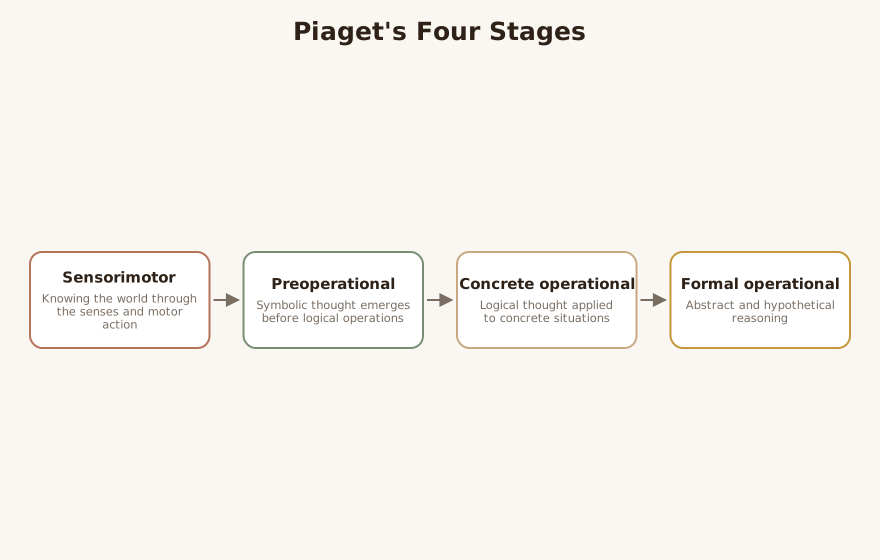
The four stages are: sensorimotor (birth to roughly 2 years), in which the infant comes to know the world through sensation and movement and acquires object permanence, the understanding that objects exist independent of the child’s perception of them 2; preoperational (roughly 2 to 7 years), marked by the rise of symbolic and representational thought — language, symbolic play, deferred imitation — alongside characteristic egocentrism and difficulty taking another’s perspective 2; concrete operational (roughly 7 to 11 years), in which logical rules can be applied to concrete, tangible situations, yielding conservation (recognizing that quantity is unchanged despite changes in appearance) and declining egocentrism 2; and formal operational (roughly 11 years onward), in which the adolescent can reason about abstractions and hypotheticals, moving from what is to what is possible through hypothetico-deductive reasoning 2.
Interventions & Techniques
Piaget did not author therapeutic techniques; what follows is clinical translation of the theory into practice, and is presented as reasoning rather than guideline-backed procedure LLM. The first technique is developmental matching — pitching language, materials, and expectations to the child’s apparent cognitive stage rather than age LLM. A preoperational child will not benefit from verbal insight work that presumes abstract reasoning, so interventions are made concrete, visual, and play-based LLM.
A second application is informal stage assessment woven into intake: probing for object permanence in infants, perspective-taking and egocentrism in early childhood, conservation in school-age children, and hypothetical reasoning in adolescents, to estimate cognitive level alongside formal testing 2. Healthcare providers are explicitly advised to use stage knowledge to guide expectations when evaluating patients across age groups, recognizing that pre-adolescent thought tends to be concrete and that abstract concepts may be inaccessible 2.
A third is the deliberate engineering of productive disequilibrium: presenting a child with a manageable mismatch between expectation and outcome to motivate accommodation, the same mechanism Piaget saw driving natural learning 1. A fourth is discovery-oriented, hands-on learning consistent with constructivism — letting the child manipulate, test, and construct understanding rather than receive it didactically 4.
LLM-generated illustrative example (not a guideline): A clinician working with an anxious 6-year-old finds that asking him to “challenge the thought” yields blank looks. Recognizing preoperational-level reasoning, the clinician switches to a concrete externalizing technique — drawing the “worry monster” and feeding it brave actions — and engagement returns. The cognitive content is unchanged; only the developmental delivery shifts LLM.
Evidence Base
Honesty about maturity matters here: Piaget’s theory is established and foundational, but substantially revised. It remains one of the most influential frameworks in developmental psychology and education, and several of its core observations — schemas, assimilation and accommodation, conservation phenomena, the child as active constructor — have held up robustly 6. The mechanisms continue to inform educational and developmental thinking decades later 4.
However, the empirical record has corrected the theory on important points. Piaget appears to have underestimated young children’s competence: later experiments using simpler, more child-friendly tasks show object permanence and perspective-taking emerging earlier than he claimed, suggesting his methods may have masked abilities children actually possessed 6. The stages are now seen as less discrete and less uniform than originally proposed — development is more continuous and domain-specific, and Piaget himself acknowledged uneven progress (horizontal décalage) within a stage 6. The theory also underweights social and cultural mediation, the gap that Vygotsky’s emphasis on language and social scaffolding fills 6. Finally, formal operational reasoning is not universal; its attainment is variable and appears tied to schooling and cultural context rather than being a guaranteed maturational endpoint 6. The durable verdict is that the architecture endures while the timetable and universality have been refined LLM.
Populations & Indications
The framework is most directly relevant to clinical work with children and adolescents, where matching intervention to cognitive stage is routinely consequential 2. It is especially useful with children with developmental delays, intellectual disability, or cognitive delays, where cognitive level may diverge markedly from chronological age and where stage-based observation helps target expectations realistically LLM. It informs work with children with autism spectrum disorder, particularly around concrete versus abstract reasoning and perspective-taking, while noting that autistic cognition does not map neatly onto Piagetian stages LLM.
The theory is also indicated for parents and educators as a psychoeducation tool — normalizing egocentrism, magical thinking, and concrete reasoning as developmentally expectable rather than as defiance or deficit LLM. It bears directly on school readiness concerns, offering a vocabulary for whether a child’s reasoning has reached the concrete-operational capacities classroom learning often assumes LLM.
Problems-for-Work
Concrete thinking and difficulty with abstract reasoning. When an adolescent or adult struggles with insight-oriented or metaphor-heavy interventions, the theory frames this as a possible developmental ceiling rather than resistance, prompting a shift to concrete, behavioral methods 2.
Egocentrism. In young children, difficulty taking another’s perspective is expectable preoperational cognition, not antisocial intent; reframing this for parents reduces blame and reshapes discipline 2.
Developmental delay, intellectual disability, and cognitive delays. Stage observation helps clinicians and families set attainable goals and avoid expectations pegged to chronological age LLM.
Learning difficulties and school readiness concerns. Mapping a child’s reasoning against concrete-operational benchmarks like conservation can clarify whether classroom demands outstrip current cognitive capacity LLM.
LLM-generated illustrative example (not a guideline): A parent reports that her 4-year-old “lies” by insisting the taller, narrower glass holds “more” juice. The clinician explains this as a normal pre-conservation error of preoperational thinking, not deception, redirecting the parent from punishment toward patient demonstration LLM.
Contraindications, Cautions & Cultural Humility
The theory is a lens, not a diagnostic instrument, and it carries real cautions LLM. Because Piaget likely underestimated children’s abilities and because stages are not as fixed as first described, clinicians should avoid rigidly labeling a child as “stuck” in a stage or using the framework to set hard ceilings on capability 6. Stage estimates should never substitute for validated developmental, cognitive, or autism-specific assessment LLM.
Cultural humility is essential: formal operational reasoning is not a universal endpoint and is shaped by schooling and culture, so applying Piagetian milestones as culture-free norms risks pathologizing children whose environments differ from those Piaget studied 6. The theory’s relative neglect of social and linguistic context means a clinician relying on it alone may miss the scaffolding role of family, language, and community that Vygotsky’s tradition foregrounds 6. Used as one input among several, it informs; used as a verdict, it misleads LLM.
Treatment-Plan Suggestions & SMART Objectives
The objectives below illustrate how the developmental lens shapes goals; they are not themselves a billable therapy and must be delivered within a recognized modality LLM.
| Goal | SMART objective (example) | Mechanism |
|---|---|---|
| Match intervention to cognitive level | Within 2 sessions, clinician documents an informal stage estimate and adapts 100% of in-session tasks to that level | Developmental matching reduces task–capacity mismatch 2 |
| Build parental developmental understanding | Parent will name 3 stage-expectable behaviors (e.g., egocentrism, pre-conservation) and reframe 1 behavior non-punitively within 4 weeks | Psychoeducation shifts attributions from intent to development LLM |
| Make a coping skill developmentally accessible | Child will use a concrete, visual coping tool independently in 3 of 5 monitored situations over 6 weeks | Concrete representation fits preoperational/concrete-operational thought LLM |
| Promote perspective-taking | School-age child will identify another person’s feeling and viewpoint in 4 of 5 role-play scenarios within 8 weeks | Targets declining egocentrism in concrete-operational range 2 |
| Set realistic family expectations in delay | Family will set 2 stage-appropriate behavioral goals aligned to assessed cognitive level within 30 days | Aligns demands to actual capacity, reducing conflict LLM |
| Support emerging abstract reasoning | Adolescent will generate 2 hypothetical solutions to a problem and evaluate outcomes in 3 sessions | Engages developing formal-operational reasoning 2 |
| Reduce caregiver blame | Caregiver self-reported frustration on a 0–10 scale decreases by 3 points over 6 weeks following stage psychoeducation | Reattribution of behavior to development lowers reactivity LLM |
Common Misconceptions
A frequent error is treating the age ranges as fixed deadlines rather than approximate, overlapping guides; the sequence is more reliable than the timing, which varies between children 1. A second is assuming stages are perfectly discrete and global, when development is uneven across domains and more continuous than the clean four-box model implies 6.
A third is believing Piaget showed children are less capable than they are; later research using simpler tasks demonstrates abilities such as object permanence emerging earlier than he reported, so the theory should not be used to underestimate a child 6. A fourth is conflating Piaget with Vygotsky — both are constructivist, but Piaget centers the individual child’s self-directed discovery while Vygotsky centers socially mediated, scaffolded learning 6. Finally, some assume everyone reaches formal operations; attainment is variable and culturally and educationally contingent 6.
Training & Certification
There is no certification in “Piagetian therapy,” because the theory is not a treatment modality LLM. Working knowledge is acquired through standard developmental psychology coursework and accessible explainer treatments of the four stages and core mechanisms 1. Clinicians typically encounter it within graduate training in child development, child clinical psychology, school psychology, counseling, and social work, and apply it through certifications in the modalities that carry the work — for example, structured parent training programs or child-adapted CBT LLM. For orientation, concise overviews and introductory media provide an efficient grounding in the framework’s logic 5.
Key Terms
Schema — a mental structure that organizes knowledge and guides interpretation of experience 1. Assimilation — applying an existing schema to a new experience 2. Accommodation — modifying or creating a schema when new information does not fit 2. Equilibration — the drive to resolve cognitive disequilibrium that propels schema change 1. Object permanence — understanding that objects continue to exist when out of sight, acquired in the sensorimotor stage 2. Egocentrism — the preoperational difficulty in distinguishing one’s own perspective from others’ 2. Conservation — recognizing that quantity stays constant despite changes in appearance, a concrete-operational achievement 2. Genetic epistemology — Piaget’s study of the origins and growth of knowledge 3.
Resources & Further Reading
▶ Watch — a video introduction to this concept:
- Piaget’s Theory and Stages of Cognitive Development — Simply Psychology
- Piaget — StatPearls (NCBI Bookshelf, NIH)
- Genetic epistemology — Encyclopaedia Britannica
- Genetic Epistemology (Jean Piaget) — InstructionalDesign.org
- The Growth of Knowledge: Crash Course Psychology #18 — YouTube
- Piaget’s theory of cognitive development — Wikipedia
Reflective / Supervision Questions
- When a child resists an intervention, how do I distinguish developmental incapacity from motivation or alliance problems, and what would change my hypothesis LLM?
- Am I pitching my language and materials to this child’s chronological age or to their actual cognitive level LLM?
- Where might I be using Piagetian stages to underestimate a child’s capability rather than to scaffold it LLM?
- How am I accounting for the social, linguistic, and cultural scaffolding that Piaget’s individual-focused model tends to under-emphasize 6?
- When I psychoeducate parents about stage-expectable behavior, am I reducing blame, or inadvertently lowering their expectations too far LLM?