
Type & Discipline
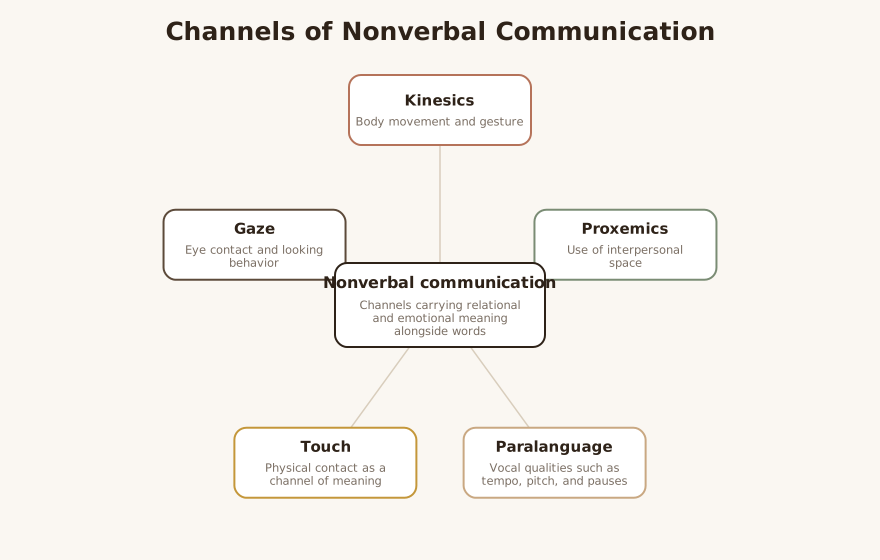
Nonverbal communication is a descriptive framework drawn from communication science rather than a freestanding treatment modality 6. It is defined as the sharing of information without words, encompassing facial expressions, gestures, body language, and tone of voice 2. The framework organizes this vast territory into channels: kinesics (movement of the hands, arms, body, and face), proxemics (the communicative use of space and distance), paralanguage or vocalics (pitch, volume, rate, tone, and verbal fillers), haptics (touch), chronemics (the communicative use of time), and personal presentation or environment 1. For clinicians, the value of the framework is that it gives structured names to channels we already monitor intuitively in the room — posture, gaze, vocal prosody, the distance a client keeps — and thereby makes attunement teachable and observable rather than purely tacit LLM. Because it is a descriptive lens, nonverbal communication is something a clinician applies within a therapeutic relationship and modality, not a treatment delivered on its own LLM. Disciplines from psychotherapy to nursing to early-childhood work all draw on these constructs, but the underlying science belongs to communication studies and social psychology 6.
Creators & Lineage
The framework’s modern vocabulary comes from several mid-twentieth-century scholars whose terms remain in use today 6. The anthropologist Ray Birdwhistell coined the term kinesics for the study of body, hand, and facial movement, and notably rejected the looser phrase “body language” as imprecise 6. The anthropologist Edward T. Hall developed proxemics, the study of how spatial distance functions communicatively, and described culturally varying distance zones — work that is foundational precisely because it framed space as a culturally relative phenomenon from the outset 6. Albert Mehrabian studied nonverbal liking and immediacy cues and is associated with the widely cited (and widely misused) 7-38-55 ratio describing the relative contribution of words, tone, and facial expression to messages about feelings and attitudes 6. Paul Ekman is known for research on facial expressions and emotion recognition, including the idea that certain basic facial expressions are broadly recognizable across cultures 1. The lineage therefore braids anthropology (Birdwhistell, Hall) with social and emotion psychology (Mehrabian, Ekman), and the tension between universal and culturally relative readings of nonverbal behavior runs through the field’s history LLM.
Core Principles
A first principle is that meaning travels through multiple simultaneous channels, and that the nonverbal channels frequently carry the relational and emotional layer of a message while words carry propositional content 2. A second principle is congruence: when the verbal and nonverbal channels align, the message is clear, and when they conflict — words saying one thing while tone and face say another — listeners experience confusion and may infer concealment 1. A third principle, central to clinical use, is that much nonverbal behavior is at least partly outside conscious control and is culturally determined, so it can leak affect that a speaker has not chosen to disclose 4. A fourth principle is that nonverbal cues are radically context-dependent: the same gesture can be complimentary in one setting and offensive in another, so cues cannot be read as a fixed dictionary 6. Finally, the framework holds that nonverbal channels are not merely decorative — vocal prosody such as tempo, pitch, and pauses can communicate emotion and attitude without any specific words at all 6. For the clinician, these principles together imply that nonverbal data are rich but ambiguous, informative but never self-interpreting LLM.
Interventions & Techniques
Because this is a framework rather than a modality, the “techniques” are ways of deploying nonverbal awareness inside an existing treatment relationship LLM. The most basic is structured observation across channels — deliberately noticing a client’s kinesic shifts (a withdrawal of eye contact, a clenching of hands), proxemic choices (leaning in or pulling back), and paralinguistic changes (a flattening or quickening of voice) as data about affect and engagement 1. A second technique is managing the clinician’s own nonverbal output: matching warmth through open posture, congruent facial expression, and prosody that conveys care, which sources describe as how nonverbal signals build connection and trust 2. A third is attending to congruence — noticing when a client’s stated “I’m fine” is contradicted by constricted posture and a tight voice, and gently naming the gap as a point of curiosity rather than accusation 1. A fourth is calibrating proxemics and touch to the individual and cultural context, since acceptable interpersonal distance and tactile norms vary substantially across cultures 6. In telehealth, clinicians adapt these techniques to a reduced channel set, attending more deliberately to vocal prosody and the visible upper body LLM.
LLM-generated illustrative example (not a guideline): A client reports a “good week” in a flat monotone while glancing repeatedly at the door. Rather than decoding this as deception, the clinician reflects the incongruence tentatively — “I hear you say it was good, and I also notice your voice sounds tired today; I’m curious what that’s about” — opening a collaborative inquiry instead of asserting a hidden truth LLM.
These techniques live inside a recognized psychotherapeutic frame; nonverbal awareness sharpens the work but does not constitute the treatment LLM.
Evidence Base
The honest appraisal requires separating two claims that are often conflated LLM. The descriptive taxonomy — that kinesics, proxemics, paralanguage, haptics, and related channels exist, are nameable, and carry relational and emotional information — is well established and is the consensus content of textbooks, clinical organizations, and reference works alike 1. The decoding claim — that a trained observer can accurately read specific internal states or detect lying from nonverbal cues — is far weaker and heavily qualified by the same sources 6. The most important specific caution concerns Mehrabian’s 7-38-55 figures: they describe the relative weight of channels only in the narrow case of communicating feelings and attitudes when the verbal and nonverbal messages are incongruent, and they do not mean that 93% of all communication is nonverbal 6. The sources note that this ratio “only applies in very specific situations,” and that for ordinary informational communication — giving directions, teaching, writing — words carry most of the meaning 6. One source goes further, citing Lapakko’s view that the popularized formula is “reckless, faulty, and misleading” 4. On deception, the evidence directly contradicts folk belief: contrary to popular assumption, liars do not reliably avoid eye contact and may make more eye contact to appear convincing, and the notion that “the body never lies” has been debunked 6. It is also worth noting that this article’s source set is largely educational — open textbooks, clinical-organization explainers, and reference articles — rather than a body of randomized clinical trials, so the framework should be treated as a well-supported descriptive vocabulary, not as an evidence-based intervention with demonstrated outcome data LLM.
Populations & Indications
Nonverbal awareness is relevant to essentially all clinical dyads, but several populations make it especially salient LLM. With minimally verbal or preverbal clients — very young children, or clients for whom language is limited — nonverbal channels may be the primary route of communication, making structured observation central rather than supplementary 1. Trauma survivors often present with nonverbal hypervigilance — startle, scanning, postural bracing — that the framework helps the clinician notice without over-interpreting LLM. Socially anxious clients may show constricted gaze, minimal gesture, and guarded proxemics that shift as safety builds, providing a non-verbal index of alliance LLM. Cross-cultural therapeutic dyads are a defining indication: because proxemic comfort, eye-contact norms, touch, and emotional display rules vary widely across cultures, clinicians must hold their own nonverbal expectations loosely 6. Telehealth contexts are an emerging indication, where the channel set is narrowed and the clinician must recalibrate what nonverbal data are even available LLM.
Problems-for-Work
The framework is most useful for relational and attunement-related problems rather than as a treatment for any single diagnosis LLM. For therapeutic-alliance ruptures, attending to nonverbal shifts — a client’s sudden withdrawal of gaze or a hardening of tone — can surface a rupture in real time so it can be repaired, since congruence and warmth are conveyed largely through these channels 2. For misattunement in the dyad, the clinician’s own nonverbal output (posture, prosody, facial responsiveness) is a primary lever, because nonverbal signals are described as how connection is built 2. For affect dysregulation, paralinguistic and kinesic changes can function as early, observable markers of rising arousal before a client can name it verbally 1. For social-communication difficulties, the framework offers a vocabulary for psychoeducation about how cues land on others, held carefully so it does not pathologize difference LLM. For cross-cultural miscommunication, explicit attention to culturally variable norms — distance, touch, gaze, emotional display — helps prevent the clinician from misreading a culturally normative behavior as clinically significant 6.
LLM-generated illustrative example (not a guideline): A clinician notices that a recently immigrated client consistently sits closer and sustains more direct eye contact than the clinician’s default expectation. Rather than coding this as boundary intrusion, the clinician recognizes it as a culturally normative proxemic and gaze pattern and adjusts their own discomfort, preserving the alliance LLM.
Contraindications, Cautions & Cultural Humility
There are no physical contraindications, but there are serious interpretive hazards, and this section is the heart of responsible use rather than boilerplate LLM. The foremost caution is that nonverbal norms are culturally situated: acceptable interpersonal distance is much shorter in some regions than others, open mourning is expected in some cultures and discouraged in others, touch norms differ sharply, and direct eye contact that signals respect in one culture can be experienced as disrespectful or intrusive in another 6. A clinician who reads cues against their own cultural defaults will systematically misjudge clients from other backgrounds 6. The second major caution concerns neurodivergence: autistic and otherwise neurodivergent clients may show atypical eye contact, gesture, and prosody that are authentic expressions of their neurotype and must not be read as “incongruence,” deception, or pathology LLM. The third caution is clinician overconfidence — the evidence that nonverbal cues do not reliably reveal lying, and that the body does not infallibly “leak” truth, means that confident decoding is itself a clinical risk 6. Because much nonverbal behavior is unconscious and culturally determined, even the act of rigorous observation can be inhibited or distorted by the observer’s own cultural norms 4. The safe stance is to treat nonverbal data as hypotheses to be checked verbally and collaboratively, never as verdicts LLM.
Treatment-Plan Suggestions & SMART Objectives
| Goal | SMART objective (example) | Mechanism |
|---|---|---|
| Strengthen the therapeutic alliance | Within 6 sessions, clinician will identify and verbally check at least one observed nonverbal shift per session, documenting the client’s response | Real-time tracking of kinesic and paralinguistic cues to detect and repair rupture 2 |
| Improve affect recognition | Over 8 weeks, client will name a felt emotion when a paralinguistic or postural change is noticed, in 3 of 5 instances | Using nonverbal markers as observable precursors to verbalized affect 1 |
| Reduce clinician misattunement | Within 4 sessions, clinician will demonstrate congruent warmth (open posture, responsive facial expression, supportive prosody) as rated in supervision | Congruent nonverbal output as the channel through which connection is conveyed 2 |
| Build cultural humility in cue-reading | Each session, clinician will withhold interpretation of at least one ambiguous nonverbal cue pending verbal clarification, logged in notes | Treating culturally variable cues as hypotheses rather than fixed meanings 6 |
| Support a socially anxious client | Over 10 sessions, client will sustain comfortable eye contact for brief, self-paced intervals in role-play, tracking tolerance | Graded practice expanding a constricted nonverbal repertoire LLM |
| Adapt to telehealth | Within 3 sessions, clinician will explicitly attend to vocal prosody and visible posture to compensate for the reduced channel set | Channel-aware observation under conditions of limited nonverbal data LLM |
| Avoid deception-detection errors | Ongoing, clinician will refrain from inferring dishonesty from gaze or fidgeting and will document verbal verification instead | Correcting the empirically unsupported belief that cues reveal lying 6 |
Common Misconceptions
The most pervasive misconception is the “93% of communication is nonverbal” claim derived from Mehrabian — in reality his figures apply only to messages about feelings and attitudes where verbal and nonverbal channels conflict, and most ordinary communication is carried by words 6. A related error is treating the 7-38-55 ratio as a general law; one source describes the popularized formula as reckless and misleading 4. A second major misconception is that nonverbal cues reliably expose deception — yet liars do not consistently avoid eye contact and may increase it, and the idea that “the body never lies” has been debunked 6. A third is that nonverbal signals have universal, fixed meanings; in fact a single gesture can shift from complimentary to offensive across cultural contexts, and distance, touch, and gaze norms vary widely 6. A fourth is that nonverbal channels are merely supplementary garnish, when prosody alone can communicate emotion and attitude without any words 6. A fifth, clinically dangerous misconception is that atypical eye contact or gesture in a neurodivergent client signals incongruence or evasion rather than an authentic communicative style LLM.
Training & Certification
There is no single certifying body for “nonverbal communication” as a standalone clinical credential, because it is a cross-disciplinary framework rather than a licensed modality LLM. Clinicians typically encounter it within communication-studies coursework, counseling and psychology training, and continuing education on alliance, attunement, and culturally responsive practice 1. Foundational literacy can be built from the open educational and reference materials that define the channels and their cultural variability 1. Deeper, modality-specific applications — for example, structured observation of movement, or relational attunement in experiential therapies — are taught within those respective modality trainings, where nonverbal awareness is embedded as a clinical skill rather than offered as a separate certificate LLM. The most important training emphasis for any clinician is calibration: learning to generate nonverbal hypotheses while resisting premature decoding, and seeking supervision on culturally and neurologically diverse presentations LLM.
Key Terms
- Kinesics: the study of communicative movement of the hands, arms, body, and face, including gesture, posture, and facial expression 1.
- Proxemics: the study of how interpersonal space and distance function communicatively, including culturally varying comfort zones 6.
- Paralanguage (vocalics): the vocalized but non-verbal features of speech — pitch, volume, rate, tone, pauses, and fillers — that convey emotion and attitude 1.
- Haptics: communication through touch, with norms that vary substantially across cultures 6.
- Chronemics: the communicative use of time, including pace and cultural time orientations 1.
- Congruence: the degree of alignment between verbal and nonverbal channels; conflict between them can convey confusion or, mistakenly, a perception of deception 1.
- 7-38-55 rule: Mehrabian’s finding on the relative contribution of words, tone, and facial expression, applicable only to incongruent messages about feelings and attitudes 6.
Resources & Further Reading
▶ Watch — a video introduction to this concept:
- Types of Nonverbal Communication — Communication in the Real World (open textbook)
- Nonverbal Communication: What It Is, Types & Examples — Cleveland Clinic
- Body Language and Nonverbal Communication — HelpGuide.org
- Nonverbal Communication Skills: 19 Theories & Findings — PositivePsychology.com
- Kinesics, Haptics and Proxemics: Aspects of Non-Verbal Communication — IOSR Journal (PDF)
- Nonverbal communication — Wikipedia
Reflective / Supervision Questions
- When I notice a nonverbal cue, am I treating it as a hypothesis to check verbally, or am I quietly converting it into a verdict about my client? LLM
- How do my own cultural defaults around distance, touch, gaze, and emotional display shape what I read as “normal” or “off” in the room? 6
- Am I at risk of misreading a neurodivergent client’s authentic eye contact, gesture, or prosody as incongruence or evasion? LLM
- Where have I absorbed the pop-psychology version of Mehrabian’s ratio, and does my clinical reasoning quietly assume that most meaning is nonverbal? 6
- Have I ever inferred dishonesty from gaze or fidgeting, and how would I revise that habit given that cues do not reliably reveal lying? 6
- In telehealth, how am I compensating for the channels I can no longer see, and am I being honest about what I cannot observe? LLM
- How is my own nonverbal output — posture, prosody, facial responsiveness — supporting or undermining the alliance in this case? 2