
Type & Discipline
Relapse Prevention (RP) is a cognitive-behavioral framework for the maintenance phase of addiction treatment — the period after a person has stopped or reduced use, when the central clinical problem becomes staying changed rather than initiating change 1. It sits within clinical psychology and the addictions, and is best understood as a self-management model: a structured set of skills and conceptual maps that help clients anticipate, interpret, and respond to the situations that threaten a treatment goal 4. Rather than a single technique, RP is a coherent theory of how relapse happens paired with a menu of interventions matched to each link in that causal chain 1.
The framework is deliberately agnostic about the ultimate treatment goal. It is most often deployed in service of abstinence, but its logic — identify the threat, build the coping response, reframe the slip — applies equally to moderation or harm-reduction targets, which is part of why it has migrated well beyond alcohol into other behaviors 1. LLM
Creators & Lineage
Relapse Prevention was developed by G. Alan Marlatt and elaborated with Judith Gordon, whose foundational 1985 text formalized the model and gave clinicians a working vocabulary for the relapse process 3. The mature overview most clinicians cite today was authored by Mary E. Larimer, Rebekka S. Palmer, and Marlatt in 1999 2.
Conceptually, RP grows out of two roots. The first is social learning theory, which frames addictive behavior as learned, situation-bound, and modifiable through new learning rather than as a fixed disease state 4. The second is the broader cognitive-behavioral therapy (CBT) tradition, from which RP borrows skills training, cognitive restructuring, and a collaborative empiricist stance 1. In practice RP is frequently combined with motivational interviewing to resolve ambivalence before skills work begins, and it was later extended into Mindfulness-Based Relapse Prevention (MBRP) by Katie Witkiewitz and colleagues, who layered formal meditation practice onto the original skills architecture 3. LLM
Core Principles
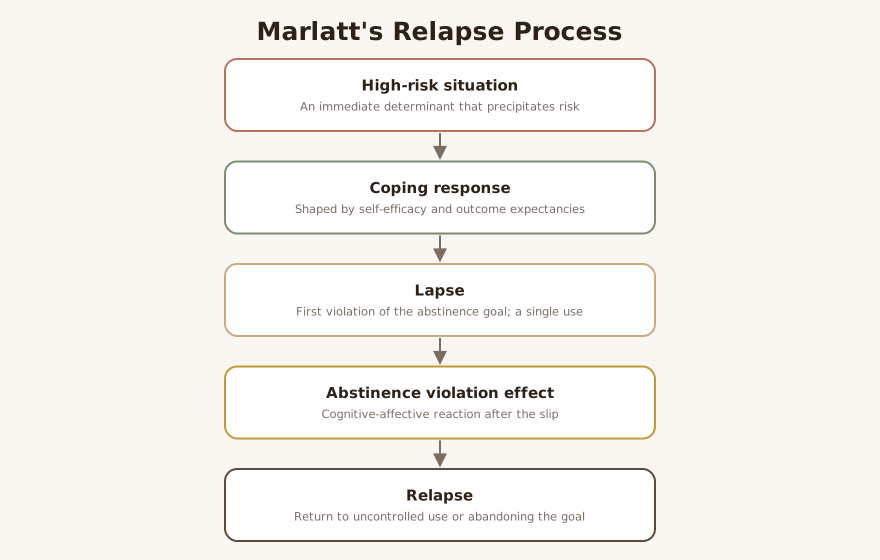
The model’s organizing claim is that relapse is a process, not an event 1. A useful distinction sits at its center: a lapse is “the first violation of the abstinence goal” — a single discrete use — while relapse is “a return to uncontrolled drinking or abandonment of the abstinence goal” 1. Critically, the progression from lapse to relapse is not inevitable; what happens in the hours and days after a slip is itself a target of intervention 1.
RP sorts the causes of relapse into two layers. Immediate determinants operate in the moment and include the high-risk situation itself, the person’s coping response, their self-efficacy, and their outcome expectancies 1. Covert antecedents are the slower, background conditions that set the stage — lifestyle imbalance, accumulating urges and cravings, and the subtle choices that steer a person toward risk 1.
Three psychological constructs do most of the explanatory work. Self-efficacy is the person’s “perception of mastery over the specific risky situation”; higher self-efficacy predicts better outcomes, and each successfully navigated situation raises it further 1. Outcome expectancies are the anticipated effects of use — often selectively positive (“one drink will calm me down”) while the delayed negative consequences are discounted 1. And the abstinence violation effect (AVE) governs the response to a lapse: when a person attributes a slip to “stable, global, internal factors beyond their control” and floods with guilt and a sense of lost control, they are far more likely to convert a single lapse into a full relapse than someone who reads the same slip as a specific, correctable error 1. The AVE is essentially an attributional and affective amplifier sitting on top of the behavioral event 5.
Interventions & Techniques
RP interventions are organized to mirror the model: specific strategies target the immediate determinants, while global strategies address the covert antecedents 1.
Specific strategies begin with assessment and identification of high-risk situations, often using self-monitoring, autobiographical accounts, and structured interviews to map an individual’s personal trigger profile 1. Marlatt’s taxonomy gives the clinician a starting grid — negative emotional states, interpersonal conflict, social pressure, positive emotional states, alcohol cues, testing personal control, and nonspecific cravings 1. Once high-risk situations are named, the clinician and client build coping skills: behavioral rehearsal of drink- and drug-refusal, assertiveness, problem-solving, and relaxation, typically through role-play and homework 3.
Self-efficacy enhancement is woven throughout, using collaborative goal-setting and incremental, achievable steps so the client accumulates mastery experiences rather than facing an all-or-nothing test 1. Cognitive restructuring is used to correct expectancy “myths” about a substance’s effects — sometimes with a decision matrix that lays out immediate versus delayed, and positive versus negative, consequences of use and abstinence 1. And lapse management is rehearsed in advance: an emergency plan, a reminder card that reframes the slip as a mistake rather than a catastrophe, and concrete steps to limit the extent of any single episode 1.
Global strategies aim to shrink the background risk. Lifestyle balancing addresses the ratio of “shoulds” (obligations) to “wants” (gratifications), often by cultivating “positive addictions” such as exercise or meditation 1. Stimulus control removes cues and paraphernalia from the environment; urge management teaches techniques such as urge surfing, in which the client visualizes a craving as a wave that “peaks and subsides” rather than something that must be obeyed 1. Finally, relapse road maps — written cognitive-behavioral analyses of likely scenarios and the coping choices at each branch point — help clients see escape routes before they are in the situation 1. In MBRP, these skills are augmented by formal mindfulness practice that trains the client to observe cravings and uncomfortable affect “without judgment,” creating a pause between cue and response 3.
Evidence Base
The evidence for Relapse Prevention is established — it is one of the more thoroughly studied psychosocial approaches in addiction, with “strong empirical support” and performance comparable to other active substance use disorder treatments 3. Both the theoretical foundations and the practical utility of the model have been substantiated for problematic drinking 2.
Honesty about the shape of the evidence matters, though. Meta-analytic reviews conclude that RP-based treatments “reduce the frequency of relapse episodes,” but do not necessarily raise overall abstinence rates 1 — the benefit is often in containing slips rather than eliminating them. Effects also show a characteristic delayed emergence, with significant improvements sometimes appearing “only at later follow-up points,” consistent with a skills model whose payoff accrues over repeated real-world challenges 1. Combining RP with pharmacotherapy improves outcomes relative to either alone 1. The model’s relapse taxonomy itself held up only moderately under independent scrutiny: the Relapse Replication and Extension Project found “moderate inter-rater reliability” for classifying relapse precipitants, a useful caution against over-precise categorization in the clinic 1. MBRP, the mindfulness extension, appears “equally effective” to standard RP, but the evidence is not yet strong enough to say it is superior 3. LLM
Populations & Indications
RP was built for and validated most extensively in adults with alcohol use disorder, and generalizes across substance use disorders broadly 3. It is a workhorse for people in addiction recovery of all kinds and is routinely applied to nicotine dependence, where the high-risk-situation/coping-skills frame translates almost directly 3. There is evidence for use with adolescents with cannabis use disorder 3.
Because the core mechanisms — high-risk situations, coping deficits, self-efficacy, and the AVE — are not specific to chemicals, the framework has been extended to behavioral addictions and to recurrent disorders outside addiction, including depression relapse prevention, where the AVE-style catastrophic interpretation of a single bad day maps onto relapse risk 5. LLM Clients whose presentation is dominated by craving and cue reactivity, self-efficacy deficits, or repeated failure in identifiable high-risk situations are especially good candidates 1.
Problems-for-Work
RP gives the clinician a direct handle on several recurrent clinical problems:
- High-risk situation coping. The client and clinician build and rehearse a tailored coping repertoire for the specific situations that precede use 1.
- Craving and trigger / cue reactivity. Urge surfing and stimulus control give the client an experiential alternative to acting on a craving 1.
- Abstinence violation effect. Pre-lapse cognitive work reframes a future slip as a correctable error, defusing the guilt-and-collapse cascade before it can occur 1.
- Self-efficacy deficits. Graded, achievable goals manufacture mastery experiences that raise situational confidence 1.
- Relapse and lapse management. A rehearsed emergency plan converts a lapse into a bounded, recoverable event 1.
LLM-generated illustrative example (not a guideline): A client three months abstinent from alcohol attends a wedding and has two glasses of wine. In session the following week, instead of “I’ve blown it, I’m an alcoholic and I always will be,” the clinician helps reframe: “I was caught off guard by an open bar and social pressure — a specific, fixable gap in my plan.” They then add a drink-refusal script and an exit cue for the next event. The lapse is metabolized as data, not verdict. LLM
Contraindications, Cautions & Cultural Humility
RP has no hard contraindications, but several cautions apply. It is a skills-and-cognition model, so it presumes a level of cognitive engagement and motivation; for clients with profound ambivalence, the field generally sequences motivational interviewing first to build commitment before loading skills work 3. LLM Severe withdrawal, acute medical instability, or untreated co-occurring psychosis typically require stabilization and, where indicated, pharmacotherapy before or alongside RP 1. LLM
Cultural humility is not optional here. The Recovery Research Institute flags evidence of potential differential effectiveness across racial and ethnic groups, noting that RP may work differently for Black and Latino individuals and that further research and cultural adaptation are needed 3. Clinicians should treat the standard high-risk-situation taxonomy and “lifestyle balance” prescriptions as starting hypotheses, not universals — what counts as social pressure, a “want,” or a meaningful positive activity is shaped by culture, faith, community, and material circumstance 3. LLM Framing a lapse as “personal failure” also lands differently against histories of stigma and structural disadvantage, so the AVE reframe should be delivered with attention to the client’s existing self-narrative 5. LLM
Treatment-Plan Suggestions & SMART Objectives
| Goal | SMART objective (example) | Mechanism |
|---|---|---|
| Map personal relapse risk | Within 2 weeks, client completes a written list of their top 5 high-risk situations using daily self-monitoring 1 | High-risk situation identification |
| Build coping responses | Over 4 weeks, client rehearses and role-plays a drink-/drug-refusal script for each top situation, practicing once per session 13 | Coping-skills training |
| Raise situational self-efficacy | Within 6 weeks, client successfully navigates 3 graded, pre-planned exposures to lower-risk triggers and rates confidence after each 1 | Mastery experiences / self-efficacy |
| Manage craving without use | Within 3 weeks, client applies urge surfing during at least 4 logged cravings and records that each peaked and subsided 1 | Urge management |
| Defuse the abstinence violation effect | By week 4, client can state, in their own words, a non-catastrophic reframe of a hypothetical lapse and carry a reminder card 15 | AVE reattribution / cognitive restructuring |
| Rebalance lifestyle | Over 8 weeks, client adds 2 regular “positive addiction” activities and tracks the shifting ratio of obligations to gratifications 1 | Lifestyle balancing |
| Prepare lapse management | Within 2 weeks, client writes a one-page emergency plan specifying who to call and how to limit any single episode 1 | Lapse containment |
| Reduce cue exposure | Within 1 week, client removes identified substance cues from home and one habitual environment 1 | Stimulus control |
Common Misconceptions
“A lapse means treatment failed.” The model explicitly separates a single lapse from full relapse and treats the slip as a fork in the road, not a foregone conclusion — the clinical action is in how the lapse is interpreted and managed 1. LLM
“Relapse Prevention is only about willpower.” RP is the opposite of a willpower model: “testing personal control” is itself listed as a high-risk situation, and the framework substitutes concrete skills, environmental control, and reattribution for raw resolve 1. LLM
“RP requires abstinence as the goal.” The framework’s machinery applies to moderation and harm-reduction targets as readily as to abstinence; the goal is a parameter, not a fixed feature 1. LLM
“Mindfulness-based relapse prevention is proven to beat standard RP.” Current evidence places MBRP as roughly equally effective, not demonstrably superior 3.
“The relapse taxonomy is a precise diagnostic system.” Independent testing found only moderate inter-rater reliability for classifying relapse precipitants, so the categories are a clinical heuristic, not a hard measurement instrument 1.
Training & Certification
There is no single proprietary credential required to practice Relapse Prevention; it is taught as a core component of cognitive-behavioral addiction treatment and is part of standard substance use disorder counselor and clinical training 3. LLM The canonical clinician reference is the Marlatt and Gordon text and its later editions, which lay out the model and its protocols in full 4. The Larimer, Palmer, and Marlatt overview is the most accessible primary summary for clinicians orienting to the framework 2. For the mindfulness extension, MBRP has its own structured curriculum and facilitator training developed by Witkiewitz, Bowen, and colleagues, generally pursued by clinicians already grounded in standard RP and in mindfulness practice 3. LLM
Key Terms
- Lapse — “the first violation of the abstinence goal,” a single discrete instance of use 1.
- Relapse — “a return to uncontrolled drinking or abandonment of the abstinence goal” 1.
- High-risk situation — a situation that serves as an immediate precipitant of use after abstinence; categories include negative and positive emotional states, interpersonal conflict, social pressure, cues, and craving 1.
- Abstinence violation effect (AVE) — the guilt and perceived loss of control that follow a lapse when it is attributed to “stable, global, internal factors,” increasing the likelihood of full relapse 15.
- Self-efficacy — the person’s “perception of mastery over the specific risky situation” 1.
- Outcome expectancies — the anticipated positive or negative consequences of using 1.
- Apparently Irrelevant Decisions (AIDs) — seemingly inconsequential choices that cumulatively steer a person toward a high-risk situation 1.
- Urge surfing — an urge-management technique in which a craving is observed as a wave that peaks and subsides rather than acted upon 1.
- Covert antecedents — background conditions such as lifestyle imbalance and accumulating cravings that set the stage for relapse 1.
Resources & Further Reading
▶ Watch — a video introduction to this concept:
- Relapse Prevention: An Overview of Marlatt’s Cognitive-Behavioral Model (Larimer, Palmer & Marlatt) — PMC full text
- Relapse prevention. An overview of Marlatt’s cognitive-behavioral model — PubMed record
- Relapse Prevention (RP) / Mindfulness-Based Relapse Prevention — Recovery Research Institute
- Relapse Prevention for Alcohol and Drug Problems, Chapter 1 — Guilford excerpt
- Abstinence Violation Effect — an overview (ScienceDirect Topics)
Reflective / Supervision Questions
- For your current caseload, can you name each client’s top three high-risk situations — and do they know what those are? LLM
- When a client lapses, does your response model the AVE reframe (specific, correctable error) or inadvertently reinforce a global, internal attribution? LLM
- Are you sequencing motivation work before skills work, or are you loading coping skills onto unresolved ambivalence? LLM
- How well does your standard high-risk-situation taxonomy fit this particular client’s culture, faith, and material circumstances — and where might you be importing assumptions? LLM
- Given that RP often reduces the frequency of relapse rather than producing immediate abstinence, how are you framing success with the client so that early slips don’t read as failure? LLM
- Where in your lifestyle-balancing recommendations are you prescribing your own values about “wants” and “shoulds” rather than eliciting the client’s? LLM