
Type & Discipline
Social Cognitive Theory (SCT) is a broad theory of human learning, motivation, and behavior rather than a manualized treatment package 4. It sits within social and clinical psychology and belongs to the social-learning/cognitive family, bridging the gap between strict behaviorism and purely cognitive models 4. SCT grew directly out of Bandura’s earlier Social Learning Theory, which he renamed and expanded in 1986 to emphasize the role of cognition in human functioning 1. For clinicians, the practical importance is that SCT supplies a coherent account of how change happens — through observation, mastery, and the beliefs people hold about their own capabilities — that can be layered onto many established therapies LLM. It is best understood as a meta-framework that informs intervention design rather than a discrete therapy you would bill as such LLM.
Creators & Lineage
The theory was developed by Albert Bandura, a Canadian-American psychologist at Stanford, whose 1986 book Social Foundations of Thought and Action: A Social Cognitive Theory formalized the framework 1. Bandura’s lineage runs from behaviorism, against which he reacted by arguing that humans are not passively shaped by reinforcement but actively interpret and anticipate their environments 1. His early observational-learning research — including the famous Bobo doll studies on the imitation of aggression — established that learning can occur vicariously, without direct reinforcement of the learner 6. Over the 1970s he articulated self-efficacy theory and the principle of reciprocal determinism, then integrated these strands under the SCT label 2. The conceptual family therefore includes Social Learning Theory, Self-Efficacy Theory, observational learning/modeling, and behaviorism, and SCT in turn became a major influence on cognitive-behavioral approaches 1.
Core Principles
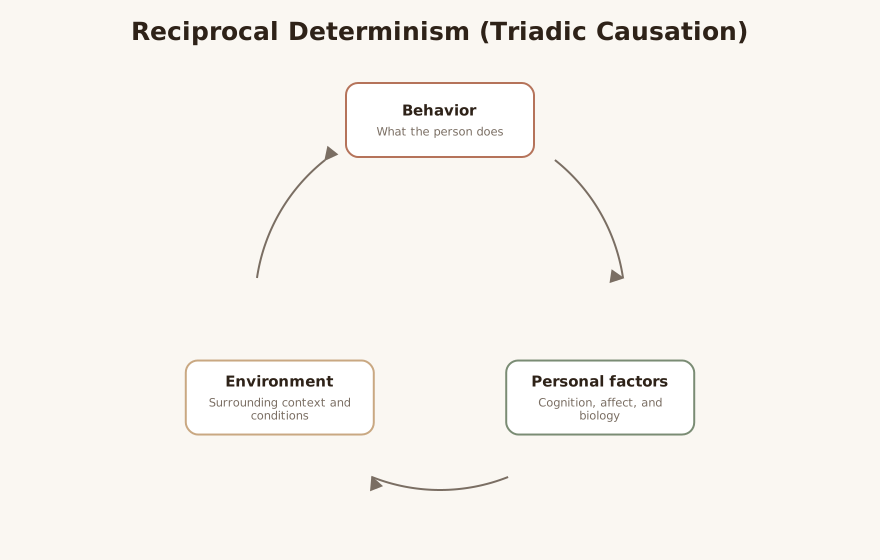
The organizing idea is reciprocal determinism (triadic reciprocal causation): behavior, personal factors (cognition, affect, biology), and the environment operate as interlocking determinants that each influence and are influenced by the others 2. Bandura argued that the self-system is part of this causal structure, so people are partly products and partly producers of their environments 2. A second pillar is observational learning — people acquire new behaviors by watching models, governed by four subprocesses: attention to the model, retention of what was observed, reproduction of the behavior, and motivation to perform it 4. Learning and performance are distinct: a behavior can be acquired through observation yet not enacted until conditions favor it 5.
A third pillar is self-efficacy, a person’s belief in their capability to execute the actions needed to reach a goal 3. Self-efficacy is theorized to be built from four sources: mastery experiences (the most powerful), vicarious experiences through modeling, verbal/social persuasion, and the interpretation of physiological and affective states 3. SCT also foregrounds distinctly human capabilities — symbolizing, forethought, vicarious learning, self-regulation, and self-reflection — that allow people to guide their own behavior toward anticipated futures rather than merely reacting 1. Outcome expectations (beliefs about the consequences of a behavior) work alongside efficacy beliefs to shape motivation 3.
Interventions & Techniques
SCT does not prescribe a fixed protocol, but it yields a recognizable toolkit that clinicians can embed in their existing modality LLM. Modeling is central: demonstrating a target behavior — live, symbolically, or via video — so the client can observe, encode, and rehearse it 5. Mastery-experience design structures graded, achievable successes so the client accumulates direct evidence of capability, the strongest driver of efficacy beliefs 3. Guided mastery for fear and avoidance pairs modeling with progressively bolder, therapist-supported approach behaviors 5.
Other SCT-derived techniques include verbal persuasion and encouragement calibrated to be credible rather than inflated, reattribution of arousal so clients reinterpret physiological signals (a racing heart as readiness rather than danger), and self-regulation training — self-monitoring, goal-setting, self-evaluation, and self-reinforcement 3. Because performance follows from both learning and motivation, clinicians also attend to outcome expectations, helping clients see that the effort will plausibly produce the result they value 3.
LLM-generated illustrative example (not a guideline): A clinician treating a socially anxious client first models initiating small talk in session, then assigns a graded hierarchy of real-world conversations, debriefs each as evidence of capability, and helps the client reframe pre-conversation nerves as ordinary activation rather than proof of inevitable failure LLM.
Evidence Base
The evidence base is established — but the nuance matters clinically LLM. SCT is one of the most influential and widely cited frameworks in psychology, and its self-efficacy construct is among the most empirically validated predictors of behavior across health, education, occupational, and clinical domains 3. Bandura’s observational-learning research is foundational and well replicated 6. The strongest treatment evidence, however, attaches to SCT-derived interventions — modeling and guided mastery for phobias, and self-efficacy-based programs for health-behavior change — rather than to “SCT therapy” as a packaged modality, which does not exist in that form LLM.
Honesty also requires noting limits. As a broad meta-theory encompassing nearly all of human functioning, SCT has been criticized as difficult to falsify and as underspecifying the relative weight of its triadic components in any given case 1. The biological and emotional elements of the personal-factors node are less developed than the cognitive ones 4. The takeaway for clinicians: trust the specific, testable mechanisms (efficacy-building, modeling) that have strong support, and treat the grand framework as an organizing heuristic rather than a settled causal map LLM.
Populations & Indications
SCT principles travel well across populations because observation, modeling, and efficacy beliefs are general mechanisms LLM. Adolescents are a natural fit given the salience of peer and media models in shaping behavior 6. Students benefit from self-efficacy and self-regulation work that supports academic persistence 3. People with health-behavior goals — smoking cessation, exercise, medication adherence — are a core application, since efficacy and outcome expectations strongly predict initiation and maintenance 3. Adults with phobias respond to modeling and guided mastery 5. People in recovery from substance use can use efficacy-building to bolster confidence in high-risk situations, and caregivers can be supported through modeling of skills and bolstering their sense of capability in a demanding role LLM.
Problems-for-Work
SCT speaks directly to a cluster of clinical targets LLM. Low self-efficacy is the signature indication and is addressed by engineering mastery experiences and credible persuasion 3. Specific phobia and avoidance behavior respond to graded modeling and guided mastery that convert anticipated catastrophe into lived evidence of coping 5. Health behavior change is supported by aligning efficacy beliefs with realistic outcome expectations 3. Procrastination, low motivation, and self-regulation difficulties map onto self-monitoring, goal-setting, and self-reinforcement 3.
LLM-generated illustrative example (not a guideline): For a client whose procrastination is fed by “I can’t focus for more than five minutes,” the clinician co-designs a 10-minute timed work block, logs each completion, and uses the accumulating record as mastery evidence to revise the capability belief upward LLM.
Skills deficits are addressed through modeling and behavioral rehearsal so clients first acquire and then perform the behavior 4. Aggression can be reframed using SCT’s account that aggressive behavior is often modeled and reinforced, informing interventions that supply and reinforce prosocial models 6. Substance use disorder work draws on situation-specific efficacy (“can I refuse in this setting?”) rather than global confidence LLM.
Contraindications, Cautions & Cultural Humility
SCT has no formal contraindications as a way of thinking, but its application carries real risks LLM. The chief caution is that efficacy and self-regulation framing can slide into individual blame — implying that a client who has not changed simply lacked confidence or willpower, while ignoring structural barriers such as poverty, discrimination, unsafe environments, or limited access to care LLM. This is a misapplication of SCT, not a faithful one: reciprocal determinism explicitly holds that the environment is a co-determinant of behavior, so a competent SCT formulation must name and address contextual constraints alongside personal factors 2. Persuasion that is not backed by genuine opportunity for mastery can also backfire, producing repeated failure that lowers efficacy further 3.
Cultural humility requires recognizing that what counts as an effective model, the value placed on individual versus collective agency, and acceptable forms of self-assertion vary across cultures LLM. Clinicians should select models the client can identify with and frame goals in terms the client’s context actually rewards, rather than importing assumptions about autonomous self-direction LLM.
Treatment-Plan Suggestions & SMART Objectives
| Goal | SMART objective (example) | Mechanism |
|---|---|---|
| Raise task self-efficacy | Client completes 3 of 4 planned graded exposure steps over 4 weeks, logging each | Mastery experiences 3 |
| Reduce avoidance of a feared situation | Client enters the feared setting twice weekly for 6 weeks, rating distress before/after | Guided mastery + modeling 5 |
| Build a health behavior | Client performs the target behavior on 5 of 7 days for 8 weeks, self-monitored | Self-regulation + outcome expectations 3 |
| Strengthen relapse-prevention confidence | Client rates and rehearses refusal in 3 specific high-risk scenarios over 3 weeks | Situation-specific efficacy 3 |
| Acquire a social/communication skill | Client observes a model then rehearses the skill in 4 sessions, then performs it once in vivo weekly | Observational learning 4 |
| Improve self-regulation of a habit | Client keeps a daily self-monitoring log for 21 days and applies a self-reward criterion | Self-monitoring + self-reinforcement 3 |
| Reframe physiological arousal | Client records and relabels pre-task arousal in 5 logged instances over 2 weeks | Reinterpreting affective states 3 |
Common Misconceptions
A first misconception is that SCT is simply behaviorism with a new label; in fact Bandura broke from behaviorism by insisting that cognition, anticipation, and self-belief are causal, not epiphenomenal 1. A second is that observational learning means immediate imitation — but learning and performance are separable, so a watched behavior may lie dormant until motivation and opportunity align 5. A third is conflating self-efficacy with self-esteem or global confidence; self-efficacy is task- and situation-specific judgment of capability, not a generalized feeling about oneself 3. A fourth is treating reciprocal determinism as the claim that the environment doesn’t matter — the model is precisely that environment, person, and behavior co-determine outcomes 2. Finally, clinicians sometimes assume verbal encouragement alone will lift efficacy; persuasion is the weakest of the four sources and is most effective when it sets up an attainable mastery experience 3.
Training & Certification
There is no certification in “Social Cognitive Theory,” and any credential claiming to certify SCT specifically should be viewed skeptically LLM. SCT is taught as core content within graduate programs in clinical and counseling psychology, social work, education, and public health, and it is foundational reading in learning, motivation, and behavior-change courses 4. Clinicians typically encounter its applied techniques inside training for evidence-based modalities — for example, exposure and modeling within CBT or motivational and self-regulation work within health-behavior counseling LLM. The most productive route to competence is to study Bandura’s primary writing on self-efficacy and reciprocal determinism, then obtain supervised practice in a modality that operationalizes those mechanisms 2.
Key Terms
Reciprocal determinism (triadic reciprocal causation): the mutual, ongoing influence among behavior, personal factors, and environment 2. Self-efficacy: belief in one’s capability to perform the actions needed to attain a goal, distinct from self-esteem and from outcome expectations 3. Outcome expectations: beliefs about the likely consequences of a behavior 3. Observational (vicarious) learning: acquiring behavior by watching models, via attention, retention, reproduction, and motivation 4. Modeling: the demonstration of a behavior intended to be learned 5. Mastery experiences: direct successful performances, the strongest source of efficacy beliefs 3. Self-regulation: self-monitoring, goal-setting, self-evaluation, and self-reinforcement that allow people to guide their own behavior 3. Human agency: the capacity, grounded in forethought and self-reflection, to influence one’s own functioning and life circumstances 1.
Resources & Further Reading
▶ Watch — a video introduction to this concept:
- Social Foundations of Thought and Action: A Social Cognitive Theory (Bandura, 1986) — Wikipedia
- The self system in reciprocal determinism (Bandura) — Semantic Scholar
- Overview of Social Cognitive Theory and of Self-Efficacy (Pajares) — PDF
- Albert Bandura’s Social Cognitive Theory — Simply Psychology
- Modeling and Mastery: Bandura’s Social-Cognitive Theory — Psychology Town
- Albert Bandura | Vicarious Learning & Social Learning Theory — Study.com
Reflective / Supervision Questions
- In a current case, can you name a specific behavior, personal factor, and environmental factor that are reciprocally maintaining the problem — and which node your interventions actually target? 2
- Are you assessing self-efficacy at the level of the specific task and situation, or relying on a global impression of the client’s confidence? 3
- When a client is not changing, how do you distinguish a genuine efficacy deficit from a structural barrier you may be at risk of misreading as low motivation? LLM
- Are the models you use — in session, in homework, in materials — ones this particular client can realistically identify with across cultural and contextual lines? LLM
- For each technique in your plan, can you state whether you are building efficacy through mastery, modeling, persuasion, or affect reinterpretation — and are you over-relying on the weakest of these? 3
- How would you document SCT-informed work as the active ingredient of a recognized billable modality rather than as a freestanding procedure? LLM