
Type & Discipline
The Rescorla-Wagner model is a formal, quantitative theory of associative learning rather than a treatment, a technique, or a school of therapy LLM. It belongs to mathematical psychology and the broader family of associative learning theory, and it specifies, trial by trial, how the association between a conditioned stimulus (CS) and an unconditioned stimulus (US) changes when the two are paired 1. Its central claim is deceptively simple: the change in association depends not on how often a cue and an outcome co-occur, but on how strongly the outcome was already predicted on that trial 1. For clinicians, this reframes conditioning from “repetition builds habit” to “surprise builds learning,” and that single shift underwrites much of modern exposure science LLM.
Creators & Lineage
The model was published by Yale psychologists Robert A. Rescorla and Allan R. Wagner in 1972 1. It sits at the convergence of several lineages: classical (Pavlovian) conditioning, from which it inherits the CS-US pairing paradigm; behaviorism and learning theory, whose stimulus-substitution accounts it was built to supersede; and mathematical psychology, which gave it the language of error-correcting equations LLM. The proximate motivation was empirical embarrassment for earlier theories: Leon Kamin’s “blocking” effect showed that a cue could be paired repeatedly with an outcome yet acquire little or no associative strength, which a pure-pairing account cannot explain 5. Downstream, the model is now read as an early and influential member of the prediction-error and reinforcement-learning family that dominates computational neuroscience and computational psychiatry LLM. It remains one of the most important and influential theoretical accounts of the conditions under which Pavlovian learning occurs 2.
Core Principles
The model’s engine is a single learning rule. The change in the associative strength of a cue X on a given trial is:
ΔV_X = α_X · β · (λ − ΣV)
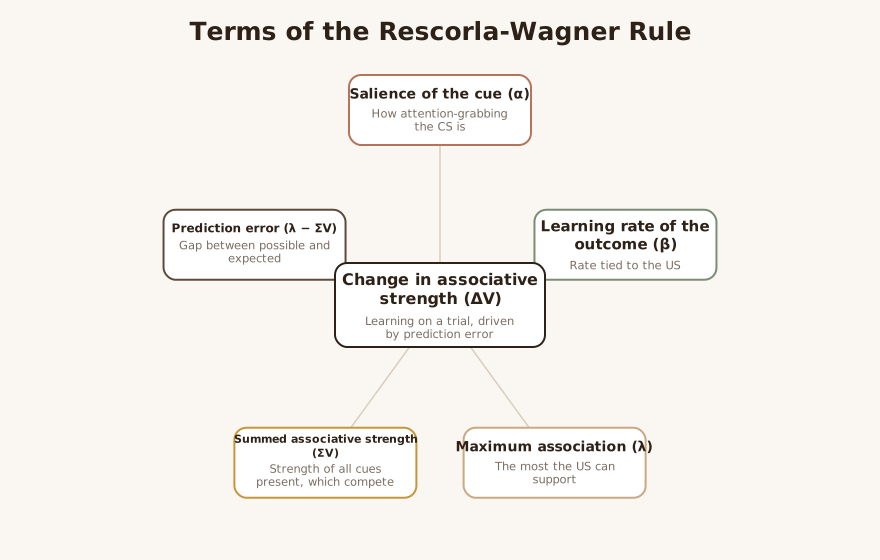
Here V_X is the current associative strength of cue X, α (alpha) is the salience of the CS, β (beta) is the learning rate tied to the US, λ (lambda) is the maximum association the US can support, and ΣV is the summed associative strength of all cues present on that trial 13. The term (λ − ΣV) is the prediction error: the gap between what the US could support and what the animal already expects given everything present 3. When that gap is large the cue is “surprised” by the outcome and learns quickly; when expectation already matches the outcome the gap shrinks toward zero and learning stalls 1.
Three features make this more than bookkeeping LLM. First, learning is error-driven: associative strength asymptotes when prediction matches reality, which is why acquisition curves flatten rather than rising forever 5. Second, cues compete through the shared term ΣV — the model sums the strength of all cues present and pits them against one another for a limited pool of associability 13. Third, the same signed error term that drives gains also drives losses: when an expected US is omitted, (λ − ΣV) goes negative and associative strength is actively unlearned 2. This single common error term is what lets the model speak to acquisition and extinction with one equation 2.
LLM-generated illustrative example (not a guideline): A clinician can picture a client who, after a car accident, fears both being a passenger and the specific song playing at the moment of impact. If the passenger cue alone already fully predicts the panic, the model says the song will gain little additional fear strength — the outcome was no longer surprising. LLM
Interventions & Techniques
The Rescorla-Wagner model is not itself an intervention, but it generates concrete, testable design principles for the interventions clinicians already use, chiefly exposure therapy LLM. The foundational move is to treat exposure as extinction: presenting the feared CS without the expected aversive US so that the omission produces a large negative prediction error, which drives down the CS-US association 2. The bigger and more sustained that error, the more unlearning occurs, so exposures that maximally violate the client’s expectancy of harm are predicted to teach the most 2.
Two derived techniques follow directly. Compound extinction presents two fear-provoking stimuli simultaneously; the model predicts this maximizes the prediction error available during exposure and reduces the likelihood of relapse 2. Multiple-context extinction conducts exposures across several settings; because the residual CS-US association generates a large negative prediction error in each new context, extinction in varied contexts both unlearns the original association and builds new inhibitory learning tied to those contexts 2. Both are direct clinical translations of the same error-correction logic LLM. Practically, a therapist operationalizes the model by eliciting a specific, falsifiable expectancy (“the panic will not stop”), arranging an exposure that disconfirms it, and varying cues and contexts so the disconfirmation generalizes LLM.
Evidence Base
Honesty about maturity matters here: the Rescorla-Wagner model is established and foundational, but it is also a model with well-documented failures LLM. On the strength side, its ability to sum associative strengths across cues and thereby explain Kamin’s blocking effect — where a pretrained cue prevents a redundant added cue from acquiring strength — was a major advance over prior pairing-based theories and remains its signature success 15. The same machinery captures overshadowing, conditioned inhibition, and the active unlearning seen in extinction, and the model continues to provide powerful behavioral tools for studying how organisms learn to fear and learn to reduce fear 2.
The limitations are equally well-catalogued and a competent clinician should know them LLM. The model does not account for latent inhibition (pre-exposure to a stimulus retards later conditioning to it), spontaneous recovery (extinguished responses returning with time), higher-order and second-order conditioning, or sensory preconditioning, in which two neutral stimuli paired together both later show conditioning 13. Notably, the phenomena the original model could not handle — sensory preconditioning and second-order conditioning — do appear to obey blocking and a common error term, suggesting the prediction-error principle generalizes even where the 1972 formulation did not 3. The fair summary is that the principle (learning tracks surprise) is robust, while the specific equation is a first approximation that later models extend LLM.
Populations & Indications
The model’s clinical reach is widest wherever a treatment hinges on changing a learned CS-US expectancy LLM. It speaks most directly to people with anxiety disorders, individuals with specific phobias, and patients with PTSD, in whom a once-neutral cue has acquired the power to predict threat and now drives fear and avoidance 2. It is the explicit rationale for clients in exposure therapy, whose treatment is essentially programmed extinction 2. It also illuminates people with substance use disorders, where drug-paired cues acquire predictive value and trigger craving, and patients with chronic pain, where movement or activity cues can become conditioned predictors of pain and fuel fear-avoidance LLM. In each case the indication is the same: a maladaptive predictive association that can, in principle, be revalued through expectancy violation LLM.
Problems-for-Work
For day-to-day case formulation, the model maps cleanly onto common targets LLM.
- Specific phobia and conditioned fear responses: the CS (spider, elevator, needle) overpredicts the US (catastrophe); graded exposure arranges repeated omission of the US to drive the prediction error negative and erode the association 2.
- Post-traumatic stress disorder: trauma cues acquire strong CS-US links; the model frames trauma-focused exposure as building disconfirming evidence across contexts so the learning generalizes beyond the therapy room 2.
- Panic disorder and anticipatory anxiety: interoceptive sensations act as cues predicting catastrophe; interoceptive exposure violates that expectancy LLM.
- Avoidance behavior: avoidance is the clinical enemy because it prevents the omission of the US, so the predictive association is never updated and the prediction error never gets to do its work LLM.
- Substance use disorders / cravings: cue-exposure approaches aim to extinguish the predictive value of drug-paired cues LLM.
- Extinction and relapse of fear: the model’s account of why fear returns — residual associations, context shifts, spontaneous recovery — directly motivates compound and multiple-context exposure to make gains durable 2.
LLM-generated illustrative example (not a guideline): For a client with panic disorder who avoids exercise because a racing heart “means” a heart attack, a clinician might frame an exercise-induced interoceptive exposure as an experiment that lets the predicted catastrophe fail to occur, so the bodily-sensation cue stops predicting disaster. LLM
Contraindications, Cautions & Cultural Humility
The model itself carries no contraindications, but the exposure practices it justifies do, and the theory can be misapplied LLM. Exposure-based extinction requires that the feared outcome genuinely not occur; in situations of ongoing real danger the “US” is not absent, so arranging “disconfirmation” is both ineffective and unethical, and a clinician must distinguish pathological overprediction from accurate appraisal of threat LLM. The model also predicts that gains can be fragile: because extinction does not erase the original association, fear can return with time, context change, or reminder of the US, so clinicians should plan for relapse rather than treat a single successful exposure as a cure 12. Cultural humility enters at the level of what counts as a “threat” and what disconfirmation is credible: a cue’s salience (α) and the meaning of the outcome are shaped by lived experience, community, and history, so a stimulus a clinician reads as benign may carry well-founded predictive weight for a client from a marginalized or trauma-exposed group LLM. The model is descriptive, not prescriptive about which fears ought to be extinguished, and that judgment must stay collaborative and context-sensitive LLM.
Treatment-Plan Suggestions & SMART Objectives
| Goal | SMART objective (example) | Mechanism |
|---|---|---|
| Reduce phobic avoidance | Client completes a 10-step graded exposure hierarchy for the feared cue within 8 weeks, with no safety behaviors on the top 3 steps | Repeated US omission drives a negative prediction error that unlearns the CS-US association 2 |
| Build durable extinction | Client conducts each mastered exposure in at least 3 distinct contexts over 4 weeks | Multiple-context extinction generates fresh prediction error per context and adds inhibitory learning 2 |
| Maximize learning per session | Client pairs two previously feared cues in a single exposure for 2 sessions | Compound extinction increases available prediction error and lowers relapse risk 2 |
| Sharpen expectancy violation | Client states a specific, testable prediction before each exposure and rates its accuracy after | Larger mismatch between predicted and actual outcome yields larger ΔV 12 |
| Reduce anticipatory anxiety | Client tolerates interoceptive exposures with SUDS ≤ 3 by week 6 | Disconfirms the sensation-as-catastrophe association via error-driven update LLM |
| Reduce cue-driven craving | Client completes weekly cue-exposure trials with craving ratings logged for 6 weeks | Extinguishes the predictive value of substance-paired cues LLM |
| Prevent relapse | Client and clinician build a written relapse-prevention plan addressing context, time, and reminders by discharge | Anticipates return of fear from residual associations and spontaneous recovery 12 |
Common Misconceptions
Several misreadings recur even among trained clinicians LLM. The first is that conditioning is about pairing frequency — but the model’s whole point is that a cue paired many times with an outcome can learn nothing if the outcome was already predicted, as blocking demonstrates 15. The second is that extinction erases the original fear; in the model extinction is new learning that competes with, but does not delete, the CS-US association, which is precisely why fear can return 12. The third is that more exposure repetitions are always better; the model implies that exposures which fail to violate expectancy add little, so quality of expectancy-violation outweighs sheer quantity 2. A fourth is treating the Rescorla-Wagner equation as a complete account of learning; it is a foundational first approximation with known gaps such as latent inhibition and second-order conditioning, not a final theory 13. Finally, the model is sometimes assumed to be purely behavioral and atheoretical about cognition, when in fact its core variable — expectancy, or prediction — is an inferential, anticipatory quantity LLM.
Training & Certification
There is no certification in the Rescorla-Wagner model itself; it is foundational knowledge, not a credentialed modality LLM. Clinicians typically encounter it within graduate coursework in learning, behavior therapy, or the science of psychotherapy, and then apply it through training in exposure-based treatments such as exposure therapy for anxiety and prolonged exposure for PTSD LLM. The most useful path to fluency is hands-on: working a trial-by-trial simulation that lets the learner manipulate CS salience, US strength, and the number of trials and watch associative strength evolve, including a built-in demonstration of the blocking effect, makes the error-correction dynamics concrete in a way equations alone do not 5. Supervised exposure practice, where the model’s predictions about expectancy violation and context are tested against real cases, completes the translation from theory to skill LLM.
Key Terms
- Associative strength (V): how strongly a cue predicts the outcome; what learning changes trial by trial 1.
- Prediction error (λ − ΣV): the gap between the outcome the US can support and what is already expected; the driver of learning 3.
- λ (lambda): the maximum association the US can support — the asymptote of conditioning 1.
- α (alpha) / salience: how attention-grabbing or intense the CS is 15.
- β (beta) / learning rate: how fast learning proceeds given the US 1.
- ΣV (summed strength): the total associative strength of all cues present, which makes cues compete 13.
- Blocking: a pretrained cue prevents a redundant added cue from gaining strength 15.
- Extinction: unlearning produced when an expected US is omitted, generating negative prediction error 2.
Resources & Further Reading
▶ Watch — a video introduction to this concept:
- Rescorla–Wagner model (Wikipedia) — equation, history, and a clear catalogue of what the model does and does not explain.
- The Rescorla-Wagner model, prediction error, and fear learning (ScienceDirect) — the clinically essential read on fear acquisition, extinction, and exposure-therapy design.
- How common is a common error term? Sensory preconditioning and second-order conditioning (Frontiers) — how the common error term generalizes to higher-order conditioning.
- Rescorla-Wagner Model interactive demo (Hanover College) — a hands-on simulator for acquisition, extinction, and the blocking effect.
Reflective / Supervision Questions
- For your current exposure cases, can you name the specific expectancy each exposure is designed to violate, and is the violation large enough to drive meaningful learning? LLM
- Where in a case might avoidance or a safety behavior be quietly preventing the US omission, so the prediction error never updates the association? LLM
- How are you varying cues and contexts to make extinction durable, given that the original association is suppressed rather than erased? LLM
- When a client’s fear “returns,” can you distinguish spontaneous recovery and context renewal from a genuine treatment failure, and how does that change your plan? LLM
- How do you check whether a feared outcome is a pathological overprediction versus an accurate appraisal of real danger before arranging disconfirmation? LLM