
Type & Discipline
Stimulus control, generalization, and discrimination are foundational principles of behavioral psychology rather than a packaged treatment protocol LLM. They describe how antecedent stimuli — the cues, contexts, and situations that precede behavior — come to influence whether a response occurs 3. Stimulus control is said to occur when an organism behaves one way in the presence of a given stimulus and another way in its absence 1. The principles sit at the intersection of operant conditioning, where reinforcement history shapes responding, and classical (Pavlovian) conditioning, where stimulus pairings establish reflexive responses 2.
For clinicians, the value of these constructs is explanatory and procedural LLM. They explain why a client panics in one parking garage but not another, why a craving spikes at a particular street corner, and why a skill rehearsed in session fails to appear at home LLM. They also supply a vocabulary — discriminative stimulus, generalization gradient, discrimination training — that maps directly onto exposure work, relapse prevention, habit reversal, and stimulus control therapy for insomnia LLM.
Creators & Lineage
The operant account of stimulus control is associated most directly with B.F. Skinner, whose work emphasized that behavior — including complex behavior such as verbal communication — is governed by multiple controlling stimuli and historical reinforcement contingencies rather than by automatic reflex alone 1. Skinner’s operant method used reinforcement to shape goal-directed behavior, in contrast to Pavlov’s classical method, which established responses through stimulus pairing 2.
Generalization and discrimination as measurable phenomena have a long experimental pedigree LLM. Classic demonstrations include Hanson’s 1959 pigeon study, in which birds trained to a 550 nm wavelength responded most strongly to that color but also responded — less intensely — to neighboring wavelengths, producing the canonical generalization gradient 1. Comparable gradients appear along auditory frequency dimensions, sharing many characteristics with visual wavelength generalization 2. The downstream applied tradition is applied behavior analysis, which translated the three-term contingency (antecedent–behavior–consequence) into structured teaching procedures 3. More recent theoretical work, such as Weiss’s two-factor model, refined the picture by showing that stimulus control reflects both discriminative learning and incentive (motivational) processes 4.
Core Principles
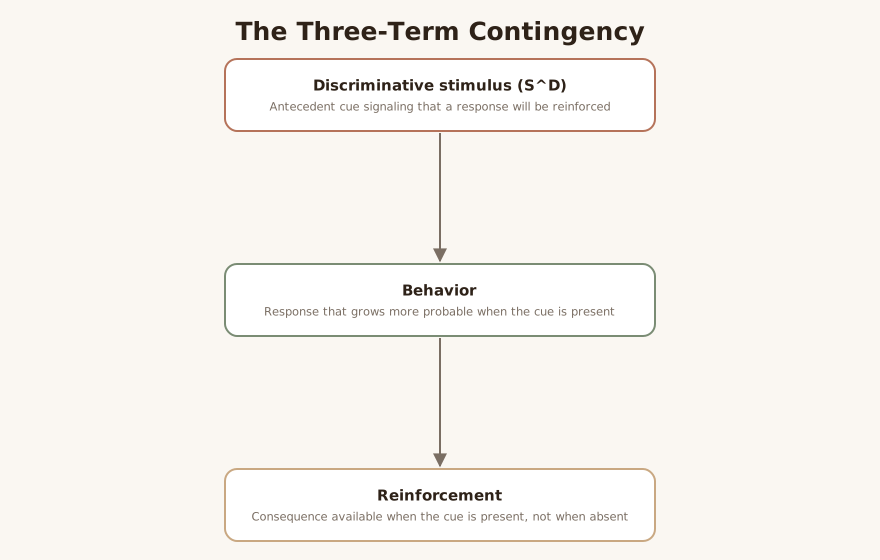
The organizing unit is the three-term contingency: an antecedent (the discriminative stimulus), the behavior, and the consequence 3. A discriminative stimulus (S^D) is an environmental cue signaling that a behavior will be reinforced; the behavior becomes more probable in its presence because it is reinforced when the cue is present and not reinforced when it is absent 3. Its complement, the S-delta (S^Δ), signals that reinforcement is unavailable 1. A stop sign functions as an everyday S^D for braking 1.
Stimulus control is the result: once an antecedent has been consistently linked to a behavior, the response grows more probable in that antecedent’s presence 3. Stimuli that share features and produce equivalent behavioral effects form a stimulus class 3.
Generalization is the tendency for a behavior to occur in the presence of similar, novel stimuli 3. In classical conditioning, generalization refers to the capacity of a stimulus other than the original conditioned stimulus to evoke the conditioned response 2. As novel stimuli become less similar to the training stimulus, response strength declines along the generalization gradient 1. Stimulus generalization is a well-recognized construct across the conditioning literature 5.
Discrimination is the inverse process: organisms learn to respond differently to signals that predict reinforcement versus those that do not 2. Discrimination training reinforces a response when the S^D is present while extinguishing it when an S-delta appears, producing a discriminated behavior that occurs only to the appropriate cue 3.
Weiss’s two-factor model adds nuance: stimulus control is not solely a matter of discriminative learning 4. A discriminated-response process and an incentive (reinforcer) process combine algebraically — enhancing each other when in agreement and counteracting each other when in opposition — so motivation and reinforcement history jointly determine responding 4. This helps explain phenomena like peak shift and inhibitory control 4.
Interventions & Techniques
Antecedent-focused procedures manipulate the cues that precede behavior rather than only its consequences 3. Discrimination training establishes a target response under one cue while extinguishing it under others 3. Generalization training reinforces a behavior across multiple situations until it transfers across the relevant stimulus class — for example, ensuring a skill appears in classroom, home, and playground rather than only where it was taught 3.
Prompts are stimuli added to a situation to raise the likelihood of a correct response, ordered from least to most intrusive: verbal, gestural, modeling, and physical 3. Prompt fading gradually removes that support — fading within a prompt, fading across prompts, or using prompt delay (waiting for an unprompted response before intervening) — so behavior comes under the control of the natural S^D rather than the clinician’s cue 3. Programming strings these together: prompt, reinforce in a novel setting, fade support, and repeat across situations to build generalization deliberately 3.
In the insomnia literature, the same logic is applied as stimulus control therapy, re-establishing the bed and bedroom as discriminative stimuli for sleep rather than for wakeful activity LLM. In exposure-based treatment, discrimination training underlies learning that a feared cue (a dog, a memory, a bodily sensation) no longer predicts the aversive outcome it once signaled LLM.
LLM-generated illustrative example (not a guideline): A client whose panic generalized from a single crowded train to all enclosed public transit practices graded exposure across buses, elevators, and theaters. The clinician frames this as deliberately re-training discrimination — teaching the nervous system that “enclosed space” is not a reliable S^D for catastrophe — and reinforcing approach across settings so gains generalize rather than staying stuck to one route LLM.
Evidence Base
The maturity of these principles is best described as established LLM. Stimulus control, generalization, and discrimination are not contested hypotheses but reproducible experimental findings demonstrated across species, sensory modalities, and decades of laboratory work, including the orderly generalization gradients reported by Hanson and replicated along auditory dimensions 12. Discrimination training reliably produces stimulus control through selective reinforcement, as in the classic pigeon preparation where pecking was reinforced only when a light was on until the light became a powerful controlling cue 1.
Honesty requires two qualifications LLM. First, the strongest, cleanest evidence is basic-science evidence from animal learning; the encyclopedia source itself notes its focus is animal learning research rather than human clinical application 2. Second, the principles are established, but the clinical packages built on them (exposure therapy, stimulus control therapy for insomnia, contingency management, ABA teaching procedures) each carry their own, separate evidence base that a clinician should evaluate on its own terms rather than assuming a clean transfer from the laboratory LLM. The two-factor model is a reminder that even within the basic science, single-mechanism accounts are incomplete and incentive processes matter alongside discriminative ones 4.
Populations & Indications
These principles are indicated wherever behavior is cue-bound, context-dependent, or failing to transfer across settings LLM. Children with developmental disabilities are a core population for the applied procedures — prompting, fading, and explicit generalization training are staples of teaching new skills and ensuring they appear outside the training room 3. Clients in behavioral therapy broadly benefit from the framework whenever a behavior must be brought under, or released from, the control of specific antecedents 3.
People with anxiety disorders and individuals with phobias present with over-narrow or over-broad stimulus control: a fear response yoked to cues that no longer warrant it, often having generalized well beyond the original conditioned stimulus 2. People with insomnia show the bed functioning as an S^D for wakefulness instead of sleep LLM. People with substance use disorders show cue reactivity, where drug-associated stimuli function as powerful antecedents for craving and use LLM. Across all of these, the clinical question is the same: which cue controls which behavior, and is that control too narrow, too broad, or attached to the wrong response LLM?
Problems-for-Work
- Phobias and specific fears — a feared object functions as an S^D for avoidance; treatment re-trains discrimination so the cue no longer predicts danger 3LLM.
- Fear generalization — a fear conditioned to one stimulus spreads along the generalization gradient to similar, harmless stimuli; the work is narrowing the gradient through corrective experience 1LLM.
- Generalized anxiety disorder — diffuse, poorly discriminated cueing where too many antecedents evoke worry; sharpening discrimination between threat and safety signals is central LLM.
- Insomnia — re-establishing the bed and bedroom as discriminative stimuli for sleep rather than for screens, eating, or rumination LLM.
- PTSD (cue reactivity) and trigger-based relapse — trauma- or use-associated cues acquire strong stimulus control over reactivity or relapse; the work targets the antecedent’s signaling value LLM.
- Substance craving and cue reactivity — replacing or re-conditioning the cues that function as S^Ds for use, as in the applied example of establishing a water bottle as a cue that displaces a coffee or smoking habit 3LLM.
- Compulsive behaviors and habit disorders — habits are tightly cue-bound; altering the controlling antecedent (or inserting a competing response under the same cue) is the lever 3LLM.
- Avoidance behavior — avoidance is reinforced in the presence of feared S^Ds; generalization training across settings prevents gains from staying stuck to one safe context 3LLM.
Contraindications, Cautions & Cultural Humility
The principles themselves are descriptive and have no contraindication, but the procedures built on them do require judgment LLM. Exposure-style discrimination work is contraindicated when a “feared” cue signals genuine, current danger; the clinician must distinguish maladaptive overgeneralization from accurate threat appraisal before trying to weaken stimulus control LLM. Prompting and physical guidance — the most intrusive prompt level — demand explicit attention to consent, dignity, and least-restrictive practice, particularly with children and people with disabilities 3LLM.
Cultural humility matters because what counts as a “trigger,” a safe context, or an appropriate behavior in the presence of a cue is shaped by culture, community, and lived history LLM. A response a clinician might label overgeneralized avoidance may be a calibrated, protective discrimination learned in a genuinely unsafe environment LLM. The two-factor model’s emphasis on incentive processes is a useful caution here: behavior reflects what is meaningful and reinforcing to the client, not only what cues are present, so collaborative formulation should precede any attempt to re-engineer stimulus control 4LLM.
Treatment-Plan Suggestions & SMART Objectives
| Goal | SMART objective (example) | Mechanism |
|---|---|---|
| Reduce phobic avoidance | Within 8 weeks, client completes a 10-step graded exposure hierarchy to the feared cue with peak distress ≤4/10, twice weekly | Discrimination re-training: the feared S^D stops predicting the aversive outcome 3 |
| Narrow over-generalized fear | Within 6 weeks, client correctly distinguishes 8/10 safe-vs-threat contexts on a self-monitoring log without avoidance | Sharpening the generalization gradient toward accurate cues 12 |
| Restore sleep-cue control | Within 4 weeks, client uses the bed only for sleep and leaves after 20 minutes awake on ≥6 of 7 nights | Re-establishing bed/bedroom as a discriminative stimulus for sleep 3 |
| Reduce craving reactivity | Within 6 weeks, client identifies top 5 use-related cues and applies a competing response to ≥80% of logged episodes | Altering the antecedent’s signaling value and inserting a competing response 3 |
| Generalize a coping skill | Within 5 weeks, client applies a learned grounding skill in ≥3 distinct settings, documented weekly | Generalization training across the relevant stimulus class 3 |
| Reduce cue-driven habit | Within 8 weeks, client replaces a habitual cue-behavior pairing in ≥75% of opportunities | Substituting a new behavior under the existing controlling cue 3 |
| Build threat–safety discrimination | Within 6 weeks, client rates situational safety on a 0–10 scale and approaches ≥3 previously avoided safe contexts | Discrimination training distinguishing S^D from S-delta 13 |
Common Misconceptions
A frequent misconception is that stimulus control is the same as classical conditioning LLM. It is not: stimulus control results from historical reinforcement contingencies and operant learning, not from automatic, reflexive pairing alone 1. A second misconception is that a behavior learned or weakened in one context will automatically appear (or stay gone) everywhere; generalization is not guaranteed and frequently must be trained deliberately across settings 3. A third is that stimulus control is purely a matter of what cue is present — the two-factor model shows that incentive and motivational processes combine with discriminative learning to determine responding, so two clients facing the same cue may behave very differently 4. Finally, clinicians sometimes assume that “more prompting is better”; in fact prompts are meant to be faded, and lingering on intrusive prompts can leave behavior under the clinician’s control rather than the natural cue’s 3.
Training & Certification
There is no certification in “stimulus control” as a standalone credential; it is foundational content within broader behavioral training LLM. The most formalized applied pathway is Applied Behavior Analysis, where antecedent-focused procedures — discriminative stimuli, prompting, fading, and generalization programming — are core competencies taught in structured curricula such as the Principles of Behavior Analysis materials 3. For clinicians outside ABA, these principles are typically absorbed through training in the treatment packages that operationalize them — exposure therapy, cognitive behavioral therapy for insomnia, and contingency-management approaches — each with its own supervision and competency expectations LLM.
Key Terms
- Discriminative stimulus (S^D) — an antecedent cue signaling that a behavior will be reinforced 3.
- S-delta (S^Δ) — a cue signaling that reinforcement is unavailable 1.
- Stimulus control — responding differently depending on the presence or absence of a given stimulus 1.
- Three-term contingency — antecedent, behavior, consequence; the basic unit of operant analysis 3.
- Stimulus class — a set of antecedents sharing features that produce equivalent behavioral effects 3.
- Generalization — occurrence of a learned response to similar, novel stimuli 3.
- Generalization gradient — the orderly decline in response strength as stimuli become less similar to the training stimulus 1.
- Discrimination — differential responding to cues that predict reinforcement versus those that do not 2.
- Discrimination training — reinforcing a response to an S^D while extinguishing it to an S-delta 3.
- Prompt / prompt fading — added cues to evoke a correct response, then their systematic removal 3.
- Two-factor model — account in which discriminated-response and incentive processes combine to produce stimulus control 4.
Resources & Further Reading
▶ Watch — a video introduction to this concept:
- Stimulus control (Wikipedia)
- Discrimination and Generalization (Encyclopedia.com)
- Advanced Operant Conditioning: Antecedent-Focused Procedures (Principles of Behavior Analysis, WSU OpenText)
- Discriminated response and incentive processes in operant conditioning: a two-factor model of stimulus control (PMC)
- Stimulus Generalization (ScienceDirect Topics)
Reflective / Supervision Questions
- For this client’s presenting problem, which specific cues currently function as discriminative stimuli, and is that control too narrow, too broad, or attached to the wrong response LLM?
- Where might gains from session fail to generalize, and what generalization training across settings would I build in deliberately rather than hope for 3LLM?
- Am I confident this client’s avoidance reflects maladaptive overgeneralization rather than an accurate, protective discrimination learned in a genuinely unsafe context 2LLM?
- If I am using prompts (including in-session coaching), do I have an explicit fading plan so behavior comes under the natural cue’s control rather than mine 3LLM?
- Beyond the cues present, what incentive and motivational processes are shaping this client’s responding, and how might those interact with the discriminative work I am planning 4LLM?