
The Relaxation Response is one of the few mind-body constructs that entered clinical medicine through a cardiology lab rather than a contemplative tradition, and that origin still shapes how it is taught and how its evidence reads 4. For practicing therapists, it is worth knowing both as a discrete, teachable intervention and as the conceptual hinge between ancient meditative practice and the contemporary mindfulness-based interventions most of us were trained in 3.
Type & Discipline
The Relaxation Response is best classified as a physiological construct — a defined bodily state — rather than a branded therapy or a school of psychotherapy LLM. Benson described it as “a natural innate protective mechanism which allows us to turn off harmful effects from stress through changes that decrease heart rate, lower metabolism, decrease rate of breathing, and in this way bring the body back into a healthier balance” 1. It sits within mind-body medicine, the field Benson helped found through Harvard’s Mind/Body Medical Institute 4.
Functionally, it belongs to the family of mantra-based, focused-attention meditation: a single repeated stimulus (word, sound, or prayer) anchors attention while the practitioner adopts a passive attitude toward intruding thoughts 1. The distinguishing move is that Benson stripped the practice of religious and cultural framing and recast it as a reproducible autonomic phenomenon — “demystifying meditation and helping to bring it into the mainstream, by renaming meditation the ‘Relaxation Response’” 4. That secularization is the reason the term names a response (a measurable physiological state) rather than a practice LLM.
Creators & Lineage
The construct is the work of Herbert Benson, M.D., a Harvard cardiologist, with the book The Relaxation Response (1975) co-authored by Miriam Z. Klipper 3. Benson’s path to it was empirical and somewhat accidental: in 1968 practitioners of Transcendental Meditation approached him to study whether their practice lowered blood pressure, and his Harvard Medical School laboratory found that when subjects meditated, their metabolic rate dropped markedly within minutes 3. Rather than tie his findings to any one tradition, Benson abstracted out the common ingredients 4.
Upstream of Benson sits Walter B. Cannon, the Harvard physiologist who described the “fight-or-flight” response in the 1920s 2. Benson explicitly positioned the Relaxation Response as the physiological counterpart and counter-state to Cannon’s stress reaction 4. Benson also located the practice in a long contemplative lineage, noting that early Christian ascetics such as St. Augustine, Martin Luther, and St. Theresa practiced “contemplation” and “recollection” to quiet the mind, and that repetitive meditative exercises appear in early Judaic mysticism — the 13th-century Rabbi Abulafia, for instance, meditated on the letters of God’s name while using yogic breathing 1.
Downstream, the Relaxation Response predates and underpins the mindfulness-based intervention era LLM. Benson’s book was, by a 1986 survey, the number-one self-help book that clinical psychologists recommended to patients — an early signal of how thoroughly secularized meditation entered Western clinical practice 3.
Core Principles
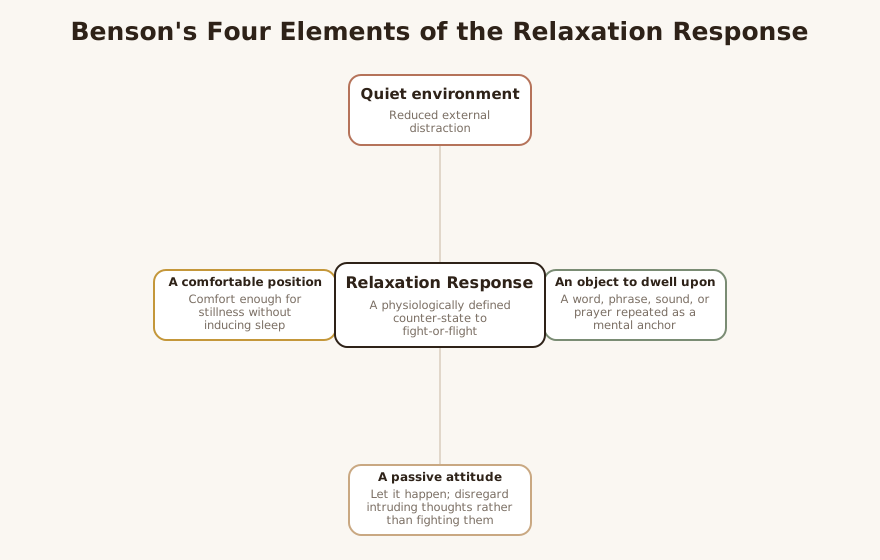
Benson reduced an elicitation of the Relaxation Response to four basic elements 1:
- A quiet environment — reduced external distraction 1.
- An object to dwell upon — a “mental device,” typically a single word, phrase, sound, or prayer repeated to keep the mind from wandering 13.
- A passive attitude — the disposition Benson summarized as “let it happen,” disregarding intruding thoughts rather than fighting them 1.
- A comfortable position — enough comfort to sustain stillness without inducing sleep 1.
By 1996 Benson had narrowed the essential ingredients to just two: the mental device and the passive attitude 3. This refinement matters clinically — it tells us that the active mechanism is not posture, setting, or even breathing per se, but the pairing of a repetitive cognitive anchor with non-striving acceptance LLM.
The second principle is the focus word or phrase. Harvard Health gives “one,” “peace,” or “shalom” as examples, and notes the device can be drawn from a client’s own faith or values 2. The third — passive disregard — is the principle most often misapplied: success is undermined by trying to relax. Benson’s instruction is explicit: “Do not worry about whether you are successful… When distracting thoughts occur, merely return to repeating ‘ONE’” 1.
A final principle is physiological non-specificity of route. Benson found that the physiologic changes elicited by six different techniques — Transcendental Meditation, Zen and Yoga, Autogenic Training, Progressive Relaxation, hypnosis with suggested deep relaxation, and Sentic Cycles — all approximated the same set of changes in oxygen consumption, respiratory rate, heart rate, alpha waves, blood pressure, and muscle tension 1. In other words, many doors open onto the same room.
Interventions & Techniques
The canonical protocol is brief and easily taught in session 1:
- Sit quietly in a comfortable position 1.
- Close your eyes 1.
- Deeply relax all your muscles 1.
- Breathe through your nose; become aware of your breathing. On each exhalation, silently say your focus word — “breathe IN—OUT, ‘ONE’” — breathing easily and naturally 1.
- Continue for 10 to 20 minutes; you may open your eyes to check the time but do not use an alarm. Afterward, sit quietly for several minutes before standing 1.
- Maintain a passive attitude; when distracting thoughts intrude, simply return to the focus word 1.
Practical parameters Benson specified: practice once or twice daily, and not within two hours of a meal, because digestion appears to interfere with elicitation 1. Harvard Health frames an even more accessible entry point — roughly ten minutes of abdominal breathing paired with a focus word — and emphasizes that “there is no single method that works for everyone” and that finding one’s effective approach takes practice 2.
LLM-generated illustrative example (not a guideline): A clinician introduces the practice to a client with sleep-onset insomnia by having them choose the word “calm,” then walks through one five-minute trial in session. The client reports the word kept slipping away; the clinician reframes this as expected and reinforces “just come back to the word” rather than “clear your mind” — modeling passive disregard in vivo. LLM
In therapy, the Relaxation Response functions well as a between-session home practice anchored by an in-session rehearsal, and as a portable downregulation skill clients can deploy before anticipated stressors LLM. Because the focus word can be a value-laden or spiritual phrase, it integrates readily into work with religious clients without requiring them to adopt an unfamiliar framework 2.
Evidence Base
The maturity of this evidence base is best described as established — the construct is roughly five decades old, originated in peer-reviewed physiology, and underlies an entire downstream field LLM. Benson’s foundational measurements demonstrated reproducible reductions in metabolic rate, with subsequent work showing blood-pressure reductions over weeks of practice 3. He published on the cardiovascular application directly in the New England Journal of Medicine in 1977, in “Systemic Hypertension and the Relaxation Response,” establishing the practice in the mainstream cardiology literature of its day 5.
The physiological signature is consistent across sources: slowed breathing rate, muscle relaxation, and reduced blood pressure, mediated by a shift toward parasympathetic dominance and away from the sympathetically driven fight-or-flight state 23. Clinically, the practice is described as helpful for conditions caused or worsened by chronic stress, including hypertension, anxiety disorders, insomnia, fibromyalgia, and gastrointestinal complaints 4.
Honest caveats for clinicians: much of the strongest framing reflects Benson’s own program and era, and several widely cited claims (for example, that more than 60 percent of healthcare visits are stress-related) are program assertions rather than independently replicated trial endpoints 3. The construct is established as a real and reproducible physiological state and as a safe, low-cost adjunct; it is not a standalone treatment for diagnosed hypertension or any psychiatric disorder, and should be positioned as one component of care LLM.
Populations & Indications
The practice was designed for, and is best supported in, adults with stress-related physiological complaints 1. Specific indications drawn from the source literature include mild or borderline hypertension, where it serves as a behavioral adjunct to medical management 5; insomnia, particularly sleep-onset difficulty 4; anxiety disorders and generalized somatic tension 4; and stress-exacerbated medical illness such as functional GI symptoms, headache, and fibromyalgia 4.
A distinct and underrated indication is the client who declines or distrusts “meditation” or “mindfulness” framing — for cultural, religious, or temperamental reasons LLM. Because Benson deliberately secularized the practice and allows the focus word to be a personal or spiritual phrase, the Relaxation Response can deliver the same downregulation under a more neutral or more faith-congruent label 24.
Problems-for-Work
- Chronic physiological hyperarousal. For a client whose baseline is “always on,” twice-daily elicitation provides a structured counter-state to repeated fight-or-flight activation 21.
- Mild hypertension as a behavioral target. Paired with medical care, the practice addresses the stress contribution to blood pressure rather than substituting for medication 53.
- Sleep-onset insomnia. A pre-sleep focus-word practice gives the ruminating mind a benign anchor and trains passive disregard of intruding thoughts 4.
- Anticipatory and performance anxiety. A brief elicitation before a feared event downregulates somatic arousal without requiring cognitive restructuring LLM.
- Somatic symptom amplification. For clients whose GI or pain symptoms flare with stress, the practice targets the autonomic mediator directly 4.
LLM-generated illustrative example (not a guideline): A client with stress-driven tension headaches practices the Relaxation Response twice daily for two weeks and tracks headache frequency. The clinician uses the log not to “prove” efficacy but to build the client’s own contingency awareness between arousal and symptom. LLM
Contraindications, Cautions & Cultural Humility
There are no major medical contraindications to the practice itself, but several cautions apply LLM. It is an adjunct, not a substitute. Clients with diagnosed hypertension should never reduce or stop antihypertensive medication on the basis of relaxation practice without their physician’s direction 5LLM. The practice should likewise not replace evidence-based treatment for an anxiety or sleep disorder, but supplement it LLM.
Relaxation-induced anxiety is a real phenomenon: for some clients — particularly those with trauma histories or panic disorder — eyes-closed interoceptive attention and stillness can provoke rather than reduce arousal LLM. Introduce the practice gradually, normalize that “letting go” can initially feel unsafe, and give permission to keep the eyes open or shorten the trial LLM. The instruction to adopt a passive attitude can paradoxically increase effortful striving in perfectionistic clients; coaching the attitude explicitly matters as much as the technique 1LLM.
On cultural humility: Benson drew the construct from contemplative traditions across Christianity, Judaism, Hinduism, and Buddhism, then secularized it 1. Clinicians should hold that history with care — offering clients the option of a focus word from their own tradition honors the practice’s roots and increases buy-in, while imposing a secular frame on a client for whom a prayer would be more meaningful does the reverse 2LLM.
Treatment-Plan Suggestions & SMART Objectives
| Goal | SMART objective (example) | Mechanism |
|---|---|---|
| Reduce physiological hyperarousal | Client will practice a 10-minute Relaxation Response elicitation once daily, 5 of 7 days, for 4 weeks, logging each session | Parasympathetic shift countering fight-or-flight activation 23 |
| Improve sleep onset | Client will use a pre-sleep focus-word practice on ≥4 nights/week and rate sleep latency for 3 weeks | Benign cognitive anchor displaces sleep-onset rumination 4 |
| Build a portable downregulation skill | Client will complete one brief elicitation before each identified stressor and rate pre/post tension (0–10) across 2 weeks | Repeated practice generalizes the response to in vivo cues 1 |
| Support blood-pressure management | Client will practice twice daily and bring home BP logs to review with their physician over 6 weeks | Behavioral adjunct addressing the stress contribution to BP 5 |
| Master passive attitude | Client will report, in 3 consecutive sessions, returning to the focus word without self-judgment when distracted | Non-striving acceptance is the active ingredient, not effortful relaxing 1 |
| Reduce stress-linked somatic symptoms | Client will track symptom flares against daily practice for 4 weeks to identify the arousal–symptom link | Direct downregulation of the autonomic mediator 4 |
| Increase practice adherence | Client will pair practice with an existing daily cue (e.g., after morning coffee, ≥2 hrs from meals) for 4 weeks | Habit-stacking plus respecting the post-meal interference window 1 |
Common Misconceptions
- “It’s just relaxing / lying down.” The construct is a specific physiological state requiring an attentional anchor and passive attitude, not mere rest 1LLM.
- “You have to clear your mind.” The goal is not an empty mind but the gentle, repeated return to the focus word; intruding thoughts are expected 1.
- “It’s the same as Transcendental Meditation.” It originated in TM research but was deliberately secularized and generalized; any of several techniques produce the same response 14.
- “More effort means better results.” Striving undermines the passive attitude that is the active ingredient 1LLM.
- “It can replace blood-pressure medication.” It is positioned as an adjunct, never a substitute for medical treatment 5LLM.
- “It’s a modern mindfulness technique.” It predates the MBSR/MBI era and is one of its conceptual ancestors 3LLM.
Training & Certification
There is no proprietary certification required to teach the Relaxation Response; the protocol is openly published and was designed to be self-administered 1. This openness is by design — Benson’s project was to make the practice broadly accessible rather than gatekept 4. Clinicians can teach it directly from the published instructions, and the core skill for a therapist is less the protocol than the coaching of the passive attitude and the management of relaxation-induced anxiety 1LLM. Clinicians seeking deeper grounding can consult Benson’s own writings and recorded teaching on the discovery and physiology of the response 6.
Key Terms
- Relaxation Response — the reproducible physiological state of decreased heart rate, metabolism, and breathing rate that counters stress 1.
- Fight-or-flight response — Cannon’s sympathetically driven stress reaction, of which the Relaxation Response is the counter-state 24.
- Mental device / focus word — the repeated word, sound, phrase, or prayer that anchors attention 13.
- Passive attitude — the non-striving “let it happen” disposition toward intruding thoughts; the active ingredient 1.
- Elicitation — the act of evoking the response through the four (later two) basic elements 13.
- Mind-body medicine — the clinical field, advanced by Benson’s Mind/Body Medical Institute, studying how mental states affect physiology 4.
Resources & Further Reading
▶ Watch — a video introduction to this concept:
- The Relaxation Response (Benson & Klipper, 1975) — patient handout, Brigham and Women’s/Faulkner Hospital
- Using the relaxation response to reduce stress — Harvard Health Publishing
- Systemic Hypertension and the Relaxation Response (Benson, NEJM 1977)
- The Relaxation Response — Wikipedia
- Dr. Herbert Benson’s Relaxation Response — Psychology Today
- Herbert Benson: Discovering the Relaxation Response — video
Reflective / Supervision Questions
- When I introduce relaxation work, do I coach the passive attitude as explicitly as the technique, or do I implicitly reinforce striving? LLM
- For a client who distrusts “meditation” or “mindfulness,” would the secularized Relaxation Response framing — or a focus word from their own faith — improve engagement? 4LLM
- How do I screen for and respond to relaxation-induced anxiety in trauma or panic-disordered clients before assigning eyes-closed practice? LLM
- Am I positioning this as an adjunct to medical and psychiatric care, and is that boundary documented and communicated to the client and any prescriber? 5LLM
- How do I distinguish, in my own evidence claims, between what is well-established (a reproducible physiological state) and what is program assertion rather than replicated trial outcome? 3LLM