
Type & Discipline
Functional analysis is an assessment technique rather than a freestanding therapy: it is the structured procedure by which a clinician identifies the relationship between a behavior and the environmental events that occasion and maintain it 4. It belongs to behavioral psychology and behavioral assessment, and it underwrites the broader activity of behavioral case formulation — the working hypothesis a clinician builds about why a particular client’s difficulties persist 1. Because it specifies the function a behavior serves rather than cataloguing its form, functional analysis is idiographic by design, producing a formulation tailored to one client rather than a diagnosis-driven protocol 1.
Its central claim is that behavior is lawful and controlled by its consequences, so the same observable act may serve entirely different functions in different people and contexts 6. This functional stance is what distinguishes the method from purely descriptive or topographical assessment, which records what a behavior looks like without explaining why it recurs 6. In contemporary practice the technique is not confined to any one school; it operates as the assessment spine inside cognitive behavioral therapy, dialectical behavior therapy, behavioral activation, and applied behavior analysis 3. LLM Treating it as a discipline-neutral tool — a way of thinking about maintenance rather than a brand of treatment — is the most useful framing for the generalist clinician LLM.
Creators & Lineage
The intellectual lineage runs from the operant tradition, in which behavior is understood as a function of its antecedents and consequences, into the clinical assessment methods that translated those principles into casework 6. Frederick Kanfer is most associated with the SORC model, an extension of the simpler antecedent–behavior–consequence sequence that inserts organism variables — the biological, cognitive, and learning-history factors a person brings to the situation — between stimulus and response 6. LLM Kanfer’s contribution made functional analysis usable with human clients whose internal states and prior learning visibly shape how the same antecedent produces different responses LLM.
Brian Iwata anchored the experimental, or analog, branch of the field 4. His work established functional analysis as a method for systematically manipulating environmental conditions — for example, varying attention, demand, and access to tangibles — to test directly which contingency maintains a problem behavior, most influentially with self-injurious and severe challenging behavior 4. This experimental approach is the gold standard within functional behavioral assessment because it identifies maintaining variables through controlled demonstration rather than inference alone 4.
Stephen Haynes developed functional analysis as a model for clinical case formulation in adult psychotherapy more broadly 1. His functional-analytic case formulation organizes a client’s presenting problems, their causal and maintaining variables, and the relative strength and modifiability of those relationships into a coherent map that guides where to intervene first 1. LLM Together these three strands — Kanfer’s SORC, Iwata’s experimental rigor, and Haynes’s formulation framework — define the modern technique, even though each emphasized a different population and level of control LLM.
Core Principles
The first principle is that behavior is selected and maintained by its consequences, so the clinician’s task is to discover what a behavior does for the client, not merely what it costs them 6. A behavior that looks self-defeating from the outside is almost always functional from the inside, producing escape, attention, sensory relief, or access to something reinforcing 4. LLM Holding this assumption changes the clinical question from “how do we stop this?” to “what need is this meeting, and how else could it be met?” LLM.
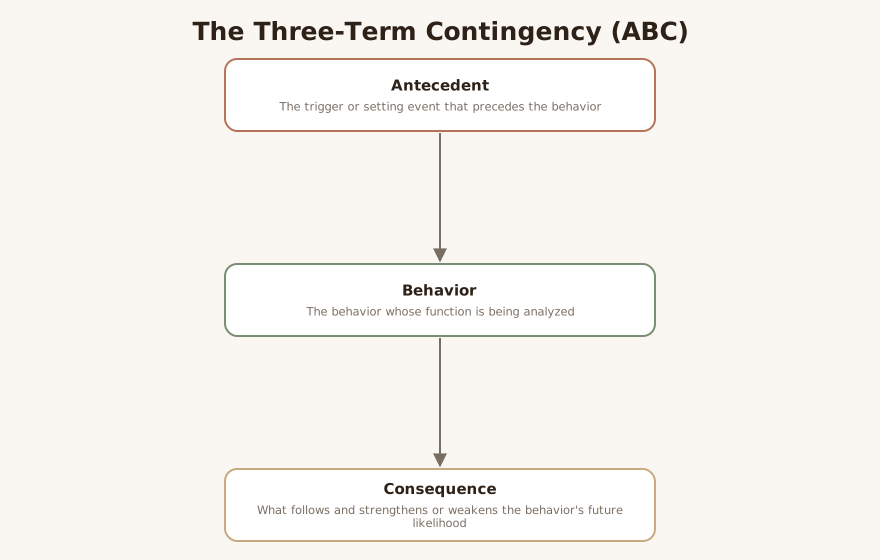
The second principle is the primacy of function over form 1. Two clients who both cut themselves, or both cancel social plans, may be doing so for opposite reasons — one to escape an aversive internal state, the other to recruit care — and the function, not the topography, dictates the intervention 1. The third principle is that the relevant unit of analysis is the three-term contingency: antecedent, behavior, and consequence, often abbreviated ABC 5. Antecedents are the triggers or setting events that precede the behavior; consequences are what follows and either strengthens or weakens its future likelihood 5.
The fourth principle elaborates the contingency for human clients through the SORC frame, where the organism variables and the response class are made explicit alongside stimulus and consequence 6. This acknowledges that mood, beliefs, physiological state, and learning history mediate the link between trigger and action in people 6. A fifth, methodological principle is that hypotheses about function should be tested rather than assumed, ranging from careful descriptive observation to direct experimental manipulation where feasible and appropriate 4.
Interventions & Techniques
The foundational technique is ABC recording: the clinician and client log episodes of the target behavior together with the antecedent that preceded it and the consequence that followed, building an empirical picture of the controlling contingencies 5. Done across many instances, this descriptive analysis reveals patterns — which settings, times, people, or internal states reliably precede the behavior, and what reliably follows it 5. In cognitive behavioral therapy this same logic is applied to chains of thoughts, feelings, and actions, so that the “behavior” under analysis may be an overt act, an avoidance move, or a covert response such as rumination 3.
A second technique is structured functional interviewing and self-monitoring, in which the client gathers antecedent–behavior–consequence data between sessions to extend the sample beyond what the clinician can observe directly 2. Standardized functional-assessment interviews and rating scales are used to generate hypotheses about maintaining function before any direct testing 4. Where the setting allows and the behavior is severe enough to warrant it, the clinician may move to experimental functional analysis, systematically presenting and withdrawing conditions to confirm which consequence maintains the behavior 4.
The output of all these techniques is a formulation that drives function-based intervention 1. Once a function is identified, treatment is matched to it: arranging that the behavior no longer produces its reinforcing consequence, teaching a functionally equivalent alternative that secures the same outcome more adaptively, and modifying the antecedents that set the occasion 4. LLM The discipline of functional analysis is precisely that the intervention follows from the assessment rather than from the diagnostic label or the clinician’s preferred method LLM.
LLM-generated illustrative example (not a guideline): A teenager refuses to attend school and the team’s first instinct is a reward chart for attendance. ABC data instead show the refusal reliably follows mornings with a particular class and reliably produces escape from a feared oral presentation, pointing to an escape function — so the intervention shifts from rewarding attendance to graded exposure and a negotiated alternative to public speaking, addressing the contingency that actually maintains the avoidance LLM.
Evidence Base
The maturity of the evidence is best described as established but uneven across applications 4. The strongest, most replicated support is for experimental functional analysis of challenging and self-injurious behavior in individuals with intellectual and developmental disabilities, where the method is treated as best practice and has decades of single-case and group demonstration behind it 4. In that domain, identifying the maintaining function through functional behavioral assessment reliably yields more effective, function-matched interventions than topography-based treatment selection 4.
The evidence is more qualified when functional analysis is used as a general case-formulation tool in adult outpatient psychotherapy 1. Here it is conceptually central and clinically valued, but its incremental and treatment-utility evidence — the demonstration that formulating a case functionally produces better outcomes than treating to diagnosis alone — is more limited and methodologically harder to establish 1. LLM Honesty with supervisees matters here: functional analysis is exceptionally well supported as an assessment logic, and far less definitively shown to add measurable outcome value once a competent manualized treatment is already in place LLM. The technique is also resource-intensive, and descriptive functional assessments can yield ambiguous or conflicting hypotheses that a brief experimental analysis would resolve but that time and setting often do not permit 4. The pragmatic conclusion is that functional analysis is an established, widely endorsed method whose strength of evidence scales with how rigorously it is conducted and how severe the behavior being formulated 4.
Populations & Indications
Functional analysis is indicated whenever the clinical question is why does this behavior persist, which makes it broadly applicable across populations 1. It is foundational in work with children and adolescents in school and clinic settings, where functional behavioral assessment guides behavior-intervention planning for disruptive, aggressive, or off-task behavior 4. It is the standard of care for individuals with intellectual and developmental disabilities presenting with self-injury, aggression, or stereotypy 4.
In adult outpatient practice it supports formulation across cognitive behavioral therapy for anxiety, avoidance, and mood difficulties, where mapping the antecedents and reinforcing consequences of avoidance is often the pivot of treatment 3. It is central to dialectical behavior therapy’s work with self-harm and emotion dysregulation, and to behavioral activation’s analysis of the contingencies maintaining withdrawal and inactivity 3. LLM It is also well suited to substance use and other addictive behaviors, where the immediate reinforcing consequence is conspicuous and the antecedent triggers are highly idiographic LLM. The method is indicated less by diagnosis than by the presence of a specifiable target behavior whose maintaining contingencies can be observed or reasonably inferred 2.
Problems-for-Work
For non-suicidal self-injury, functional analysis distinguishes whether cutting functions to regulate an overwhelming internal state, to communicate distress, or to escape an interpersonal demand, and the intervention differs accordingly 1. For avoidance behavior in anxiety, ABC analysis exposes the negative-reinforcement loop in which avoidance produces immediate relief that strengthens future avoidance, justifying exposure-based intervention 3.
For self-injurious and challenging behavior in developmental disability, experimental analysis sorts attention-maintained from escape-maintained from automatically reinforced behavior, each calling for a different treatment package 4. For procrastination and behavioral inactivity, the analysis identifies the short-term relief or low-effort reinforcement that maintains the pattern and the longer-term reinforcers being forgone 3. For substance use and craving, mapping the antecedent cues and the immediate reinforcing consequence supports stimulus-control and alternative-reinforcement strategies 2. LLM Across all of these, the common move is to replace a guess about cause with a tested contingency, then to design the intervention around that contingency rather than around the diagnostic label LLM.
LLM-generated illustrative example (not a guideline): An adult repeatedly leaves work meetings to check her phone, and a manager frames it as a discipline issue. Self-monitored ABC data reveal the exits reliably follow a spike in physiological anxiety and reliably produce relief, identifying an escape-from-arousal function — so the work shifts to in-session arousal regulation and graded tolerance rather than to willpower or rules LLM.
Contraindications, Cautions & Cultural Humility
Functional analysis has few absolute contraindications because it is an assessment logic rather than a procedure imposed on a client, but several cautions are real 2. Experimental functional analysis that deliberately evokes a dangerous behavior to identify its function should only be conducted in settings equipped to manage that risk and with appropriate consent and oversight, and is not a casual outpatient activity 4. LLM Inducing self-injury or aggression to confirm a hypothesis is justified only when the behavior’s severity and the planned intervention warrant it, and never as a default LLM.
Descriptive functional assessment carries the opposite risk: confidently inferring a function from limited observation and building a treatment on a hypothesis that was never tested 4. LLM Clinicians should hold functional hypotheses lightly and revise them when the function-matched intervention fails to change the behavior LLM. Cultural humility is essential because what counts as an antecedent, a reinforcer, or even a “problem” behavior is shaped by cultural norms, family context, and systemic conditions 1. A behavior framed as disruptive may be an adaptive response to an inequitable or unsafe environment, and a function-based formulation that ignores context can pathologize a reasonable response to circumstance 1. LLM The clinician’s job is to analyze the contingencies the client actually lives within, not to assume that the dominant culture’s reinforcers are universal LLM.
Treatment-Plan Suggestions & SMART Objectives
| Goal | SMART objective (example) | Mechanism |
|---|---|---|
| Build a shared map of the target behavior | Client completes ABC monitoring logs for at least 5 episodes per week for 3 weeks 5 | Descriptive functional analysis surfaces controlling antecedents and consequences LLM |
| Identify the maintaining function | Clinician and client name a primary hypothesized function for the target behavior within 4 sessions 1 | Functional formulation links behavior to its reinforcing consequence LLM |
| Reduce escape-maintained avoidance | Client completes 3 graded exposure tasks per week without the avoidance response for 4 weeks 3 | Breaking the negative-reinforcement contingency weakens avoidance LLM |
| Teach a functionally equivalent alternative | Client uses a replacement skill that secures the same function in at least 60% of trigger situations over 4 weeks 4 | Functional equivalence makes the adaptive response more efficient than the problem behavior LLM |
| Modify antecedents | Client and clinician implement 2 antecedent or stimulus-control changes and track effect for 3 weeks 4 | Altering setting events reduces the occasion for the behavior LLM |
| Test and revise the hypothesis | Clinician reviews outcome data at session 6 and revises the functional hypothesis if no change is observed 1 | Treatment-utility check prevents committing to an untested formulation LLM |
| Generalize gains across settings | Client demonstrates the replacement behavior in 2 new contexts within 6 weeks 4 | Programming for generalization extends function-based gains beyond the clinic LLM |
Common Misconceptions
A first misconception is that functional analysis and statistical “functional analysis” are the same thing; in clinical behavioral psychology the term refers specifically to identifying the function of a behavior, not to any mathematical procedure 6. A second is that the technique requires a behaviorist’s full theoretical commitment, when in practice clinicians from many orientations use ABC and SORC mapping as a pragmatic assessment tool 3.
A third misconception is that “function” means cause in the sense of a single hidden origin; functional analysis is concerned with the maintaining variables operating now, not with a developmental etiology 1. LLM A behavior can be maintained by consequences that have nothing to do with how it originally began LLM. A fourth is that descriptive ABC logging is equivalent to experimental functional analysis; the former generates hypotheses and the latter tests them, and conflating the two overstates the certainty of a descriptive formulation 4. A fifth is that identifying a function is the end of the work, when the formulation is only useful insofar as it is translated into a function-matched intervention 1.
Training & Certification
There is no single certification in functional analysis as such, because it is a method embedded within larger training pathways 4. The most formal and credentialed expertise sits within applied behavior analysis, where experimental functional analysis of challenging behavior is core to board-certified behavior-analyst training and supervised practice 4. LLM Clinicians intending to conduct experimental functional analyses of dangerous behavior should obtain that level of specialized, supervised training rather than improvising LLM.
For the broader clinical use of functional analysis in case formulation, competence is typically developed within graduate clinical training and within evidence-based modality training — cognitive behavioral therapy, dialectical behavior therapy, and behavioral activation all teach functional or chain analysis as part of their core curriculum 3. Practical fluency is built through supervised case formulation, in which a supervisor reviews the trainee’s ABC data and tests whether the proposed function actually accounts for the behavior 1. LLM Reusable clinical resources and information sheets can scaffold this learning, but they substitute for neither supervision nor the modality-specific training in which the technique is embedded LLM.
Key Terms
Functional analysis — the procedure for identifying the relationship between a behavior and the environmental events that maintain it, yielding a hypothesis about the behavior’s function 4.
Antecedent (A) — the trigger or setting event that precedes and occasions a behavior 5.
Behavior (B) — the specific, observable (or covert) response under analysis, defined precisely enough to be counted or tracked 5.
Consequence (C) — what follows the behavior and either strengthens or weakens its future likelihood 5.
ABC model — the three-term contingency of antecedent, behavior, and consequence that forms the descriptive backbone of functional analysis 5.
SORC model — Kanfer’s extension of ABC that adds organism variables and an explicit response term, accommodating the cognitive, physiological, and learning-history factors that mediate behavior in people 6.
Function — the effect a behavior reliably produces (such as escape, attention, sensory relief, or tangible access) that maintains it over time 4.
Functional behavioral assessment — the broader assessment process, including interviews, observation, and where appropriate experimental analysis, used to determine a behavior’s function 4.
Case formulation — the integrated, idiographic hypothesis about a client’s problems and their maintaining variables that guides intervention selection 1.
Resources & Further Reading
▶ Watch — a video introduction to this concept:
- Behavioral Case Formulation and Intervention: A Functional Analytic Approach / Functional Analysis in clinical assessment (Haynes)
- Functional Analysis — Psychology Tools
- What is a Functional Analysis of Behavior in CBT? — PositivePsychology.com
- Functional Behavioral Assessment — ScienceDirect Topics
- ABC Model — Psychology Tools
- Functional analysis (psychology) — Wikipedia
Reflective / Supervision Questions
- When I formulate a client’s behavior, am I describing its function or only its form, and could two clients with the same behavior need opposite interventions? LLM
- How confident am I that my functional hypothesis was tested against data rather than assumed from a single observation, and what would change my mind? LLM
- For this client, what does the problem behavior reliably produce, and have I designed an alternative that secures the same function more adaptively? LLM
- Have I considered whether what I am labeling a “problem” behavior is in fact an adaptive response to the client’s actual environment? LLM
- Where on the spectrum from descriptive to experimental analysis does this case fall, and is the rigor of my assessment proportionate to the severity of the behavior? LLM
- If the function-matched intervention does not change the behavior, what is my plan for revising the formulation rather than escalating the same approach? LLM