
Type & Discipline
Stoicism is not a therapy but a Hellenistic school of philosophy — a complete system of logic, physics, and ethics — whose ethical and psychological insights have been borrowed directly by modern psychotherapy.1 In this wiki it sits as a cross-disciplinary framework: a set of principles from philosophy whose mechanisms map cleanly onto clinical practice.2 Its single most clinically relevant claim is cognitive: that distress arises from our judgments about events rather than the events themselves.1 LLM
Creators & Lineage
Stoicism was founded in Athens around 300 BCE by Zeno of Citium, and systematized by Cleanthes and Chrysippus.1 Its best-known voices are the Roman-era Stoics — the statesman Seneca, the formerly-enslaved teacher Epictetus (c. 50–135 CE), and the emperor Marcus Aurelius (121–180 CE).1 After centuries of dormancy, Stoicism re-entered psychology in the 20th century: Albert Ellis explicitly credited Epictetus — “Men are disturbed not by things, but by the views which they take of them” — as the seed of Rational Emotive Behavior Therapy, and through Ellis it influenced Aaron Beck’s cognitive therapy.235 Modern “Stoic” self-help and resilience programs are a further revival. LLM
Core Principles
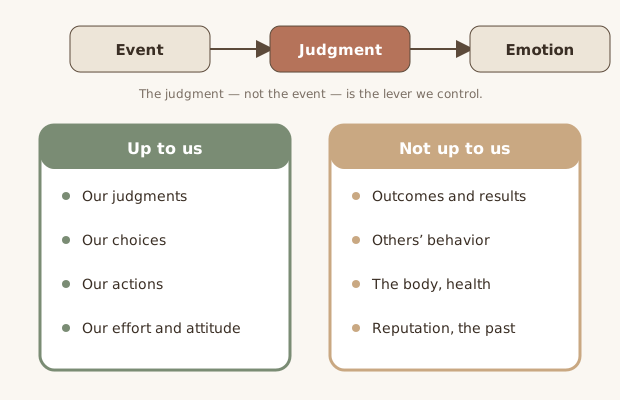
- The dichotomy of control. Some things are “up to us” (our judgments, choices, actions) and some are not (others’ behavior, the body, reputation, outcomes). Serenity comes from investing effort only in the former.5
- Emotions follow judgments. For the Stoics a “passion” is the product of assent to a false value-judgment; revise the judgment and the disturbance changes.1 This is the philosophical core of cognitive restructuring.2
- Virtue is the only true good. Health, wealth, and status are “preferred indifferents” — worth pursuing, but not the basis of a good life.1
- Living according to nature / reason. Aligning oneself with what is reasonable and within one’s nature as a rational, social being.1
- Practices: premeditatio malorum (negative visualization), the “view from above,” voluntary discomfort, and evening reflection.4 LLM
The deeper architecture: impressions, assent, the three disciplines, and the virtues
For the Stoics, distress begins with an impression (phantasia) — an automatic appraisal that something is good or bad — to which we then give or withhold assent.1 LLM Because assent is “up to us,” the decisive leverage point is the moment between impression and agreement — precisely the appraisal-checking that cognitive therapy later formalized.23 Epictetus organized practice into three disciplines: the discipline of desire (wanting only what accords with nature — accepting what we cannot control), the discipline of action (acting justly toward others), and the discipline of assent (judging impressions accurately).1 LLM The aim is eudaimonia through the four cardinal virtues — practical wisdom, justice, courage, and temperance — and the cultivation of eupatheiai, the rational positive emotions (joy, caution, reasonable wishing), rather than apatheia misread as numbness.1 LLM Two further ideas carry clinical weight: amor fati (embracing, even loving, what happens) and sympatheia (the interconnection of all things), which grounds the “view from above” perspective-taking exercise.1 LLM
From Stoicism to the Clinic
The Stoic-to-clinical mapping is unusually direct:2 LLM
- Judgments → cognitions. “Events don’t disturb us, our beliefs about them do” prefigures the CBT/REBT ABC model.25
- Dichotomy of control → acceptance + agency. Distinguishing the controllable from the uncontrollable parallels ACT’s acceptance of internal experience plus committed action on what one can influence.2
- Premeditatio malorum → decatastrophizing / exposure in imagination. Rehearsing adversity to drain its terror. LLM
- View from above → cognitive distancing / defusion. Widening perspective to loosen the grip of a thought. LLM
Core Stoic Practices in Detail
Stoicism is a practical discipline, and its exercises map onto recognizable clinical techniques.2 LLM The dichotomy-of-control review — sorting a stressor into “up to me” and “not up to me” — works as worry-postponement and locus-of-control intervention.5 LLM Premeditatio malorum (premeditation of adversity) is a measured, values-anchored form of imaginal exposure and decatastrophizing: rehearsing loss to drain its terror and prepare a response.2 LLM The view from above — picturing one’s situation from a cosmic vantage — is a perspective-taking and cognitive-distancing exercise akin to defusion.1 LLM Evening reflection (reviewing the day’s judgments and actions) is structured self-monitoring and values-checking.4 LLM Voluntary discomfort (brief, deliberate hardship) builds distress tolerance and disconfirms catastrophic beliefs about deprivation.4 LLM Negative visualization toward gratitude (contemplating loss to renew appreciation) supports savoring.1 LLM Each is delivered — and billed — within a recognized modality, most naturally CBT/REBT or existential and supportive therapy.2
Stoicism Alongside CBT, ACT & Buddhism
Stoicism’s clearest descendant is cognitive therapy: the claim that judgments, not events, drive emotion is the ABC model in embryo, and Ellis (and, indirectly, Beck) said as much.23 It also rhymes with ACT — the dichotomy of control parallels acceptance of the uncontrollable plus committed action on the controllable, and the “view from above” parallels self-as-context.2 LLM And it converges with Buddhism on impermanence, non-attachment to outcomes, and present-focus, while differing in metaphysics (a Stoic providential cosmos vs. Buddhist emptiness).1 LLM Clinically, this means Stoic content can be woven into whichever evidence-based modality a client is already in, rather than practiced as a freestanding therapy. LLM
Evidence Base
Stoicism itself has not been tested as a manualized treatment, so it carries no RCT rating; its standing is historical and theoretical.1 Its evidentiary weight is indirect but strong: the therapies it seeded — CBT and REBT — are among the most empirically supported in psychology.23 Small contemporary studies of explicitly “Stoic” resilience interventions exist but are preliminary. The honest framing for clinicians: use Stoicism as a conceptual and philosophical scaffold, and deliver change through its evidence-based descendants. LLM
Populations & Indications
Stoic principles resonate with adults seeking a coherent personal philosophy, high-achieving professionals prone to over-investment in uncontrollable outcomes, caregivers facing what they cannot change, and older adults confronting mortality and loss.1 LLM They are most useful where rumination over uncontrollables, or rigid judgments of “should,” drive distress. LLM
Problems-for-Work
- Anxiety — separating the controllable (preparation, response) from the uncontrollable (outcome) reduces anticipatory worry.5 LLM
- Anger — reframing the judgment that one has been “wronged” loosens the passion.1 LLM
- Perfectionism — relocating worth from outcomes (indifferents) to character and effort (virtue).1 LLM
- Adversity & resilience — premeditation and the dichotomy of control build tolerance for hardship. LLM
- Grief — Senecan consolation reframes loss while honoring love; used carefully, not to rush mourning.1 LLM
LLM-generated illustrative example (not a guideline): A perfectionistic executive lists a stalled promotion’s elements as “up to me” (effort, attitude, skill-building) vs. “not up to me” (the committee’s decision) and redirects worry into a controllable weekly action. LLM
Contraindications, Cautions & Cultural Humility
The chief risk is “toxic stoicism” — confusing the philosophy with emotional suppression, stiff-upper-lip avoidance, or invalidation of legitimate feeling; the Stoics counseled examining emotions, not numbing them.4 LLM “Control your judgments” can shade into victim-blaming when distress stems from real injustice, abuse, discrimination, or material deprivation; here the controllable/uncontrollable line must never excuse harm or substitute for advocacy and safety.2 LLM Stoic determinism and its talk of “nature” may also clash with some clients’ spiritual or cultural frameworks — adapt language with humility. LLM
Treatment-Plan Suggestions & SMART Objectives
| Goal | SMART objective (example) | Stoic principle |
|---|---|---|
| Reduce uncontrollable-focused worry | For 4 weeks, client completes a daily control/no-control sort of one stressor, ≥5 days/week | Dichotomy of control |
| Shift judgment-driven distress | Within 6 weeks, client logs and reframes 3 “event → belief → consequence” episodes/week | Emotions follow judgments |
| Reduce anger reactivity | For 6 weeks, before reacting to a provocation, client names the impression and withholds assent ≥3×/week, logged | Discipline of assent |
| Loosen perfectionism | Over 8 weeks, client re-rates self-worth on character/effort (virtue) rather than outcome (indifferent) after each “failure,” weekly | Virtue vs. preferred indifferents |
| Build adversity tolerance | Twice weekly for 6 weeks, client practices brief negative visualization + one voluntary-discomfort exercise | Premeditatio malorum |
| Process grief without avoidance | Across 6 sessions, client writes a Senecan “consolation” letter honoring the loss while distinguishing love from despair | Amor fati / eupatheiai |
| Increase perspective & gratitude | Daily for 4 weeks, client does a 3-minute “view from above” or evening reflection, rating equanimity 0–10 | Sympatheia / view from above |
Illustrative; deliver via CBT/REBT methods and measure with validated tools. LLM
Associated Practices & Measures
Stoic practice tools include the dichotomy-of-control worksheet, evening reflection journaling, and negative visualization; outcomes are best tracked with standard clinical measures (e.g., GAD-7, PHQ-9) rather than Stoicism-specific scales. LLM
Common Misconceptions
- “Stoics are unemotional / repressed.” Stoicism targets unhealthy passions rooted in false judgments, and endorses healthy, rational feeling (eupatheiai).1 LLM
- “It’s just positive thinking.” It is the opposite — clear-eyed acceptance of what cannot be changed, including hardship.1 LLM
- “It means passivity.” Stoics were famously engaged statesmen; the point is wise action on the controllable.1 LLM
Training & Certification
There is no Stoic clinical credential. Competent use rests on philosophical literacy (the primary texts and reputable secondary sources) combined with training in the evidence-based therapies that operationalize it (CBT/REBT).2 LLM
Key Terms
- Dichotomy of control — the controllable vs. the uncontrollable.5
- Preferred indifferents — externals worth pursuing but not constitutive of the good life.1
- Premeditatio malorum — deliberate rehearsal of adversity.4
- Eupatheiai — the Stoics’ healthy, rational emotions.1
A Practical Stoic Toolkit for the Session
Several Stoic exercises translate into brief, repeatable client practices.4 LLM A morning premeditation (“what is in my control today?”) primes the dichotomy of control; an evening review (“what did I do well, badly, and what would I do differently?”) is structured self-monitoring.4 LLM The reserve clause (“I will do X, fate permitting”) couples committed action with acceptance of the outcome.1 LLM Naming the impression before reacting (“this is an impression, not the thing itself”) inserts the pause cognitive therapy depends on.2 LLM Voluntary discomfort (a cold shower, a skipped luxury) rehearses resilience and disconfirms catastrophic beliefs about deprivation.4 LLM These pair naturally with CBT homework and behavioral experiments.2 LLM
Limits, Misuse & the “Toxic Stoicism” Trap
Stoicism’s clinical usefulness has real boundaries.4 LLM Misread, it becomes emotional suppression — “don’t feel that” — which is the opposite of the Stoic aim of examining and re-judging emotion; clinicians must distinguish equanimity from avoidance and alexithymia.4 LLM Its emphasis on individual agency can minimize structural harm (poverty, discrimination, abuse): “focus on what you control” must never become counsel to tolerate injustice.2 LLM And its providential metaphysics (“live according to nature”) may clash with a client’s worldview and should be held lightly.1 LLM As with any philosophy-as-therapy, Stoic content supplements — it does not replace — an evidence-based treatment plan. LLM
Resources & Further Reading
▶ Watch — a video introduction to this concept:
Reference & scholarship - Stoicism — Stanford Encyclopedia of Philosophy - Epictetus — Stanford Encyclopedia of Philosophy - Marcus Aurelius — Stanford Encyclopedia of Philosophy - Stoicism — Internet Encyclopedia of Philosophy - Stoicism — Wikipedia
Stoicism & psychotherapy - The Western origins of cognitive/mindfulness therapy in ancient Rome — Cavanna et al. (PMC)
Video - The philosophy of Stoicism — Massimo Pigliucci (TED-Ed)
Related wiki articles: Acceptance & Commitment Therapy. Explore in the graph: Cognitive Behavioral Therapy · Rational Emotive Behavior Therapy · or filter by Anxiety and Anger.
Reflective / Supervision Questions
- When I invoke “control what you can,” am I empowering the client or subtly dismissing a real injustice they face?
- How do I help a client use acceptance of the uncontrollable without sliding into resignation or emotional suppression?
- Where do my own Stoic-sounding beliefs help, and where might they bypass grief that needs to be felt?