
Type & Discipline
This is a philosophical framework, not a treatment modality LLM. It belongs to the discipline of moral philosophy, specifically the modern revival of virtue ethics, and is most fully developed in Alasdair MacIntyre’s 1981 book After Virtue: A Study in Moral Theory 35. Virtue ethics is the family of normative theory that takes the character of the agent — rather than rules (deontology) or consequences (consequentialism) — as the primary subject of moral evaluation 2. MacIntyre’s distinctive contribution sits inside that family: he argues that virtues become intelligible only when located within social “practices,” within the narrative unity of a single human life, and within an ongoing moral tradition 1.
For clinicians, the value of this material is conceptual rather than procedural LLM. It does not prescribe interventions; it supplies a vocabulary — practice, internal good, external good, narrative unity, the quest, dependence — that maps unusually well onto problems of meaning, identity, and values that arrive in the consulting room LLM. Treat it as a lens that sharpens case formulation, not as a manualized protocol LLM.
Creators & Lineage
Alasdair MacIntyre (1929–) is a Scottish-American philosopher whose work moved across Marxism, ethics, and, eventually, Thomistic-Aristotelian thought 3. After Virtue is his foundational text and one of the most influential works of twentieth-century moral philosophy 35. Its lineage runs back to Aristotle’s account of the virtues as excellences of character oriented toward human flourishing, which MacIntyre self-consciously revives and reconstructs for modern conditions 25.
MacIntyre’s diagnosis is that modern moral language is in disarray — we use fragments of older traditions without the shared framework that once gave them sense, a condition he links to “emotivism,” the view that moral claims are merely expressions of preference 4. He extended the project in later works, most importantly Dependent Rational Animals (1999), which adds an account of human vulnerability and dependence that After Virtue underplays 1. Within counseling, the framework has no single clinical author; it has been absorbed indirectly through narrative therapy, values-based behavioral approaches, and meaning-centered work LLM.
Core Principles
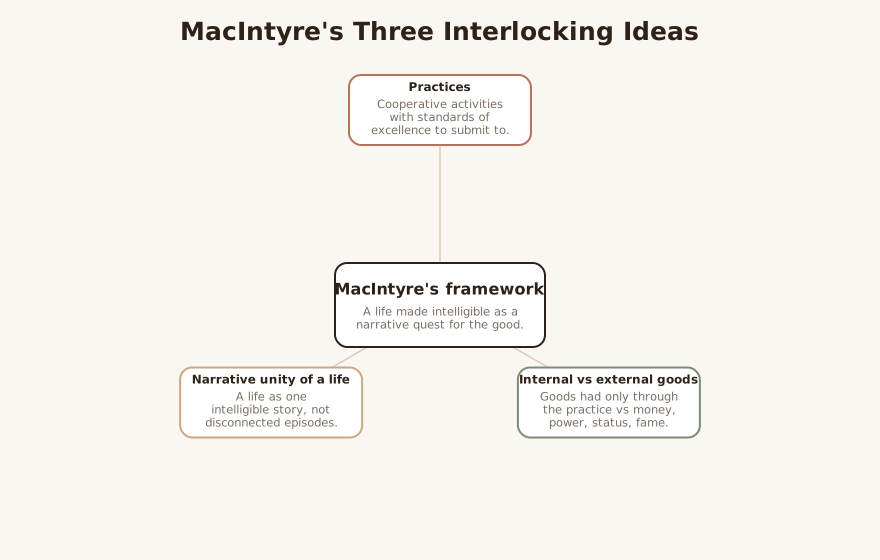
Three interlocking ideas carry the weight of the framework LLM.
First, practices. A practice, for MacIntyre, is a coherent and complex form of socially established cooperative human activity — medicine, teaching, farming, music, parenting — through which “goods internal to that form of activity” are realized 1. Practices have standards of excellence that the practitioner must submit to, and they generate goods that can only be had by engaging in the practice itself 1.
Second, the distinction between internal and external goods. Internal goods are the understandings, abilities, and forms of excellence available only through honestly pursuing a given practice; external goods — money, power, status, fame — can be obtained in many ways, often by cutting corners or by deception 14. Institutions characteristically pursue external goods, and a healthy practice depends on institutions yet is constantly threatened by their pull toward those external rewards 4. The corruption of a practice begins when external goods crowd out internal ones LLM.
Third, the narrative unity of a human life. A life is not a disconnected series of episodes but an intelligible story — a quest in which a person seeks their good “as the good of his or her whole life,” connecting past, present, and projected future into a coherent whole 1. Virtues, on this account, are the acquired qualities that let us achieve the goods internal to practices and that sustain us in the larger quest by helping us overcome harms, dangers, temptations, and distractions 1. The whole structure is carried forward by tradition — the historically extended, socially embodied conversation that supplies practices and lives with their context 1.
Interventions & Techniques
MacIntyre offers no techniques; what follows are clinical translations LLM. Practitioners who draw on this framework tend to do four things LLM.
They map the client’s practices — asking what activities the client engages in for the goods found inside them, and where life has collapsed into the pursuit of external goods alone LLM. They distinguish internal from external goods explicitly, helping a client notice that a career chased only for status may have starved them of the mastery and meaning that once made the work alive LLM. They reconstruct narrative unity, working with the client to retell a fragmented or problem-saturated life as an intelligible quest with continuity and direction — a move that overlaps strongly with narrative therapy’s re-authoring conversations LLM. And they rehabilitate dependence, normalizing the need for others as a feature of being a rational animal rather than a personal failure LLM.
LLM-generated illustrative example (not a guideline): A client says, “I made partner, and I feel nothing.” The clinician reframes: the firm rewarded an external good (rank), but the internal goods of the practice of law — craft, judgment, advocacy done well — went unfed. Therapy then explores which practices still offer the client internal goods and how to reorient toward them LLM.
Evidence Base
Honesty here matters LLM. The maturity label “established” refers to the standing of After Virtue within moral philosophy, where it is a canonical and widely cited work — not to any clinical evidence base 35. As a philosophical framework, it has no randomized controlled trials, no manualized protocol, and no direct outcome data of its own LLM. It is not, and does not claim to be, an empirically validated treatment LLM.
Clinically, its influence is mediated LLM. The modalities that operationalize MacIntyrean ideas — narrative therapy, acceptance and commitment therapy’s values work, and meaning-centered approaches — carry their own (variable) evidence bases, and any efficacy claim should be located there, not attributed to MacIntyre LLM. A clinician using this material should describe it accurately to clients and supervisors as a conceptual lens that organizes meaning- and values-focused work, while drawing empirical legitimacy from the validated modality that delivers it LLM.
Populations & Indications
The framework is most indicated when the presenting difficulty is one of meaning, coherence, or values rather than acute symptom reduction LLM. It suits adults in identity, meaning, or purpose crises; clients in major life transitions such as retirement, late career, divorce, or the empty nest, where an old narrative has ended and a new one has not formed LLM. It speaks to high-achieving clients reporting achievement-driven emptiness — success measured in external goods with internal goods hollowed out LLM. It is apt for moral injury and values confusion, where a person has acted against, or lost contact with, what they hold good LLM. And the Dependent Rational Animals extension makes it relevant to caregivers and to clients grappling with disability, illness, or aging, for whom acknowledging dependence is itself the therapeutic task 1.
It is a poor fit, by contrast, as a first-line frame for acute crisis stabilization, active psychosis, or situations demanding immediate behavioral or safety intervention LLM.
Problems-for-Work
The framework lends itself to several recurring problems-for-work LLM.
- Meaninglessness / existential emptiness — reconnecting the client with practices that yield internal goods LLM. Application: a recently retired client rebuilds a sense of purpose by identifying which of their former work’s internal goods can be sought elsewhere LLM.
- Identity fragmentation — restoring narrative unity so the life reads as one intelligible quest rather than disconnected episodes 1. Application: re-authoring a “story of failure” into a coherent arc with continuity and learned direction LLM.
- Achievement-driven emptiness — naming the substitution of external goods for internal ones 1. Application: a client examines which pursuits they kept only for status, and what mastery they abandoned LLM.
- Demoralization / loss of purpose — locating a quest worth resuming LLM. Application: clarifying one near-term practice the client can re-enter for its own sake LLM.
- Difficulty accepting dependence — reframing help-seeking as a virtue of acknowledged dependence rather than weakness 1. Application: a client recovering from injury practices receiving care as part of, not a betrayal of, rational agency LLM.
Contraindications, Cautions & Cultural Humility
Several cautions deserve attention LLM. MacIntyre is a sharp critic of modern therapeutic culture: a recurring strand of After Virtue treats the manager and the therapist as emblematic figures of an emotivist age, social roles that reduce moral questions to matters of effective technique and individual feeling LLM. Clinicians who borrow his vocabulary should sit honestly with the fact that he regarded the therapeutic stance itself with suspicion — a tension that should make us humble rather than evangelical about importing his ideas into the consulting room LLM.
The framework also embeds substantive commitments — to tradition, to community, to objective goods — that are not value-neutral and may not match a given client’s worldview 1. Imposing a “narrative unity” or a vision of the good life on a client risks colonizing their meaning-making rather than serving it LLM. Cultural humility is essential: notions of practice, tradition, and the good vary profoundly across communities, and a clinician must let the client author the content while the framework offers only the scaffolding LLM. Finally, none of this substitutes for evidence-based care where symptom-focused or safety-focused treatment is indicated LLM.
Treatment-Plan Suggestions & SMART Objectives
| Goal | SMART objective (example) | Mechanism |
|---|---|---|
| Restore narrative coherence | Over 8 sessions, client will co-construct a written timeline retelling their life as a continuous quest, identifying at least 3 connecting themes LLM | Re-authoring toward narrative unity 1 |
| Reconnect with internal goods | Within 6 weeks, client will resume one valued practice (e.g., music, craft) for ≥30 minutes weekly, pursued for its intrinsic rewards LLM | Recovery of goods internal to a practice 1 |
| De-center external goods | By session 10, client will name 3 pursuits maintained only for status and articulate one internal good they wish to recover LLM | Internal/external goods distinction 14 |
| Clarify the quest | Within 4 sessions, client will draft a one-page statement of what they seek as the good of their life as a whole LLM | Life-as-quest reflection 1 |
| Rehabilitate dependence | Over 6 weeks, client will practice asking for help in 2 specific situations and record the outcomes LLM | Virtues of acknowledged dependence 1 |
| Reduce demoralization | Within 5 sessions, client will identify and re-enter one near-term practice, rating purpose weekly on a 0–10 scale LLM | Renewed engagement in a practice 1 |
| Repair values alignment | By session 8, client will map current actions against stated goods and select 2 behaviors to bring into alignment LLM | Virtue as character sustaining the quest 1 |
Common Misconceptions
A few misreadings recur LLM. First, that MacIntyre offers a therapy — he does not; he offers a moral philosophy, and any clinical use is a translation 5. Second, that “internal goods” means private or psychological goods — in fact they are goods internal to a practice, public and shared among its practitioners, not feelings inside a person 1. Third, that narrative unity means a tidy, happy story — it means an intelligible one, in which failures and reversals are part of a coherent quest rather than evidence against it 1. Fourth, that MacIntyre would endorse therapeutic culture — on the contrary, he treated the therapist as a characteristic figure of the emotivist modernity he critiqued LLM. Fifth, that the framework is evidence-based as a treatment — its “established” status is philosophical, not clinical 3.
Training & Certification
There is no certification in MacIntyrean therapy, because it is not a credentialed modality LLM. Clinicians develop facility with it by reading the primary text, After Virtue, supported by reputable secondary overviews, and by training in the modalities that operationalize its ideas — narrative therapy and acceptance and commitment therapy in particular 51. Familiarity with the broader virtue-ethics tradition is helpful background 2. Supervision and consultation, rather than a course or credential, are the appropriate vehicles for integrating this material responsibly into practice LLM.
Key Terms
- Practice — a complex, socially established cooperative activity with internal standards of excellence 1.
- Internal goods — goods (mastery, understanding, excellence) obtainable only by honestly engaging in a practice 1.
- External goods — goods such as money, power, and status, obtainable many ways and possessed competitively 14.
- Narrative unity — the intelligibility of a single human life understood as one connected story or quest 1.
- The quest — the search for one’s good understood as the good of a whole life 1.
- Tradition — the historically extended, socially embodied argument that situates practices and lives 1.
- Virtue — an acquired quality that secures internal goods and sustains a person in the quest 1.
- Dependent rational animals — MacIntyre’s account of humans as vulnerable beings whose rationality presupposes acknowledged dependence on others 1.
- Emotivism — the view that moral judgments merely express preference; MacIntyre’s diagnosis of modern moral incoherence 4.
Resources & Further Reading
▶ Watch — a video introduction to this concept:
- Alasdair MacIntyre (Internet Encyclopedia of Philosophy) — accessible overview of After Virtue, practices, internal goods, narrative unity, and Dependent Rational Animals.
- Virtue Ethics (Stanford Encyclopedia of Philosophy) — the wider tradition MacIntyre revives.
- Alasdair MacIntyre (Encyclopaedia Britannica) — biographical and intellectual context.
- After Virtue (Wikipedia) — summary of the book’s argument, including emotivism and internal/external goods.
- After Virtue: A Study in Moral Theory (book overview) — overview of the foundational text.
Reflective / Supervision Questions
- When a client describes emptiness amid success, am I helping them distinguish internal from external goods, or quietly endorsing the pursuit of external goods? LLM
- Whose narrative unity am I reconstructing — the client’s, or one I find more comfortable? LLM
- MacIntyre was skeptical of the therapist’s role; how does that critique land on my own practice, and what does it ask me to hold more lightly? LLM
- Am I importing substantive commitments to tradition, community, or the good that this particular client has not chosen? LLM
- Where am I claiming empirical authority that belongs to the validated modality rather than to this philosophical frame? LLM
- How does the idea of acknowledged dependence reshape how I work with a client’s shame about needing help? LLM