
Type & Discipline
Total institution is a sociological theory, not a treatment, diagnosis, or therapeutic modality 3. It originates in the discipline of sociology, within the symbolic-interactionist tradition and the sociology of institutions, and it describes a kind of place and the processes it imposes on the people who live in it rather than prescribing any intervention 2. Erving Goffman defined a total institution as “a place of residence and work where a large number of like-situated individuals, cut off from the wider society for an appreciable period of time, together lead an enclosed, formally administered round of life” 6. The defining feature is the collapse of the ordinary separations of modern life: in conventional society people sleep, play, and work in different places, with different co-participants, under different authorities, while the total institution erodes precisely these barriers so that all aspects of life are conducted in the same place, under a single authority, in the immediate company of a large batch of others treated alike 5.
For a clinician, the value of total institution is not that it is something one delivers in session, but that it supplies a precise vocabulary and a process map for a recognizable class of harms produced by institutional life itself LLM. Because it is a descriptive frame rather than a modality, it travels across treatment approaches and informs how a therapist reads the presentation of a recently discharged psychiatric patient, a person leaving prison, a veteran, or an older adult in long-term care, rather than constituting a therapy in itself LLM. Goffman’s central claim is that institutions as different in stated purpose as asylums, prisons, monasteries, barracks, and boarding schools share an underlying social structure and a common set of effects on the self, and it is that shared structure that makes the concept generalizable across settings 6.
Creators & Lineage
The concept was developed and named by the Canadian-American sociologist Erving Goffman in his 1961 book Asylums: Essays on the Social Situation of Mental Patients and Other Inmates 1. The book is a collection of four essays, the first of which, “On the Characteristics of Total Institutions,” is the foundational statement of the concept 6. Goffman’s empirical base was an ethnographic field study he conducted in 1955 and 1956 at St. Elizabeths Hospital, a large federal psychiatric institution in Washington, D.C., where he observed the daily life of patients largely from their own point of view rather than from the staff’s 6. The method was the engine of the theory: by attending closely to the inmate’s experience inside one institution and then comparing it with prisons, military camps, ships, convents, and concentration camps, Goffman argued for a process common to all enclosed establishments 5.
Goffman grouped total institutions into several rough types according to their stated purpose: places established to care for the incapable and harmless, such as homes for the blind, the aged, the orphaned, and the indigent; places to care for those felt to be both incapable and an unintended threat, such as tuberculosis sanatoria, mental hospitals, and leprosaria; institutions organized to protect the community from those felt to be an intentional danger, such as jails, penitentiaries, and prisoner-of-war camps; institutions purporting to pursue a worklike task, such as army barracks, ships, boarding schools, and labor camps; and retreats from the world such as abbeys, monasteries, and convents 4. The point of the typology was not to sort institutions neatly but to show that establishments with utterly different missions converge on the same social form 4.
The theory sits at the heart of Goffman’s larger project on the presentation and management of the self, and it carries a pointed lineage into clinical and political history LLM. Asylums became one of the most influential critiques of the mental-hospital system of its era and is widely credited as a catalyst for the deinstitutionalization and anti-psychiatry currents that reshaped psychiatric care in the decades that followed 6. It is also closely allied, conceptually, with labeling theory and the sociology of stigma — Goffman’s own Stigma extends the same interest in spoiled identity — so that total institution belongs to a family of mid-twentieth-century work on how social settings construct and degrade identity LLM. That the book remains continuously in print, taught, and cited marks total institution as an established, foundational concept rather than a settled empirical law 1.
Core Principles
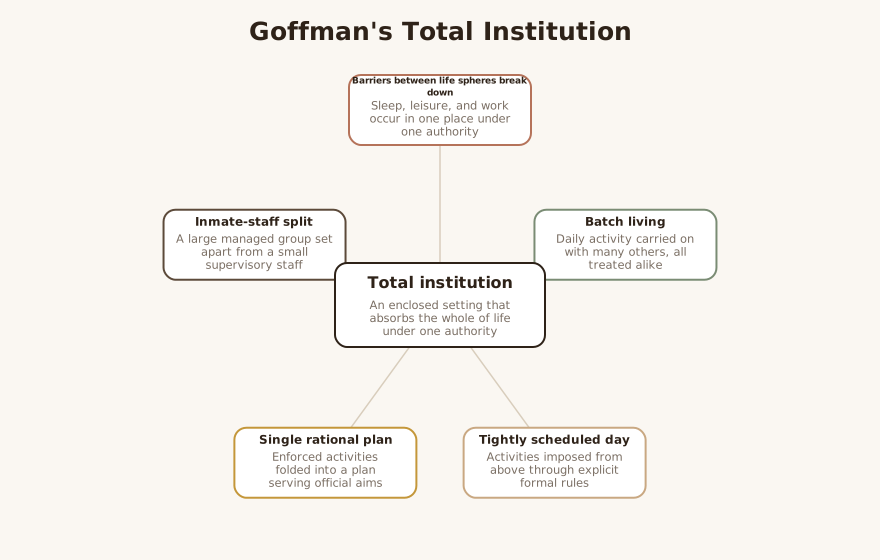
The first principle is the breakdown of the barriers ordinarily separating the three spheres of life 5. In the total institution, sleep, leisure, and work occur in one place, under one authority; each phase of a member’s daily activity is carried on in the immediate company of a large batch of others, all treated alike and required to do the same things together; the day’s activities are tightly scheduled and imposed from above through a system of explicit formal rules; and the various enforced activities are folded into a single rational plan purportedly designed to fulfill the official aims of the institution 5. These features are not incidental rules but the structural skeleton of the setting, and together they distinguish the total institution from ordinary workplaces and households 6.
The second principle is the basic split between a large managed group, the inmates, and a small supervisory staff, with restricted movement and information between them 5. Each grouping tends to conceive of the other in narrow, hostile stereotypes; staff often see inmates as bitter, secretive, and untrustworthy, while inmates often see staff as condescending and high-handed, and social mobility between the two strata is grossly restricted, frequently formalized in prohibitions on talk across the divide 6. Information about the staff’s plans for the inmate is typically withheld, which keeps the inmate in a state of dependence and uncertainty that is itself part of how the institution governs 5.
The third principle is that the institution does not merely house the self but reworks it 6. On entry, the recruit arrives with a “presenting culture” derived from a home world that had supported a stable conception of self; the institution then sets in motion a series of “abasements, degradations, humiliations, and profanations of self” through which that prior conception is systematically dismantled, a process Goffman called the mortification of the self 6. Mortification is not random cruelty but a structured stripping that prepares the inmate to be remade according to the institution’s requirements LLM. What replaces the dismantled identity is partly the institution’s official remaking and partly the inmate’s own improvised adjustments, so that the self that emerges is a joint product of imposition and resistance 6.
Interventions & Techniques
Because total institution is a sociological theory rather than a therapy, there are no “total-institution techniques”; the concept works by shaping formulation and is then operationalized through recognized modalities LLM. The first practical move is recognition: identifying when a client’s presentation is better read as the residue of institutional life than as an internal trait or a discrete disorder, so that flattened affect, passivity, or difficulty making ordinary choices is understood as an adaptation to a setting that punished initiative rather than as a stable deficit LLM. Goffman’s account of how the institution strips autonomy and imposes a scheduled, surveilled round gives the clinician a non-pathologizing explanation for behavior that can otherwise look like personality disorder or treatment resistance 6.
A second move is naming and reversing the mortification process LLM. Where the institution systematically degraded the self through loss of name, possessions, privacy, and decision-making, the clinical task after exit is the slow restoration of agency, personal narrative, and a self-concept not defined by the inmate role, which maps closely onto identity-focused and narrative work 6. A third move is anticipating and scaffolding re-entry: because the total institution removes the small, continuous exercises of judgment that civilian life requires, a person leaving one needs graduated practice in self-direction rather than an expectation of immediate, full autonomy LLM. These moves are delivered through the clinician’s primary modality; the theory supplies the why and what to look for, while the modality supplies the how LLM.
LLM-generated illustrative example (not a guideline): A client discharged after eighteen months on a locked unit asks the therapist what time he is “allowed” to use the bathroom and waits to be told what to talk about. Using the total-institution frame, the clinician reads this not as dependency pathology but as a learned adaptation to a setting where every choice was scheduled by staff, names the pattern explicitly, and structures early sessions to return small decisions to the client — what to discuss, where to sit, when to pause — as deliberate practice in reclaiming agency LLM.
Evidence Base
The honest appraisal is that total institution is an established and durably influential sociological theory, continuously taught and cited since 1961, but it is a conceptual and ethnographic framework, not an intervention with its own outcome trials LLM. Asylums is treated as a foundational text of medical sociology and of the sociology of institutions, and its enduring citation and in-print status are the form “evidence” takes for a theory of this kind — explanatory reach and conceptual fertility rather than randomized efficacy data 1. Its empirical base is a single ethnographic field study at one psychiatric hospital, supplemented by Goffman’s wide reading across other institutional settings, which is a rich source for theory-building but is observational and interpretive rather than experimental 6.
The framework’s standing also rests on its historical impact: it is widely regarded as one of the most important critiques of the asylum system and a contributor to the deinstitutionalization movement, an influence on policy and public understanding that few sociological texts can claim 6. For the clinician, two implications follow LLM. First, total institution should be offered as a powerful map of how enclosed settings damage the self, not as a validated treatment for a specific disorder, and certainly not as a blanket condemnation of every inpatient or residential placement LLM. Second, the model’s reliability is greatest as a formulation heuristic — a way to widen attention to the institutional origins of a client’s presentation — and weakest if its mid-century portrait of the asylum is applied uncritically to modern, reformed, or voluntary settings that differ in important ways LLM. Specific claims about how to apply the concept clinically are best held as clinical reasoning, since the source literature establishes the social process, not its therapeutic operationalization LLM.
Populations & Indications
The theory’s natural population is people who are living in, or have recently left, an enclosed and totally administered setting 6. The concept maps directly onto common clinical presentations: inpatient psychiatric patients, whom Goffman studied first-hand; incarcerated and forensic populations in jails and prisons; military personnel formed by barracks life; institutionalized older adults in long-term and nursing care; and clients in residential treatment, where the round of life is scheduled and supervised 4. People in any long-term care arrangement that absorbs the whole of daily life — and, by extension, those formed by boarding schools or monastic communities — fit the same structure, where a single authority governs sleep, work, and leisure together 4.
The concept is especially indicated when the presenting difficulty appears organized around the effects of confinement and regimentation rather than around a freestanding symptom cluster — when a client’s problem is less “I feel anxious” than a pervasive passivity, loss of initiative, or disorientation that began or deepened during institutional life LLM. It is well matched to the period of transition out of an institution, because the model gives both clinician and client a shared language for the strange, deskilled feeling of returning to a world that expects continuous self-direction LLM. It is also useful in supervision and case formulation when a treatment team is at risk of reading institutionally produced behavior as fixed personality, since the frame relocates the cause from inside the person to the social setting LLM.
Problems-for-Work
Total institution maps onto a recognizable cluster of problems centered on the damage that enclosed, totally administered settings do to identity and agency 6. Institutionalization effects are the core target: the syndrome of passivity, dependence, and loss of initiative that follows a long stay, which Goffman traced to the institution’s removal of the ordinary occasions for self-direction 6. Loss of identity and depersonalization are read here as the direct result of the mortification process — the stripping of name, role, and possessions through which a prior self is dismantled — rather than as an inexplicable inner emptiness 6.
Loss of autonomy and learned helplessness follow from a daily round in which every activity is scheduled and imposed from above, so that a person can be trained out of the very habit of choosing 5. Stigma attaches to the inmate role and persists after discharge, marking the former patient or prisoner as a spoiled identity in the wider community, a problem that intersects directly with the labeling and stigma traditions allied to Goffman’s work 6. Adjustment difficulties and re-entry and community reintegration problems are paradigmatic applications: the deskilling produced inside the institution collides with a civilian world that assumes continuous competence, and the gap between the two is where much post-discharge distress lives LLM.
LLM-generated illustrative example (not a guideline): A veteran who spent years in highly regimented service settings reports that civilian life feels “shapeless” and that he freezes when no one tells him the day’s plan. Formulated through total institution, the clinician hypothesizes that the structure that once organized his self has been withdrawn, normalizes the disorientation as an expectable cost of leaving a totally administered round, and orients the work toward rebuilding internal structure and a self-narrative that is not defined by the former role LLM.
Contraindications, Cautions & Cultural Humility
The foremost caution is conceptual restraint and historical accuracy: Goffman’s portrait was drawn from the large, custodial asylums of the 1950s, and a clinician should not treat every contemporary inpatient unit, group home, or residential program as if it were that institution, nor present “you have been institutionalized” as a diagnostic verdict LLM. Modern settings vary enormously in how much autonomy they preserve, and applying the mortification model wholesale can both insult well-run programs and obscure the real clinical picture LLM. The model is a lens for understanding institutional effects, not a blanket indictment of residential care, some of which is necessary and protective LLM.
A second caution is clinical triage: passivity, flat affect, and loss of initiative after a long placement can also reflect major depression, the negative symptoms of a psychotic disorder, the effects of medication, or untreated trauma, and the total-institution frame must never displace differential diagnosis, risk assessment, and indicated evidence-based care LLM. Where a client’s distress is acute or dangerous, stabilization and safety take priority, and the sociological narrative is resumed only when it is safe to do so LLM.
A third caution concerns cultural humility about institutions and about what counts as a “healthy” exit LLM. Some enclosed settings that fit Goffman’s structural definition — a monastery, a religious community, certain collectivist living arrangements — are experienced by their members as freely chosen, meaningful, and identity-giving rather than as mortifying, and the framework can smuggle in an individualistic, Western assumption that autonomous self-direction is always the goal LLM. The lived meaning of confinement, surveillance, and shared regimentation is also shaped by race, class, immigration status, and history, so that the same setting may be a refuge for one person and a site of profound harm and stigma for another LLM. Cultural humility requires interpreting institutional experience against the client’s own values and community, checking the clinician’s inference rather than asserting it, and remaining alert to the power the therapist holds in framing which version of post-institutional life counts as “adjustment” LLM.
Treatment-Plan Suggestions & SMART Objectives
| Goal | SMART objective (example) | Mechanism |
|---|---|---|
| Recognize institutional effects as adaptation, not trait | Within 3 sessions, client will identify 3 behaviors learned in the institution (e.g., waiting for permission, deferring decisions) and reframe them as adaptations rather than personal deficits | Relocates the cause from inside the person to the institutional setting, reducing shame 6 |
| Restore everyday agency | Over 6 weeks, client will make and act on 5 small self-directed daily choices and review them in session | Reverses the autonomy-stripping round of scheduled, imposed activity 5 |
| Repair the mortified self | Within 10 sessions, client will produce a written self-statement describing who they are apart from the inmate or patient role | Rebuilds an identity dismantled by the mortification process 6 |
| Reduce learned helplessness | Over 8 weeks, client will complete one progressively more demanding self-initiated task per week without external prompting | Re-establishes the link between personal initiative and outcome eroded inside the institution 5 |
| Process loss and depersonalization | Over 6 sessions, client will name 3 specific losses of self (name, privacy, possessions, role) tied to the placement and one thing they wish to reclaim | Works the grief of identity stripping rather than leaving it unspoken 6 |
| Address stigma of the former role | Within 8 sessions, client will identify 2 settings where they fear being defined by their institutional history and rehearse a chosen response | Counters the spoiled identity that follows the inmate role into the community 6 |
| Scaffold community re-entry | Within 12 sessions, client will establish 2 self-managed routines and 1 community connection that do not depend on institutional structure | Bridges the deskilling gap between the administered round and civilian self-direction LLM |
Common Misconceptions
A frequent error is treating “total institution” as a synonym for any large or unpleasant organization; Goffman’s definition is specific, requiring the collapse of the barriers between sleep, work, and play under a single authority for an appreciable period, so an ordinary hospital ward, school, or workplace does not automatically qualify 5. A second misconception is that the concept condemns all residential or inpatient care as inherently abusive, when the analysis describes a social structure and its tendencies, not a verdict that every such setting mortifies everyone equally LLM. A third is reading mortification as deliberate sadism on the part of staff, when Goffman located it largely in the routine, often well-intentioned machinery of batch living and formal administration rather than in individual cruelty 6.
A fourth misconception is that total institution is a therapy one “does,” when it is a descriptive frame from sociology that informs interventions delivered through other modalities LLM. A fifth is treating Goffman’s 1950s asylum as an accurate picture of modern psychiatric or correctional settings without acknowledging the reforms, legal protections, and deinstitutionalization his own work helped set in motion 6. Finally, the institution is sometimes imagined as wholly overpowering the inmate, when Goffman emphasized that members actively make “secondary adjustments” — small, unauthorized ways of working the system and preserving a self the institution did not sanction — so that the self is never simply erased 6.
Training & Certification
There is no certification in “total institution”; the concept is foundational theory studied within sociology, social psychology, and the sociology of health and illness rather than a credentialed clinical technique LLM. Clinicians typically encounter it through graduate coursework in sociology, the social context of mental health, or the history of psychiatry, where Goffman’s Asylums is the standard primary text and the essay “On the Characteristics of Total Institutions” is the core reading 1. Reading that primary source remains the most direct route to understanding the theory in its original terms, and accessible secondary summaries situate the concept and its typology for quick orientation 4.
For applied clinical competence, the relevant training lives in the recognized modalities that operationalize the frame — narrative and identity-focused therapy for rebuilding a self after mortification, trauma-informed care for the harms of confinement and coercion, and the general competencies of working with major life transitions and re-entry — where supervised practice teaches clinicians to restore agency rather than merely document deficit LLM. Generalist therapists can legitimately use total institution for formulation provided they represent its evidentiary and historical status honestly and deliver care through modalities in which they are trained LLM.
Key Terms
Total institution — a place of residence and work where a large number of like-situated people, cut off from wider society for an appreciable time, lead an enclosed, formally administered round of life 6. Mortification of the self — the systematic process of abasement, degradation, and stripping of a person’s prior identity that begins on entry to the institution 6. Presenting culture — the conception of self and the supports a recruit brings from the home world before the institution begins to dismantle them 6. Batch living — the conduct of all daily activity in the immediate company of a large group, all treated alike and required to do the same things together 5. Inmate–staff split — the basic division between a large, managed group and a small supervisory staff, with restricted movement, information, and social mobility between them 5. Secondary adjustments — the unauthorized practices through which members work the system to obtain forbidden satisfactions and preserve a self the institution did not grant 6. Institutionalization — the cluster of passivity, dependence, and loss of initiative produced by a long stay in a totally administered setting 6. Deinstitutionalization — the later movement away from large custodial asylums, which Goffman’s critique is widely credited with helping to catalyze 6.
Resources & Further Reading
▶ Watch — a video introduction to this concept:
- Goffman, E. (1961) — Asylums: Essays on the Social Situation of Mental Patients and Other Inmates (Routledge edition)
- Erving Goffman and the total institution (ResearchGate)
- Total Institution — Encyclopedia.com
- Total Institution in Sociology: Definition, Types & Examples — Study.com
- Erving Goffman – Asylums (1961) — SozTheo
- Asylums (book) — Wikipedia
Reflective / Supervision Questions
- When a recently discharged client presents as passive or “unmotivated,” have I considered whether this is an adaptation to a totally administered setting rather than a fixed trait or treatment resistance 6?
- Am I helping this client rebuild a self apart from the inmate or patient role, or am I unintentionally reproducing the institution’s definition of who they are 6?
- Whose cultural and personal frame am I using to judge what a “healthy” exit from an institution looks like, and have I checked it against the client’s own values rather than defaulting to autonomous self-direction as the goal LLM?
- Where confinement was experienced as meaningful or chosen rather than mortifying, am I respecting that meaning instead of imposing a deficit narrative LLM?
- Am I applying Goffman’s 1950s asylum to a modern, reformed, or voluntary setting without acknowledging the real differences between them 6?
- In team or supervision discussions, am I noticing when institutionally produced behavior is being read as fixed personality, and can I offer the total-institution frame to relocate the cause 5?