
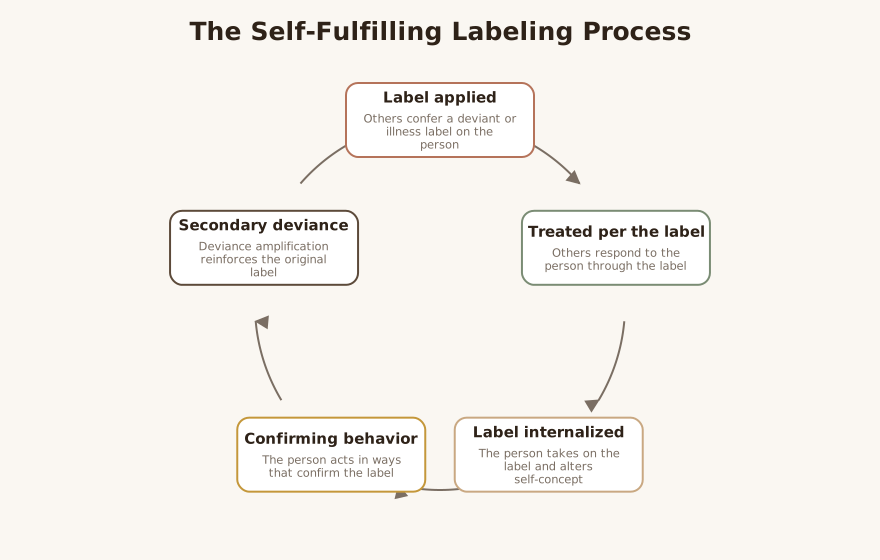
Labeling theory is one of the few sociological frameworks that bears directly on what happens in the consulting room the moment a clinician writes a diagnosis LLM. It does not tell you how to treat a disorder; it tells you something about what the act of naming a condition can do to the person who carries the name LLM. For practicing therapists, that makes it a lens rather than a modality — but a clinically consequential one, because it reframes self-stigma, demoralization, and treatment avoidance as predictable social processes rather than private failings LLM.
Type & Discipline
Labeling theory is a sociological and criminological theory, not a psychotherapy 1. It belongs to the family of symbolic interactionism and the sociology of deviance, which study how meaning is created through social interaction and how societies define and respond to rule-breaking 1. Its central claim is that deviance is not an inherent quality of an act but a consequence of the application, by others, of rules and sanctions to an “offender” 5. In other words, deviance is produced by the social audience’s reaction, not solely by the behavior itself 4.
For mental health specifically, the theory enters through the sociology of health and illness, where it is sometimes called the “labeling approach” to deviance and illness 4. Here the argument is that diagnostic and social labels — “mentally ill,” “schizophrenic,” “addict” — carry social meanings that shape how others treat the labeled person and how the person comes to see themselves 4. Because the theory treats labels as socially constructed rather than naturally given, it sits adjacent to social constructionism and is methodologically opposed to approaches that treat deviance or illness as a fixed objective property 5.
Creators & Lineage
The theory’s intellectual roots lie in symbolic interactionism, the early-twentieth-century tradition associated with George Herbert Mead and the Chicago School, which held that the self develops through interaction and through the meanings others reflect back to us 5. Frank Tannenbaum’s idea of the “dramatization of evil” — the notion that singling out and tagging a young person as bad can fix that identity — is an early precursor 5. Edwin Lemert built on this by distinguishing primary deviance (the initial rule-breaking, often situational and inconsequential to identity) from secondary deviance (behavior that follows from, and is organized around, society’s reaction to the first act) 5.
The figure most associated with the modern theory is Howard Becker, whose work crystallized the claim that social groups create deviance by making rules whose infraction constitutes deviance, and then applying those rules to particular people 5. Becker’s formulation shifted the analytic question from “why do people break rules?” to “who gets labeled, by whom, and with what consequences?” 5. In the mental illness domain, Thomas Scheff extended labeling theory to argue that being labeled mentally ill could itself stabilize a deviant role through societal expectations 1. Peggy Thoits later complicated and partially internalized the model, examining how individuals come to label their own emotional experience as disordered — a self-labeling process — rather than the label being purely imposed from outside 2. The lineage thus runs from symbolic interactionism and the sociology of deviance into social constructionism, and, in clinical practice, connects naturally to narrative therapy, which similarly treats problem-saturated identities as stories that can be externalized and re-authored LLM.
Core Principles
Several interlocking principles define the theory. First, no act is intrinsically deviant or pathological; deviance is conferred by the reaction of others, so the same behavior may be labeled in one context and ignored in another 4. Second, labels are not neutral descriptions but powerful social facts that, once applied, tend to become a “master status” — an identity that overrides other attributes and through which the person is subsequently perceived 5.
Third, labeling can be self-fulfilling. When a person is treated according to a label, they may internalize it, alter their self-concept, and behave in ways that confirm it, producing secondary deviance or what is sometimes called deviance amplification 5. Fourth, the consequences of labeling depend heavily on power: those with less social power are more likely to be labeled and less able to resist or shed the label 4. Fifth, and importantly for clinicians, the labeling process can operate not only from the outside but from within — Thoits argued that people actively apply illness labels to their own emotional and behavioral states when those states violate cultural feeling rules about what one should feel in a given situation 2.
A frequently cited caution within the literature itself is that the strong version of the theory — that labeling alone produces durable mental illness — is not well supported, and that labeling is better understood as one contributing social process among many 1.
Interventions & Techniques
Labeling theory generates no proprietary techniques, but it informs how a clinician handles naming, diagnosis, and identity throughout treatment LLM. The most direct clinical move it suggests is person-first, non-totalizing language — describing a person as “someone experiencing psychosis” rather than “a schizophrenic” — to resist the master-status effect the theory predicts LLM. A second move is transparent, collaborative diagnosis: sharing the rationale and limits of a label so the client can hold it as useful information rather than as a verdict on who they are LLM.
The theory aligns closely with narrative therapy’s technique of externalization, which separates the person from the problem and thereby counters the internalization the theory warns about LLM. It also supports psychoeducation aimed specifically at self-stigma, helping clients distinguish the symptoms they experience from the social meanings attached to the label LLM.
LLM-generated illustrative example (not a guideline): A clinician notices that a young adult newly diagnosed with bipolar disorder has begun introducing himself as “I’m bipolar” and has stopped applying to jobs because “people like me can’t hold them down.” The clinician names the master-status dynamic gently — “It sounds like the diagnosis has started to feel like the whole story of you” — and works to re-author a fuller identity in which bipolar disorder is one managed condition among many roles he holds LLM.
Evidence Base
The honest summary is that labeling theory is an established and influential sociological theory whose empirical support is genuinely mixed and contested 1. The descriptive mechanism — that labels carry social meaning, shape interaction, and can be internalized — is well documented and broadly accepted 4. The strong causal claim — that labeling is a primary cause of stable mental illness, as Scheff’s early version implied — has been substantially criticized and is not well supported by evidence 1.
The literature itself documents this tension: critics argue the theory underweights the real distress and impairment of the underlying condition and overstates the label’s causal force, while defenders point to robust evidence that stigma and labeling worsen outcomes, employment, and self-concept 1. Thoits’s self-labeling work represents a more empirically tractable middle position, treating labeling as a real social-psychological process that individuals participate in, measurable through how people interpret their own emotional deviance 2. For clinicians, the defensible takeaway is that labeling effects on self-stigma and demoralization are real and worth addressing, while resisting any claim that diagnosis itself creates the disorder LLM.
Populations & Indications
The theory is most clinically relevant for populations whose conditions carry heavy social labels 4. People with serious mental illness are the paradigm case, since psychiatric diagnoses such as schizophrenia frequently function as master statuses that color employment, housing, and relationships 4. People with substance use disorders face the highly moralized label “addict,” which the theory predicts can both invite social rejection and be internalized as identity 4.
Justice-involved individuals are central to the original criminological theory, where the labels “delinquent,” “criminal,” or “felon” are shown to channel people toward secondary deviance and re-offending 5. Adolescents are especially vulnerable because identity is still consolidating, making the dramatization-of-evil dynamic — tagging a young person as bad and watching the identity stick — particularly potent 5. More broadly, marginalized and stigmatized groups, and people with chronic illness, are differentially exposed to labeling because they hold less power to resist the labels applied to them 4.
Problems-for-Work
Labeling theory maps onto a recognizable cluster of clinical problems LLM. Internalized stigma and self-stigma are the most direct: the client absorbs the negative social meaning of a label and turns it against the self 4. Application: a client with depression who believes “weak people get depressed” and therefore hides symptoms and resists help LLM.
Self-fulfilling prophecy and deviance amplification describe how acting in line with a label confirms it — the secondary-deviance loop 5. Application: a teenager repeatedly labeled “the troublemaker” who escalates because the role already feels assigned 5. Identity disturbance and low self-esteem follow when the label becomes a master status that crowds out other self-definitions 5. Demoralization, social isolation, and treatment avoidance form a downstream cluster: anticipating the label’s social cost, a person withdraws and avoids care to avoid being labeled at all 4. Application: an adult who delays seeking help for psychosis because being “officially” diagnosed feels like an irreversible status loss LLM. Discrimination-related distress captures the real external consequences — not only internalized but enacted stigma in housing, work, and relationships 4.
Contraindications, Cautions & Cultural Humility
The chief caution is theoretical overreach 1. A clinician who applies labeling theory too strongly may minimize genuine pathology, frame necessary diagnosis as harmful, or imply to a suffering client that their illness is “just a label” — a stance the literature itself warns against, because it neglects the reality of the underlying condition 1. Diagnosis remains clinically and often practically necessary; the theory cautions about how labels are applied and held, not that they should be abandoned LLM.
A second caution is power and culture. Because labeling falls disproportionately on those with less social power, the theory demands attention to who in a given community is more likely to be diagnosed, criminalized, or pathologized for the same behavior 4. Cultural humility is therefore intrinsic to the framework: what counts as deviant or disordered is culturally defined, and Thoits’s feeling-rules concept makes explicit that the emotional norms against which people self-label are themselves cultural 2. Clinicians should hold their own diagnostic labels as situated within a particular cultural and institutional context rather than as neutral facts 5.
Treatment-Plan Suggestions & SMART Objectives
| Goal | SMART objective (example) | Mechanism |
|---|---|---|
| Reduce internalized stigma | Within 8 weeks, client will identify and verbally challenge 3 self-stigmatizing beliefs tied to their diagnosis in session, rated on a stigma scale | Disrupts internalization of the label’s negative social meaning 4 |
| Counter master-status identity | Within 6 weeks, client will articulate 4 valued roles or identities unrelated to the diagnosis and reference them in 2 between-session activities | Re-broadens self-concept against the master-status effect 5 |
| Interrupt self-fulfilling behavior | Over 10 weeks, client will identify 2 situations where they acted “as the label expects” and substitute one alternative behavior each | Breaks the secondary-deviance loop 5 |
| Reduce treatment avoidance | Within 4 weeks, client will attend all scheduled sessions and name 1 anticipated stigma driving prior avoidance | Addresses anticipated labeling that fuels withdrawal from care 4 |
| Externalize the problem | By session 6, client will describe the problem in externalized, non-totalizing language in at least 3 examples | Separates person from label, countering internalization LLM |
| Address self-labeling of emotion | Within 8 weeks, client will distinguish a feeling from its self-applied “disordered” label on 5 logged occasions | Targets the self-labeling of emotional deviance 2 |
| Build stigma-resistant social support | Within 12 weeks, client will disclose selectively to 2 trusted people and report the outcome | Counters social isolation and enacted-stigma distress 4 |
Common Misconceptions
A first misconception is that labeling theory claims diagnosis itself causes mental illness; the defensible reading is that labeling is one social process affecting outcomes and self-concept, not the origin of the disorder 1. A second is that the theory is purely about external imposition — Thoits’s work shows that people also actively self-label, applying illness labels to their own experience 2. A third is that labeling theory equals “diagnosis is bad”; in fact it is neutral on whether to diagnose and concerned with the social consequences of how labels are used 4. A fourth, common in criminology, is that labeling is the only explanation of deviance, when the theory was always meant to complement, not replace, accounts of why primary deviance occurs in the first place 5. A fifth is that the theory is dated; its core mechanism of master status and self-fulfilling identity remains current in research on stigma and recovery 5.
Training & Certification
There is no certification in labeling theory, because it is a body of social theory rather than a treatment protocol LLM. Clinicians typically encounter it within graduate coursework in the sociology of deviance, medical sociology, or social work, and through the foundational primary texts of Becker, Lemert, and Scheff 5. Practical fluency comes less from a credential than from integrating the lens into modalities that already operationalize it — most notably narrative therapy and stigma-focused psychoeducation LLM. Reading Thoits’s self-labeling work is a useful bridge from the abstract theory to measurable clinical processes 2.
Key Terms
Primary vs. secondary deviance — the initial rule-breaking versus the deviant behavior that follows from society’s reaction to it 5. Master status — a label that comes to dominate how a person is perceived, overriding other attributes 5. Self-fulfilling prophecy / deviance amplification — the process by which being treated as deviant elicits behavior that confirms the label 5. Dramatization of evil — Tannenbaum’s term for how singling out and tagging a young person can fix a deviant identity 5. Self-labeling — Thoits’s concept that individuals apply illness labels to their own emotional states that violate cultural feeling rules 2. Feeling rules — culturally specific norms about what one ought to feel in a given situation, against which emotional deviance is judged 2. Social construction of deviance — the principle that deviance and illness are defined by social reaction rather than being intrinsic properties 4.
Resources & Further Reading
▶ Watch — a video introduction to this concept:
- Labeling Theory — ScienceDirect Topics (Social Sciences)
- Self-Labeling Processes in Mental Illness: The Role of Emotional Deviance (Thoits, 1985) — American Journal of Sociology
- Labeling Theory — Simply Psychology
- The Labeling Approach — Social Sci LibreTexts (Introduction to Sociology)
- Labeling theory — Wikipedia
Reflective / Supervision Questions
- When I write a diagnosis, how do I imagine the client will carry it — as information, or as identity? LLM
- Which of my clients hold a diagnosis as a master status, and where might I be inadvertently reinforcing it through my own language? LLM
- Where in my caseload might enacted stigma (housing, work, family) be a larger driver of distress than the underlying symptoms? LLM
- How do I distinguish, in a given client, between genuine impairment and the social consequences of being labeled? 1
- Whose behavior in my community gets pathologized or criminalized while similar behavior in others is overlooked, and how does that shape who reaches my office? 4
- When a client self-labels — “I’m just an addict” — am I reflexively agreeing, gently challenging, or helping them examine the feeling rules underneath it? 2