
Type & Discipline
Role exit is a sociological theory, not a treatment, diagnosis, or stand-alone therapy LLM. It originates in the discipline of sociology, specifically within role theory and the symbolic-interactionist study of identity, and it describes a process rather than prescribing an intervention 1. Helen Rose Fuchs Ebaugh defined the object of study as “the phenomenon of becoming an ex” — the disengagement from a role that has been central to a person’s identity and the construction of a new identity organized around having formerly occupied that role 1. The home discipline frames role exit as one possible response within the broader dynamics of role strain, the tension a person experiences in meeting the demands of a social role 4.
For a clinician, the value of role exit is not that it is something one delivers in session, but that it supplies a vocabulary and a developmental map for a recognizable class of presenting problems: the disorientation, grief, and identity disturbance that follow the loss of a defining role LLM. Because it is a descriptive frame rather than a modality, it travels across treatment approaches and informs how a therapist reads a divorce, a retirement, a recovery, or a departure from a religious community, rather than constituting a therapy in itself LLM. Ebaugh’s central claim is that exits as different in content as leaving a marriage, leaving an addiction, and leaving the priesthood share an underlying social-psychological structure, and that this common structure is what makes the concept generalizable 1.
Creators & Lineage
The theory was developed and named by the American sociologist Helen Rose Fuchs Ebaugh in her 1988 book Becoming an Ex: The Process of Role Exit, published by the University of Chicago Press 1. The work is widely indexed and cited as the foundational statement of role-exit theory 2. Ebaugh built the theory from interviews with 185 people who had left significant roles, and her sample was deliberately heterogeneous, spanning “ex-convicts, ex-alcoholics, divorced people, mothers without custody of their children, ex-doctors, ex-cops, retirees, ex-nuns, and — perhaps most dramatically — transsexuals” 1. The breadth of that sample was the methodological engine of the theory: by comparing exits that differ enormously in content, Ebaugh argued for a process common to all of them 1.
The theory carries an unusually direct biographical lineage LLM. Ebaugh is “herself an ex, having left the life of a Catholic nun to become a wife, mother, and professor of sociology,” and her own passage out of religious life informs the book’s attention to the lived texture of disengagement 1. The work sits within role theory and the symbolic-interactionist tradition of identity theory, where the self is understood as organized around socially situated roles, and it extends that tradition by treating the leaving of a role — not only its occupancy — as a sociologically structured process 4.
Role-exit theory also intersects, conceptually, with the anthropological idea of rites of passage and liminality and with the clinical practice of narrative re-authoring of identity, though these are adjacent traditions rather than Ebaugh’s direct sources LLM. The theory has not gone uncontested within sociology; Loïc Wacquant published a critical review pointedly titled “Exiting Roles or Exiting Role Theory? Critical Notes on Ebaugh’s Becoming an Ex,” signaling a debate about whether the framework’s reliance on role theory is its strength or its limitation 3. That the founding statement and a sustained scholarly critique both remain in circulation marks role exit as an established, debated concept rather than a settled law LLM.
Core Principles
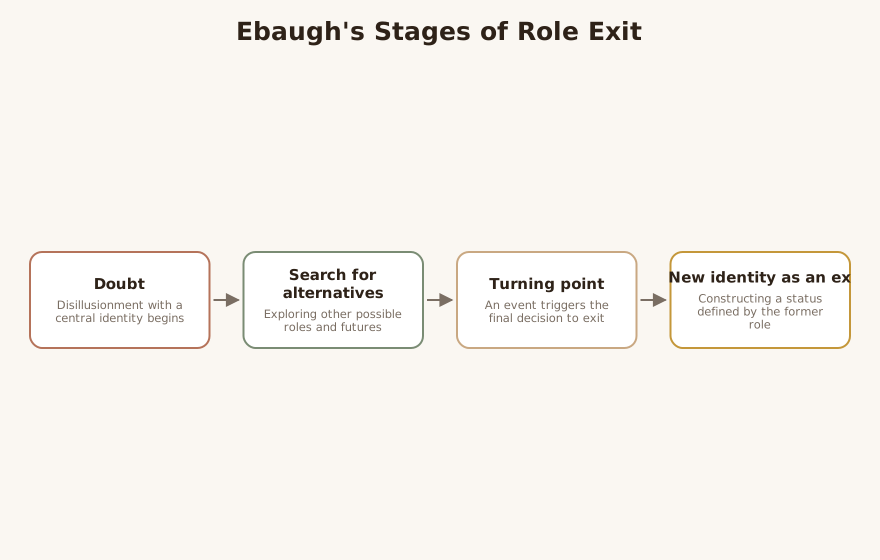
The first principle is that role exit is a process with discernible stages, not a single event 1. Ebaugh described a movement that runs “from disillusionment with a particular identity, to searching for alternative roles, to turning points that trigger a final decision to exit, and finally to the creation of an identity as an ex” 1. The same sequence is summarized in the secondary literature as four phases — doubt, the search for alternatives, the turning point, and the creation of a new identity as an ex — which makes the model easy to apply as a rough developmental map 4. The stages are not rigidly sequential in lived experience, but they name predictable tasks a person must accomplish to complete an exit LLM.
The second principle is that an exit does not end in a vacuum but in a new social identity defined by the former role — the “ex” 1. To become an ex-spouse, an ex-clergy member, or an ex-addict is not simply to subtract a role but to occupy a new status that is partly constituted by reference to what one used to be 1. This is why the work is titled becoming an ex: the destination is itself a role with its own expectations, and the person must learn to hold their history as part of who they now are rather than as a void where an identity used to be LLM.
The third principle locates role exit within the dynamics of role strain 4. In the role-theory tradition, the strain of inhabiting a demanding or ill-fitting role is ordinarily managed through coping within the role; exit is the response that occurs when that strain becomes unmanageable and the person abandons the role rather than continuing to negotiate it 4. Framed this way, the decision to exit is not a personal failing but one structurally available outcome of accumulated, irresolvable strain, a reframe with obvious clinical utility LLM.
Interventions & Techniques
Because role exit is a sociological theory rather than a therapy, there are no “role-exit techniques”; the concept works by shaping formulation and is then operationalized through recognized modalities LLM. The first practical move is staging: locating where a client sits on Ebaugh’s arc — still in first doubts, actively searching for alternatives, at or past a turning point, or in the work of building the ex-identity — and tailoring the clinical task to that stage 1. A client mired in doubt needs space to articulate ambivalence; a client past the turning point needs help constructing a livable new identity, and conflating the two misreads the work LLM.
A second move is normalizing the gap that opens after an exit LLM. The theory’s most clinically resonant observation is that leaving a defining role produces a period in which the old identity has been relinquished but the new one is not yet built, and naming this in-between explicitly can reframe a client’s panic as an expectable feature of the process rather than evidence of breakdown 1. A third move is working with the “ex” identity directly — helping a client integrate the former role into a coherent self-story instead of either clinging to it or disowning it, which maps closely onto narrative re-authoring of identity LLM. These moves are delivered through the clinician’s primary modality; the theory supplies the why and when, while the modality supplies the how LLM.
LLM-generated illustrative example (not a guideline): A recently divorced client says, “I don’t even know who I am when I’m not someone’s wife.” Using the role-exit frame, the clinician names this as the predictable space between leaving the spouse role and building an ex-spouse identity, normalizes the disorientation rather than treating it as a deficit, and shifts the work toward constructing a self-story in which “wife” becomes one chapter of a continuing life rather than the whole book LLM.
Evidence Base
The honest appraisal is that role exit is an established and durably influential sociological theory, continuously taught and cited since 1988, but it is a conceptual and qualitative framework, not an intervention with its own outcome trials LLM. Ebaugh’s Becoming an Ex is treated as the canonical statement of the process and is heavily cited in the scholarly literature, which is the form “evidence” takes for a theory of this kind — conceptual fertility and explanatory reach rather than randomized efficacy data 2. Its empirical base is a qualitative, interview study of 185 voluntary exiters, which is a substantial dataset for theory-building but is descriptive rather than experimental 1.
The framework’s standing also rests on the fact that it has been seriously contested within its own discipline, which is a sign of a live rather than a dead idea LLM. Wacquant’s review questions whether Ebaugh’s findings vindicate role theory or expose its limits, a critique aimed at the theoretical scaffolding rather than at the existence of the phenomenon 3. For the clinician, two implications follow LLM. First, role exit should be offered to clients as a useful map of a common experience, not as a validated treatment for a specific disorder LLM. Second, the model’s reliability is greatest as a formulation heuristic — a way to widen attention to the staged, identity-reconstructive nature of role loss — and weakest if treated as a precise causal mechanism that predicts what any individual will do LLM. Specific claims about how to apply the stages clinically are best held as clinical reasoning, since the source literature establishes the process, not its therapeutic operationalization LLM.
Populations & Indications
The theory’s natural population is people undergoing the loss or relinquishment of a role that has been central to their identity 1. Ebaugh’s own sample maps directly onto common clinical presentations: divorced individuals leaving the spouse role, people in addiction recovery building a sober identity, retirees leaving an occupational role, and people who have left religious communities, alongside career changers and others in major status transitions 1. Veterans transitioning to civilian life and the bereaved building a widowed identity fit the same structure, where a defining role ends and a new “ex” or “post-” identity must be constructed LLM.
The concept is especially indicated when the presenting distress is organized around identity rather than around a discrete symptom cluster — when a client’s difficulty is less “I feel anxious” than “I no longer know who I am now that this role is gone” LLM. It is well matched to life transitions in which the social role itself has changed, because the model gives both clinician and client a shared language for an experience that often feels formless and shameful 1. It is also useful when a person is anticipating an exit and stuck in protracted doubt, since the early stages of the model legitimize ambivalence as part of the process rather than as indecision to be cured LLM.
Problems-for-Work
Role exit maps onto a recognizable cluster of problems centered on identity disturbance and the loss of self that follows role loss 1. Self-redefinition difficulties are the core target: the model treats the inability to construct a new identity after leaving a role as the central task of the work, not as a peripheral complaint 1. Life transition distress and adjustment difficulties are read here as the expectable turbulence of moving through the stages of an exit, which reframes them as developmental rather than purely pathological 4.
Grief and bereavement and divorce adjustment are core applications, because both involve relinquishing a role — spouse, partner, the person one was in that relationship — and building an identity defined partly by its absence 1. The recovery identity in substance use disorder is a paradigmatic role exit: becoming an “ex-addict” or a person in recovery is precisely the construction of a new self organized around having left the using role 1. Loneliness and existential distress often intensify in the gap between roles, when the old social world recedes before a new one is built, and the model makes that gap discussable LLM.
LLM-generated illustrative example (not a guideline): A client three years sober reports feeling “lost” despite stable abstinence. Formulated through role exit, the clinician hypothesizes that the client completed the behavioral exit from the using role but never built a durable “ex” identity to inhabit, and the work turns toward constructing a positive self-story — values, relationships, and roles that define who the client is now, not only what they no longer do LLM.
Contraindications, Cautions & Cultural Humility
The foremost caution is conceptual restraint: role exit is a sociological heuristic, not a validated clinical law, so a clinician should not present “you are between roles” as a diagnostic verdict or treat the four stages as a schedule a client is obligated to follow LLM. People do not move through the stages in tidy order, and imposing the map can pathologize a client who is grieving in their own sequence LLM. The model is a lens for understanding, not a timeline for compliance LLM.
A second caution is clinical triage: identity disturbance after role loss can co-occur with major depression, acute suicidality, or, in some cases, the identity instability seen in personality disorders, and the role-exit frame must never displace risk assessment and indicated evidence-based care LLM. Where a client’s distress is acute or dangerous, stabilization and safety planning take priority, and the role-exit narrative is resumed only when it is safe to do so LLM.
A third caution concerns cultural humility about what counts as a “successful” exit and a healthy new identity LLM. Judgments about how quickly a divorced or bereaved person “should” build a new self, or about whether leaving a religious community is liberation or loss, are culturally and personally shaped, and the framework can smuggle in an individualistic, Western assumption that autonomous self-redefinition is the goal LLM. For a client embedded in a collectivist or faith community, the “ex” identity may carry profound stigma or, conversely, the former role may remain a valued and continuing part of the self rather than something to move past LLM. Cultural humility requires interpreting the exit against the client’s own values and community, checking the clinician’s inference rather than asserting it, and remaining alert to the power the therapist holds in framing which version of the new self is “adjustment” LLM.
Treatment-Plan Suggestions & SMART Objectives
| Goal | SMART objective (example) | Mechanism |
|---|---|---|
| Name and stage the role exit | Within 4 sessions, client will identify which phase of leaving they are in (doubt, searching, turning point, or building the ex-identity) and describe it in their own words | Locates the work on Ebaugh’s process map so tasks fit the stage 1 |
| Normalize the between-roles gap | Over 6 weeks, client will articulate the disorientation of having left the old role before the new one is built and reframe it as expectable rather than as breakdown | Reframes post-exit distress as a feature of the process, reducing shame 1 |
| Reduce identity disturbance | Within 10 sessions, client will draft a written self-statement that integrates the former role as one chapter of a continuing identity | Builds the “ex” identity rather than leaving a vacuum 1 |
| Process role-loss grief | Over 8 weeks, client will name 3 specific losses tied to the former role and one thing they wish to carry forward from it | Works the grief of relinquishing a defining role 1 |
| Build a new social identity and roles | Within 12 sessions, client will initiate 2 value-aligned activities or relationships that express who they are becoming | Constructs the post-exit self and counters loneliness in the gap LLM |
| Resolve protracted doubt before an anticipated exit | Over 6 sessions, client will list the role strains driving the doubt and weigh staying versus leaving without self-judgment | Legitimizes ambivalence as the doubt stage rather than indecision to be cured 4 |
| Strengthen recovery identity | Over 8 weeks, client in recovery will define 3 elements of a positive self-story beyond “not using” | Builds a durable ex-role identity to sustain behavioral change 1 |
Common Misconceptions
A frequent error is reading the four stages as a rigid, lockstep timeline that every client must traverse in order; Ebaugh described a process, and lived exits loop, stall, and skip rather than marching cleanly from doubt to new identity 1. A second misconception is treating an exit as finished once the behavioral act is complete — once the divorce is filed or the last drink is taken — when the model’s central insight is that becoming an ex continues well past the act, in the slower work of building a new identity 1. A third is assuming the new “ex” identity means erasing or disowning the former role; the framework describes incorporating the old role into a new self, not amputating it 1.
A fourth misconception is that role exit is a therapy one “does,” when it is a descriptive frame from sociology that informs interventions delivered through other modalities LLM. A fifth is reading a client’s prolonged ambivalence about leaving as mere indecision or non-compliance, when the model locates such doubt as a structured early stage of the exit process 4. Finally, the concept is sometimes treated as a precise predictive mechanism rather than an explanatory heuristic, overstating how much it can forecast about any individual’s path — exactly the kind of overreach Ebaugh’s critics have flagged in role theory 3.
Training & Certification
There is no certification in “role exit”; the concept is foundational theory studied within sociology, role theory, and identity studies rather than a credentialed clinical technique LLM. Clinicians typically encounter it through graduate coursework in sociology, the social psychology of identity, or the literature on life transitions, where Ebaugh’s Becoming an Ex is the standard primary text 1. Reading that primary source remains the most direct route to understanding the theory in its original terms, and the secondary literature situating role exit within role strain offers a quick orientation 4.
For applied clinical competence, the relevant training lives in the recognized modalities that operationalize the frame — narrative therapy for re-authoring identity, grief-focused and adjustment-focused approaches for processing role loss, and the general competencies of working with life transitions — where supervised practice teaches clinicians to help a client construct a new identity rather than merely mourn an old one LLM. Generalist therapists can legitimately use role exit for formulation provided they represent its evidentiary status honestly and deliver care through modalities in which they are trained LLM.
Key Terms
Role exit — the process of disengaging from a role central to one’s identity and establishing a new identity as a former occupant of that role 1. Becoming an “ex” — the construction of a new social identity defined partly by the previously held role, e.g., ex-spouse, ex-addict, ex-clergy 1. The four stages — first doubts, searching for alternatives, the turning point, and creation of the ex-identity; the staged movement Ebaugh described from disillusionment to a new identity as an ex 1. Turning point — the event or realization that triggers the final decision to leave the role 1. The ex-role — the new status a person occupies after exiting, with its own expectations and its reference back to the former role 1. Role strain — the tension experienced in meeting the demands of a social role, the dynamic within which exit becomes one possible response 4. Role theory — the sociological tradition treating the self as organized around socially situated roles, within which role exit was developed and which Ebaugh’s critics have debated 3.
Resources & Further Reading
▶ Watch — a video introduction to this concept:
- Ebaugh, H.R.F. (1988) — Becoming an Ex: The Process of Role Exit (University of Chicago Press)
- Becoming an Ex: The Process of Role Exit — Ebaugh (Semantic Scholar citation record)
- Wacquant, L. — “Exiting Roles or Exiting Role Theory? Critical Notes on Ebaugh’s Becoming an Ex” (Acta Sociologica)
- Role Strain in Sociology — role exit section (Simply Psychology)
- Role Exit: Examples and Stages (Helpful Professor)
Reflective / Supervision Questions
- When a client describes feeling “lost” after a major loss, have I located which stage of the exit they are in, or am I treating a doubt-stage ambivalence and a new-identity gap as the same problem 1?
- Am I helping this client build a livable “ex” identity, or am I implicitly asking them to either cling to or erase the role they have left 1?
- Whose cultural and personal frame am I using to judge what a “successful” exit looks like, and have I checked it against the client’s own values and community rather than a default toward autonomous self-redefinition LLM?
- When a client is stuck in protracted doubt about leaving a role, am I pathologizing indecision or recognizing a structured early stage of an exit that deserves space 4?
- Am I presenting role exit to this client as a useful map of a common experience, or am I overstating it as a validated treatment that predicts how their transition must unfold 3?