
Mad Studies is not a therapy you deliver; it is a critical lens you bring to whatever therapy you already practice. It descends from the anti-psychiatry and critical psychiatry currents of the 1960s and from the psychiatric survivor movement of the 1980s onward, and it treats the categories of “mental illness” as historically and socially produced rather than simply discovered in nature 2. For a practicing clinician, the value is less in adopting a new protocol and more in noticing what the dominant model takes for granted: who gets to define distress, whose knowledge counts, and what gets done to people in the name of help 1. This article is written so you can hold that critique alongside ordinary clinical responsibility, not as a replacement for it LLM.
Type & Discipline
Mad Studies is best classified as an interdisciplinary academic field and social movement rather than a clinical modality 4. It is explicitly survivor-led and theoretically grounded, combining first-person experiential knowledge with scholarship from sociology, anthropology, social work, cultural studies, feminist and queer studies, disability studies, and history 2. Its disciplinary home is therefore “interdisciplinary” by design, and it positions itself in tension with psychiatry, which it names as the lead discipline that both individualises and pathologises social problems 2.
It is useful to distinguish three overlapping but non-identical traditions that clinicians often collapse together LLM. Anti-psychiatry, associated with figures like R.D. Laing, David Cooper (who coined the term), and Thomas Szasz, was largely a professional-led critique of psychiatry’s coercive practices and disease model 2. Critical psychiatry continues that internal reform impulse from within the profession. Mad Studies is the newer, distinctively survivor-led project; one of its founding handbook chapters is titled precisely “How is Mad Studies different from anti-psychiatry and critical psychiatry?”, signalling that the field defines itself partly against being absorbed into professional critique 2. The maturity of the field as a body of scholarship is established, even though it is young and contested 2.
Creators & Lineage
The intellectual lineage runs through the anti-psychiatrists of the 1960s, whose search for meaning in psychosis and whose challenge to involuntary “treatment” prefigured later survivor critiques 2. A pivotal but often-overlooked bridge is the survivor writer and activist Peter Sedgwick, whose 1982 book Psychopolitics offered an explicitly ideological, left-political challenge to the biomedical model from lived experience, and which was republished decades later amid the emergence of Mad Studies 2. Sedgwick is notable for being as critical of psychiatry’s radical opponents as of psychiatry itself, refusing the easy assumption that the enemies of bad policy are automatically the friends of service users 2.
The contemporary field crystallized in Canada. The 2013 anthology Mad Matters: A Critical Reader in Canadian Mad Studies, edited by Brenda A. LeFrançois, Robert Menzies, and Geoffrey Reaume, was the first book to gather this movement’s writings, framing Mad Studies as a project of inquiry, knowledge production, and political action devoted to the critique and transcendence of psy-centered ways of thinking 4. The editors explicitly located Mad Studies not only within the community of people deemed Mad, but also including allies, social critics, and radical professionals who privilege Mad knowledge over the biological determinism of psychiatry 2. The field was internationalised by The Routledge International Handbook of Mad Studies (Beresford & Russo, 2022), which gathered survivor activists from the Global North and South 2. Parallel to the scholarship runs Mad Pride, launched on 18 September 1993 as “Psychiatric Survivor Pride Day” in Toronto’s Parkdale neighbourhood, with a simultaneous UK movement whose founders included Pete Shaughnessy and Robert Dellar 5. Judi Chamberlin’s 1978 work On Our Own is widely treated as foundational to the survivor movement that preceded both 5.
Core Principles
The field’s organising slogan, inherited from disability activism, is “Nothing About Us Without Us”: Mad people must lead the research, policy, and service decisions that affect them 4. From this follow several commitments that a clinician can recognise as practice values LLM. First, lived experience is treated as expertise that equals or surpasses traditional clinical knowledge 4. Second, the field insists on diversity of experience and rejects one-size-fits-all approaches to distress 4. Third, it is avowedly political, challenging the power structures embedded in mental health systems rather than treating them as neutral 4.
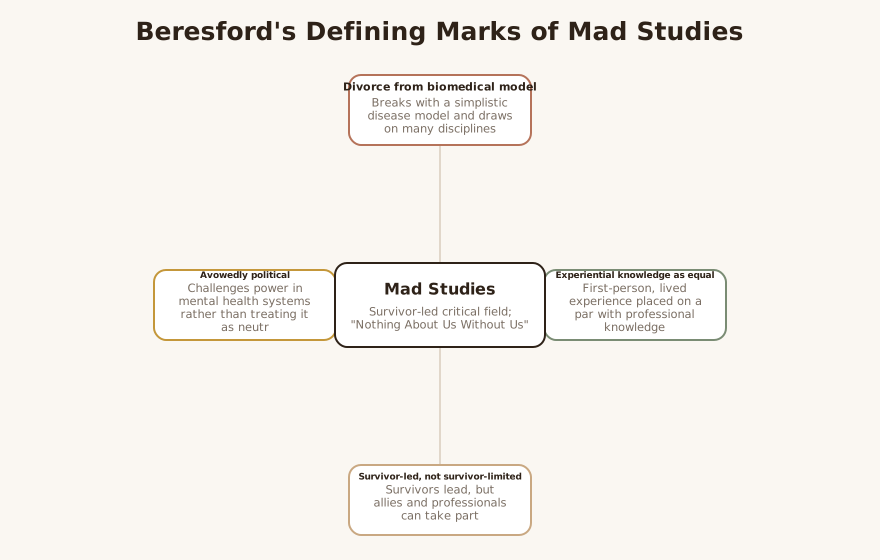
Beresford names three defining characteristics in the handbook’s introduction 2. Mad Studies is based on an explicit divorce from a simplistic biomedical model and the treatment premises attached to it, drawing instead on a range of disciplines 2. It places experiential, first-person knowledge on an equal footing with professional knowledge, returning to the founding value of the survivor movement that survivors’ viewpoints must be treated with equality 2. And it is survivor-led but not survivor-limited: allies, professionals, researchers, and loved ones can participate if they accept its core principles 2. A central analytic concept is sanism — the societal prejudice against those labelled mentally ill that produces systemic oppression, paralleling racism and ableism 4. Language reclamation is also core: words like “mad” are deliberately recovered as identities of pride and resistance rather than slurs 4.
Interventions & Techniques
Mad Studies does not prescribe techniques in the manualized sense, so what follows are practice translations rather than protocol steps LLM. The clearest behavioural commitment is centering and not overriding first-person accounts: treating a client’s own interpretation of voices, visions, or distress as knowledge to be explored rather than symptoms to be suppressed 2. This is exemplified historically by the Hearing Voices approach of Marcus Romme and Sandra Escher, which — though initiated by psychiatrists — centred voice-hearers’ own understandings and built international peer-support networks 2.
In a clinical encounter, a Mad Studies sensibility tends to show up as concrete choices LLM. You can de-emphasise diagnostic labels as explanations and instead ask what the experience means to the person and what social and relational conditions surround it 2. You can attend to power asymmetries in the room and to the iatrogenic history many clients carry, including coercion and forced treatment 2. You can support self-defined goals, including recovery framed by the person rather than by the service, while remaining alert to how survivor-led ideas such as “peer support,” “self-management,” and “recovery” can be co-opted and re-medicalised by services 2.
LLM-generated illustrative example (not a guideline): A client describes hearing a critical voice and says prior clinicians only ever asked whether the voice had “gotten louder” so they could adjust medication. The clinician instead asks what the voice says, whose voice it resembles, and when it began — and learns it echoes a former abuser. The work shifts from symptom-suppression to making relational meaning, without abandoning safety planning LLM.
Evidence Base
Honesty about evidence matters here, because Mad Studies is not the kind of object that randomized trials evaluate LLM. Its maturity is established as a scholarly and activist field — it has foundational anthologies, an international handbook, university courses, and a sustained peer-reviewed literature 2. What it does not have is an outcome-validated evidence base in the clinical-trial sense, because it is a critical framework and political praxis rather than a discrete intervention with measurable endpoints LLM. Treating it as if it were a treatment to be empirically validated misreads what kind of claim it makes LLM.
Where the field intersects with empirical argument, it tends to marshal historical and human-rights evidence: the documented harms of large-scale institutionalisation, forced treatment, restraint, insulin shock therapy, and ECT, and contemporary abuses such as people with mental health conditions being chained and maltreated in some settings 2. In global mental health, Mad Studies scholarship advances a decolonial critique, arguing that exporting Northern biomedical models constitutes epistemic injustice — that people with direct experience of distress or colonisation are routinely granted less credibility, and that care should shift from technocratic adaptation of Northern models toward epistemically horizontal processes valuing local knowledge systems 3. Clinicians should weigh these as well-developed conceptual and ethical arguments, not as effectiveness data LLM.
Populations & Indications
The framework speaks most directly to populations who have experienced the sharp end of psychiatric power: psychiatric survivors and service users, people with serious mental illness, and people subjected to involuntary commitment 2. It is especially relevant to people labelled with schizophrenia or psychosis, whose self-understandings have historically been most readily overridden, and to mental health consumers and ex-patients organising for autonomy 5. Because sanism intersects with race, gender, sexuality, class, and disability, the lens is also pertinent to marginalized and disabled populations carrying compounded discrimination 4.
As an “indication,” a Mad Studies stance is most useful when a clinician suspects that the standard model is itself contributing to harm — when labelling, coercion, or systemic exclusion are part of the clinical picture rather than incidental to it LLM. It is correspondingly less about selecting a population and more about adjusting the clinician’s posture across populations LLM.
Problems-for-Work
The framework offers traction on a recognisable set of clinical problems-for-work, several of which it names directly LLM. Internalized stigma can be addressed by externalising the medical narrative and reclaiming a non-pathologising identity, drawing on the Mad Pride move of recasting devalued words 5. Trauma from psychiatric hospitalization and iatrogenic harm and coercive treatment become explicit topics rather than unspoken background, since the field foregrounds the documented violence of past and present psychiatric practice 2.
LLM-generated illustrative example (not a guideline): A client who was involuntarily hospitalised years earlier flinches whenever the clinician reaches for an assessment form. Naming the prior coercion openly, and explicitly contracting around choice and consent in the room, becomes the early work — addressing trauma from psychiatric hospitalization before any deeper exploration LLM.
Other apt problems-for-work include loss of autonomy / disempowerment, approached by restoring decisional authority to the client; psychiatric labeling and diagnostic overreach, approached by holding diagnoses lightly as administrative artifacts rather than identities; and distress reframed outside the medical model, approached by exploring social, relational, and political contributors alongside biological ones 2. Social marginalization and discrimination and social exclusion are treated as causes of distress to be addressed, not merely as consequences of illness 2.
Contraindications, Cautions & Cultural Humility
The most important caution is clinical, not ideological: a critical stance toward diagnosis and the medical model must never translate into withholding care a client wants or needs, or into ignoring acute risk such as suicidality or psychosis with safety implications LLM. Mad Studies critiques coercion, but the framework does not relieve a clinician of duty-of-care and safety obligations, and using the philosophy to justify under-treatment would be a misapplication LLM. Notably, some of the field’s own founders, like Sedgwick, warned against assuming that opponents of mainstream psychiatry are automatically allies of service users 2.
The field is also self-critical in ways clinicians should heed 2. It has been charged with being elitist and academicised, with most prominent writers holding PhDs, and with centering the Global North at the expense of the Global South 2. Its “Mad” terminology has been described as damaging or offensive to some Black and minority-ethnic communities and to people in the Global South, where it can read as another imposition of Western ideas 2. Brenda LeFrançois has warned of the “potential undoing” of the field unless it decenters whiteness and stays accountable to Mad communities outside academia 2. For a clinician, the cultural-humility takeaway is to apply the lens with the client’s own language and meaning system, not to impose “madness” as an identity on someone who experiences their distress as illness or as a vale of tears, since by no means all survivors feel positive about their experience 2.
Treatment-Plan Suggestions & SMART Objectives
| Goal | SMART objective (example) | Mechanism |
|---|---|---|
| Reduce internalized stigma | Over 8 sessions, client articulates 3 non-pathologising self-descriptions and reports a measurable drop in self-stigma on a brief scale | Language reclamation and externalising the medical narrative 5 |
| Restore decisional autonomy | Within 6 weeks, client co-authors their own care goals and exercises an explicit consent/choice point in each session | Centering lived experience and “Nothing About Us Without Us” 4 |
| Process hospitalization trauma | Over 10 sessions, client narrates the involuntary-admission experience and identifies 2 grounding strategies for trauma cues | Trauma-informed exploration of iatrogenic harm 2 |
| Re-meaning of voices/experiences | Within 12 sessions, client maps the content and relational origins of a recurring voice and rates distress weekly | Experiential-knowledge-centred meaning-making 2 |
| Rebuild social belonging | Within 3 months, client engages one peer-support or community connection and tracks attendance | Countering social marginalization and exclusion 2 |
| Hold diagnosis lightly | Over 4 sessions, client distinguishes the administrative label from their lived self-understanding in writing | Critique of diagnostic overreach as social construction 1 |
| Name and resist sanism | Within 6 sessions, client identifies 2 instances of sanist treatment and rehearses a self-advocacy response | Sanism as a named, resistible form of oppression 4 |
Common Misconceptions
A frequent misconception is that Mad Studies equals anti-psychiatry; in fact the field defines itself partly against that older, professional-led movement and asks explicitly how it differs 2. A second is that it is anti-medication or anti-treatment in a blanket way; its target is the dominance of a simplistic biomedical model and coercion, not the existence of help that people freely choose 2. A third is that “Mad Pride” implies everyone should celebrate their distress; the handbook is explicit that many survivors do not experience their madness as positive and that Mad Pride speaks to only a portion of the movement 2.
A fourth misconception is that this is a fringe, marginal idea with no scholarly weight; it is in fact an established interdisciplinary field with major anthologies and an international handbook 4. Finally, clinicians sometimes assume the lens is only relevant in radical or activist settings, when its core moves — centering the client’s account, attending to power, holding diagnosis lightly — are portable into mainstream practice LLM.
Training & Certification
There is no licensure, credential, or certification in Mad Studies, and any claim of one should be treated with suspicion LLM. The field is taught primarily through university courses, particularly in Canada and the UK, and through its scholarly literature, with the foundational texts being Mad Matters and The Routledge International Handbook of Mad Studies 2. Because the field is survivor-led, much of its “training” is relational and community-based, taking place, as LeFrançois puts it, within or without academia but never without community 2.
For a clinician, meaningful engagement looks less like accreditation and more like sustained reading, supervision that interrogates one’s own use of power, and direct relationship with survivor-led organisations LLM. The decolonial strand of the literature would add that genuine learning means valuing local and experiential knowledge systems rather than transposing a Northern model wholesale 3.
Key Terms
Sanism — systemic prejudice and discrimination against people labelled mentally ill, analogous to racism and ableism 4. Psychiatric survivor — a person who identifies as having survived psychiatric intervention, often including coercion, and a core constituency of the movement 5. Service user / consumer / ex-patient — alternative self-descriptors reflecting differing relationships to the system 2. Mad Pride — the movement, launched in 1993, to reclaim stigmatised terms and assert a positive Mad identity 5. Epistemic injustice — the routine denial of credibility to people with direct experience of distress or oppression, central to the decolonial critique 3. The biomedical model — the framing of distress primarily as brain-based illness, which Mad Studies explicitly divorces itself from 2. Experiential / first-person knowledge — lived-experience knowledge treated as equal to professional expertise 2.
Resources & Further Reading
▶ Watch — a video introduction to this concept:
- Mad Matters: A Critical Reader in Canadian Mad Studies (LeFrançois, Menzies & Reaume, 2013)
- The Routledge International Handbook of Mad Studies (Beresford & Russo, 2022) — PDF excerpt
- Decolonising global mental health: The role of Mad Studies (PMC)
- Introduction to Mad Studies: Key Concepts and Principles — Mad and Crip Theology Press
- Mad pride — Wikipedia
Reflective / Supervision Questions
- When a client interprets their experience differently from my diagnostic formulation, whose account am I privileging in the room, and why? 2
- Where in my own practice do I exercise power over a client’s autonomy, and is that power genuinely necessary for safety or merely habitual? 4
- How do I hold a critical stance toward the medical model while still honouring a client’s wish for medication or diagnosis when that is what they want? LLM
- Am I importing “Mad” identity or pride onto clients who experience their distress as suffering they would rather be rid of? 2
- How does sanism show up in my caseload, my team, and my documentation, and what would naming it change? 4
- When I invoke “recovery,” “peer support,” or “self-management,” am I using these in the survivor-led sense, or in a re-medicalised, service-defined one? 2