
Type & Discipline
Idioms of distress are not a treatment modality but a construct — a conceptual tool for interpreting how people communicate suffering — drawn from medical anthropology and cultural psychiatry 3. The term was coined to name the culturally constituted, socially acceptable ways through which individuals and groups signal distress that may not map onto a biomedical diagnostic category 1. As a construct, it belongs to the assessment-and-formulation layer of clinical work rather than to any single school of therapy: it shapes how you listen, interpret, and respond regardless of the modality you ultimately deliver LLM.
The core observation is that distress is rarely communicated in raw, unmediated form; people draw on the expressive repertoires their culture makes available, whether somatic (“my body is weak,” “burning in the chest”), behavioral, or verbal (“thinking too much,” “nerves”) 1. These idioms are alternatives to — and sometimes substitutes for — the psychiatric vocabulary clinicians are trained to elicit 1. For the practicing therapist, the practical upshot is that a patient’s presenting complaint is often a culturally shaped message about a problem, not a transparent report of a discrete disorder 3.
Creators & Lineage
The construct was introduced by medical anthropologist Mark Nichter in a 1981 paper based on fieldwork among Havik Brahmin women in South India, where he documented how distress arising from social and familial circumstances was expressed through somatic complaints, dietary idioms, and ritual rather than through a language of emotion or mental illness 1. Nichter’s argument was that these expressions were not simply “somatized depression” to be decoded into Western categories, but meaningful idioms embedded in local moral and social worlds 1. He returned to and broadened the concept nearly three decades later, arguing that idioms of distress should be studied as dynamic, strategic communications rather than fixed cultural templates 2. In his own synthesis of the construct, Nichter frames idioms as the means by which suffering is rendered communicable and actionable within a social world 6.
The lineage runs through medical anthropology and cultural psychiatry, fields that critiqued psychiatry’s tendency to reify disorders on a biomedical model while neglecting social etiologies 5. The construct sits alongside, and partly displaced, the older notion of culture-bound syndromes — discrete, geographically fixed disorders — by emphasizing that idioms are flexible vehicles of communication rather than bounded illnesses 5. This conceptual stream fed directly into DSM-5, where “cultural idioms of distress” became one of three components of the broader Cultural Concepts of Distress framework, operationalized clinically through the Cultural Formulation Interview 5.
Core Principles
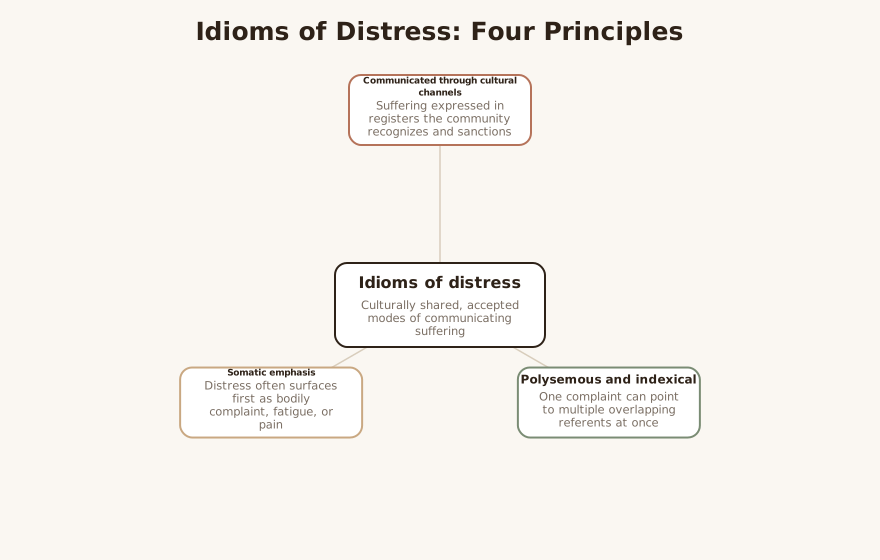
The first principle is that distress is communicated through culturally available channels 1. People express suffering in the registers their community recognizes and sanctions; a somatic idiom may carry social meaning that an emotional disclosure could not, particularly where naming psychological problems risks stigma 1.
The second principle is that idioms are polysemous and indexical — a single complaint can point to multiple, overlapping referents at once 2. “Thinking too much,” for instance, may simultaneously index grief, rumination, economic hardship, and a moral statement about one’s circumstances 5. The idiom is not a code with a one-to-one translation into a DSM symptom; it is a condensed reference to a web of meaning 2.
The third principle is the somatic emphasis of much distress expression 4. In many cultural settings — and in everyday life more broadly — distress surfaces first and most legitimately as bodily complaint, fatigue, weakness, or pain 4. This is not necessarily a defense or a “masking” of “real” psychological problems; the body is a primary, valid medium of distress communication 4.
The fourth principle, emphasized in Nichter’s revisitation, is that idioms are strategic and relational 2. People deploy idioms to recruit support, negotiate roles, register protest, or make claims on others, so the same idiom can do different social work in different hands 2. The fifth principle is non-pathologizing interpretation: idioms of distress include expressions that fall short of disorder, signaling subclinical suffering, social strain, or moral concern that a purely diagnostic lens would miss 5.
Interventions & Techniques
Because idioms of distress is a construct rather than a manualized therapy, its “techniques” are interpretive and assessment-oriented practices that can be embedded within whatever modality you deliver LLM. The central practice is eliciting the patient’s own explanatory account — inviting them to name and describe their distress in their own terms before mapping anything onto diagnostic criteria 1. This is the same move operationalized in the DSM-5 Cultural Formulation Interview, whose first domain asks the patient to define the problem in their own words 5.
A second practice is decoding the idiom in context rather than translating it prematurely 2. The clinician treats a complaint such as “nerves” or “thinking too much” as a starting point for inquiry — what does this expression refer to, what social circumstances surround it, what does the patient hope happens when they voice it — instead of reflexively recoding it as anxiety or depression 2. A third practice is tracking the somatic channel respectfully: taking bodily complaints seriously as legitimate distress communication while still screening for medical and psychiatric conditions 4.
A fourth practice is negotiating a shared frame that honors the idiom while introducing a treatment rationale the patient can accept, rather than imposing a biomedical relabeling 1. Across these practices the stance is interpretive humility: the idiom is data about meaning, and the clinician’s task is to understand its referents before acting on them 3.
LLM-generated illustrative example (not a guideline): A clinician meets a patient who reports that she “thinks too much” and that her “head is hot.” Rather than immediately scoring a depression measure, the clinician asks what the thinking is about and when it started. The patient describes a son’s migration abroad, financial precarity, and shame about needing help. The clinician keeps the patient’s idiom in the room — framing therapy as a way to “rest the mind from too much thinking” — while still assessing for a depressive episode in the background. LLM
Evidence Base
The maturity of idioms of distress is best described as established — as an anthropological and cultural-psychiatry construct, not as an intervention with outcome trials LLM. It is a foundational concept in medical anthropology, originating in a widely cited 1981 case study and sustained through decades of ethnographic and cross-cultural research 1. Its conceptual establishment is reflected in its incorporation into DSM-5’s Cultural Concepts of Distress framework and in ongoing literature mapping idioms across populations 5.
What the evidence base supports is the construct’s descriptive and explanatory validity: ethnographic and review literature documents recurrent idioms (somatic complaints, “thinking too much,” “nerves,” and culturally specific expressions) across many settings and shows they carry consistent social and emotional meaning 5. Reviews in the cultural-concepts literature also argue that attending to idioms improves the cultural validity of assessment and reduces the risk of misreading culturally normative expression as disorder 5. There is published work specifically synthesizing the construct and its clinical relevance 7.
What the evidence base does not establish is that any specific “idioms-informed” technique produces superior symptom reduction or retention in a controlled trial; the construct’s support is conceptual, ethnographic, and validity-oriented rather than efficacy-oriented LLM. Honest practice treats idioms of distress as a lens that improves assessment fidelity and engagement, not as a proven outcome intervention 5.
Populations & Indications
The construct is indicated across the full range of cross-cultural and culturally diverse encounters, and especially where a patient’s expressive repertoire may differ from the clinician’s diagnostic vocabulary 5. Priority populations include immigrants and refugees, whose distress often arises at the interface of cultures and may be voiced through somatic or relational idioms 5. It is also central with ethnic and cultural minorities, non-Western populations, and Indigenous communities, among whom distress is frequently expressed in locally recognized terms that biomedical screening can miss 1.
A distinct indication is people with prominent somatic complaints, in whom bodily idioms may be the primary channel of distress communication and where premature medicalization risks missing the social or emotional source 4. The construct’s relevance is not, however, limited to “exotic” or minority presentations: distress is communicated through somatic and idiomatic channels in everyday life across populations, so the lens applies broadly whenever presentation and standard criteria fit poorly 4.
Problems-for-Work
Idioms of distress is most useful for problems where the form of a patient’s complaint is driving clinical difficulty — where what is said, and how, does not map cleanly onto a diagnosis LLM.
- Somatization and somatic symptom disorder. When distress presents as fatigue, weakness, pain, or “heat,” the construct directs the clinician to read the body as a communicative channel rather than only as a symptom to be eliminated, while still screening for medical and psychiatric conditions 4.
- Medically unexplained symptoms and health anxiety. Persistent bodily complaints without organic findings are often legible as idioms pointing to social or emotional strain, which reframes engagement away from a frustrating “nothing is wrong” message 4.
- Depression, anxiety, and grief. Expressions like “thinking too much” or “nerves” frequently overlap these presentations; decoding the idiom clarifies whether and how diagnostic criteria apply rather than forcing a translation 5.
- Trauma reactions. Idioms can encode trauma history in culturally sanctioned terms; attending to them surfaces material a symptom checklist may not elicit 5.
- Acculturative stress and culturally-bound distress. For immigrants and bicultural patients, distress voiced through idioms often indexes the strain of living across cultures, which a context-attentive reading brings into view 5.
LLM-generated illustrative example (not a guideline): A refugee patient repeatedly reports “pain all over” and exhaustion, and prior providers have told him his labs are normal. The clinician treats the bodily complaint as a serious idiom, explores it, and learns it tracks intrusive memories and survivor guilt. Diagnosis and trauma-focused work proceed, but the body remains an acknowledged part of how the patient names and monitors his distress. LLM
Contraindications, Cautions & Cultural Humility
The construct has no medical contraindications, but it carries real misuse risks LLM. The foremost caution is stereotyping: treating an idiom as a fixed group template — “this group says X, therefore the patient means Y” — contradicts the construct’s own emphasis on idioms as flexible, strategic, and individually deployed 2. Idioms are polysemous; their meaning must be inquired into with the particular patient, not assumed from group membership 2.
A second caution is romanticizing the idiom and missing the disorder LLM. Reading every somatic complaint as “merely” a cultural idiom can lead a clinician to overlook a treatable medical condition or a major psychiatric disorder; the construct supplements differential diagnosis and screening, it does not replace them 4. The cultural-concepts literature explicitly frames idioms as one part of assessment that must be integrated with, not substituted for, diagnostic rigor 5.
A third caution concerns conceptual boundaries — idioms of distress, cultural syndromes, and cultural explanations overlap, and the construct should be applied as an interpretive aid rather than a rigid taxonomy 5. Cultural humility here means holding the patient as the expert on their own meaning while the clinician remains responsible for safety, medical screening, and diagnostic accuracy LLM. It also means examining one’s own diagnostic vocabulary as itself a culturally situated idiom, not a neutral standard 3.
Treatment-Plan Suggestions & SMART Objectives
| Goal | SMART objective (example) | Mechanism |
|---|---|---|
| Elicit the patient’s own distress language | Within the first 2 sessions, document the patient’s primary idiom (e.g., “thinking too much,” “nerves,” somatic complaint) in their own words | Person-centered elicitation surfaces meaning a checklist misses 1 |
| Decode the idiom’s referents | Over 3 sessions, map the patient’s idiom to its social, somatic, and emotional referents on a shared formulation | Idioms are polysemous and require contextual inquiry 2 |
| Honor the somatic channel | Over 4 weeks, track the patient’s bodily complaint weekly while completing medical/psychiatric screening | Treating the body as a valid distress channel aids engagement and safety 4 |
| Distinguish idiom from disorder | Within 3 sessions, confirm or revise the working diagnosis with explicit rationale linking idiom to criteria | Integrating idioms with differential diagnosis improves validity 5 |
| Negotiate a shared treatment frame | By session 3, co-author one treatment-rationale statement using the patient’s own idiom, confirmed with the patient | A negotiated, idiom-honoring frame strengthens alliance 1 |
| Address acculturative strain | Over 8 weeks, name three culture-interface stressors voiced through the idiom and rehearse a coping response to each | Idioms often index the strain of living across cultures 5 |
| Reduce health anxiety around somatic idiom | Over 6 weeks, reframe recurring somatic complaints as meaningful signals, reducing reassurance-seeking by a target frequency | Reframing the body as communication shifts the help-seeking pattern 4 |
Common Misconceptions
A persistent misconception is that a somatic idiom is just “somatized depression” awaiting translation into the real (Western) diagnosis — the very assumption Nichter challenged, since idioms are meaningful communications in their own right, not disguised versions of biomedical categories 1. A related error is treating idioms as fixed, group-specific codes with one-to-one meanings; the construct insists they are polysemous and strategically deployed, so the same idiom does different work for different people and occasions 2.
Another misconception is that idioms of distress and culture-bound syndromes are the same thing. The idioms construct deliberately moves away from the “bound,” geographically fixed connotation, emphasizing flexible expression rather than discrete localized disorders 5. Finally, some clinicians assume idioms are relevant only to ethnic-minority or non-Western patients; in fact distress is communicated through somatic and idiomatic channels in everyday life across populations, making the lens broadly applicable 4.
Training & Certification
There is no certifying body or credential for idioms of distress; competence is acquired through cultural-psychiatry and medical-anthropology education and supervised practice rather than a licensure pathway LLM. The most concrete clinical training resource is the DSM-5 Cultural Formulation Interview, which operationalizes idiom elicitation in its first domain and is usable by general clinicians without specialist certification 5.
Foundational reading begins with Nichter’s original 1981 case study and his 2010 revisitation, which together define the construct and its evolution 1. The cultural-concepts review literature situates idioms within the broader DSM-5 framework and offers guidance for research and assessment 5. Encyclopedia and synthesis entries provide accessible overviews for clinicians new to the construct 3. In practice, proficiency grows by integrating idiom elicitation into routine intakes, reviewing formulations in supervision, and reading idioms against the patient’s social context rather than a fixed glossary LLM.
Key Terms
- Idiom of distress: A culturally shared, socially acceptable mode of expressing and communicating suffering, somatic or verbal, that may signal distress not captured by a biomedical category 1.
- Somatization (as idiom): The expression of distress primarily through bodily complaints, treated here as a valid communicative channel rather than only a symptom to eliminate 4.
- “Thinking too much”: A widely documented verbal idiom indexing rumination, worry, grief, and social strain, with meanings that vary by context 5.
- Polysemy / indexicality: The property of an idiom referring to multiple overlapping meanings at once, requiring contextual inquiry rather than direct translation 2.
- Cultural Concepts of Distress: The DSM-5 umbrella framework within which “cultural idioms of distress” is one of three components 5.
- Cultural Formulation Interview (CFI): The DSM-5 semi-structured interview that operationalizes eliciting a patient’s own definition of the problem 5.
- Culture-bound syndrome: The older, partly superseded notion of discrete, geographically fixed disorders, contrasted with flexible idioms 5.
Resources & Further Reading
▶ Watch — a video introduction to this concept:
- Idioms of distress: Alternatives in the expression of psychosocial distress — Nichter (1981) 1
- Idioms of Distress Revisited — Nichter (2010) 2
- Idioms of Distress — International Encyclopedia of Anthropology (Wiley) 3
- Idioms of distress: Somatic responses to distress in everyday life 4
- Culture-bound syndromes, idioms of distress, and cultural concepts of distress: new directions (eScholarship PDF) 5
- Idioms of Distress — Nichter full text (ResearchGate PDF) 6
- Idioms of Distress — PubMed (PMID 28936079) 7
Reflective / Supervision Questions
- In my last five intakes, how often did I let the patient name their distress in their own terms before mapping it onto diagnostic criteria? LLM
- When a patient offered a somatic idiom, did I treat it as meaningful communication or reflexively recode it as anxiety or depression? LLM
- Have I slipped into using an idiom as a group template, rather than inquiring into what it means for this particular patient? LLM
- Where a patient’s distress presented through the body, did I honor that channel while still completing appropriate medical and psychiatric screening? LLM
- How does my own diagnostic vocabulary function as a culturally situated idiom rather than a neutral standard? LLM
- For my most diagnostically uncertain current case, what would change if I formulated the presenting complaint as an idiom of distress first? LLM