
Type & Discipline
Systematic Treatment Selection (STS) is a framework within clinical psychology and the broader project of psychotherapy integration 2. It is best described as a form of technical eclecticism: a model that develops and plans treatments using empirically founded principles of psychotherapy rather than allegiance to a single theory 2. Its central premise is that no single theory or technique works for all clients, and that the fit between a client’s characteristics and the procedures used is what drives change 2. The Society of Clinical Psychology (APA Division 12) characterizes STS as an evidence-based treatment that uses empirical principles to compile an integrated treatment plan, applied within or across theories to tailor care to a client’s personal qualities and problem characteristics 1.
The framework operates at two levels LLM. STS proper is a decisional structure for the full range of treatment decisions — setting, format, modality, intensity, and intervention class 2. Prescriptive Therapy (PT) is the name given to its specific application to individual outpatient psychotherapy, derived from the subset of STS principles that govern one-to-one work 2. Throughout this article, “Prescriptive Therapy” refers to that individual-treatment application, while “STS” refers to the parent framework LLM.
Creators & Lineage
STS was developed primarily by Larry E. Beutler (b. 1941), a clinical psychologist who earned his Ph.D. at the University of Nebraska and held positions at Duke University Medical Center, Baylor College of Medicine, the University of Arizona, UC Santa Barbara, and the Pacific Graduate School of Psychology 3. Beutler is a past president of APA Division 12 (Clinical) and Division 29 (Psychotherapy) and twice served as international president of the Society for Psychotherapy Research 3. He has published over 350 articles and chapters and authored or co-authored roughly 15 books on psychotherapy, assessment, and psychopathology 3.
The framework was first articulated in Systematic Treatment Selection: Toward Targeted Therapeutic Interventions (Beutler & Clarkin, 1990) and extended in Prescriptive Therapy (Beutler & Harwood, 2000) 2. John F. Clarkin and T. Mark Harwood are therefore central collaborators, not peripheral ones 2. STS drew on two contemporary integration models — Differential Therapeutics (Frances, Clarkin & Perry, 1984) and Beutler’s own Systematic Eclectic Psychotherapy (1983) — and on the earlier prescriptive traditions of Lazarus’s multimodal therapy and Goldstein and Stein’s prescriptive psychotherapy 2. Its intellectual debts run to the common-factors tradition and to Goldfried’s call to delineate principles of therapeutic change that transcend “trademark” psychotherapies 2.
Core Principles
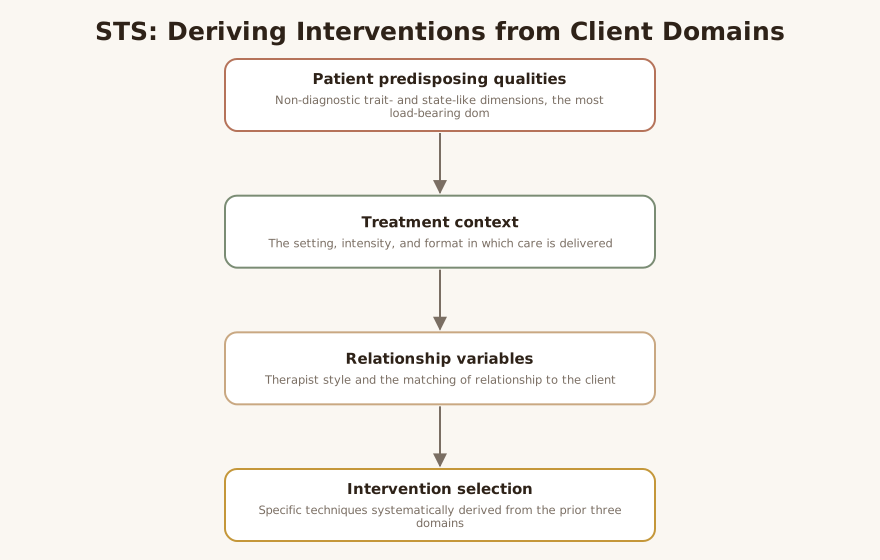
STS organizes treatment decisions around four decisional domains: patient predisposing qualities, treatment context, relationship variables, and intervention selection 2. The interaction of the first three guides the systematic derivation of specific interventions; the review frames this almost as an additive equation in which client qualities, context, and relationship combine to indicate technique 2.
The most load-bearing domain is patient predisposing qualities — non-diagnostic, trait- and state-like characteristics treated as continuous dimensions 2. Six reliable dimensions emerged from iterative literature reviews, arranged from most trait-like to most state-like: level of functional impairment; preferred coping style (externalizing to internalizing); problem complexity (chronicity, comorbidity, recurrence); level of social support; level of resistance; and level of subjective distress 2. Four of these — functional impairment, coping style, resistance, and subjective distress — are treated as the most critical to treatment selection 2.
A defining claim of STS is that the single most powerful source of influence on treatment outcome is the non-diagnostic characteristics a client brings to therapy, not the DSM diagnosis or the brand of treatment 2. Accordingly, STS deliberately places less weight on diagnosis and more on these predisposing variables when guiding clinical decisions 2.
Interventions & Techniques
STS is implemented as a sequence of matching decisions rather than a fixed protocol 2. After assessing predisposing qualities, the clinician specifies the treatment context — setting (inpatient vs. outpatient), mode (psychosocial vs. medical/somatic), format (individual, group, or family), and frequency/duration (crisis, short-term, long-term, or even no treatment) 2. Relationship variables are then considered, and finally specific interventions are selected along a symptom-focused versus conflict-focused axis 2.
Two matching rules carry most of the clinical weight LLM. First, coping style guides the focus of intervention: externalizing clients respond better to behaviorally and symptom-focused work, while internalizing clients benefit more from insight-, conflict-, and relationship-focused procedures 4. Second, resistance level guides directiveness: low-resistance clients do better with therapist-directed activities, whereas high-resistance clients do better with patient-directed, less directive, or even paradoxical interventions, because change is greatest when directiveness is inversely matched to resistance 2. A third rule governs distress: a moderate level of subjective distress is therapeutically optimal, so the clinician works to raise distress when it is too low to motivate change and to contain it when it is too high to permit work 2.
A practical sequencing rule follows from these: for internalizing clients who also present acute external symptoms or risky behavior, symptom reduction is stabilized first before conflict- or insight-oriented work begins 2.
LLM-generated illustrative example (not a guideline): A reflective, self-blaming client with major depressive disorder and high resistance might be offered a less directive, insight-oriented stance, whereas an impulsive client who externalizes blame and shows low resistance might be offered structured, therapist-led behavioral activation — same diagnosis, different procedures LLM.
Evidence Base
STS is recognized by Division 12 as an evidence-based treatment for general outpatient populations, with effects generally retained over 6- and 12-month follow-up 1. The principles themselves were empirically derived through iterative literature reviews of mixed, depressed, and substance-using samples, then tested for impact on client change 2. Supporting trials include Beutler et al. (1991), which found that externalizing depressed clients improved more in group cognitive therapy while internalizing clients improved more in supportive/self-directed therapy, and that resistant clients fared better in less directive treatment 2. A 2003 trial reported that prescriptive, multi-factor matching outperformed manualized treatments for depressed, stimulant-abusing clients 2.
Honesty about maturity is warranted LLM. While Division 12 classifies STS as established and the framework rests on decades of accumulated principle research 1, the most striking quantitative claims — for example, that the collection of differential indicators may predict up to 90% of outcome variance — come from Beutler’s own research group rather than independent labs 2. The matching dimensions are real and replicated for coping style and resistance, but the framework’s overall effect sizes and the strongest predictive figures should be read as originating-group findings awaiting broader independent replication LLM.
Populations & Indications
STS was designed for, and validated mainly in, general adult outpatient populations seeking psychotherapy 1. Its empirical base draws heavily from samples with depression and with substance use, and the model has been extended to anxiety disorders, personality disorders, and chemical abuse and dependence through the Division 12 / NASPR principles task force 2. The framework is particularly well suited to clients with comorbid and complex presentations, where diagnosis alone gives weak guidance and the matching dimensions add predictive power 2.
STS is indicated whenever a clinician must choose among defensible treatments and wants a principled basis for that choice LLM. It is especially useful for clients who have not responded to a first-line, diagnosis-driven protocol, since nonresponse may reflect a mismatch between the client’s coping style or resistance and the procedures used rather than a failure of the technique itself 2. Prescriptive Therapy as an individual modality is typically delivered within an 8-to-24-session frame, with length varying by functional impairment, readiness for change, and therapist flexibility 1.
Problems-for-Work
Major depressive disorder. STS’s depression research is its empirical core; coping-style and resistance matching directly shape whether a depressed client receives behavioral/symptom-focused or insight/conflict-focused work 2.
Resistance/reactance in therapy. A client who bristles at homework and direction is, in STS terms, high in reactance; the indicated move is to reduce therapist directiveness and increase client-led structure rather than to push harder 2.
Comorbid presentations and problem complexity. When chronicity, comorbidity, and recurrence are high, diagnosis predicts little; STS shifts the clinician toward the non-diagnostic dimensions that do carry predictive weight 2.
Substance use disorders. Beutler’s alcohol-treatment work indicated that “internalizing” drinkers whose use is embedded in family dynamics benefit from family/systems-oriented treatment, while “externalizing” drinkers benefit from symptom-focused cognitive-behavioral work 2.
Treatment nonresponse and poor matching. STS reframes nonresponse as a candidate matching failure, prompting reassessment of coping style, resistance, and distress before abandoning the approach LLM.
Contraindications, Cautions & Cultural Humility
STS includes an explicit “no treatment” decision: treatment may be withheld when it is unnecessary, when it is unlikely to help, when it risks worsening the client’s condition, or when withholding is itself a deliberate therapeutic move 2. Crisis presentations point toward more restrictive settings before outpatient matching is attempted 2.
The framework’s reliance on formal instruments is a practical caution LLM. Coping style and resistance are operationalized through tools such as MMPI-2 subscales, the Therapeutic Reactance Scale, and the STS Clinician Rating Form, and clinicians without access to these measures must approximate the constructs, introducing rater subjectivity 2. The internalizing/externalizing dichotomy is also a simplification; the source material notes that many clients show both patterns at different times or with different conflicts 2.
On cultural humility, the STS literature itself flags that demographic and ethnic similarity can strengthen alliance and commitment, and that ethnic similarity is particularly important for minority clients 2. At the same time, productive change often depends on contrasting interpersonal viewpoints between client and therapist, so matching on surface demographics alone is insufficient 2. Clinicians should hold the matching dimensions as hypotheses to be checked against the individual rather than as fixed categories, and remain alert to how culture shapes the expression of resistance, distress, and what counts as a problem LLM.
Treatment-Plan Suggestions & SMART Objectives
| Goal | SMART objective (example) | Mechanism |
|---|---|---|
| Establish client’s matching profile | Within 2 sessions, document functional impairment, coping style, resistance, and distress using a structured rating form | Predisposing-quality assessment drives treatment selection 2 |
| Match directiveness to reactance | Over 4 sessions, the clinician calibrates directiveness to assessed resistance and tracks alliance ruptures weekly | Inverse matching of directiveness to resistance maximizes change 2 |
| Match focus to coping style | Within 6 sessions, deliver symptom-focused work to externalizing clients or insight-focused work to internalizing clients, reviewing fit at session 6 | Coping-style matching to symptom vs. insight focus 4 |
| Keep distress in the working range | Each session, the clinician monitors subjective distress and intervenes to sustain a moderate level | Moderate arousal sustains motivation for change 2 |
| Stabilize acute symptoms first | For internalizing clients with risky behavior, reduce target risk behaviors to baseline before beginning conflict-focused work | Symptom control precedes insight work for safety 2 |
| Reduce depressive severity | Over 12 sessions, lower a standardized depression score by a clinically meaningful margin | Matched procedures improve depression outcomes 2 |
| Re-evaluate after nonresponse | If no measurable change by session 8, reassess coping style and resistance and adjust the procedure | Nonresponse reframed as candidate mismatch LLM |
Common Misconceptions
A frequent misreading is that STS is itself a school of therapy with its own techniques LLM. It is not; it is a meta-level decisional framework that selects and arranges procedures borrowed from existing approaches according to principles of change 2. A second misconception is that diagnosis drives the treatment plan; in STS, non-diagnostic client qualities are held to be the more powerful predictors, and diagnosis is deliberately de-emphasized 2.
A third error is treating the internalizing/externalizing and high/low-resistance distinctions as fixed personality types rather than as continuous, sometimes state-dependent dimensions that the same client may express differently across time and conflicts 2. Finally, the therapeutic relationship is sometimes dismissed as a “nonspecific” or placebo factor; STS reframes the alliance as a potentiating factor that catalyzes the skillful deployment of specific interventions 2.
Training & Certification
STS does not operate through a formal certification credential in the way some branded modalities do; it is disseminated chiefly through its books, the principles task-force reports, and the associated rating instruments 2. The originating authors propose that the most effective training combines workshop exposure with sustained coaching, small-group case presentations, and direct feedback on tape-recorded sessions in supervision 2. For clinicians already committed to a single orientation, the authors note that workshop exposure works best when paired with ongoing coaching rather than delivered as a one-off 2. Familiarity with the STS Clinician Rating Form and with personality measures used to index coping style and reactance is the practical entry point 2.
Key Terms
Predisposing qualities — non-diagnostic client characteristics (functional impairment, coping style, resistance, distress) that predict differential response to treatment 2. Coping style — the characteristic pattern of defenses a client uses, ranging from externalizing (acting out, blaming external factors) to internalizing (turning inward, self-blame) 4. Resistance / reactance — an interpersonal tendency to respond oppositionally when freedom or control is threatened, guiding the level of therapist directiveness 2. Subjective distress — the client’s felt level of pain, optimal for change at a moderate level 2. Prescriptive Therapy — the individual-psychotherapy application of STS principles 2. Technical eclecticism — selecting techniques across theories on empirical grounds rather than theoretical allegiance 2.
Resources & Further Reading
▶ Watch — a video introduction to this concept:
- Systematic Treatment Selection for General Outpatient Populations — Society of Clinical Psychology (APA Division 12)
- Systematic Treatment Selection (STS): A Review and Future Directions — Nguyen, Bertoni, Charvat, Gheytanchi & Beutler (2007), ERIC full text
- Larry E. Beutler — Wikipedia
- Using Coping Style for Client-Therapist Matching — tmatch.org
Reflective / Supervision Questions
- For a current client, what are your best estimates of their coping style, resistance level, and subjective distress — and on what evidence, formal or clinical, do you base each LLM?
- When a client stalls or disengages, how often do you consider mismatch (between their reactance and your directiveness) before concluding the technique has failed LLM?
- Are you defaulting to your preferred orientation regardless of the client’s predisposing profile, and how would you know if you were LLM?
- How do you decide whether to raise or contain a client’s distress in a given session, and is that decision deliberate or reactive LLM?
- Where might the internalizing/externalizing frame be flattening cultural or individual differences in how this client expresses and explains their problems LLM?