
Type & Discipline
Imagery rescripting (ImRs) is a technique within clinical psychology that sits at the intersection of the cognitive-behavioral and experiential traditions 2. Rather than a standalone therapy, it is a procedure embedded in broader cognitive-behavioral work, in which the client accesses a distressing mental image and then deliberately modifies its content, meaning, or emotional charge 2. Its defining maneuver is active transformation: the client does not merely tolerate or habituate to the image but re-enters it and changes what happens, most characteristically by having an adult, compassionate, or protective figure intervene on behalf of the younger or threatened self 3.
The technique is best understood as a hybrid of cognitive and imaginal methods 2. It shares the exposure heritage of trauma-focused cognitive-behavioral therapy—the client confronts rather than avoids the aversive memory—but it departs from pure exposure by introducing new, corrective elements into the imagined scene rather than relying on extinction alone 2. For clinicians, the most accurate framing is that ImRs is a portable, transdiagnostic experiential procedure that can be inserted into cognitive-behavioral therapy, schema therapy, and other models wherever a maladaptive image or memory is maintaining symptoms 1.
Creators & Lineage
The contemporary form of imagery rescripting was pioneered by Mervin Smucker and David Edwards, who developed structured rescripting work with adult survivors of childhood trauma, and the technique was subsequently consolidated and extended across disorders by Arnoud Arntz and colleagues 2. The widely cited synthesis by Holmes, Arntz, and Smucker articulated how distressing images function in cognitive-behavioral therapy and how rescripting techniques act on them, giving the method a coherent conceptual home within CBT 2. Arntz in particular has carried much of the technique’s empirical and theoretical development, including its formal review and research agenda 1.
The lineage runs through several traditions. ImRs descends from cognitive-behavioral therapy, from which it inherits its attention to beliefs and meanings, and from imaginal exposure, from which it inherits the practice of holding a feared memory in mind rather than avoiding it 2. It is also a core procedure within schema therapy, where rescripting of early aversive memories is used to meet the unmet emotional needs of the “vulnerable child” mode 1. Its emphasis on transforming a trauma image places it in conceptual proximity to other image-transformation methods such as Eye Movement Desensitization and Reprocessing, though ImRs is distinguished by the explicit, content-level rewriting of the scene rather than reliance on bilateral stimulation LLM.
Core Principles
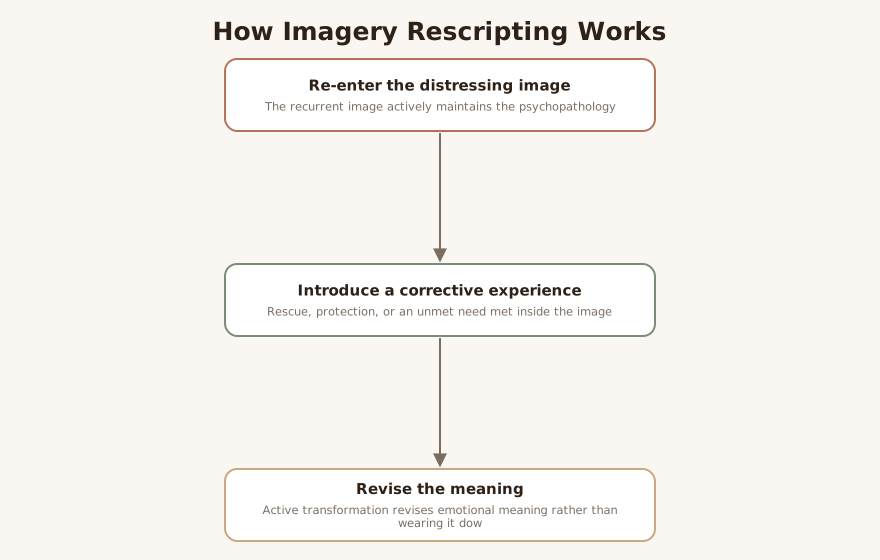
The first principle is that intrusive and recurrent images are not epiphenomena but active maintainers of psychopathology 2. In social anxiety, for example, recurrent negative self-images are “often linked in meaning and content to early socially traumatic” experiences, and these images sustain the disorder by leading the person to treat a distorted self-perception as reality 3. Rescripting targets the image directly on the assumption that changing it will change the belief and the affect bound to it 3.
The second principle is active transformation over passive habituation 2. Where imaginal exposure works by repeated confrontation until distress declines, rescripting introduces a corrective experience inside the image—rescue, protection, the meeting of an unmet need, or the delivery of “updated information”—so the emotional meaning of the memory is revised rather than merely worn down 3. Notably, the PTSD process literature suggests rescripting may require less activation of the original trauma processes than traditional exposure, since the change appears driven by the new imagery rather than by maximal reactivation of the old 4.
The third principle is that the original factual memory is not erased; what changes is the image’s intrusive grip and its meaning 1. This distinction matters both clinically and ethically: rescripting is designed to update emotional learning, not to convince the client that events happened differently than they did 6. The technique therefore aims at the involuntary, intrusive, distressing image rather than at the voluntary, intentional recollection of facts 5.
Interventions & Techniques
In its most studied trauma-and-social-anxiety form, rescripting proceeds in phases 3. Treatment often begins with cognitive preparation: in the social phobia protocol, roughly thirty to forty-five minutes of cognitive restructuring is used to challenge the “encapsulated belief” linking the negative self-image to the early memory, gathering evidence against it before the imagery work begins 3. The rescripting itself is then conducted with eyes closed across distinct stages 3.
In the canonical three-stage sequence, the client first relives the event from the perspective of their younger self at the age it occurred; next, the scene is viewed from the vantage of the present-day adult observer; and finally, the client re-experiences the event as the younger self while the adult self enters the image to provide protection, compassion, and updated information 3. The intervening figure may be the client’s own adult self, the therapist, or another protective presence, and the corrective action is guided by the client’s own needs and wishes rather than imposed 3. Across PTSD work, process coding has identified several within-session ingredients associated with benefit, including the timing of when the new image appears, the degree of activation of the new imagery, whether the rescripting is “self-guided,” the believability of the rescript, the narrative coherence of the revised scene, and the cognitive and emotional shift that follows 4.
LLM-generated illustrative example (not a guideline): A clinician working with an adult who was humiliated by a teacher in front of the class guides the client to relive the scene as their nine-year-old self, then to step in as their present-day adult self—standing between the child and the teacher, naming the unfairness aloud, and reassuring the child that the contempt said nothing true about them. The client is invited to notice the felt shift as the protective adult remains in the image and the child’s body settles. LLM
Evidence Base
The evidence base for imagery rescripting is best characterized as established and broad, though uneven in trial size and quality 1. Arntz’s review of clinical trials, basic studies, and the research agenda documents application and supportive findings across a wide range of disorders and consolidates ImRs as a serious, researched technique rather than a clinical anecdote 1. The Holmes, Arntz, and Smucker synthesis situates the method within CBT and reports its use and outcomes across multiple presentations including PTSD, social anxiety, depression, and eating disorders 2.
Honesty about maturity requires noting how much of the foundational work is small-sample or analogue LLM. The social phobia evidence rests on pilot work: a single roughly ninety-minute rescripting session produced “significant improvements in patients’ negative social beliefs, the vividness and distress of their image and early memory,” and a controlled comparison found the rescripting session yielded “significantly greater improvement” than a control session on negative beliefs, image and memory distress, fear of negative evaluation, and anxiety in feared situations—but benefits were documented only at one-week follow-up, leaving durability untested 3. The PTSD process study examined 27 participants in whom rescripting was embedded within cognitive therapy after imaginal exposure; eight of 27 showed reliable change, and the coded session-content factors associated with improvement included self-guided rescripting and rescript believability 4. Experimental analogue work using the trauma-film paradigm shows that post-trauma imagery rescripting reduces the later development of intrusive memories relative to a no-intervention control, supporting a preventive mechanism, while acknowledging that film analogues do not fully reproduce clinical trauma 5. The technique thus has wide and converging support across paradigms, but clinicians should hold individual effect claims with the appropriate caution given sample sizes 1.
Populations & Indications
The populations with the strongest representation are trauma survivors, adults with histories of childhood abuse, and people with PTSD, for whom rescripting was originally developed and continues to be most studied 2. People with social anxiety are a second well-supported group, particularly those whose disorder is anchored to recurrent negative self-images traceable to early socially traumatic events 3. People with depression, eating disorders, and personality disorders appear across the application literature, the last reflecting ImRs’s central role in schema therapy 1.
Indications extend to people troubled by nightmares and recurrent distressing imagery, where the rescripting logic of rewriting a feared scene maps naturally onto the dream content 1. Across these groups the common thread is the presence of a vivid, recurrent, emotionally charged image or memory that is maintaining the clinical picture; where such an image can be identified and accessed, rescripting is a candidate intervention 2. Where no salient image is present, the technique has less obvious purchase, and a clinician should not force imagery work onto a presentation that is not organized around it LLM.
Problems-for-Work
The clearest problem-for-work is PTSD organized around intrusive trauma images, where rescripting can be inserted into trauma-focused cognitive-behavioral therapy to transform the meaning of the index memory 4. Intrusive memories more generally are a natural target because the technique acts selectively on the involuntary, distressing image rather than on factual recall 5. Social anxiety disorder maintained by a negative self-image linked to an early humiliation is a well-defined application, addressed by rescripting that early memory 3.
Shame is frequently the affective core of these images, and rescripting’s introduction of a protective, validating presence is well suited to revising shame-laden meanings LLM. For complex PTSD and borderline personality disorder, rescripting of early aversive memories is a core schema-therapy procedure aimed at the unmet needs underlying the presentation, though such work generally presupposes a stabilized therapeutic frame 1. Depression accompanied by intrusive autobiographical images, nightmare disorder, and image-anchored conditions such as health anxiety, body dysmorphic disorder, and specific phobias are further candidate applications wherever a discrete distressing image can be located 1 2.
LLM-generated illustrative example (not a guideline): A client with social anxiety reports a recurring image of herself “looking pathetic and red-faced” whenever she speaks in meetings, an image she traces to being laughed at while reading aloud in middle school. After restructuring the belief that the image is accurate, the clinician guides her to re-enter the classroom scene, bring her adult self in to confront the jeering, and comfort her younger self, then to notice how the meeting-room image has loosened. LLM
Contraindications, Cautions & Cultural Humility
Because rescripting deliberately reactivates distressing material, the standard cautions for activating trauma work apply: acute suicidality, severe untreated dissociation, unmanaged substance use, and unstable circumstances generally warrant stabilization before image-focused processing LLM. The technique is experientially demanding, and clinicians should ensure containment, grounding, and adequate session time, recognizing that the studied protocols can run to ninety minutes 3. It is also unclear how much prior general training in cognitive therapy is required to deliver rescripting well, which argues for caution and supervision in less-experienced hands 3.
A specific and important caution concerns memory: trauma-focused rescripting raises the question of whether changing an image might distort the client’s accurate, voluntary memory of events—a concern with clinical and potential forensic weight 6. The technique is designed to act on the intrusive image rather than on intentional recall, and clinicians should be explicit with clients that rescripting updates the emotional meaning of a memory, not the historical record 5 6. Cultural humility extends pointedly to the rescripting step: the corrective action, the protective figure, and the “updated information” must arise from the client’s own values, meanings, and wishes rather than the therapist’s preferred resolution, since an imposed rescript is neither believable nor the client’s own 3 LLM.
Treatment-Plan Suggestions & SMART Objectives
| Goal | SMART objective (example) | Mechanism |
|---|---|---|
| Reduce intrusive trauma imagery | Within 6 sessions, reduce frequency of intrusive images of the index event from daily to ≤1×/week by self-monitoring log | Rescripting acts selectively on involuntary intrusive images 5 |
| Revise the meaning of the trauma memory | By end of treatment, client states a revised, believable meaning of the event on a written rescript summary | Cognitive and emotional shift following an active, believable rescript 4 |
| Lower distress and vividness of a recurrent image | Reduce client-rated image distress and vividness from severe to mild over the rescripting phase | Active transformation of image content and charge 3 |
| Disconfirm an encapsulated negative self-belief | Within agreed sessions, client rates the linked negative social belief as ≤30% believable | Restructuring plus rescripting of the early linked memory 3 |
| Build self-protective imagery capacity | Client independently generates and holds a protective-adult image in two consecutive sessions | Self-guided rescripting with a protective intervening figure 4 |
| Reduce nightmare-related distress | Over the treatment course, reduce nightmare-related awakenings and morning distress by self-report | Rewriting feared scene content via rescripting 1 |
| Reduce shame affect tied to a memory | Client reports a meaningful drop in shame intensity when the memory is recalled by end of treatment | Introduction of validating, protective presence revising shame meaning 1 LLM |
| Confirm and consolidate gains | Re-assess intrusion frequency and image distress at follow-up and confirm maintenance | Re-evaluation and durability check of treated images 3 |
Common Misconceptions
A first misconception is that rescripting rewrites or falsifies the client’s memory of events; in fact, it targets the intrusive image and its emotional meaning while the factual recollection remains, and the literature explicitly examines—and is concerned to preserve—the integrity of voluntary memory 5 6. A second is that rescripting is just a softer form of exposure; it differs by actively introducing corrective content rather than relying on habituation, and may require less reactivation of the original trauma than exposure does 4. A third is that the therapist supplies the corrective ending; the more effective rescripting tends to be self-guided, with the client generating the intervention 4.
A fourth misconception is that rescripting is only for PTSD; the technique is transdiagnostic and has been applied across social anxiety, depression, eating disorders, personality disorders, and nightmares 1 2. A fifth is that vivid emotional flooding is necessary for benefit, whereas process data point to the timing, activation, and believability of the new image as the operative ingredients rather than maximal distress 4. Finally, the brevity of some protocols can create the impression that rescripting requires little skill; in reality the level of cognitive-therapy training needed is not well established, and the procedure demands clinical judgment 3.
Training & Certification
There is no single proprietary certification gating imagery rescripting; it is taught as a technique within cognitive-behavioral therapy, schema therapy, and trauma-focused training rather than as a standalone licensed brand 2. The Holmes, Arntz, and Smucker literature provides the conceptual grounding clinicians typically learn from, and schema therapy training programs embed rescripting of early memories as a core experiential competency 1 2. Because the published protocols specify phased procedures, clinicians are best served by learning a defined protocol rather than improvising the steps 3.
The open question of how much prior cognitive-therapy background is needed argues for supervised practice on early cases, particularly with complex trauma, dissociation, or personality-disordered presentations 3. Prudent practice is to develop the technique under consultation, attend to risk and stabilization, and build informed-consent language that accurately describes what rescripting does and does not do to memory 6 LLM.
Key Terms
- Imagery rescripting (ImRs): An experiential technique in which the client accesses a distressing image and actively modifies its content, meaning, or emotional charge 2.
- Encapsulated belief: A negative belief linking a recurrent distressing self-image to an early aversive memory, targeted for restructuring before rescripting 3.
- Rescript: The transformed version of the scene, including the corrective action and any “updated information” introduced into the image 3.
- Self-guided rescripting: Rescripting in which the client, rather than the therapist, generates the intervention—associated with symptom improvement 4.
- Intrusive image: The involuntary, recurrent, distressing mental picture that the technique selectively targets, as distinct from voluntary recall 5.
- Voluntary memory: Intentional, factual recollection of an event, which rescripting is designed not to distort 6.
- Protective intervening figure: The adult self, therapist, or other presence who enters the image to protect or meet the needs of the younger self 3.
Resources & Further Reading
▶ Watch — a video introduction to this concept:
- Imagery Rescripting as a Therapeutic Technique (review)
- Imagery rescripting in cognitive behaviour therapy (Holmes, Arntz & Smucker, 2007)
- Imagery Rescripting of Early Traumatic Memories in Social Phobia
- Imagery re-scripting for PTSD: session content and symptom improvement
- Reduced intrusion development after post-trauma imagery rescripting (Arntz et al.)
- The dilemma of trauma-focused therapy: effects of imagery rescripting on voluntary memory
Reflective / Supervision Questions
- For this client, is there a discrete, accessible distressing image organizing the presentation, or am I reaching for rescripting where no salient image exists? 2 LLM
- How am I ensuring the rescript—the protective figure, the corrective action, the “updated information”—comes from the client’s own meanings and wishes rather than my preferred resolution? 3 LLM
- Have I assessed risk, dissociation, and stability adequately before beginning activating, image-focused work? 3 LLM
- How do I describe to the client, in informed consent, that rescripting updates the emotional meaning of a memory without distorting their accurate recollection of events? 6 5
- Am I making space for self-guided rescripting, given that client-generated interventions are associated with better outcomes? 4
- Given that much of the supporting evidence is small-sample or analogue, how am I framing realistic expectations about durability with this client? 1 3