
Type & Discipline
Synergetics is a general theory of self-organization, not a treatment, a diagnosis, or a stand-alone clinical modality LLM. Its home discipline is nonlinear, far-from-equilibrium physics: it is an interdisciplinary science explaining the formation and self-organization of patterns and structures in open systems far from thermodynamic equilibrium 3. The theory’s central question is how a system built of many nonlinearly interacting subsystems can, without any external blueprint or central controller, spontaneously produce ordered macroscopic structure in space, time, or function 2.
For a clinician this is an unfamiliar starting point, because synergetics was built to describe lasers, fluids, and chemical reactions in the same breath, not to guide psychotherapy LLM. Its appeal in the consulting room is conceptual rather than technical: it offers a precise vocabulary for thinking about change as a process — about how a stuck symptom pattern can hold for months and then reorganize abruptly, about destabilization preceding reorganization, and about a few governing themes shaping a whole clinical picture LLM. None of the sources for this article address psychotherapy, so every clinical application below is an analogy and a piece of clinical reasoning, not a sourced clinical method, and is marked accordingly LLM.
Creators & Lineage
Synergetics is overwhelmingly the work of one figure: the German theoretical physicist Hermann Haken, who established the field around the late 1960s 3. Haken came to it through laser theory: his interpretation of laser principles as the self-organization of a non-equilibrium system paved the way at the end of the 1960s to the development of synergetics 3. He laid out the framework systematically in his textbook Synergetics: An Introduction, which became the standard statement of the program 4. Decades later he extended the same apparatus to neuroscience in his 2006 paper Synergetics of brain function, treating the brain as a self-organizing system governed by collective order parameters 7.
The intellectual parents of synergetics are the physics of phase transitions and the broader study of nonlinear dynamic systems LLM. The order-parameter concept that anchors the theory was borrowed and generalized from Ginzburg-Landau theory, originally developed to describe equilibrium phase transitions, and Haken extended it to systems driven far from equilibrium 3. Synergetics sits within the same broad family as chaos and complexity theory, dissipative-structure thermodynamics, and general systems theory, sharing their concern with emergence, nonlinearity, and order arising from disorder LLM.
There is a distinctly clinical branch of this lineage, but it is not represented in the sources provided for this article LLM. Beginning in the 1980s and 1990s, the German clinical psychologist and psychotherapy researcher Günter Schiepek and colleagues imported synergetics into psychotherapy, reframing therapeutic change as a self-organizing process and developing high-frequency process-monitoring methods to track it; this “clinical synergetics” is the bridge by which Haken’s physics reaches the therapy room LLM. Because no provided source documents Schiepek’s clinical program or its outcomes, every statement about clinical synergetics in this article is flagged as synthesis rather than sourced fact LLM.
Core Principles
The first principle is self-organization: in an open system of many nonlinearly interacting subsystems, far from thermodynamic equilibrium, ordered patterns can form spontaneously, without an external organizer dictating the result 2. This far-reaching macroscopic order is, strikingly, largely independent of the details of the microscopic interactions, which is why the same mathematics describes phenomena across physics, chemistry, and biology 3.
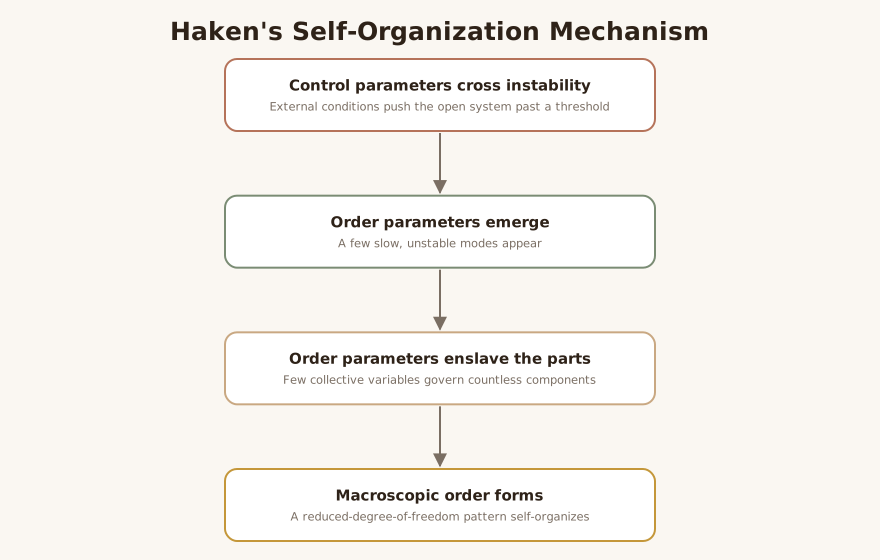
The second and most important principle is the order parameter together with the slaving (enslaving) principle. As a system approaches an instability, its very many fast-relaxing, stable modes become completely determined by the slow dynamics of, as a rule, only a few unstable modes — the order parameters 3. The order parameters are the amplitudes of these unstable modes, and they determine the macroscopic pattern; in effect a handful of collective variables “enslave” the countless individual parts, so that the behavior of the whole can be described by a drastically reduced number of degrees of freedom 3. Haken stated this for the brain in exactly these terms: the brain is conceived as a self-organizing system operating close to instabilities where its activities are governed by collective variables, the order parameters, that enslave the individual parts, the neurons 7. The relationship is one of circular causality: the parts generate the order parameter, and the order parameter in turn governs the parts LLM.
The third principle is the control parameter and the instability it produces. Self-organization is driven by external control parameters — features of the environment or the flux of energy and matter into the system 3. The control parameter is not a switch that imposes a particular pattern; it is an unspecific driving force, and the system itself selects which ordered state emerges LLM. As a control parameter is gradually changed and crosses a critical threshold, the system passes through an instability and undergoes a qualitative reorganization — a nonequilibrium phase transition — that can be abrupt and that produces an enormous reduction of degrees of freedom and a corresponding increase of order 3. Near these transition points classic nonlinear signatures appear, including bistability and hysteresis 7. These three principles — self-organization, order parameters with enslavement, and control-parameter-driven phase transitions — are the conceptual core that any clinical application borrows LLM.
Interventions & Techniques
Because synergetics is a theory of self-organization rather than a therapy, there are no “synergetics techniques”; its clinical value, if any, lies in the formulation and stance it offers, operationalized through recognized modalities LLM. Everything in this section is clinical reasoning by analogy, not a method drawn from the physics LLM.
The first move is to identify a clinical order parameter: the small number of collective themes that appear to organize an otherwise sprawling clinical picture — a core relational fear, a shame schema, a self-worth contingency — such that many surface symptoms behave as enslaved expressions of one or two governing variables LLM. Naming this candidate order parameter can give a chaotic presentation a tractable shape, much as a few order parameters reduce the degrees of freedom of a complex system LLM. The second move follows from the control-parameter idea: rather than trying to install the desired end-state directly, the therapist alters the conditions — the relational safety, the activation level, the meaning frame — under which the client’s system can reorganize itself, on the analogy that control parameters drive transitions but the system selects the new order LLM. The third move is to expect and work with instability: synergetics predicts that reorganization is preceded by a loss of stability, so increased variability, agitation, or symptom turbulence may be a signature of an approaching transition rather than simply deterioration, a reading that asks the clinician to titrate rather than suppress destabilization LLM. A fourth, more empirical move associated with clinical synergetics is high-frequency process monitoring — frequent self-ratings analyzed for shifts in pattern and variability that may flag an impending change point — used as a feedback aid within ongoing therapy LLM.
These moves are vehicles for, not replacements for, the documented techniques of an actual modality; the lens supplies a rationale and a sense of timing, while the work itself is delivered through cognitive, emotion-focused, systemic, or behavioral methods LLM.
LLM-generated illustrative example (not a guideline): A client with long-standing depression has plateaued. Reading the picture through a synergetics lens, the clinician hypothesizes that a single order parameter — “I am a burden, so I must disappear” — is enslaving the surface symptoms of withdrawal, anergia, and self-criticism. Rather than targeting each symptom, the work, delivered through emotion-focused therapy, deliberately raises the relational and emotional “control parameters” of the sessions. For two weeks the client reports more agitation and tearfulness; instead of reading this as worsening, the clinician treats it as the loss of stability that precedes reorganization and supports the client through it, after which a more flexible self-narrative begins to consolidate LLM.
Evidence Base
The honest appraisal has two layers, and a clinician should be candid about both LLM. As a physical and mathematical theory, synergetics is mature and rigorous. It grew from laser physics, where the slaving principle and order-parameter description are quantitatively validated, and it provides an exact account of pattern formation and nonequilibrium phase transitions across physics and chemistry 3. Its extension to brain function is a genuine scientific application, not merely a metaphor: Haken modeled movement coordination and visual perception as self-organizing processes governed by order parameters, reproducing real phenomena such as bistability, hysteresis, and oscillations, and progressing from phenomenological models to microscopic neural networks 7. At the level of motor and perceptual neuroscience, then, the framework has demonstrated explanatory and predictive value 6.
As a clinical psychotherapy framework, its maturity is best described as metaphorical, and this must be stated plainly LLM. None of the provided sources connects synergetics to psychotherapy process or outcome; the jump from “neurons enslaved by an order parameter” to “a client’s symptom system reorganizing through a therapeutic order parameter” is an analogical mapping, however elegant, and not an established mechanism LLM. The appealing clinical claims that follow from it — that sudden gains and relapses are phase transitions, that destabilization must precede reorganization, that a few order parameters govern a case — are heuristics, not findings supported by the sources here LLM. A defensible stance is therefore to treat synergetics as a generative source of process-oriented concepts and a useful corrective to purely linear, dose-response thinking about change, held loosely and represented honestly as a mature physics with, in this sourcing, an unvalidated clinical analogy LLM.
Populations & Indications
The theory’s natural objects are any systems whose behavior is collective, nonlinear, and prone to qualitative shifts, so its clinical analogies fit best where change appears discontinuous rather than gradual LLM. It is most plausibly relevant to clients in psychotherapy generally, where the framework reframes the whole enterprise as facilitating self-organized change, and especially to presentations marked by abrupt transitions: mood disorders with sudden gains or sudden relapses, and any behavior-change effort where a person holds steady for a long time and then shifts quickly LLM.
Two applications deserve special mention LLM. The framework is especially apt for process researchers and clinicians studying change itself, because synergetics is at least as much a methodology for thinking about temporal dynamics — variability, stability, and transition points — as it is a lens on any one client, and it underwrites the high-frequency, time-series approach to studying therapy LLM. It is also frequently invoked for conditions experienced as rigidly self-maintaining yet capable of sudden reorganization, such as eating disorders, obsessive-compulsive disorder, and chronic conditions, where the idea of a stuck attractor giving way at an instability is intuitively resonant LLM. For most individual cases, only the general principles — a few governing themes, destabilization before reorganization, the clinician as a shaper of conditions rather than an installer of outcomes — transfer cleanly, and the full mathematical apparatus is not something a clinician applies literally LLM.
Problems-for-Work
The lens maps, by analogy, onto a recognizable cluster of process problems LLM. Therapeutic change dynamics sit at the center: synergetics reframes the basic question of how and when change happens as a question about order parameters, control parameters, and the timing of instabilities, giving the clinician a way to think about why progress is so often nonlinear LLM. Sudden gains and relapse in treatment are read as phase transitions — abrupt jumps between attractor states — so that a sudden improvement and a sudden setback are understood as the same kind of nonlinear event in different directions, which can normalize relapse and sharpen attention to its precursors LLM.
Symptom fluctuation and treatment nonresponse are reinterpreted through the dynamics of stability: increased variability may signal an approaching transition rather than mere noise, and a flat nonresponse may mean the system has not yet been brought near an instability where reorganization is possible LLM. Emotion dysregulation and crisis and instability can be framed as a system that has lost its stable order parameter and is moving turbulently between states; the clinical task becomes helping a workable new order consolidate rather than only suppressing the turbulence LLM. In every case the use is interpretive analogy layered onto a recognized modality, not a technique the theory itself prescribes, and none of it is supported as a clinical mechanism by the provided sources LLM.
LLM-generated illustrative example (not a guideline): A client in dialectical behavior therapy shows wildly fluctuating distress ratings week to week, and the team is tempted to read the volatility as failure. Borrowing the synergetics frame, the clinician treats the rising variability as a possible signature of a system near a transition, holds steady on skills coaching and validation, and watches the precursors; over the following month the ratings settle into a lower, more stable band, consistent with the system having reorganized toward a new attractor rather than simply “calming down” LLM.
Contraindications, Cautions & Cultural Humility
The foremost caution is conceptual honesty about status: in the sourcing available here, synergetics is a mature physics with an unvalidated clinical analogy, and a clinician should never present a synergetics formulation to a client as an established mechanism of their suffering or recovery LLM. A specific hazard is the seductive justification of destabilization: the principle that reorganization follows a loss of stability can be misread as license to provoke crisis, when deliberately destabilizing a fragile client — particularly someone with trauma, psychosis, suicidality, or a precarious eating disorder — risks real harm, and “instability before order” is a description of system dynamics, not a clinical mandate to push people toward the edge LLM. The framework’s physics vocabulary is a second hazard: telling a person they are “an enslaved mode of a depressive order parameter” is dehumanizing and reductive, and such language belongs in the clinician’s private formulation, never in psychoeducation delivered verbatim LLM.
The model’s mathematical completeness can also encourage over-application — treating every clinical wobble as an impending phase transition and every theme as an order parameter — when much of human change is in fact gradual and much human suffering does not decompose into a few collective variables LLM. Cultural humility imposes a further limit, because judgments about which state is the “stuck attractor” and which the “healthier order” are value-laden, not given by the physics: what one cultural frame reads as a symptom to be reorganized, another may read as adaptive or meaningful LLM. The clinician should therefore interpret a client’s dynamics against the client’s own values and context, hold the order-parameter story as a provisional hypothesis to be checked rather than asserted, and remain alert to the power they hold in deciding which “new order” is supposed to emerge LLM.
Treatment-Plan Suggestions & SMART Objectives
The objectives below translate the theory’s principles into ordinary, process-oriented therapy goals; synergetics supplies the rationale, while the documented psychotherapy is delivered through a recognized modality LLM.
| Goal | SMART objective (example) | Mechanism |
|---|---|---|
| Name the governing theme | Within 4 sessions, client and clinician will articulate one or two core themes that appear to organize the presenting symptoms, in writing | Identifies a candidate clinical “order parameter” so a sprawling picture reduces to a few governing variables, by analogy to the slaving principle LLM |
| Map change as nonlinear | Within 3 sessions, client will track daily mood/symptom ratings for 2 weeks to make fluctuation and possible shift-points visible | High-frequency process monitoring renders variability and transition points observable rather than hidden in weekly snapshots LLM |
| Adjust the conditions for change | Over 6 sessions, the dyad will identify and modify two “control conditions” (e.g., safety, activation, meaning frame) hypothesized to enable reorganization | Treats the clinician as a shaper of control parameters rather than an installer of outcomes, on the analogy that control parameters drive transitions LLM |
| Tolerate productive instability | Within 8 sessions, client will rate distress during a planned period of increased emotional activation and remain engaged across it | Frames a transient rise in variability as a possible precursor to reorganization, to be supported rather than suppressed LLM |
| Consolidate a new pattern | Over 10 sessions, client will practice and sustain one new response to the core theme for 3 consecutive weeks | Supports a newly emerged order so it stabilizes into a durable attractor rather than collapsing back LLM |
| Anticipate relapse as a transition | Within 6 sessions, client will identify two early signs that preceded past setbacks and a plan for each | Reframes relapse as a backward phase transition with detectable precursors, allowing early response LLM |
| Hold the formulation as provisional | Across treatment, the clinician will revise the working order-parameter hypothesis at least twice in response to client feedback, documented | Embeds humility about an analogy that no provided source validates clinically, preventing reification of the model LLM |
Common Misconceptions
The most basic error is hearing “synergetics” and assuming it means “synergy” in the loose sense of teamwork or things working well together; it is a technical theory of how order parameters and instabilities govern self-organization in many-component systems, not a slogan about cooperation LLM. A second misconception treats the control parameter as a lever that imposes a chosen outcome, when the control parameter is an unspecific driver and the system itself selects which ordered state emerges as it crosses an instability LLM. A third reads self-organization as implying there is no role for the clinician, when the framework instead reframes the clinician’s role — from installing change to shaping the conditions under which a system reorganizes itself LLM.
A fourth misconception is that more order parameters mean a richer description; the whole power of the slaving principle is the opposite — that very many degrees of freedom collapse onto a few order parameters that determine the macroscopic pattern 3. A fifth is to treat the clinical version as established science: synergetics is rigorously validated in physics and meaningfully applied to brain function 7, but its mapping onto psychotherapy process is, in the sources here, an analogy without demonstrated clinical efficacy LLM. Finally, the framework is sometimes mistaken for a therapy one “does,” when it is an abstract account of how systems form order that can, at most, inform interventions delivered through other modalities LLM.
Training & Certification
There is no certification in synergetics as a clinical technique; it is a body of nonlinear-systems theory studied within physics, applied mathematics, and the cognitive and brain sciences rather than a credentialed psychotherapy LLM. Clinicians who want to understand it on its own terms encounter it through Haken’s own work — his textbook Synergetics: An Introduction for the foundations and his Synergetics of brain function paper for the application to neural dynamics 47. The theory belongs to the same broad family as chaos and complexity theory, dissipative-structure thermodynamics, and general systems theory, and is most often met inside graduate physics, complexity-science, or computational-neuroscience coursework rather than clinical training 2.
For applied clinical use there is no Haken-specific clinical pathway in the provided sources; the relevant skills live in the recognized modalities — emotion-focused, cognitive-behavioral, systemic, and behavioral approaches — into which a synergetics-informed stance is folded LLM. A clinician interested in the dedicated clinical program should look to the work of Günter Schiepek and colleagues on real-time process monitoring and the synergetics of psychotherapy, while recognizing that this literature lies outside the sources cited here and should be evaluated on its own merits LLM. A generalist therapist can legitimately borrow the order-parameter, control-parameter, and phase-transition concepts for private formulation, provided they represent the status honestly — mature as physics and neuroscience, unvalidated as a clinical mechanism in this sourcing — and obtain supervised training in the modality actually delivering the treatment LLM.
Key Terms
Self-organization — the spontaneous formation of ordered spatial, temporal, or functional patterns in an open system of many nonlinearly interacting subsystems, far from thermodynamic equilibrium, with no external organizer 2. Order parameter — a small number of collective, slow variables (the amplitudes of the unstable modes) that determine the macroscopic pattern and “enslave” the system’s many fast modes 3. Slaving (enslaving) principle — the principle that the fast-relaxing stable modes are completely determined by the few unstable order parameters, drastically reducing the system’s effective degrees of freedom 3. Control parameter — an external, relatively unspecific driver (environmental conditions or energy/matter flux) whose change can push a system through an instability 3. Instability / nonequilibrium phase transition — the qualitative, often abrupt reorganization a system undergoes when a control parameter crosses a critical threshold 3. Circular causality — the two-way relationship in which the parts generate the order parameter and the order parameter in turn governs the parts LLM. Bistability and hysteresis — nonlinear signatures near transitions, in which a system can occupy two states and its path depends on its history, demonstrated by Haken for perception and movement 7. Clinical order parameter — an analogical term for the few core themes hypothesized to organize a client’s symptom picture; a clinical heuristic, not a sourced construct LLM.
Resources & Further Reading
▶ Watch — a video introduction to this concept:
- Synergetics — Scholarpedia (curated by H. Haken)
- Self-organization — Scholarpedia
- Synergetics (Haken) — Wikipedia
- Haken, H. — Synergetics: An Introduction (Springer)
- Haken, H. (2006), Synergetics of brain function — ScienceDirect
- Haken, H. (2006), Synergetics of brain function — PubMed
Reflective / Supervision Questions
- When I describe a client’s presentation, can I name the one or two candidate “order parameters” I think are organizing the surface symptoms — and am I holding that as a hypothesis to test rather than a fact LLM?
- Am I trying to install a desired end-state directly, or am I working as a shaper of the conditions (the control parameters) under which this client’s system might reorganize itself LLM?
- When variability or agitation rises, do I automatically read it as deterioration, or do I consider that it may be the loss of stability that precedes a reorganization — and how do I tell the difference safely LLM?
- Where am I tempted to provoke destabilization, and is this client resourced enough that an instability would lead to new order rather than harm LLM?
- Am I treating the synergetics analogy as the elegant heuristic it is in this sourcing, or have I let “phase transitions” and “order parameters” harden into claims of established clinical mechanism 7?
- Whose values define which state is the “stuck attractor” to be left and which the “healthier order” to be reached — mine, the client’s, or an unexamined cultural default LLM?