
Type & Discipline
Social systems theory in its autopoietic form is a grand sociological theory, not a treatment, a diagnosis, or a stand-alone clinical modality LLM. Its home discipline is sociology — specifically the systems-theoretic wing developed by the German sociologist Niklas Luhmann, who built an account of society as a self-producing system rather than as a collection of individuals or actions 1. The theory’s defining and deliberately counterintuitive claim is that social systems are made of communications, and that “society is the most encompassing social system” of communication 1. People, on this account, are not parts of social systems at all; they belong to the system’s environment, supplying the consciousness that makes communication possible without ever becoming components of it 1.
For a clinician this is an unfamiliar starting point, because most systemic therapy talks about families and couples as “systems of people,” whereas Luhmann insists the system is the network of communication itself, with the persons as its environment 2. The theory is therefore best understood as a radical descriptive frame, not an intervention: it offers a vocabulary for thinking about how a relational system reproduces its own patterns of communication and remains, in a precise sense, closed off from direct access to the minds in its environment LLM. Because nothing in Luhmann’s own corpus is addressed to psychotherapy, every clinical application in this article is an analogy and a piece of clinical reasoning rather than a sourced clinical method, and is marked accordingly LLM.
Creators & Lineage
The theory is overwhelmingly the work of one figure: Niklas Luhmann (1927–1998), a German sociologist, philosopher of social science, and systems theorist who held a full professorship at the University of Bielefeld from 1969 to 1993 1. Luhmann spent a 1961 sabbatical studying under Talcott Parsons at Harvard, absorbing Parsons’s structural-functionalist systems theory before “soon mov[ing] away from the Parsonian concept” toward his own, more radical formulation 1. He was famously prolific — over 70 books and 400 articles, aided by a Zettelkasten slip-box of roughly 90,000 index cards — with the 1984 Soziale Systeme (Social Systems) and the 1997 Die Gesellschaft der Gesellschaft (Theory of Society) as his central works 1.
The decisive borrowing came from biology 4. The concept of autopoiesis — literally “self-creation” — was coined in 1972 by the Chilean biologists Humberto Maturana and Francisco Varela to describe how living cells produce and organize themselves, and Luhmann transposed it from living cells to systems of communication 4. With Social Systems (1984) his theory shifted onto an explicitly autopoietic footing, recasting social systems as “self-reproducing networks of communication” rather than as systems of action 2. The broader intellectual lineage runs through general systems theory and cybernetics — the study of feedback, closure, and self-regulating systems — and through the constructivist epistemology that underwrites the claim that a system can only ever observe its environment through its own distinctions 4. Luhmann’s debate with the critical theorist Jürgen Habermas over the very “potential of social systems theory” marks the position of his project within twentieth-century sociology 1.
There is no clinical branch of this lineage in the way there is for second-order cybernetics or for morphostasis and morphogenesis LLM. Where those frameworks have documented bridges into family therapy, Luhmann’s autopoietic theory entered sociology, law, and organization studies rather than the consulting room, so any use of it in therapy is an importation a clinician makes, not a tradition handed down LLM.
Core Principles
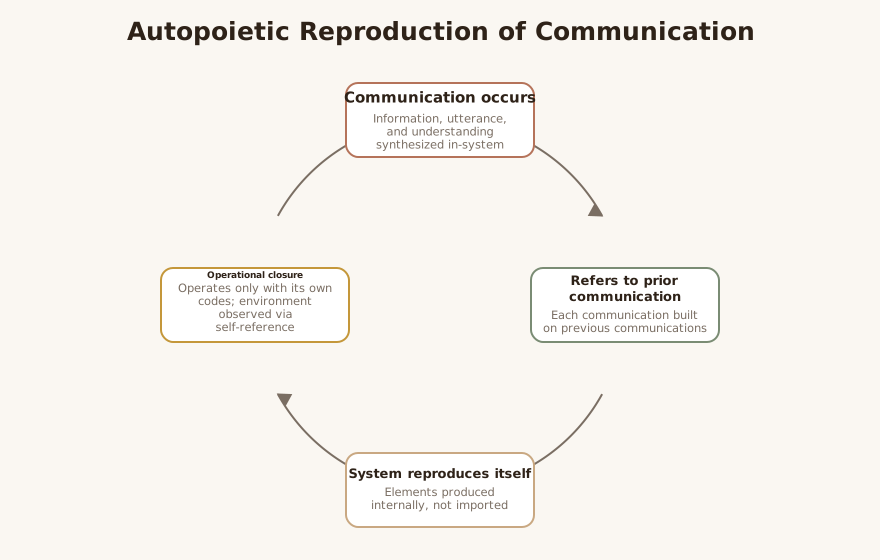
The first and most consequential principle is that the elements of a social system are communications, not people 1. Communication, for Luhmann, “is not simply the transmission of a message” but a synthesis of three inseparable components — information, utterance, and understanding (including misunderstanding) — and this synthesis “unfolds within the system itself,” while consciousness “remains external to it” 2. The often-quoted shorthand is that “only communication communicates”: neither participant controls it, and communication is an emergent phenomenon that must be “recreated from situation to situation by referring to previous communications” 4.
The second principle is autopoiesis and operational closure 4. A social system is a “closed system of self-referential communication” that “constantly reproduce[s] and evolve[s]” itself “via the repetition of [its] own operations,” producing its own elements rather than importing them 4. Such a system is operationally closed: it operates “only with [its] own operative codes, programmes, and memory,” and it cannot interact directly with its environment but “can only observe it via self-reference” 4. Closure is not isolation — systems “use and rely on resources from their environment,” but “those resources do not become part of the systems’ operation,” and the boundary between system and environment is “decided by the system itself” and can shift with each operation 1.
The third principle is the system/environment distinction and the reduction of complexity 2. A system emerges by drawing a boundary against its environment, and the critical, disorienting insight is that “humans are the environment of social systems,” not their components — psychic systems (consciousness), social systems, and living systems are each operationally closed and autopoietic, coupled to one another but not reducible to one another 2. Within that boundary, meaning (Sinn) is the medium through which a system selects: it functions to “reduce infinite worldly complexity to what humans can process,” structuring expectations and connectivity as selections among infinite possibilities 2. A fourth principle, double contingency, names the basic problem that communication has to overcome: each party is an opaque, unpredictable horizon to the other, so social order is the improbable achievement of mutual expectation under conditions of mutual unpredictability 1.
At the level of whole societies, Luhmann adds functional differentiation: modern society splits into autonomous functional subsystems — economy, politics, law, science, religion, art, media — each operating by its own binary code, such as payment/non-payment for the economy, legal/illegal for law, power/powerlessness for politics, and true/false for science 1. This macro-social architecture is central to the sociology but only loosely analogizable to the small relational systems clinicians treat LLM.
Interventions & Techniques
Because autopoietic social systems theory is a sociological theory rather than a therapy, there are no “autopoietic techniques”; its clinical value, if any, lies in the formulation lens it offers, operationalized through recognized systemic modalities LLM. Everything in this section is clinical reasoning by analogy, not a method drawn from Luhmann’s work LLM. The first move the lens suggests is to attend to the family’s or couple’s communication as the unit of analysis rather than to the individuals — to ask what patterns of communication keep reproducing themselves, and how each utterance is built only by referring back to the ones before it LLM. This reframes a recurring argument as a self-perpetuating communicative loop the system keeps regenerating, rather than as the fault of one member LLM.
A second move follows from operational closure and self-reference: a relational system processes everything that reaches it through its own established distinctions, so a clinician can ask how this particular family “reads” events through its own habitual code — what it can and cannot let itself notice — rather than assuming the family sees the situation as the therapist does LLM. A third move draws on double contingency: because each partner is, in a strict sense, a black box to the other, the work can be framed as building workable mutual expectations under genuine uncertainty about what the other “really” means, treating misunderstanding as a normal feature of communication rather than a personal failing LLM. These moves are vehicles for, not replacements for, the documented techniques of an actual modality — communication-pattern mapping, enactment, circular questioning — within which the lens supplies a rationale rather than a procedure LLM.
LLM-generated illustrative example (not a guideline): A couple presents with a repeating fight that “always goes the same way.” Using the autopoietic lens, the clinician treats the fight not as something either partner causes but as a communicative pattern the couple’s system keeps reproducing — each remark generated by reference to the last, the meaning of each utterance fixed by the system’s own habitual reading rather than by either speaker’s intent. The work, delivered through ordinary couple-therapy technique, helps the pair notice the loop as a loop and introduce a different kind of communication that the system has not been reproducing on its own LLM.
Evidence Base
The honest appraisal has two layers LLM. As sociological theory, autopoietic social systems theory is established and foundational — one of the most ambitious and widely debated bodies of social theory of the late twentieth century, durably influential in German sociology and in Scandinavia, Japan, Latin America, and Eastern Europe, and continuously taught and cited 1. Its standing rests on conceptual reach and on Luhmann’s systematic working-out of society as communication, not on any clinical outcome data, because it is a theory of society rather than an intervention LLM.
As a clinical framework it has no evidence base of its own at all, and a clinician should be candid about that LLM. None of the available sources connects the theory to psychotherapy; its clinical use here is an analogy this article constructs, and it is a notably more abstract and indirect lens than its systems-theory siblings, with much of its apparatus — functional differentiation, binary codes, the architecture of whole societies — having no natural application to a family or couple LLM. The theory is also genuinely contested even within sociology: the scholarly literature openly asks whether social systems can be autopoietic at all, the question posed directly in the title of Mingers’s assessment of Luhmann’s social theory, since autopoiesis was originally a biological concept defined for living cells 3. A defensible stance, then, is to treat the theory as a generative source of metaphors for reflecting on communication and self-perpetuating patterns — held loosely, represented honestly as theory and analogy — rather than as a validated clinical model LLM.
Populations & Indications
The theory’s natural object is communication systems rather than individuals, so its clinical analogies fit relational systems best: families, couples, and groups, where recurring patterns of communication are directly observable, and, more loosely, organizations and teams, where the theory’s own sociological vocabulary of subsystems and codes was originally pitched LLM. It is most plausibly useful where the presenting difficulty is itself communicational — where talk keeps reproducing the same outcome regardless of intentions — rather than where the issue is primarily an individual’s internal state LLM.
Two applications warrant a note about scale LLM. Clinicians and systems consultants are a fitting audience, because the theory is at least as much a discipline for thinking about communication as a lens on clients, and it can sharpen a consultant’s reading of how an organization reproduces its own patterns LLM. Larger care systems and organizations are where Luhmann’s macro-level apparatus — operationally closed subsystems pursuing their own codes — is least metaphorical and most literal, since the theory was built to describe exactly such large differentiated structures 1. For couples and individual families, by contrast, only the most general principles (communication as the unit, closure and self-reference, double contingency) transfer, and the grand-social machinery should be left aside LLM.
Problems-for-Work
The lens maps, by analogy, onto a recognizable cluster of relational problems LLM. Communication breakdown sits at the center, reframed through double contingency: each party is an opaque horizon to the other, so breakdown is the expected difficulty of building shared expectation under mutual unpredictability, not simply a skills deficit 1. Relationship conflict and family conflict can be read as communicative loops the system keeps reproducing — each move generated by reference to prior moves — which shifts the clinical question from “who is at fault” to “what pattern keeps regenerating itself” 4.
Systemic stuckness and repetitive maladaptive interaction patterns are the most natural fit, because autopoiesis is precisely a theory of how a system reproduces its own form through the repetition of its own operations; a stuck family, in this analogy, is one whose communication keeps producing more of the same communication 4. Organizational dysfunction is where the theory’s literal vocabulary applies best: a unit operationally closed around its own code, observing the rest of the organization only through its own distinctions, can describe a department that cannot take in information that does not fit its established way of reading the world 1. In every case the clinical use is interpretive analogy layered onto a recognized modality, not a technique the theory itself prescribes LLM.
LLM-generated illustrative example (not a guideline): An interdisciplinary care team repeatedly fails to coordinate, each discipline insisting the others “don’t get it.” Read through the theory, each subgroup is operationally closed around its own professional code and can only observe the others through its own distinctions, so information that does not fit a group’s code is effectively invisible to it. The consultation, delivered through ordinary team-facilitation methods, works to build structured points of contact where the groups can translate across their codes rather than expecting one to simply adopt another’s view LLM.
Contraindications, Cautions & Cultural Humility
The foremost caution is conceptual honesty about status: this is abstract sociological theory with no clinical evidence base, and a clinician should never present an autopoietic formulation to a client as an established mechanism or as anything more than one heuristic among many LLM. The theory’s most distinctive moves can be actively unhelpful if taken too literally in the room — telling a suffering family that “people are not part of the system” or that “only communication communicates” risks sounding dismissive of the persons who are actually hurting, when the framing was never meant as a clinical address to them LLM. The lens belongs in the clinician’s private formulation, not in psychoeducation delivered verbatim LLM.
A second caution is the de-centering of agency and responsibility LLM. By locating action in communication rather than in persons, the theory can be misread to imply that no one is accountable for what happens in a relationship — a dangerous slide when a clinician is facing abuse, coercion, or material harm that requires holding a specific person responsible and acting on real risk LLM. Cultural humility imposes a further limit: judgments about which communicative patterns are “dysfunctional,” and about how much directness or autonomy a healthy relationship requires, are culturally shaped, and the theory offers no neutral standpoint from which to make them — indeed its own claim is that every observer reads the world only through its own distinctions LLM. The clinician should therefore treat their own reading as one operationally closed vantage among others, check inferences against the family’s own meanings, and remain alert to the power they hold in deciding which account of the system gets to count LLM.
Treatment-Plan Suggestions & SMART Objectives
The objectives below translate the theory’s principles into ordinary systemic goals; the theory supplies the rationale, while the documented psychotherapy is delivered through a recognized modality LLM.
| Goal | SMART objective (example) | Mechanism |
|---|---|---|
| Shift attention from blame to communicative pattern | Within 6 sessions, each partner will describe one recurring conflict as a self-repeating loop rather than a one-way cause, in session | Treats the system’s element as communication that reproduces itself, not as a culpable person 4 |
| Build mutual expectation under uncertainty | Within 8 sessions, partners will check the other’s intended meaning before responding in 70% of difficult exchanges, logged | Works the problem of double contingency by making each partner’s opaque horizon discussable 1 |
| Surface the family’s habitual “reading” of events | Within 6 sessions, the family will name two assumptions through which they routinely interpret a recurring event | Externalizes the system’s operational closure and self-referential coding so it can be examined 4 |
| Interrupt a self-perpetuating interaction loop | Over 10 sessions, the family will introduce one new response to a stuck sequence and sustain it across 2 weeks, observed | Introduces communication the autopoietic pattern would not generate on its own 4 |
| Improve coordination across closed sub-units (teams) | Within 8 sessions, two team subgroups will establish one regular structured point of contact, maintained for a month | Builds coupling across operationally closed subsystems that observe one another only through their own codes 1 |
| Reduce complexity overload in communication | Within 6 sessions, the family will agree on one shared focus per difficult conversation, demonstrated in session | Uses meaning-based selection to reduce overwhelming complexity to what the system can process 2 |
| Hold formulations as provisional observations | Across treatment, the clinician will revise the working hypothesis at least twice in response to family feedback, documented | Embeds the theory’s claim that any observer sees only through its own distinctions, never the whole 4 |
Common Misconceptions
The most basic error is hearing “social system” and assuming it means “a group of people”; Luhmann’s whole move is that social systems are made of communications, and that people belong to the system’s environment, not its membership 1. A second misconception treats communication as the transmission of a message from a sender to a receiver, when the theory defines it as a three-part synthesis of information, utterance, and understanding that “unfolds within the system itself,” with no one in control and “only communication communicat[ing]” 2. A third reads “operationally closed” as “isolated” or “unaffected by the world,” whereas the system depends on environmental resources and is structurally coupled to its environment — it simply processes everything through its own operations and cannot import elements directly 1.
A fourth misconception is to import the grand apparatus of functional differentiation and binary codes wholesale onto a couple or a single family; those concepts describe whole modern societies and their large subsystems, and they fit organizations only loosely and individual relationships barely at all 1. A fifth is to treat the theory as settled fact: even within sociology it is contested whether social systems can be autopoietic in the first place, given that the concept was defined for living cells, which is the open question Mingers’s assessment puts in its very title 3. Finally, the framework is sometimes mistaken for a therapy one “does,” when it is an abstract description of how systems reproduce themselves that can, at most, inform interventions delivered through other modalities LLM.
Training & Certification
There is no certification in autopoietic social systems theory; it is foundational sociological theory studied within sociology, social theory, and systems-theory curricula rather than a credentialed clinical technique LLM. Clinicians who want to understand it on its own terms encounter it through Luhmann’s own works — Social Systems (1984) for the autopoietic turn and Theory of Society (1997) for the mature statement — though his prose “presents a challenge even to readers of German,” and the secondary literature is the usual point of entry 1. The theory belongs to the same broad family as general systems theory, cybernetics, and constructivism, and is most often met inside graduate sociology rather than clinical training 4.
For applied clinical competence there is no Luhmann-specific pathway at all; the relevant skills live in the recognized systemic modalities — family systems therapy and constructivist and systemic couple and family approaches — where supervised practice teaches clinicians to think in patterns rather than persons and to hold formulations as provisional LLM. A generalist therapist can legitimately borrow the theory’s metaphors for private formulation provided they represent its status honestly — established as social theory, untested and indirect as a clinical lens — and pursue supervised systemic training before treating complex family systems LLM.
Key Terms
Autopoiesis — literally “self-creation”; coined by Maturana and Varela (1972) for the self-production of living cells and transposed by Luhmann to systems of communication that reproduce themselves through the repetition of their own operations 4. Communication — for Luhmann the basic element of social systems, a synthesis of information, utterance, and understanding that “unfolds within the system itself,” so that “only communication communicates” 2. Operational closure — the property by which a system operates only with its own codes, programmes, and memory and “can only observe [its environment] via self-reference,” depending on environmental resources without incorporating them 4. System/environment distinction — a system emerges by drawing a boundary against its environment; on Luhmann’s account “humans are the environment of social systems,” not their components 2. Meaning (Sinn) — the medium through which a system selects, reducing “infinite worldly complexity to what humans can process” 2. Double contingency — the basic problem that each party is mutually unpredictable to the other, making shared expectation an improbable achievement 1. Functional differentiation — the splitting of modern society into autonomous subsystems (economy, law, politics, science, religion, art), each with its own binary code such as payment/non-payment or legal/illegal 1. Structural coupling — the way operationally closed systems (psychic, social, living) remain coupled to one another without becoming reducible to one another 2.
Resources & Further Reading
- Niklas Luhmann — Wikipedia
- Niklas Luhmann – Social Systems (1984) — SozTheo
- Niklas Luhmann: What is Autopoiesis? — Critical Legal Thinking
- Can Social Systems Be Autopoietic? Assessing Luhmann’s Social Theory (Mingers, 2002)
- An introduction to Niklas Luhmann’s concept of society — YouTube
Reflective / Supervision Questions
- When I call a family “a system,” am I quietly assuming it is a system of people, and what changes if I treat the communication — not the persons — as the thing reproducing the problem 1?
- Where am I telling a one-way, blame-locating story about a conflict, and what would I notice if I described it as a communicative loop the system keeps regenerating from its own prior moves 4?
- How is this family “reading” events through its own habitual distinctions, and what is it structurally unable to let itself notice because of that operational closure 4?
- Am I respecting double contingency — that each partner is genuinely opaque to the other — or am I assuming I (or they) can simply know what the other “really” means 1?
- Am I representing this theory honestly as an untested, indirect clinical analogy, or have I let an abstract sociological model harden into a confident verdict about this family 3?
- Whose reading of the system am I privileging in the room, and how does the power I hold as therapist shape which account of “the communication” gets to count LLM?