
Type & Discipline
System Dynamics is a framework and modeling method drawn from management and systems science, not a psychotherapy 1. It studies how feedback-rich systems behave over time by representing them as networks of stocks (quantities that accumulate or deplete), flows (the rates that fill or drain those stocks), time delays, and feedback loops that connect the parts back to themselves 1. Its central claim is that the behavior of a system—growth, collapse, oscillation, stubborn stability—arises primarily from the system’s own internal structure rather than from outside shocks 5.
For a clinician, this lands as a familiar idea wearing unfamiliar clothes. The notion that a problem is maintained by its own internal loops, not merely by the events that started it, is the conceptual spine of cognitive-behavioral maintenance models, of family-systems work, and of relapse-prevention thinking LLM. System Dynamics offers a rigorous, transferable vocabulary for that intuition LLM. This article treats it as a conceptual lens and formulation aid rather than as a standalone clinical modality, because that is what the evidence supports LLM.
Creators & Lineage
The field was founded by Jay Forrester at MIT’s Sloan School of Management in the mid-1950s 1. Forrester’s originating insight came from consulting with General Electric managers who were puzzled by boom-and-bust employment cycles at their Kentucky appliance plants; rather than blaming external business cycles, he showed that the instability was generated by the internal structure of the firm itself—its ordering rules, inventories, and hiring delays 1. That move—from “something is happening to us” to “our own structure is producing this”—is the founding gesture of the discipline and, not coincidentally, a core therapeutic reframe LLM.
The method matured alongside computing. Hand calculations gave way to simulation languages: SIMPLE in 1958, then DYNAMO in 1959, which remained the standard tool for over three decades 1. Forrester extended the approach beyond firms into Urban Dynamics (1968) and, through the Club of Rome, into global models of population and resources 1.
Two later figures shaped how the framework is taught today. Donella H. Meadows, who worked within Forrester’s MIT group, wrote Thinking in Systems: A Primer—drafted in 1993, circulated informally for years, and published posthumously in 2008—which made the field’s core ideas accessible to non-modelers and introduced the influential idea of leverage points 5. John Sterman, the Jay W. Forrester Professor of Management at MIT, authored Business Dynamics and teaches the discipline’s modern curriculum, emphasizing that “many of the problems we now face arise as unanticipated side effects of our own past actions” 34.
The intellectual lineage runs through general systems theory and cybernetics/feedback theory; within mental health, the same feedback logic independently animated family systems therapy and cognitive-behavioral maintenance models LLM.
Core Principles
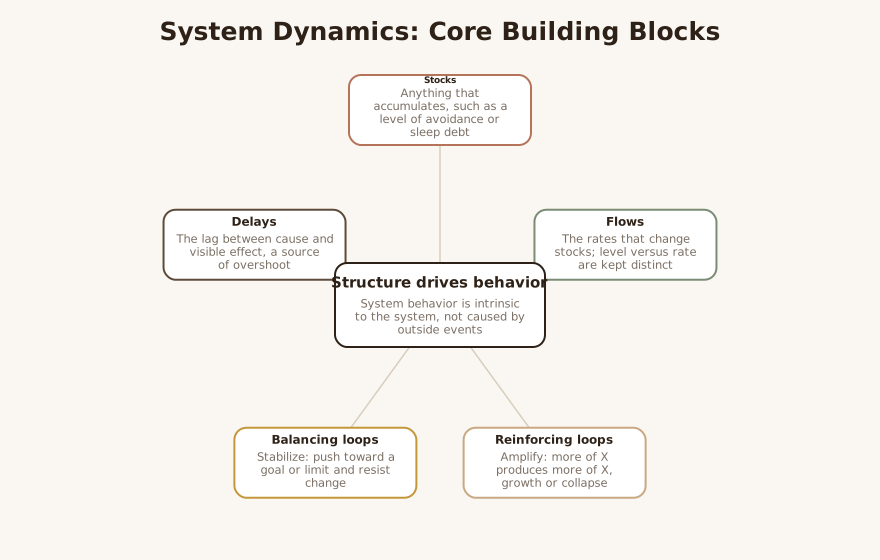
Structure drives behavior. The defining principle is that system behaviors are intrinsic to the system, not caused by exogenous events 5. Clinically, this is the difference between asking “what happened to you?” and “what keeps this going?”—both matter, but the second is where leverage lives LLM.
Stocks and flows. A stock is anything that accumulates: water in a tub, money in an account, or—by analogy—a client’s avoidance repertoire, accumulated sleep debt, or relational resentment 1LLM. Flows are the rates that change stocks. A useful discipline of the framework is separating the level of something from the rate at which it changes, which clinicians often conflate LLM.
Feedback loops come in two kinds. Reinforcing loops (R) amplify—more of X produces more of X, generating exponential growth or collapse 1. Balancing loops (B) stabilize—they push the system toward a goal or limit and resist change 1. Most real systems contain both, operating simultaneously with shifting strength, which is why behavior over time is counterintuitive and rarely linear 1.
Delays. The lag between a cause and its visible effect is a frequent source of overshoot, oscillation, and misattribution 1. People act on what they can currently see, so delayed feedback reliably produces over-correction 3.
Misperception of feedback. Sterman’s work documents that humans systematically misread feedback-rich systems—bounded rationality and cognitive biases lead us to underestimate delays and nonlinearity, so our well-intended interventions backfire 3. This is the framework’s most clinically resonant finding LLM.
Interventions & Techniques
System Dynamics supplies thinking tools, which a clinician adapts rather than administers LLM.
Causal loop diagrams (CLDs). A CLD maps variables and the feedback loops connecting them, labeling each loop as reinforcing or balancing 14. In session, a simplified CLD drawn collaboratively can externalize a vicious cycle—making the loop, not the client, the target LLM.
LLM-generated illustrative example (not a guideline): With a client caught in panic, the clinician sketches: bodily sensation → catastrophic interpretation → anxiety → hypervigilance to sensation → more sensation. Labeling this an R-loop (“a snowball, not a character flaw”) reframes the work as loop-interruption rather than symptom-suppression LLM.
Stock-and-flow framing. Distinguishing a stock (e.g., accumulated avoidance) from its inflows (each avoided situation) and outflows (each approach behavior) clarifies that the stock only shrinks when outflow exceeds inflow—a precise rationale for graded exposure 1LLM.
Identifying leverage points. Meadows’s central practical contribution is that interventions vary enormously in power; small changes at high-leverage places produce large system shifts, while effort at low-leverage points exhausts everyone 52. Clinically, this argues for targeting the loop that maintains the problem rather than its most visible symptom LLM.
Simulation and “flight simulators.” In its rigorous form the method uses computer simulation and management flight simulators to test what-if scenarios safely before acting 43. The clinical analogue is behavioral experiments and mental rehearsal: low-cost simulation of a feared action before the real one LLM.
Evidence Base
Honesty about maturity matters here. As a modeling discipline, System Dynamics is well established: it has a sixty-plus-year history, a standard methodology, dedicated software, peer-reviewed literature, and a graduate curriculum at MIT and elsewhere 14. Its validity as a way to model supply chains, epidemics, urban systems, and organizational behavior is not in serious dispute 31.
Its standing as a psychotherapy is a different question, and the candid answer is that System Dynamics is not a clinical treatment with its own outcome trials LLM. There is no body of randomized controlled trials of “System Dynamics therapy,” because no such modality exists LLM. What is established is the underlying principle—that symptoms are maintained by feedback loops—which is independently validated through the evidence base of the modalities that operationalize it, particularly cognitive-behavioral maintenance models and family-systems approaches LLM. System Dynamics should therefore be presented to clients and documented as a formulation framework, not as an evidence-based treatment in its own right LLM. The discipline does have a legitimate, growing applied footprint in public health and health-policy modeling, where it informs intervention design at the population level 13.
Populations & Indications
The framework is most useful wherever a problem is sustained by recurring cycles rather than a single static cause LLM. Indicated applications include:
- Clients with maintaining-cycle problems—any presentation where the behavior that relieves distress in the short term feeds the problem in the long term LLM.
- People with chronic or recurring conditions, where the question “what keeps bringing this back?” is more useful than “what caused it?” 5LLM.
- Families, whose interactional patterns are a textbook feedback system; the framework dovetails with family systems therapy LLM.
- Couples, where escalation and withdrawal form clear reinforcing and balancing loops LLM.
- Organizations and teams, the framework’s native habitat, relevant for clinicians doing consultation, supervision, or workplace-stress work 36.
- Public-health populations, where delays and feedback drive uptake, relapse, and intervention side effects 1.
Problems-for-Work
- Anxiety maintenance. The avoidance loop is reinforcing: avoidance lowers anxiety now, which strengthens avoidance, which shrinks the client’s world LLM. Naming the R-loop reframes exposure as loop-interruption LLM.
- Depressive rumination cycles. Low mood → withdrawal → fewer rewards → lower mood is a reinforcing spiral; behavioral activation is an outflow that drains the stock LLM.
- Behavioral addiction and substance use disorders. Craving → use → short relief → tolerance and consequence → more craving forms a loop with delayed costs, a classic misperception-of-feedback trap 3LLM.
- Recurrent relapse. Modeling the loop that reinstates the behavior after a period of change locates leverage at the reinstating mechanism, not just the symptom 5LLM.
- Procrastination. Task aversion → delay → relief → larger task → more aversion is reinforcing, with a delay that hides the accumulating cost LLM.
- Relationship conflict and family system dysfunction. Pursue–withdraw and criticize–defend sequences are mutually reinforcing loops sustained by each partner’s response to the other LLM.
- Organizational dysfunction. Overwork → errors → rework → more overwork is a documented dynamic in Sterman’s case studies and a useful map for burnout consultation 3LLM.
Contraindications, Cautions & Cultural Humility
System Dynamics has no physical contraindications, but it has conceptual hazards LLM. Do not present it as an evidence-based treatment; it is a formulation lens, and overselling it misleads clients and misrepresents the literature LLM. Beware over-modeling. A diagram is a tool for shared understanding, not a deliverable; a client in acute distress needs containment before a causal loop diagram, and an overly elaborate map can intellectualize away affect LLM.
Watch the blame valence of “structure causes behavior.” The reframe is liberating when it externalizes a loop (“the cycle, not you, is the problem”) but harmful if a client hears “you are the broken system” LLM. In family or couples work, mapping a loop must scrupulously avoid implying that a victim is “part of the cycle” in ways that excuse abuse; safety and accountability override systemic neutrality LLM.
Cultural humility. The framework originates in mid-century American management science and carries that worldview’s assumptions about agency, control, and optimization 1. What counts as a “dysfunctional” loop is culturally situated—interdependence that one tradition reads as enmeshment, another reads as health LLM. Clinicians should hold the model lightly, co-construct the loops with the client’s own meanings, and avoid imposing an engineer’s view of a person’s life LLM.
Treatment-Plan Suggestions & SMART Objectives
| Goal | SMART objective (example) | Mechanism |
|---|---|---|
| Make the maintaining cycle explicit | Within 3 sessions, client will collaboratively draw and name one reinforcing loop sustaining the presenting problem | Externalizing the loop; structure-drives-behavior reframe 1 |
| Interrupt an avoidance loop | Over 6 weeks, client will complete 2 graded approach tasks per week, logging anxiety before/after | Increasing outflow from the avoidance stock 1 |
| Reduce a rumination spiral | Within 4 weeks, client will schedule and complete 3 activating activities weekly, rating mood pre/post | Adding a balancing loop to a reinforcing spiral LLM |
| Shorten a destructive feedback delay | Within 8 weeks, client will use a daily check-in to notice early cues before escalation 4 of 7 days | Reducing delay so correction precedes overshoot 1 |
| Identify a high-leverage change | By session 5, client will name one small change with disproportionate impact on the cycle | Leverage-point selection over symptom-chasing 5 |
| De-escalate a relational loop | Over 5 sessions, couple will practice one agreed pause-and-repair sequence during conflict, twice weekly | Inserting a balancing loop into a reinforcing escalation LLM |
| Build relapse foresight | Within 6 weeks, client will map the loop that reinstates the behavior and list 2 early-warning signs | Anticipating delayed feedback before it acts 3 |
Common Misconceptions
“System Dynamics is a type of therapy.” It is not; it is a modeling discipline from management science that clinicians borrow as a formulation lens 1LLM. “It’s the same as family systems therapy.” They share feedback logic and a common ancestor in systems theory and cybernetics, but System Dynamics is broader and was built for organizations and policy, not for treating families 1LLM. “Mapping the loop fixes it.” Insight into structure is necessary but not sufficient; the loop changes only when a flow changes, which requires behavioral action over time 1LLM. “Bigger interventions produce bigger results.” Meadows’s leverage-point work shows the opposite is often true—small changes at the right place outperform large ones at the wrong place 5. “Problems come from outside.” The framework’s founding finding, from Forrester at GE onward, is that much instability is internally generated 1.
Training & Certification
There is no clinical certification in System Dynamics, consistent with its status as a non-clinical discipline LLM. Formal training lives in management and engineering education: MIT offers graduate coursework such as 15.871 Introduction to System Dynamics, taught by Sterman and Rahmandad, with materials—simulation models, flight simulators, and case studies—freely available through MIT OpenCourseWare 4. For self-study, Meadows’s Thinking in Systems: A Primer is the standard accessible entry point, and Sterman’s Business Dynamics is the comprehensive practitioner text 23. Professional community and resources are maintained by the System Dynamics Society 2. Clinicians need no certification to use the conceptual tools responsibly; what they need is competence in an actual evidence-based modality into which the lens is embedded LLM.
Key Terms
- Stock — a quantity that accumulates or depletes over time 1.
- Flow — the rate that increases or decreases a stock 1.
- Reinforcing loop (R) — feedback that amplifies change, producing growth or collapse 1.
- Balancing loop (B) — feedback that resists change and seeks a goal or limit 1.
- Delay — the lag between a cause and its visible effect, a source of overshoot and oscillation 1.
- Causal loop diagram (CLD) — a map of variables and the feedback loops linking them 1.
- Leverage point — a place in a system where a small change yields a large effect 5.
- Misperception of feedback — the documented human tendency to underestimate delays and nonlinearity in complex systems 3.
- Structure-drives-behavior — the principle that behavior is intrinsic to a system’s internal structure, not its external shocks 5.
Resources & Further Reading
▶ Watch — a video introduction to this concept:
- System dynamics — Wikipedia
- Thinking in Systems: A Primer (Donella H. Meadows, 2008) — System Dynamics Society
- Thinking In Systems: A Primer — Wikipedia
- Business Dynamics: Systems Thinking and Modeling for a Complex World (John Sterman) — MIT faculty page
- Introduction to System Dynamics — MIT OpenCourseWare (15.871)
- Jay Forrester and System Dynamics: Seeing Feedback Loops in Your Workflows — Kanban Zone
Reflective / Supervision Questions
- For a current client, can you name the single reinforcing loop that most maintains the presenting problem—and is your treatment plan aimed at that loop or merely at its most visible symptom? LLM
- Where in this client’s system is the highest-leverage point, and what makes you confident your effort is going there rather than somewhere comfortable but low-impact? 5LLM
- When you reframe a problem as “structure, not the person,” how do you ensure the client hears liberation rather than blame—especially across cultural difference? LLM
- In couples or family work, are you mapping mutual loops in a way that preserves accountability and safety, or could the systemic framing inadvertently neutralize harm? LLM
- How are delays in this client’s feedback shaping their (and your) sense of whether the work is “working,” and are you over-correcting on incomplete information? 3LLM
- Are you using System Dynamics honestly as a formulation lens inside an evidence-based modality, or have you started treating the map as the treatment? LLM