
Type & Discipline
Hysteresis is a theoretical concept from physics — originally the study of magnetism and, more broadly, phase transitions in nonlinear systems — not a treatment, diagnosis, or stand-alone clinical modality 1. The word, coined from the Greek for “lagging behind,” names the property that the state of a system depends on its history and not only on its present inputs 1. In its home discipline it describes systems in which the output lags behind the input and traces a different path on the way up than on the way down, so that the system “remembers” where it has been 2. It belongs to the family of nonlinear-systems and memory-effect concepts, sitting alongside path dependence, bistability, and threshold dynamics 4.
For the practicing clinician, hysteresis is not something one delivers but a lens for case formulation LLM. Its value is that it gives a precise vocabulary for an observation every therapist knows: the conditions under which a problem develops are often not the same conditions required to undo it, and a system pushed into a new state can stay there even after the original pressure is gone LLM. This article treats hysteresis as an imported analogy — a physics regularity borrowed to sharpen clinical thinking about relapse, chronicity, and the asymmetry between getting ill and getting well — and is honest throughout that the borrowing is analogical, not an evidence-based therapy LLM.
Creators & Lineage
The term hysteresis was introduced by the Scottish-born physicist and engineer Sir James Alfred Ewing in the 1880s, in his work on the magnetic behavior of iron, to describe the lag he observed between an applied magnetizing force and the resulting magnetization 1. Ewing’s magnetic hysteresis loop — the closed curve traced as a ferromagnetic material is magnetized in one direction, demagnetized, magnetized in the other, and returned — became the canonical picture of a system whose response depends on its prior states 3. The same loop is still used in materials science to read off a magnet’s key properties, including how much field must be applied to drive its magnetization back to zero 5.
From magnetism the concept generalized into a broad principle of nonlinear and path-dependent systems, applicable wherever a system’s trajectory, rather than only its current conditions, determines its state 2. A major extension occurred in economics, where “hysteresis” and the closely related idea of “path dependence” were imported to explain why a temporary shock — a recession, a spell of unemployment — can leave permanent or long-lasting effects that persist after the shock has passed, so that the system does not return to its prior equilibrium 4. Economists have since worked to formalize what they mean by the term, distinguishing several mathematical descriptions of path-dependence and debating their causes and policy implications 7. The clinical lineage is more diffuse and largely analogical: hysteresis enters mental-health thinking through nonlinear dynamical-systems theory, through the kindling model of recurrent mood disorders, and through synergetics and related systems frameworks that treat psychological change as movement between stable states separated by thresholds LLM.
Core Principles
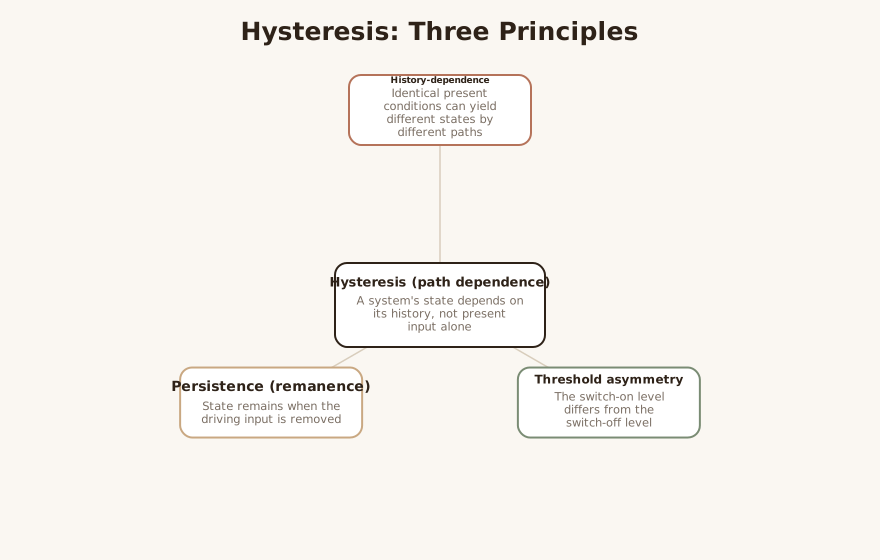
The first principle is history-dependence: the state of a hysteretic system is not a function of its current input alone but also of the sequence of inputs that preceded it 1. Two people, or two systems, exposed to identical present conditions can occupy entirely different states because they arrived by different paths 2. The system carries a memory of where it has been, and that memory shapes how it responds now 4.
The second principle is threshold asymmetry: the level of input at which a system switches “on” differs from the level at which it switches “off” 2. In the magnetic loop, the field needed to push magnetization up is not the mirror image of the field needed to bring it back down; there is a gap between the switching points 3. The practical consequence is that reversing a change requires pushing further than the point at which the change first occurred — it takes more to undo than it took to do 5. This is the feature with the most direct clinical resonance, because it formalizes why the threshold for recovery can sit well past the threshold for onset LLM.
The third principle is persistence, or remanence: when the driving input is removed, the system does not necessarily return to its starting point but can retain part of the change 5. In a magnet this is the residual magnetization that remains at zero applied field; in economics it is the lasting damage of a transient shock 4. A related fourth principle is bistability — a hysteretic system can have more than one stable state available under the same conditions, and which one it occupies depends on its history LLM. Together these principles describe a system that can be tipped into a new regime by a sufficient push and can then stay there, resisting return even when conditions improve LLM.
Interventions & Techniques
Because hysteresis is a concept rather than a therapy, there are no “hysteresis techniques”; it operates by shaping formulation and by being operationalized through recognized, evidence-based modalities LLM. The first practical move is psychoeducation that externalizes the asymmetry: drawing the loop for a client and explaining that the effort to climb out of a depressive or addictive state is not symmetric with the slide into it can reframe slow recovery as an expected property of the system rather than a personal failure LLM. This reframing can reduce the shame and demoralization that accompany the experience of “doing everything right and still feeling stuck” LLM.
A second move uses the threshold-asymmetry principle to set the dose of intervention realistically: if reversing a change requires pushing further than the point at which it began, then interventions that look “more than enough” to prevent a problem may be barely enough to reverse it once entrenched, which argues for intensity, duration, and consolidation rather than minimal sufficient effort LLM. The persistence principle similarly supports building in relapse-prevention and maintenance work, on the logic that removing the original stressor does not by itself return the system to baseline 4.
A third move treats hysteresis as a rationale for consolidation — continuing treatment past symptom remission to move the system safely away from the switching threshold, and deliberately strengthening new patterns so they become the stable state rather than a fragile exception LLM. None of this is specific to one school; the concept supplies the why, while cognitive-behavioral therapy, behavioral activation, relapse-prevention models, and contingency management supply the concrete vehicles LLM.
LLM-generated illustrative example (not a guideline): A clinician treating a client with recurrent depression sketches a hysteresis loop and explains that the low mood, withdrawal, and inactivity have settled into a self-sustaining state that the original life stressor no longer needs to maintain. They frame behavioral activation as the work of pushing the system back across a threshold that sits further out than where the slide began, and they plan continued, consolidating sessions past the point of feeling “better” so the new pattern becomes the stable one rather than a temporary excursion. LLM
Evidence Base
The honest label for the maturity of hysteresis in mental health is analogical LLM. As a physical principle, hysteresis is rigorously established: it is a measured, mathematically described property of magnetic materials and other nonlinear systems, and the hysteresis loop is a standard quantitative tool in materials science 35. As an explanatory import into the social sciences it is mature but contested: economists have used it for decades to model the persistence of shocks, and ongoing work is still actively formalizing what “hysteresis” and “path dependence” should mean and which of several competing mathematical descriptions of path-dependence are appropriate 467.
In clinical psychology and psychiatry, however, there is no body of randomized trials of a “hysteresis treatment,” because no such manualized therapy exists LLM. The concept enters clinical reasoning as a metaphor and a formulation aid drawn from physics and economics, and its clinical claims are reasoned analogies rather than direct empirical findings about the brain or behavior LLM. The closest established clinical bridge is the kindling model of recurrent mood disorders, which independently describes a history-dependent lowering of the threshold for future episodes — a phenomenon that resembles hysteresis but is supported by its own clinical literature rather than by the physics of magnetism LLM. Clinicians should therefore use hysteresis as a thinking tool that organizes observations and motivates known interventions, never as evidence that a particular treatment works; the evidence for any intervention it inspires comes from that intervention’s own trial base, not from the analogy LLM.
Populations & Indications
Hysteresis is most illuminating wherever a presentation shows a gap between how a problem started and what it now takes to undo it, or wherever a state persists after its original cause has resolved LLM. People with mood disorders, especially those with recurrent or treatment-resistant major depressive disorder, are the paradigm case, because the experience of a low state that maintains itself long after the precipitating stressor is gone is exactly what the persistence and threshold-asymmetry principles describe LLM. People with addiction and substance use disorder fit the same frame, where a pattern that began under specific conditions becomes self-sustaining and demands far more to reverse than it took to establish LLM.
Trauma survivors can be understood through history-dependence and bistability: a nervous system tipped into a hypervigilant regime by past events may remain there under present safety, occupying a different stable state than circumstances alone would predict LLM. People with chronic illness and those facing a chronic course of illness illustrate persistence directly, where the body or the illness narrative settles into a state that resists return to baseline LLM. People with anxiety disorders show the asymmetry in the way avoidance, once entrenched, requires sustained exposure well past the point at which the fear first took hold LLM. Across all of these, the construct is an adjunct formulation lens, never a diagnosis-specific protocol LLM.
Problems-for-Work
Relapse. Hysteresis reframes relapse not as a return to square one but as a system slipping back across a switching threshold it was never moved far enough from, which argues for consolidation and maintenance work rather than treatment that stops at first remission 4.
Threshold for recovery versus onset. The asymmetry principle gives client and clinician a shared map: the input needed to recover is not the mirror image of the input that produced the problem, so “it took this little to get sick, why is recovery so hard?” becomes an expected feature rather than a sign of failure 5.
Chronic course of illness. The persistence principle explains why a condition can outlive its original cause, validating the client’s experience of being stuck and motivating interventions aimed at moving the system to a new stable state rather than merely removing the initial stressor 4.
Kindling and symptom sensitization. The history-dependence principle parallels the clinical observation that each episode can lower the threshold for the next, supporting early, vigorous intervention to prevent the system from settling into an easily re-triggered regime LLM.
Treatment resistance. Bistability reframes a stubborn presentation as a system held in an alternative stable state, prompting the clinician to ask what is required to push it across the threshold rather than to conclude the client cannot change LLM.
LLM-generated illustrative example (not a guideline): A client in early recovery from alcohol use disorder is discouraged that “a couple of drinks” reignited a full pattern of daily use, when the same couple of drinks years ago would not have. The clinician uses the hysteresis frame to explain that the system’s switching threshold has shifted — far less input now flips it into the entrenched state — and that this argues not for self-blame but for a recovery plan built around staying well clear of the threshold and consolidating the new pattern. LLM
Contraindications, Cautions & Cultural Humility
Because hysteresis is a conceptual model rather than a treatment, it carries no direct contraindications, but its misuse does LLM. The first and most important caution is that the analogy is only an analogy: a metaphor drawn from magnetism and economics is not evidence about a person’s brain or prognosis, and the clinician must not let an elegant physical picture substitute for assessment or for evidence-based care LLM. The concept should sit alongside established interventions, never replace them, and the clinician should be transparent that it is a way of thinking rather than a finding LLM.
A second caution is determinism: framing a client’s state as a system “locked” in a stable regime can, if delivered carelessly, imply that change is unlikely or that the person is trapped, which is both inaccurate to the model — hysteretic systems can be switched — and demoralizing LLM. The clinically responsible use emphasizes that thresholds, while higher than one might hope, are crossable, and that the same principle which explains stuckness also explains why consolidated change can become durable LLM.
Cultural humility matters in at least two ways LLM. First, what looks like a maladaptive “stuck state” may be an accurate adaptation to ongoing adversity — discrimination, poverty, genuine threat — rather than a system to be reset; the persistence may reflect a persisting environment, and treating it as mere internal hysteresis would be both wrong and invalidating LLM. Second, mechanistic, physics-derived framings can collide with a client’s spiritual, communal, or moral understanding of their suffering, and for some the loop-and-threshold language will feel alienating; the clinician should offer the analogy tentatively, check how it lands, and set it aside whenever it does not fit the person in the room LLM.
Treatment-Plan Suggestions & SMART Objectives
| Goal | SMART objective (example) | Mechanism |
|---|---|---|
| Normalize the asymmetry between onset and recovery | Client will explain, in their own words, why recovery can require more effort than onset and apply it to their own history by session 3 LLM | Psychoeducation on threshold asymmetry reduces shame and corrects expectations 5 |
| Consolidate gains past first remission | Client will continue scheduled maintenance sessions and complete a written maintenance plan within 2 sessions of symptom remission LLM | Moves the system away from the switching threshold to counter persistence 4 |
| Reduce relapse risk | Client will identify 3 conditions that move them toward their “switching threshold” and pair each with a coping response within 4 sessions LLM | Targets the path back across the threshold before it is crossed 4 |
| Build a durable new pattern | Client will complete a scheduled rewarding or values-based activity on 5 of 7 days for 4 weeks LLM | Strengthens a new stable state so it resists return to the old one LLM |
| Intervene early on sensitization | Client will track early-warning signs daily and contact the clinician within 48 hours of 2 or more appearing for 6 weeks LLM | Prevents the system from settling into an easily re-triggered regime LLM |
| Reframe a treatment-resistant state | Client will articulate their current difficulty as a “stable state that can be switched” rather than a fixed trait in 3 sessions LLM | Bistability framing restores a sense of crossable thresholds LLM |
| Match intervention intensity to entrenchment | Client and clinician will set a treatment dose (frequency and duration) calibrated to the chronicity of the problem by session 4 LLM | Applies “more to undo than to do” to realistic dosing 5 |
Common Misconceptions
A frequent misreading is that hysteresis is the same as simple “inertia” or slowness — that the system merely takes time to catch up 2. The defining feature is not lag in time but lag in path: the system traces a different curve going up than coming down, so its state depends on its history and not just on how long one waits 1. A second misconception is that a hysteretic state is permanent or that the system is “broken”; remanence means part of a change persists, but the loop is precisely a description of a system that can be switched between states by sufficient input 5.
A third error is to treat the threshold for onset and the threshold for reversal as the same point; the whole clinical interest of the concept lies in their being different, with the reversal threshold lying further out 3. A fourth, and the most important for clinicians, is to mistake the analogy for evidence — to speak as though a client’s brain literally obeys a magnetic hysteresis loop, or as though invoking the physics validates a treatment LLM. The analogy organizes thinking; it does not establish mechanism or outcome, both of which require their own clinical evidence LLM.
Training & Certification
There is no certification, credential, or formal training pathway specific to hysteresis as a clinical tool, because it is a borrowed theoretical concept rather than a practice modality LLM. Clinicians typically encounter the underlying physics in general science education and the path-dependence idea through economics or systems-theory reading, and accessible explainer and reference entries are sufficient for the conceptual use described here 12. A deeper grasp of the quantitative loop is available through materials-science and engineering treatments for clinicians who want it, though that depth is not required for formulation use 35.
For applied competence, the relevant training is in the established interventions the concept informs — relapse-prevention and maintenance models, behavioral activation and cognitive-behavioral therapy for mood disorders, exposure-based methods for anxiety, and substance-use treatment — each of which has its own evidence base and credentialing routes LLM. Familiarity with the kindling model of recurrent mood disorders and with nonlinear dynamical-systems approaches to psychotherapy provides the most direct clinical context for using the analogy responsibly LLM. The most useful preparation is therefore to learn the concept well enough to use it as psychoeducation and case formulation, while building credentialed skill in the treatments it complements LLM.
Key Terms
Hysteresis: the property that a system’s state depends on its history, so that its response lags behind and traces a different path on the way up than on the way down 1.
Path dependence: the related idea that a system’s current state and trajectory are determined by the sequence of past states, not by present conditions alone 4.
Hysteresis loop: the closed curve traced by a hysteretic system as its input is increased and then decreased, used in materials science to read off a system’s key properties 3.
Threshold asymmetry: the difference between the input level at which a system switches into a new state and the (further) level required to switch it back 2.
Remanence (persistence): the part of a change that remains after the driving input is removed, so the system does not return to its starting point 5.
Bistability: the existence of more than one stable state available under the same conditions, with the occupied state determined by history LLM.
Kindling (clinical parallel): the independent clinical observation that successive episodes can lower the threshold for future ones, a history-dependent pattern that resembles hysteresis LLM.
Resources & Further Reading
▶ Watch — a video introduction to this concept:
- Hysteresis | Britannica
- Hysteresis — Wikipedia
- The Hysteresis Loop and Magnetic Properties — NDE-Ed (Iowa State / ASNT)
- Magnetic Hysteresis — Engineering LibreTexts
- Hysteresis and path dependence in economic analysis — Review of Keynesian Economics (2023)
- Hysteresis Effects in Economics: Different Methods for Describing Economic Path-Dependence (SSRN)
- Hysteresis and path dependence in economic analysis: formalizations, causes and implications
Reflective / Supervision Questions
- When a client is demoralized that recovery is harder than onset was, how might naming the threshold asymmetry of the system reframe their effort as expected rather than as failure? 5
- How do you guard against letting an elegant physical analogy stand in for assessment or for the actual evidence base of the interventions you deliver? LLM
- For a client whose “stuck state” may reflect an ongoing adverse environment rather than internal persistence, how do you tell the difference, and how does that change the work? LLM
- Where in your caseload would planning for consolidation past first remission — moving the system away from its switching threshold — change how long or how intensively you treat? 4
- How do you use the hysteresis frame to motivate early, vigorous intervention on sensitization without implying to the client that they are permanently locked in place? LLM
- When does the loop-and-threshold language help a particular client, and when does it feel mechanistic or alienating enough that you should set it aside? LLM