
General Systems Theory (GST) is a meta-theory rather than a therapy: it supplies a way of seeing that has reshaped how clinicians think about families, couples, and organizations, but it does not prescribe a specific treatment protocol LLM. For the practicing therapist, its value is conceptual — it explains why an “identified patient” so often improves only when the surrounding relational field changes, and why interventions aimed at a single person can be quietly undone by the system that person lives in LLM. This article situates GST for clinicians, separates its enduring conceptual contribution from the much narrower question of treatment evidence, and shows how its principles translate into recognized, billable family and systemic work LLM.
Type & Discipline
GST is a theory in the strict sense — a framework of organizing concepts — that originated in theoretical biology and became an explicitly interdisciplinary systems science 1. Its founder, Ludwig von Bertalanffy, argued that conventional physics-based science proceeded by “reducing [phenomena] to an interplay of elementary units investigable independently of each other,” and that this reductionism failed for living and social systems 1. He proposed instead a science of “systems of various order not understandable by investigation of their respective parts in isolation” 1. The discipline it belongs to is therefore not psychology or psychotherapy per se, but a transdisciplinary study of systems — cohesive groups of interrelated components that exhibit synergy and emergent behavior 3.
Within the systems-theory family, GST is the most general layer: it sits alongside and partly overlaps with cybernetics (the study of communication and control), though von Bertalanffy himself cautioned against conflating the two entirely 3. Its clinical descendants — Bowen family systems theory and Minuchin’s structural family therapy — are downstream applications that operationalize GST’s abstractions into therapeutic technique LLM.
Creators & Lineage
Ludwig von Bertalanffy, an Austrian biologist, began developing GST in the 1930s and formalized it in his 1968 volume General System Theory: Foundations, Development, Applications 2. He sought principles applicable across all scientific domains rather than discipline-specific rules, on the premise that universal laws govern systems from biological to social 3. A defining move in his thought was to treat the human being as “primarily [an] active system” that creates its world, rejecting the passive stimulus-response models dominant in mid-century psychology 1.
The lineage from GST into clinical practice runs through cybernetics and the family-therapy pioneers LLM. Family systems theory emerged directly from von Bertalanffy’s mid-twentieth-century work, which rejected mechanistic models in favor of the recognition that organisms are complex, organized, and interactive 4. Salvador Minuchin advanced the spatial and structural dimensions of this thinking, examining the social contexts and structures in which families are embedded 4. Beyond the clinic, figures such as Bateson, Ashby, Boulding, Maturana, Varela, and Luhmann extended systems thinking into communication, ecology, and sociology 3. Murray Bowen’s family systems theory belongs to this same generation of clinical translation, carrying GST’s emphasis on the whole-system over the individual into a model of multigenerational emotional process LLM.
Core Principles
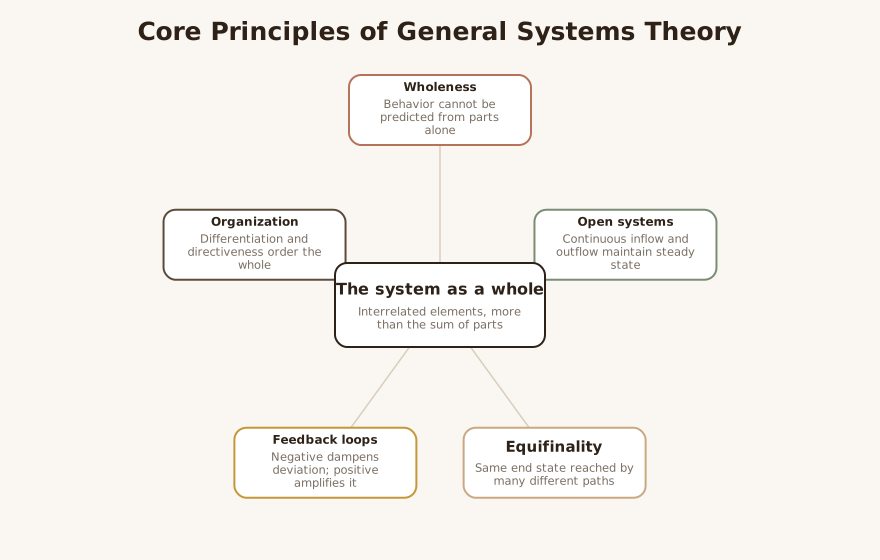
The foundational claim is wholeness: a system is “a set of elements standing in interrelation amongst themselves and with environment,” and its behavior cannot be predicted from the elements taken separately 1. Put colloquially, a system is more than the sum of its parts 3. GST therefore foregrounds concepts that von Bertalanffy called “alien to conventional physics” — organization, wholeness, directiveness, and differentiation — which he considered indispensable for dealing with living organisms or social groups 1.
Several derived principles carry directly into clinical reasoning LLM. Living systems are open systems, characterized by continuous inflow and outflow, a building up and breaking down of components, maintaining a steady state distinct from static equilibrium 1. Equifinality holds that in open systems the same final state may be reached from different initial conditions and in different ways — meaning a given symptom can arise from many distinct family histories, and conversely that there is rarely one “correct” path to change 1. Feedback loops regulate the system: negative feedback dampens deviation and maintains stability, while positive feedback amplifies change and enables growth, and neither term carries a value judgment 4. Homeostasis describes the self-regulating tendency to preserve balance between the challenges a family confronts and its resources 4. Boundaries regulate the movement of people and information into and out of the system, and their permeability varies from open to tightly restricted 4. Circular causality captures that a change in one member affects others, which reciprocally influence the first — replacing the linear “A causes B” with a recursive loop 4. Finally, isomorphism — the observation that formally identical laws appear across disciplines — is what licenses applying the same systemic concepts to a cell, a family, and an organization 1.
Interventions & Techniques
GST is not itself a set of techniques; the interventions are supplied by the therapies built on it LLM. In social-work and counseling practice, three broad systemic intervention families are commonly described 5. Structural work identifies problematic interaction patterns and interrupts them 5. Strategic work surfaces the perceptions sustaining a problem 5. Systemic work targets the dysfunctional shared beliefs or “ideologies” that hold a maladaptive pattern in place 5.
In day-to-day clinical terms, applying GST means a set of moves: tracking the pattern rather than the person, mapping subsystems and boundaries (marital, parental, sibling), externalizing the “identified patient” framing, and anticipating that any intervention will ripple through the whole system LLM. Because to work effectively with families one must consider the systemic impact of any intervention, the clinician deliberately weighs how a change for one member will land on the others 4. Notably, systemic reasoning does not require all members in the room — a clinician can help a client recognize the familial patterns contributing to, for example, depression and build self-awareness without convening the whole family 5.
LLM-generated illustrative example (not a guideline): A 15-year-old is referred for “oppositional behavior.” A systemic lens reframes the question from “what is wrong with this teenager?” to “what does this behavior do within the family?” The clinician notices the symptom flares whenever the parents’ marital conflict escalates and recedes when the parents unite to manage the teen — a homeostatic loop in which the child’s behavior stabilizes the marriage. Intervention targets the loop, not the child alone LLM.
Evidence Base
Honesty about evidence requires a sharp distinction here LLM. As a meta-theory, GST is established — it is one of the most influential transdisciplinary paradigms of the twentieth century and reorganized how biology, family therapy, social work, and organizational science conceptualize their objects 3. That status is a measure of intellectual influence and conceptual durability, not of clinical efficacy LLM.
GST itself has no randomized-controlled-trial evidence base, and it would be a category error to expect one: it is a conceptual framework, not a treatment that can be manualized and tested against a control condition LLM. The testable propositions live in its clinical offspring — Bowen family systems therapy, Minuchin’s structural family therapy, and the broader family-therapy tradition — and whatever outcome evidence exists attaches to those specific, operationalized models rather than to GST as such LLM. Clinicians should therefore treat GST as a heuristic that organizes formulation and guides the choice of an evidence-based systemic modality, not as an intervention they can claim is “proven” in its own right LLM. When discussing efficacy with referrers or payers, the defensible statement is about the specific family-therapy model being delivered, not about systems theory in the abstract LLM.
Populations & Indications
GST-informed work is indicated wherever the unit of concern is relational rather than purely intrapsychic LLM. The classic populations are families and couples, where the system is the explicit focus 4. It extends naturally to groups, organizations and teams, and communities, because the same systemic abstractions apply across levels of scale 3. In social work, the person-in-environment perspective makes systems thinking the default lens, examining how family relationships, environment, economic status, and social connections collectively shape a client’s experience 5.
A particularly apt indication is people managing chronic illness within a family context, where the illness reorganizes roles, boundaries, and caregiving loops across the whole household LLM. Systems-informed framing is also commonly applied where presenting concerns — depression, anxiety, bipolar disorder, eating disorders, and risky behaviors such as substance use — are maintained or amplified by family behavior patterns 5.
Problems-for-Work
Systemic formulation is most useful for problems that are relational in nature or maintained by interactional loops LLM.
- Family conflict and relationship conflict: mapped as repeating feedback cycles rather than the fault of one party, with intervention aimed at the loop 4.
- Communication problems: reframed as patterned information flow across boundaries that can be made more permeable or better regulated 4.
- Enmeshment and boundary problems: addressed by clarifying subsystem boundaries (parental vs. sibling) and adjusting their permeability 4.
- Scapegoating dynamics: the “identified patient” is reframed as carrying a system-level function, redistributing responsibility for change LLM.
- Caregiver strain: understood as a homeostatic imbalance between family demands and resources, prompting redistribution of load 4.
- Behavioral problems in children: examined for the systemic function the behavior serves rather than treated as an isolated deficit 5.
- Maladaptive interaction patterns: targeted directly via structural interruption of the problematic sequence 5.
LLM-generated illustrative example (not a guideline): A couple presents with a “pursue-withdraw” loop: one partner escalates demands for closeness, the other withdraws, which intensifies the pursuit. Rather than asking who started it, the clinician names the circular causality and helps each partner see how their move cues the other’s, then coaches a different sequence LLM.
Contraindications, Cautions & Cultural Humility
GST has no contraindications in the pharmacological sense, but its application carries cautions LLM. The most serious is safety: in situations involving intimate-partner violence, child abuse, or coercive control, a “circular causality” frame can be misused to distribute responsibility onto a victim, and clinicians must hold abuse as the perpetrator’s responsibility rather than a shared systemic product LLM. Conjoint family sessions can be contraindicated where they expose a member to retaliation, and individual or split formats may be safer LLM.
A second caution is over-application: the isomorphism principle — that similar laws span disciplines — can tempt clinicians to treat every difficulty as relational and to neglect biological, trauma, or psychiatric drivers that need their own treatment 1. Systems language can also become abstract enough to obscure rather than clarify, and it has been critiqued for being difficult to operationalize LLM.
Cultural humility is essential because the very definitions of “healthy boundaries,” appropriate “enmeshment,” and family hierarchy are culturally variable LLM. What reads as enmeshment in one cultural frame may be valued interdependence in another, and a clinician must establish the family’s own norms before labeling a pattern dysfunctional LLM. Because behavior is influenced by many factors that work together as a system, the social-work tradition treats economic, environmental, and structural context as part of the formulation rather than background noise 5.
Treatment-Plan Suggestions & SMART Objectives
| Goal | SMART objective (example) | Mechanism |
|---|---|---|
| Interrupt a conflict feedback loop | Within 8 sessions, the couple will identify their primary escalation cycle and use a rehearsed “pause-and-name” step in at least 3 of 5 logged conflicts | Negative feedback / circular causality LLM |
| Clarify subsystem boundaries | Over 6 weeks, parents will hold one weekly child-free planning conversation and report reduced cross-generational triangulation on a session check-in | Boundary regulation / subsystems LLM |
| Reduce scapegoating of the identified patient | By session 10, family will reframe the referred child’s behavior in systemic terms in at least 2 of 3 sessions, per clinician observation | Reattribution of system function LLM |
| Rebalance caregiver load | Within 4 weeks, the family will redistribute 2 specific caregiving tasks and the primary caregiver will report a measurable drop on a strain check-in | Homeostasis / resource balance LLM |
| Improve cross-boundary communication | Over 8 sessions, family will adopt one structured turn-taking routine and use it in 80% of difficult conversations they log | Information flow across boundaries LLM |
| Increase relational self-awareness (individual format) | By session 6, client will accurately map one recurring family pattern that maintains low mood and name their role in it | Pattern recognition / circular causality 5 |
| Strengthen open-system support links | Within 6 weeks, family will activate 2 external supports (extended kin, community resource) and report on uptake | Open-system exchange with environment 1 |
Common Misconceptions
A frequent misconception is that GST is a therapy you can “do” and bill for; it is a meta-theory that informs therapies but is not a treatment protocol in itself LLM. A second is that systems thinking blames the family or denies individual agency — yet von Bertalanffy explicitly framed humans as active systems that create their world, not passive products of their environment 1. A third is the belief that “positive feedback is good and negative feedback is bad”; in systems language these terms are descriptive — negative feedback maintains stability, positive feedback drives change — and neither carries a value judgment 4. A fourth is that systemic work always requires the whole family in the room, when in fact a clinician can work systemically with a single client by helping them recognize and shift their part in family patterns 5. Finally, equifinality is often forgotten: clinicians sometimes hunt for the single “root cause,” but in open systems the same end state can arise from many different starting points 1.
Training & Certification
There is no certification in “General Systems Theory” itself, because it is a theoretical foundation rather than a credentialed modality LLM. Clinicians acquire it as part of graduate training in marriage and family therapy, social work, counseling, and psychology, where it underpins the person-in-environment and family-systems curricula 5. Formal competence is gained instead by training in the specific systemic models that operationalize it — Bowen family systems therapy, Minuchin’s structural family therapy, and other recognized family-therapy approaches — typically through supervised clinical hours and model-specific postgraduate institutes LLM. The original source text, von Bertalanffy’s 1968 General System Theory, remains the canonical primary reading for the underlying concepts 2.
Key Terms
- System: a set of elements standing in interrelation amongst themselves and with their environment 1.
- Wholeness / emergence: the property that a system is more than the sum of its parts, with characteristics no single element can produce alone 3.
- Open system: a system maintaining a steady state through continuous inflow and outflow with its environment 1.
- Equifinality: the same final state can be reached from different initial conditions and by different routes 1.
- Homeostasis: self-regulation that preserves balance between demands and resources 4.
- Feedback loop: negative feedback dampens deviation and stabilizes; positive feedback amplifies change 4.
- Boundary: the regulator of movement of people and information into and out of a system, varying in permeability 4.
- Subsystem: a smaller organized unit within the system (e.g., marital, parental, sibling) 4.
- Circular causality: reciprocal influence in which each member’s change affects and is affected by the others 4.
- Isomorphism: formally identical laws recurring across different disciplines and scales 1.
Resources & Further Reading
▶ Watch — a video introduction to this concept:
- Ludwig von Bertalanffy, General System Theory (1968) — full-text excerpt
- Ludwig von Bertalanffy, General System Theory: Foundations, Development, Applications (Internet Archive)
- Systems theory — Wikipedia
- Systems Theory — an overview | ScienceDirect Topics
- Family Systems Theory | Encyclopedia.com
- Theoretical Approaches in Social Work: Systems Theory | Social Work License Map
Reflective / Supervision Questions
- When I formulate a case as “the patient’s problem,” whose behavior in the surrounding system am I leaving out, and what function might the symptom serve for that system? LLM
- Where am I at risk of using circular causality in a way that obscures responsibility for harm or unsafe dynamics? LLM
- Am I treating a culturally normative pattern of interdependence as pathological “enmeshment,” and have I checked the family’s own norms? LLM
- For this case, am I claiming evidence for “systems theory” when I should be naming the specific, evidence-based modality I am actually delivering? LLM
- Given equifinality, have I prematurely fixed on a single root cause when several distinct histories could produce this presentation? LLM
- If I shift one part of this system, where do I predict the change will ripple, and how will I monitor for compensatory homeostatic pushback? LLM