
Type & Discipline
Morphostasis and morphogenesis are a conceptual distinction drawn from general systems theory and sociology, not a treatment, diagnosis, or stand-alone modality LLM. They were introduced as paired terms for two opposed classes of process operating in any complex adaptive system: morphostasis names “those processes which tend to stabilize and recreate a system’s given form, structure or state,” while morphogenesis names “those processes which tend to elaborate or change a system’s given form, structure, or state” 5. The home discipline is sociology — specifically the sociocybernetic and systems-theoretic wing of it — where the pair was developed to describe how societies and social groups both reproduce and transform themselves 2.
For a clinician, the value of the distinction is not that it is something one delivers, but that it supplies a vocabulary for case formulation: it lets a therapist ask, of any relational system, which processes are holding the current form in place and which are pushing toward a new one LLM. Because it is a descriptive frame rather than an intervention, it travels across modalities and informs how a clinician reads a family’s stuckness or a couple’s transition rather than constituting a therapy in itself; its migration from sociology into family therapy is precisely what makes it clinically useful, and that bridge is the subject of this article LLM.
Creators & Lineage
The terms were coined and systematized by the American sociologist Walter Buckley in Sociology and Modern Systems Theory, published by Prentice-Hall in 1967 2. Buckley’s project was to replace the dominant models of his era — the mechanical equilibrium model and the organismic homeostasis model — with a model of society as a complex adaptive system, arguing that the older models “have outlived their usefulness” for understanding sociocultural life 4. Within that argument, morphostasis and morphogenesis are the two faces of system process: the conservative, form-maintaining face and the creative, form-changing face 5.
Buckley drew directly on the broader systems tradition: the general systems theory of Ludwig von Bertalanffy and the cybernetics of feedback and homeostasis, which he extended and partly criticized as too static for social systems 4. He insisted that “openness is an essential factor underlying a system’s viability, continuity, and its ability to change,” reframing social order as something continuously produced rather than simply maintained 4. The lineage continues into contemporary sociology through Margaret Archer, who built a research program on social morphogenesis and argued that both stabilizing and change-driving mechanisms require social explanation and operate simultaneously 1. The same program asks whether a “morphogenic society” — one in which change-driving processes dominate over stabilizing ones, yielding continuous structural change without convergence on equilibrium — is emerging 1.
The clinical branch of the lineage runs through family-systems theory LLM. The most direct bridge is David Speer’s 1970 paper in Family Process, “Family Systems: Morphostasis and Morphogenesis, or ‘Is Homeostasis Enough?’”, which imported Buckley’s distinction into family therapy and questioned whether the then-standard concept of family homeostasis was sufficient to describe healthy family functioning 3. That intervention positioned the morphostasis/morphogenesis pair as a corrective to an over-emphasis on stability in the family-homeostasis tradition associated with Don Jackson and the Palo Alto group LLM.
Core Principles
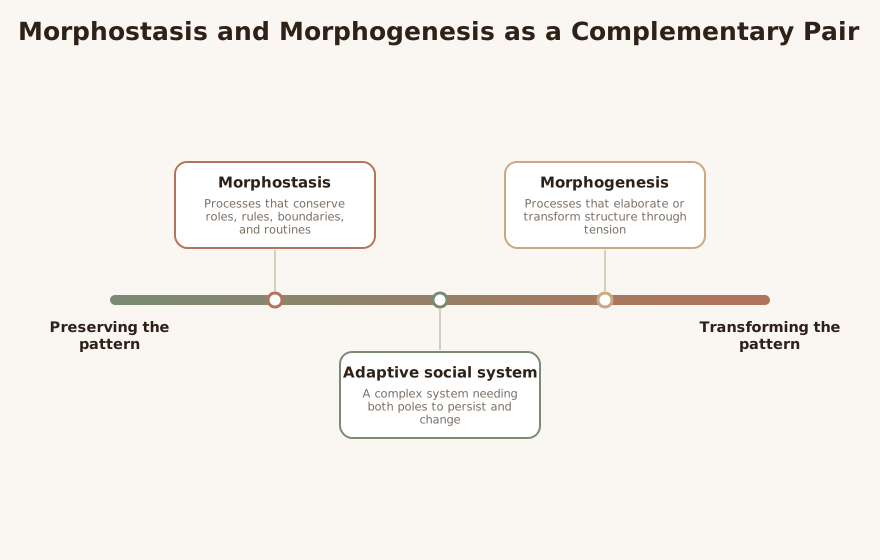
The first principle is that the two processes are a complementary pair, not opposites to be ranked: every living social system needs both LLM. Morphostasis is the set of processes that conserve a system’s pattern — the roles, rules, boundaries, and routines that let a family or group remain recognizably itself over time 5. Morphogenesis is the set of processes that elaborate or transform that pattern — the negotiations, conflicts, and adaptations through which the system acquires new structure 5. A system with no morphostasis would dissolve; a system with no morphogenesis could not grow or adapt LLM.
The second principle is Buckley’s central claim that social systems are complex adaptive systems rather than equilibrium-seeking machines or self-regulating organisms 4. In the older homeostatic model, deviation triggers correction and the system returns to its set point; Buckley argued this captures only morphostasis and misses the system’s capacity to use deviation, tension, and “variety” as raw material for generating genuinely new structure 4. He held that in sufficiently complex, interrelated systems, simple linear cause “disappears,” and order is better understood as an emergent, continuously produced property than as a fixed state to be restored 4.
The third principle, made explicit in the sociological literature, is that stability and change are not a default-plus-disturbance arrangement but two mechanisms that must each be explained and that operate at the same time 1. Margaret Archer’s morphogenesis program treats both the persistence and the transformation of social form as requiring active social processes, and frames cases of “unbound morphogenesis” — change freed from stabilizing constraint — as producing novel formations, sometimes with only temporary local pockets of stability persisting inside ongoing change 1. Translated to clinical thinking, this means a therapist should expect both forces to be live in any family at any time, and should ask which is dominant and whether the balance fits the system’s developmental moment LLM.
Interventions & Techniques
Because morphostasis and morphogenesis are a theoretical distinction rather than a therapy, there are no “morphostasis techniques”; the distinction works by shaping formulation and by being operationalized through recognized modalities LLM. The first practical move is diagnostic listening: mapping which processes in a family are holding the current form in place — fixed roles, rigid rules, repetitive sequences — and which, if any, are pushing toward a new structure, then asking whether the balance is adaptive for where the family is in its life cycle LLM. Naming this aloud can itself reframe a presenting complaint, recasting “our teenager has become impossible” as “our family’s morphostatic rules have not yet updated for an adolescent who needs more autonomy” LLM.
A second move, drawn from the structural-family tradition the concept maps onto, is to treat the therapeutic task during a developmental transition as deliberately supporting morphogenesis — helping the system tolerate disequilibrium long enough to build new structure rather than snapping back to the old form LLM. Techniques such as enactment, boundary-making, and unbalancing within structural family therapy are the concrete vehicles, with the distinction supplying the rationale for why a clinician would intentionally destabilize a too-rigid pattern; conversely, when a system is in chaotic, unbound change with too little morphostasis, the same frame argues for shoring up structure, predictability, and protective rules LLM. A third use is reframing symptom maintenance: when a presenting symptom keeps recurring no matter what, the frame invites the clinician to ask what morphostatic function the symptom may serve for the system — what form it is protecting from change — and to make that function discussable LLM.
LLM-generated illustrative example (not a guideline): A family presents because their 16-year-old has begun refusing the family rules that worked smoothly for years. Using the morphostasis/morphogenesis lens, the clinician reframes the conflict as a developmental life-cycle transition in which the family’s morphostatic rules — designed for a child — are colliding with a legitimate morphogenic push toward adolescent autonomy. Rather than helping parents reinstate the old equilibrium, the work supports a controlled period of disequilibrium, delivered through structural enactments, so the family can negotiate updated rules and roles that fit who their child is becoming LLM.
Evidence Base
The honest appraisal is that morphostasis and morphogenesis form an established, foundational distinction within systems theory and sociology — durably influential, continuously taught and cited since 1967, and structurally embedded in family-systems thinking — but it is a conceptual framework rather than an intervention with its own outcome trials LLM. Buckley’s Sociology and Modern Systems Theory is treated as a classic statement of society-as-complex-adaptive-system, and its terminology has propagated through sociology and into clinical systems theory 2. The framework’s standing rests on conceptual fertility and explanatory usefulness, not on efficacy data for the distinction as a technique LLM.
Within sociology, the distinction remains live: Margaret Archer’s contemporary morphogenesis program has extended and debated it, including the question of whether societies are tipping toward dominance of morphogenesis over morphostasis 1. Within clinical work, the concept entered the literature chiefly as a critique — Speer’s 1970 Family Process paper used the morphostasis/morphogenesis pair to challenge whether the family-homeostasis model was sufficient, arguing that an exclusive focus on stability could not account for healthy family growth and change 3. Beyond that title-level argument, specific clinical claims about how to apply the distinction are best treated as clinical reasoning rather than as findings the source literature directly establishes LLM. A defensible stance is to use the distinction as a generative heuristic for formulation — a reliable way to widen attention to both stability and change in a system — rather than as a validated causal law or proven intervention LLM.
Populations & Indications
The framework’s natural population is relational systems rather than isolated individuals: families, couples, groups, and organizations or teams, where a persisting “form” and the processes that maintain or change it are directly observable 1. It is especially indicated for multi-generational family systems and for families navigating developmental life-cycle transitions — a child entering adolescence, a young adult launching, a remarriage forming a stepfamily — where the question of whether the system can shift its form is the clinical crux LLM.
A family with an adolescent in transition is a paradigmatic indication, because adolescence is precisely the developmental moment when a child’s morphogenic push for autonomy meets a family’s accumulated morphostatic structure, and the fit or misfit between them often drives the presenting problem LLM. Couples at the threshold of a major change — parenthood, relocation, role renegotiation — are similarly apt, as are organizations and teams facing the tension between preserving identity and adapting to a new environment, a domain Buckley’s original sociological framing speaks to directly 2. Across these systems, the distinction indicates where attention to the balance of stability and change is likely to be most useful LLM.
Problems-for-Work
The distinction maps onto a recognizable cluster of systemic problems, with maladaptive family homeostasis at the center — the situation in which a family’s morphostatic processes are so dominant that the system cannot update its form even when development or circumstance demands it LLM. Resistance to change and difficulty adapting to change are read here not as individual traits but as an excess of morphostasis relative to the morphogenic pressure the system is under LLM. Rigid family roles are a concrete expression of over-strong form-maintenance, where roles that once fit have ossified LLM.
Developmental life-cycle transitions and parent-child relational problems are core targets: many such problems are, in this frame, a stalled morphogenesis, where the family is being asked to change form and cannot 3. Family conflict and communication problems often intensify at exactly these transition points, as the system’s stabilizing and changing forces pull against each other LLM. Symptom maintenance in family systems is illuminated by asking what morphostatic function a recurring symptom serves — what form it is protecting from change — which reframes an apparently irrational persistence as systemically meaningful LLM.
LLM-generated illustrative example (not a guideline): A multi-generational family seeks help because an adult daughter’s recurring depressive episodes always seem to flare when she attempts to move out. Formulated through the distinction, the clinician hypothesizes that the symptom may serve a morphostatic function — its recurrence repeatedly pulls the family back to its familiar form and forestalls the morphogenic change of a member launching. The work makes that pattern discussable and supports the family in tolerating the change rather than recreating the old equilibrium LLM.
Contraindications, Cautions & Cultural Humility
The foremost caution is conceptual restraint: morphostasis and morphogenesis are a heuristic from sociology, not a validated clinical law, so a clinician should not present systemic formulations as proven mechanisms or treat “the family is resisting morphogenesis” as an objective verdict rather than one hypothesis among several LLM. The frame can be misused to pathologize stability itself — to imply that a family that is not changing is necessarily stuck — when robust morphostasis is exactly what a system in crisis or grief may legitimately need LLM. Both processes are healthy, and the clinical question is fit, not a preference for change 1.
A second caution concerns cultural humility about what counts as “appropriate” change LLM. Judgments about whether a family is too rigid or too fluid, about how much autonomy an adolescent should have, and about the proper pace of role renegotiation are culturally shaped, and the morphostasis/morphogenesis frame can smuggle in a Western, individualistic bias toward differentiation and autonomy as the developmental goal LLM. In many cultural and family contexts, strong form-maintaining structures — multi-generational obligation, defined roles, continuity of tradition — are not maladaptive homeostasis but valued, adaptive functioning LLM. Cultural humility requires interpreting a system’s balance of stability and change against the family’s own values and context, checking the clinician’s inference rather than asserting it, and remaining alert to the power the therapist holds in deciding which “form” a family ought to move toward LLM.
Treatment-Plan Suggestions & SMART Objectives
| Goal | SMART objective (example) | Mechanism |
|---|---|---|
| Build family awareness of stability vs. change forces | Within 6 sessions, family members will each name one rule that helps and one rule that no longer fits, in session | Surfaces morphostatic structure so the system can decide what to keep and what to update 5 |
| Support a stalled developmental transition | Over 10 sessions, family will renegotiate 3 age-appropriate autonomy rules for the adolescent, reviewed across sessions | Enables morphogenesis where the family’s form has not updated for development 3 |
| Loosen rigid family roles | Within 8 sessions, two members will trade or share one fixed role for an agreed period, observed in session | Reduces over-dominant morphostasis that has ossified roles LLM |
| Make symptom-maintaining patterns discussable | Within 6 sessions, family will articulate one systemic function a recurring symptom may serve | Reframes symptom maintenance as a morphostatic function that can be named and changed LLM |
| Increase tolerance for productive disequilibrium | Over 8 weeks, family will sustain one renegotiation conversation to completion without reverting to the old pattern, logged | Helps the system stay in change long enough to build new structure rather than snapping back 4 |
| Shore up structure in a chaotically changing system | Within 6 sessions, family will establish 3 predictable routines or boundaries, maintained across 2 weeks | Restores needed morphostasis where unbound change has left too little structure 1 |
| Re-balance an over-fused or over-rigid family form | Over 10 sessions, family will adjust one boundary toward a developmentally fitting level, observed in enactment | Targets the fit between morphostasis and morphogenesis rather than favoring either 1 |
Common Misconceptions
A frequent error is treating morphogenesis (change) as good and morphostasis (stability) as bad; the framework’s whole point is that both are necessary processes and that health is a matter of their balance and fit, not a preference for change 1. A second misconception is equating morphostasis with homeostasis and stopping there — but the distinction was introduced partly to argue that homeostasis alone is not enough, because the homeostatic model captures only the form-preserving side and misses the system’s genuine capacity to generate new structure 3. Buckley’s argument was explicitly that the equilibrium and homeostasis models of society “have outlived their usefulness” as complete accounts 4.
A third misconception is that this is a therapy one “does”; it is a descriptive frame from sociology that informs interventions delivered through other modalities LLM. A fourth is reading change in a family as automatically the therapeutic goal — when robust form-maintenance is exactly what some systems, in some moments, most need LLM. A fifth is locating “resistance” inside an individual; in this frame, apparent resistance is better understood as the system’s morphostatic processes doing their job, which reframes blame as pattern LLM. Finally, the concept is sometimes treated as a precise mechanism rather than an explanatory heuristic, overstating how much predictive force it carries LLM.
Training & Certification
There is no certification in “morphostasis and morphogenesis”; the terms are foundational theory studied within sociology, systems theory, and family-systems training rather than a credentialed technique LLM. Clinicians typically encounter the distinction inside graduate coursework in family therapy and within the broader systems-theory canon, where Buckley’s work and its family-therapy applications are part of the background literature 2. Reading the primary sources — Buckley’s Sociology and Modern Systems Theory for the sociological statement, and Speer’s Family Process paper for the clinical bridge — remains the standard route to understanding the distinction in its original terms 2.
For applied competence, the relevant training lives in the recognized modalities that operationalize the frame — structural and other family-systems therapies — where supervised practice teaches clinicians to read a system’s balance of stability and change, support transitions, and intervene in patterns rather than persons LLM. Generalist therapists can legitimately use the distinction for formulation provided they represent its evidentiary status honestly and pursue supervised systemic training before treating complex family systems LLM.
Key Terms
Morphostasis — processes that tend to stabilize and recreate a system’s given form, structure, or state; the form-preserving face of system process 5. Morphogenesis — processes that tend to elaborate or change a system’s given form, structure, or state; the form-changing face of system process 5. Complex adaptive system — Buckley’s model of society as an open system that uses tension and variety to generate new structure, contrasted with mechanical-equilibrium and organismic-homeostasis models 4. Homeostasis — a self-regulating return-to-set-point process; in this frame it captures morphostasis but, on its own, is “not enough” to describe a healthy adaptive system 3. Morphogenic society — a society in which change-driving processes dominate over stabilizing ones, producing continuous structural change without convergence on equilibrium 1. Unbound morphogenesis — change freed from morphostatic constraint, generating novel social formations with only temporary local pockets of stability 1. Family homeostasis — the family-therapy concept of a system’s tendency to maintain its accustomed equilibrium, which the morphostasis/morphogenesis distinction was used to interrogate 3. Openness — for Buckley, an essential factor underlying a system’s viability, continuity, and capacity to change 4.
Resources & Further Reading
▶ Watch — a video introduction to this concept:
- Buckley, W. (1967) — Sociology and Modern Systems Theory (Prentice-Hall) — Google Books
- Buckley (1967) Sociology and Modern Systems Theory — bibliographic reference (SciRP)
- Speer, D. (1970) — Family Systems: Morphostasis and Morphogenesis, or ‘Is Homeostasis Enough?’ (Family Process)
- Walter F. Buckley — Wikiquote
- What is a morphogenic society? — Understanding Society (Daniel Little)
Reflective / Supervision Questions
- When I describe a family as “stuck,” am I treating its morphostasis as a defect, or am I asking honestly whether form-maintenance is exactly what this system needs at this moment 1?
- For a family in a developmental transition, can I distinguish a healthy morphogenic push from a chaotic loss of structure, and does my plan support the one the system actually needs LLM?
- Whose cultural frame am I using to judge whether a family is “too rigid” or “too fluid,” and have I checked that judgment against the family’s own values rather than a default toward autonomy and change LLM?
- When a symptom keeps recurring, have I asked what morphostatic function it may serve for the system before treating it as merely an individual problem 3?
- Am I representing this distinction as a generative heuristic for formulation, or am I overstating it as a proven mechanism that predicts what a family will do 2?