
Type & Discipline
Living Systems Theory (LST) is a grand, general theory of systems science, not a treatment, a diagnosis, or a stand-alone clinical modality LLM. Its home discipline is the cross-disciplinary field of general systems theory, and its specific ambition is unusually large: to identify the structures and processes common to all living systems, from a single cell to an international organization, within one unified framework 1. The theory’s central thesis is that every living system is an open system that maintains itself by processing inputs, throughputs, and outputs of matter, energy, and information, and that each must contain a fixed set of “critical subsystems” defined by their functions 4.
For a clinician, this is an unfamiliar and frankly abstract starting point, because LST was built to describe biology, organizations, and societies in the same breath, not to guide psychotherapy LLM. Its value in the consulting room is not as something one delivers but as a formulation lens: a vocabulary for asking which functions a relational system is performing well, which it cannot perform, and how a problem at one level (a person) is coupled to problems at another (a family, a team, a service) LLM. Because nothing in Miller’s corpus is addressed to psychotherapy, every clinical application in this article is an analogy and a piece of clinical reasoning rather than a sourced clinical method, and is marked accordingly LLM.
Creators & Lineage
Living Systems Theory is overwhelmingly the work of one figure: James Grier Miller (1916–2002), an American biologist, psychologist, and systems scientist who is credited with coining the term “behavioral science” and who founded the journal Behavioral Science as a vehicle for the program 6. Miller spent decades assembling the theory and stated it definitively in his 1,100-page magnum opus Living Systems, published by McGraw-Hill in 1978 4. He continued to develop and defend it into the 1990s, including a programmatic restatement, “Introduction: The Nature of Living Systems,” in Behavioral Science in 1990 3.
The intellectual parent of LST is the general systems theory of Ludwig von Bertalanffy, whose insistence that open systems share organizing principles across disciplines is the soil LST grew from LLM. Miller absorbed that tradition and pushed it toward an empirical, almost taxonomic specificity that von Bertalanffy himself did not attempt, enumerating exact subsystems and proposing testable cross-level generalizations 1. The broader lineage runs through cybernetics — the study of feedback, control, and self-regulation — whose concepts of information, control, and steady state are woven throughout Miller’s account of how systems keep themselves alive 4. LST is also frequently discussed alongside related macro-frameworks such as social entropy theory, with which it shares a concern for how systems resist disorder by importing negative entropy from their environments 7.
There is no clinical branch of this lineage in the direct way there is for family systems therapy LLM. The conceptual siblings most relevant to a therapist are the systems frameworks that did enter the consulting room: Murray Bowen’s family systems theory, with its account of the family as an emotional unit; ecological systems theory, with its nested levels of influence; and the cybernetic and second-order cybernetic traditions that reshaped systemic family therapy LLM. LST sits in the same intellectual family as these, sharing their systems vocabulary, but it entered biology, engineering, and organizational science rather than the therapy room, so any clinical use of it is an importation a clinician makes, not a tradition handed down LLM.
Core Principles
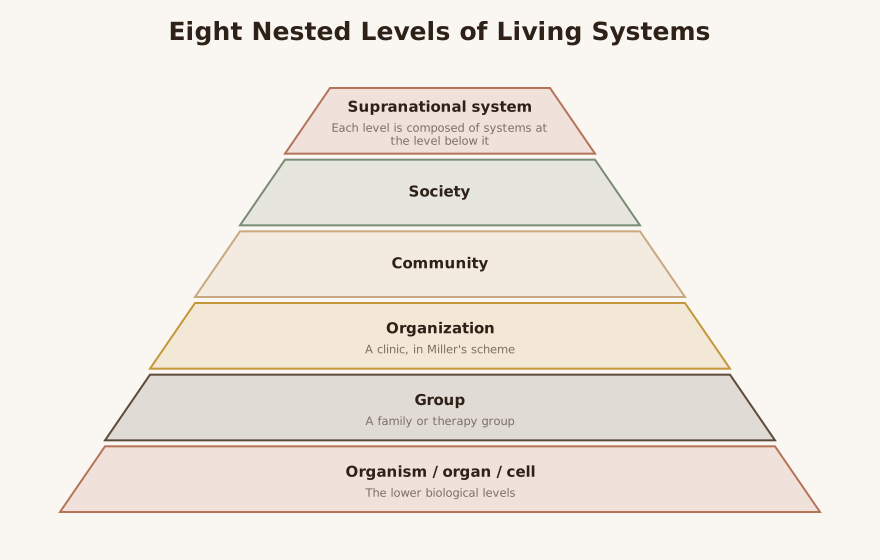
The first and defining principle is that living systems exist at eight nested levels, each composed of systems at the level below: cell, organ, organism, group, organization, community, society, and supranational system 5. A family or a therapy group is, in Miller’s scheme, a system at the group level; a clinic is an organization; a health-care network is a community or society — and the theory’s claim is that the same fundamental processes operate, with increasing complexity, at every one of these levels 5. This nesting is what makes LST a candidate lens for thinking about how an individual, a family, and the larger systems around them are coupled LLM.
The second principle is that every living system, at every level, must perform the same twenty critical subsystem functions, or obtain them through a symbiotic relationship with another system 1. These twenty are sorted into three groups by what they process: two subsystems process both matter-energy and information — the reproducer, which produces new systems like itself, and the boundary, which holds the system together and protects it from its environment 5. Eight subsystems process matter-energy only — the ingestor, distributor, converter, producer, matter-energy storage, extruder, motor, and supporter 5. The remaining ten process information only — the input transducer, internal transducer, channel and net, timer, decoder, associator, memory, decider, encoder, and output transducer 5. Of these, Miller treats the decider as the essential, irreducible control subsystem: “without such interaction under decider control there is no system” 1.
The third principle is that living systems are open, negentropic, and self-regulating 1. They maintain a steady state of order — what Miller, following Schrödinger, frames as feeding on “negative entropy” — only by continuously importing matter, energy, and information across their boundaries; walling a living system off from such exchange produces what Miller, citing Brillouin, calls “death by confinement” 1. They are, in his words, “actively self-regulating, developing, unitary systems with purposes and goals,” existing only within narrow ranges of environmental conditions 1. A fourth, more methodological principle is LST’s signature ambition of cross-level generalization: because the same subsystems recur at every level, Miller proposed that hypotheses formulated at one level (say, the organism) could be tested for analogous operation at another (say, the organization) 4. This claim — that there are formal commonalities across levels of living systems — is the theory’s most distinctive and most contested feature 7.
Interventions & Techniques
Because Living Systems Theory is a general theory rather than a therapy, there are no “living-systems techniques”; its clinical value, if any, lies in the formulation lens it offers, operationalized through recognized modalities LLM. Everything in this section is clinical reasoning by analogy, not a method drawn from Miller’s work LLM. The first and most natural move is a subsystem audit: treating a family, couple, or team as a group-level living system and asking which of its critical functions are intact and which are failing — is information getting in (input transducer), being routed to the right members (channel and net), remembered across time (memory), and acted on by a working decision process (decider)? LLM. Reframing a presenting complaint as a specific failed function — “the family has no working channel for getting bad news to the person who needs it” — can give a vague systemic stuckness a concrete, addressable shape LLM.
A second move follows from the open-system principle: a clinician can ask what a relational system is taking in and putting out across its boundary, and whether its boundary is too permeable (overwhelmed by intrusion) or too closed (starved of new input, drifting toward “death by confinement”) 1. A third move follows from the nesting of levels: because the same processes recur across levels, a clinician can ask how a problem at one level is coupled to another — how an individual’s distress (organism) is bound up with a dysfunctional decider at the family level (group) or a chaotic information flow at the agency level (organization) LLM. These moves are vehicles for, not replacements for, the documented techniques of an actual modality — communication-pattern mapping, enactment, circular questioning, structural boundary-making — within which the lens supplies a rationale rather than a procedure LLM.
LLM-generated illustrative example (not a guideline): A blended family presents with constant “miscommunication.” Using the subsystem lens, the clinician maps the family as a group-level system and notices that information reaches the household (input) but is never routed to the stepparent (a broken channel and net) and no shared decision process exists for resolving conflicts (a weak decider). Delivered through ordinary structural family-therapy technique, the work builds an explicit channel for sharing information and a small, agreed decision routine, rather than treating the trouble as a personal failing of any one member LLM.
Evidence Base
The honest appraisal has two layers, and a clinician should be candid about both LLM. As a theoretical framework, LST is an ambitious and historically significant synthesis — one of the most comprehensive attempts ever made to unify the study of living systems across disciplines, anchored by Miller’s encyclopedic 1978 volume and sustained through Behavioral Science 4. Its maturity, however, is best described as theoretical: it is a grand conceptual architecture, prized for its scope and integrative reach rather than for a body of confirmatory empirical trials, and its boldest empirical claim — that hypotheses generalize across the eight levels — has never been broadly validated and remains debated within systems science itself 7.
As a clinical framework it has essentially no evidence base of its own, and this must be stated plainly LLM. None of the available sources connects LST to psychotherapy outcomes; its clinical use here is an analogy this article constructs, and it is a notably more abstract and indirect lens than its systems-theory cousins that actually entered family therapy LLM. The theory has also drawn substantive criticism for over-extension — for assuming that the same twenty subsystems and the same cross-level laws really do hold from cells to supranational systems, an assumption that is elegant but extraordinarily strong 7. A defensible stance is therefore to treat LST as a generative source of organizing concepts — a checklist of functions and a reminder that systems are nested and open — held loosely and represented honestly as theory and analogy, rather than as a validated clinical model with measurable effects LLM.
Populations & Indications
The theory’s natural objects are systems at the group, organization, and community levels, so its clinical analogies fit relational and institutional systems best: families and couples (group-level systems), organizations and teams, communities, and health-care systems, where critical functions like information flow, decision-making, and boundary maintenance are directly observable 5. It is most plausibly useful where the presenting difficulty is itself about a system’s functioning — where information is not getting where it needs to go, where there is no working decision process, or where a boundary has failed — rather than where the issue is primarily an individual’s internal state LLM.
Two applications deserve special mention LLM. Organizations, teams, and larger care systems are where LST is least metaphorical and most literal, because Miller built the theory precisely to describe such multi-level structures, and a systems consultant can use the subsystem framework to locate exactly which function an organization is failing to perform 1. Therapists and systems consultants are themselves a fitting audience, because LST is at least as much a discipline for thinking about coupled, nested systems as it is a lens on any one client, and it can sharpen a clinician’s reading of how an individual, a family, and an agency interlock LLM. For couples and individual families, by contrast, only the most general principles — the system as open and boundaried, the need for a working decider and clear channels — transfer cleanly, and the full twenty-subsystem apparatus should be applied selectively rather than wholesale LLM.
Problems-for-Work
The lens maps, by analogy, onto a recognizable cluster of relational and systemic problems LLM. Communication breakdown sits at the center, reframed as a failure in specific information-processing subsystems — a blocked input transducer, a broken channel and net, an unreliable memory, or a decoder that systematically misreads incoming messages 5. Relationship conflict and family dysfunction can be read as a system whose decider subsystem is contested or absent, so that no shared, authoritative decision process exists and conflicts cannot be resolved at the system level 1.
Boundary problems map directly onto the boundary subsystem: a family or team whose boundary is too porous is overwhelmed by intrusion and cannot maintain its own steady state, while one whose boundary is too rigid drifts toward “death by confinement,” cut off from the new input it needs to adapt 1. Organizational stress and group conflict are where the framework’s literal vocabulary applies best — a team in which the matter-energy and information subsystems are overloaded, mis-routed, or duplicated shows the strain Miller’s model would predict 1. Systemic burnout can be read as a living system whose negentropic balance has failed: outputs chronically exceed the matter, energy, and information it can import across its boundary, so order can no longer be maintained 1. In every case the clinical use is interpretive analogy layered onto a recognized modality, not a technique the theory itself prescribes LLM.
LLM-generated illustrative example (not a guideline): An interdisciplinary clinical team is in chronic conflict and several members report burnout. Read through LST, the consultant notes that the team’s decider is contested (two leaders issue conflicting directions), its channel and net is overloaded (everything routes through one coordinator), and its boundary is too porous (it absorbs every external demand without filtering). Delivered through ordinary team-facilitation methods, the work clarifies a single decision pathway, redistributes information flow, and builds a boundary function that screens incoming demands, rather than framing the burnout as the failing of individual staff LLM.
Contraindications, Cautions & Cultural Humility
The foremost caution is conceptual honesty about status: LST is a grand theoretical framework with no clinical evidence base, and a clinician should never present a living-systems formulation to a client as an established mechanism or as anything more than one heuristic among many LLM. The theory’s mechanistic, almost engineering vocabulary — subsystems, transducers, throughput — is a second hazard: describing a grieving family as a system with a “malfunctioning decider” or a “blocked input transducer” risks sounding dehumanizing and reductive, treating people as components rather than persons, and such language belongs in the clinician’s private formulation, never in psychoeducation delivered verbatim LLM. The model’s seductive completeness can also encourage over-application — forcing every clinical phenomenon into a slot in a twenty-box grid when much of human suffering does not decompose so neatly LLM.
A second caution concerns LST’s contested cross-level claim: the assumption that the same functions and laws govern a cell, a family, and a nation is powerful but unproven, so a clinician should resist treating an analogy between an organism and an organization as if it were an identity 7. Cultural humility imposes a further limit, because judgments about which subsystems are “working” — what counts as a healthy boundary, an appropriate decision process, or adequate communication — are culturally shaped, and the theory offers no neutral standpoint from which to make them LLM. A family with strongly centralized, hierarchical decision-making is not a “decider malfunction” but, in many cultural contexts, valued and adaptive functioning; permeable, multi-generational boundaries are not a defect but a norm LLM. The clinician should therefore interpret a system’s functioning against the family’s own values and context, check inferences rather than assert them, and remain alert to the power they hold in deciding which account of “the system” gets to count LLM.
Treatment-Plan Suggestions & SMART Objectives
The objectives below translate the theory’s principles into ordinary systemic goals; the theory supplies the rationale, while the documented psychotherapy is delivered through a recognized modality LLM.
| Goal | SMART objective (example) | Mechanism |
|---|---|---|
| Repair information flow within the family | Within 6 sessions, the family will establish one regular routine for sharing important news with all members, demonstrated in session | Restores the channel-and-net and input-transducer functions so information reaches the members who need it 5 |
| Build a working shared decision process | Within 8 sessions, the couple will agree on and use one explicit method for resolving recurring disputes, logged across 2 weeks | Strengthens the decider subsystem, the control function Miller treats as essential to any system 1 |
| Right-size an over-porous boundary | Within 6 sessions, the family will agree on two limits that filter external demands on the household, observed | Restores boundary function so the system can maintain its steady state rather than be overwhelmed 1 |
| Open an over-closed system to new input | Over 10 sessions, the family will introduce one new source of outside support or information and sustain it for a month | Counters “death by confinement” by reopening matter-energy and information inputs across the boundary 1 |
| Reduce systemic overload and burnout | Within 8 sessions, the team will redistribute two duplicated or overloaded functions among members, maintained for a month | Re-balances matter-energy and information throughput so outputs no longer exceed sustainable input 1 |
| Map a problem across coupled levels | Within 6 sessions, family and clinician will name how one member’s distress is linked to a family-level and an agency-level process | Uses the nesting of levels to locate where, across cell-to-community levels, the function is failing 5 |
| Hold the systems formulation as provisional | Across treatment, the clinician will revise the working subsystem map at least twice in response to family feedback, documented | Embeds humility about the theory’s contested cross-level claims rather than reifying the model 7 |
Common Misconceptions
The most basic error is hearing “living system” and assuming the theory is only about biology; Miller’s whole move is that the same twenty subsystem functions operate at eight levels, from cells to supranational systems, so a family and a clinic are “living systems” in his technical sense 5. A second misconception treats LST as interchangeable with Bowen family systems theory or general “systems thinking,” when it is a far more specific, taxonomic framework with a fixed inventory of subsystems and an explicit cross-level program that the family-therapy traditions never adopted LLM. A third reads the eight levels as a value hierarchy, with “higher” levels being better, when the levels are simply scales of organization, each composed of the level below and each performing the same critical functions 5.
A fourth misconception is to treat the cross-level generalizations as established fact: the claim that hypotheses confirmed at one level will hold at another is the theory’s most distinctive feature but also its most contested, and it has not been broadly validated 7. A fifth is to mistake “open system” for “boundaryless”: Miller’s living systems are emphatically boundaried — the boundary is one of the twenty critical subsystems — and openness means controlled exchange across that boundary, not its absence 1. Finally, the framework is sometimes mistaken for a therapy one “does,” when it is an abstract description of how systems maintain themselves that can, at most, inform interventions delivered through other modalities LLM.
Training & Certification
There is no certification in Living Systems Theory; it is a body of general systems theory studied within systems science, organizational science, and interdisciplinary curricula rather than a credentialed clinical technique LLM. Clinicians who want to understand it on its own terms encounter it through Miller’s own work — the 1978 Living Systems volume and his 1990 Behavioral Science restatement — and through systems-science societies such as the International Society for the Systems Sciences, which maintains primers on the theory 3. The theory belongs to the same broad family as general systems theory, cybernetics, and ecological systems theory, and is most often met inside graduate systems-science or organizational coursework rather than clinical training 4.
For applied clinical competence there is no Miller-specific pathway at all; the relevant skills live in the recognized systemic modalities — family systems therapy and constructivist and systemic couple and family approaches — where supervised practice teaches clinicians to think in terms of patterns, boundaries, and feedback rather than isolated individuals LLM. A generalist therapist can legitimately borrow LST’s subsystem checklist and its open-system and nested-level concepts for private formulation, provided they represent its status honestly — ambitious and integrative as systems theory, untested and indirect as a clinical lens — and pursue supervised systemic training before treating complex family systems LLM.
Key Terms
Living system — Miller’s technical term for a special subset of concrete systems that are open, negentropic, self-regulating, and goal-directed, and that contain (or symbiotically obtain) all twenty critical subsystems 1. Eight levels — the nested hierarchy of living systems: cell, organ, organism, group, organization, community, society, and supranational system, each composed of systems at the level below 5. Critical subsystems — the twenty functions every living system must perform: two processing both matter-energy and information (reproducer, boundary), eight processing matter-energy, and ten processing information 5. Matter-energy processing subsystems — ingestor, distributor, converter, producer, matter-energy storage, extruder, motor, and supporter 5. Information processing subsystems — input transducer, internal transducer, channel and net, timer, decoder, associator, memory, decider, encoder, and output transducer 5. Decider — the control subsystem Miller treats as essential, since “without such interaction under decider control there is no system” 1. Boundary — the critical subsystem that holds the system together and protects it from its environment, processing both matter-energy and information 5. Negentropy — the negative entropy a living system imports across its boundary to maintain its order, without which it suffers “death by confinement” 1. Cross-level hypotheses — Miller’s proposal that generalizations holding at one level of living system can be tested for analogous operation at others; the theory’s most distinctive and most contested claim 7.
Resources & Further Reading
▶ Watch — a video introduction to this concept:
- Miller, J.G. (1978), Living Systems — book overview (panarchy.org)
- General Living Systems Theory (Miller) — Springer chapter
- Miller, J.G. (1990), “Introduction: The Nature of Living Systems” — Behavioral Science
- Living systems — encyclopedia overview (Wikipedia)
- The Living Systems Theory of James Grier Miller — ISSS Primer
- A General Theory of Living Systems (James Grier Miller) — Coevolving Innovations
- Living systems theory and social entropy theory
Reflective / Supervision Questions
- When I call a family or team “a system,” which of Miller’s critical functions am I actually tracking — and which subsystem (information flow, decision-making, boundary) is the presenting problem really located in 5?
- Is this system’s boundary too porous or too closed, and am I helping it maintain a workable steady state rather than drift toward overwhelm or “death by confinement” 1?
- Where is the working decider in this family or organization, and what happens to conflict when no shared, authoritative decision process exists 1?
- Am I treating an analogy between levels — an individual, a family, an agency — as a useful heuristic, or have I let LST’s contested cross-level claim harden into an assumption that the same laws simply must apply 7?
- Whose cultural frame am I using to judge that a subsystem is “malfunctioning,” and have I checked that judgment against the family’s own values rather than a default toward Western, individualistic norms of boundaries and decision-making LLM?
- Am I keeping the mechanistic vocabulary in my private formulation, or have I let “transducers” and “deciders” creep into how I speak to the people who are actually suffering LLM?