
Type & Discipline
Active inference is a theory, not a therapy. LLM It originates in computational neuroscience and theoretical biology as a corollary of the Free Energy Principle, a broad account of how self-organizing systems persist over time. 1 Within that family, active inference is the part of the framework that explains action: it proposes that perception, learning, and behavior all reduce to a single imperative, the minimization of variational free energy, which serves as a tractable upper bound on “surprise” (the improbability of an organism’s sensory states given its model of the world). 3 For practicing therapists, the useful framing is that active inference belongs to the predictive-processing family alongside the Bayesian brain hypothesis, and it has migrated into clinical thinking through computational psychiatry rather than through any clinical trial program. 5
It is essential to set expectations at the outset. Active inference is a way of understanding mind and brain, and increasingly a way of modeling psychopathology, but it does not prescribe a manualized protocol you deliver in session. LLM Its clinical value, at present, is conceptual and heuristic: it can sharpen case formulation and give a mechanistic vocabulary that maps onto interventions you already use. LLM
Creators & Lineage
The framework is most associated with Karl Friston, a neuroscientist at University College London, who formalized the Free Energy Principle and developed active inference as its account of perception and action. 5 The canonical synthesis for the field is the open-access MIT Press monograph Active Inference: The Free Energy Principle in Mind, Brain, and Behavior by Thomas Parr, Giovanni Pezzulo, and Karl Friston, which consolidates two decades of formal work into a single reference. 1 The MIT Press catalog frames the book explicitly as a unifying account spanning mind, brain, and behavior. 2
The intellectual lineage runs from Hermann von Helmholtz’s nineteenth-century notion of perception as unconscious inference, through the late-twentieth-century Bayesian brain hypothesis, into predictive processing, and finally into the Free Energy Principle, which subsumes these as special cases. 5 Active inference extends predictive coding by adding action as a second route to error reduction, and it has more recently been connected to deep learning, where “deep active inference” agents implement the same imperatives using neural networks. 4 Its arrival in clinical discourse came through computational psychiatry, which treats psychiatric symptoms as the behavioral signatures of altered inference. 5
Core Principles
The central claim is deceptively simple. An organism that wants to stay alive must keep its sensory states within a viable range, which is equivalent to minimizing the long-run surprise of those states. 5 Because surprise itself cannot be evaluated directly by a brain, the system instead minimizes a quantity called variational free energy, which is mathematically guaranteed to sit at or above surprise and is therefore a usable proxy. 3 Minimizing free energy is the same as maximizing the evidence for the organism’s own internal model of the world, a process sometimes called self-evidencing. 1
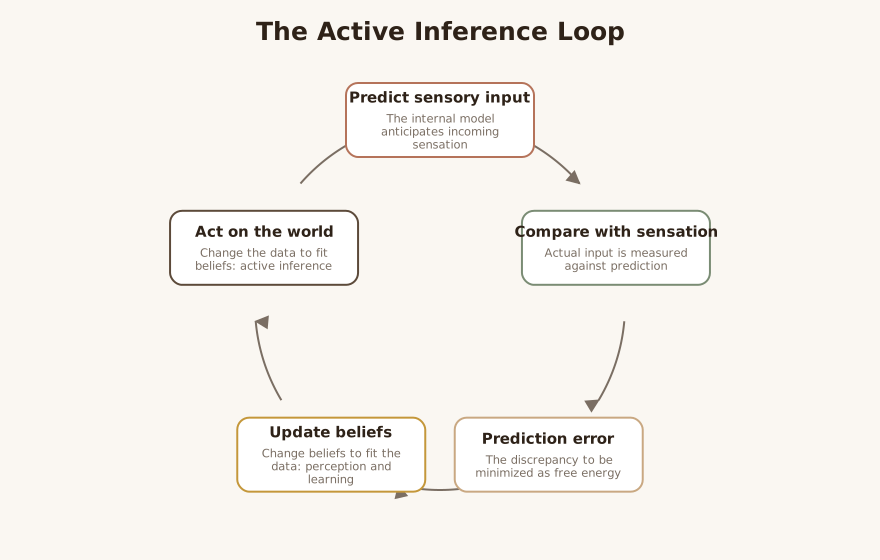
The signature insight for clinicians is that there are two ways to reduce prediction error, not one. LLM You can change your beliefs to fit the data, which is perception and learning. 1 Or you can change the data to fit your beliefs by acting on the world so that incoming sensations come to match what you predicted. 1 This second route is “active” inference, and it reframes action as the resolution of a discrepancy between expected and actual sensation rather than as the output of a separate motor command system. 4
Two further constructs do most of the clinical work. The first is precision, the brain’s estimate of the reliability of a given prediction or sensory signal, which functions like an attention or confidence gain; precision-weighting determines whether a prediction error gets to update beliefs or is dismissed as noise. 1 The second is the distinction between epistemic and pragmatic value in planning: agents select actions that both reduce uncertainty about the world (information-seeking, exploration) and secure preferred outcomes (goal-seeking, exploitation), and the generalized free energy formulation shows how a single quantity can balance both. 3
Interventions & Techniques
Active inference does not supply techniques of its own. LLM What it supplies is a mechanistic reading of why existing techniques work, which can guide how you deploy them. LLM Three mappings are particularly serviceable in the consulting room.
First, exposure can be read as supplying corrective sensory evidence that the patient’s catastrophic predictions cannot accommodate, forcing belief update along the perceptual route rather than letting the patient act to confirm the prediction. LLM Active inference predicts that avoidance is itself a free-energy-minimizing action: it keeps sensations consistent with a fearful model, so the model never gets disconfirmed. LLM
Second, behavioral activation and behavioral experiments can be framed as deliberately altering the world (the active route) to generate prediction errors that the depressive or anxious model has been working to suppress. LLM
Third, much of what therapy does can be cast as adjusting precision: helping a patient downweight the inflated confidence they place on threat predictions, or upweight neglected interoceptive and contextual signals, so that disconfirming evidence is actually allowed to update their model. LLM The technical literature treats precision modulation as the locus of many candidate pathologies, which is why this framing has clinical traction. 1
LLM-generated illustrative example (not a guideline): A patient with panic disorder predicts that a racing heart means imminent collapse. Active inference suggests two leverage points: an interoceptive exposure that delivers strong, survivable sensory evidence against the catastrophic prediction (perceptual update), and work to reduce the precision the patient assigns to the catastrophic interpretation so that benign explanations can compete (precision reweighting). The avoidance behaviors—sitting down, leaving the gym—are reframed not as harmless coping but as actions that keep the world consistent with the feared model. LLM
Evidence Base
Honesty about maturity is required here. Active inference is a mathematically mature and internally rigorous framework, but its clinical evidence base is emerging and largely indirect. LLM The foundational work is theoretical and computational, formalized in peer-reviewed venues such as the generalized free energy paper and consolidated in the MIT Press monograph. 3 1 There is no body of randomized controlled trials testing “active inference therapy,” because no such therapy exists as a discrete intervention. LLM
What evidence does exist is of three kinds. There is formal-modeling evidence showing the equations reproduce features of perception, choice, and learning. 3 There is computational-implementation evidence, including deep-learning agents that instantiate the principles and behave adaptively, which demonstrates the framework can scale and is not merely a metaphor. 4 And there is a growing computational-psychiatry literature that models specific disorders as aberrant inference, which is hypothesis-generating rather than confirmatory. 5 A fair clinician’s summary is that active inference is a promising explanatory framework with strong formal support and weak direct clinical-trial support, and it should be used to inform formulation rather than to claim an evidence-based treatment. LLM
Populations & Indications
The populations where active inference has been most actively applied are those that computational psychiatry has prioritized. 5 In people with anxiety disorders, the framework models excessive precision on threat predictions and the self-reinforcing role of avoidance. LLM In people with psychosis and across the schizophrenia spectrum, aberrant precision-weighting of prediction errors is a leading computational account of how hallucinations (over-weighted priors) and delusions (failure to update) might arise. 5 In autistic people, an influential hypothesis frames atypical precision—often described as reduced reliance on priors or heightened weighting of sensory input—as a route to sensory sensitivity and difficulty with prediction in noisy social environments. LLM In people with functional neurological and somatic symptoms, symptoms are modeled as high-precision priors that the nervous system actively realizes in the body, which fits the clinical picture of “real” symptoms without structural disease. LLM Depression and addiction have also been formulated in free-energy terms, the former through pessimistic priors and suppressed exploration, the latter through distorted expected value. LLM
The “indication,” then, is not a diagnosis but a formulation question: active inference is most useful where the clinical problem can be read as a mismatch between an over-confident internal model and the evidence the patient is allowing in. LLM
Problems-for-Work
- Anxiety disorders. Reframe avoidance as a free-energy-minimizing action that protects a fearful model from disconfirmation; the work is to introduce prediction errors the model cannot absorb. LLM
- Psychosis / schizophrenia spectrum. Use the precision lens to understand why reassurance fails and why gentle, repeated reality-testing that respects the patient’s confidence may be more tolerable than direct confrontation. 5
- Autism spectrum. Anticipate that unpredictable environments are genuinely more costly; structure, predictability, and explicit signposting reduce the inferential load. LLM
- Functional / somatic symptoms. Validate symptoms as products of high-precision prediction rather than fabrication, which supports a non-stigmatizing rehabilitation rationale. LLM
- Depression. Behavioral activation can be framed as forcing the world to generate the positive prediction errors a pessimistic model has stopped sampling for. LLM
- Addiction. Frame relapse cues as high-value predictions that bias action selection toward the substance. LLM
Contraindications, Cautions & Cultural Humility
The framework is descriptive, so it has no contraindications in the clinical sense, but its use carries several hazards. LLM The first is overreach: because the mathematics can be applied to almost anything, it is easy to produce a free-energy “explanation” for any symptom that adds no testable content and risks pseudo-precision. LLM The framework’s own breadth—described as spanning mind, brain, and behavior—is exactly what makes it vulnerable to unfalsifiable storytelling in untrained hands. 2
The second caution is communication. LLM Telling a patient that their “brain is minimizing free energy” or that their symptoms are “predictions” can be experienced as dismissive or as implying the symptoms are imaginary, which is the opposite of the intended meaning for functional presentations. LLM Language should foreground that the symptoms and distress are real and that the model explains mechanism, not blame. LLM
Cultural humility matters because “priors” are learned from a person’s lived environment, including experiences of racism, marginalization, migration, and threat. LLM What looks like an over-weighted threat prediction may be an accurate model of a genuinely unsafe environment, and pathologizing it as miscalibrated inference would be a clinical and ethical error. LLM The framework should never be used to relocate structural harm into an individual’s faulty brain. LLM
Treatment-Plan Suggestions & SMART Objectives
| Goal | SMART objective (example) | Mechanism |
|---|---|---|
| Reduce avoidance maintaining anxiety | Patient completes 3 graded exposures per week for 6 weeks, logging predicted vs. actual outcome each time | Generates prediction errors the fearful model cannot absorb, forcing belief update 1 |
| Lower precision on catastrophic interpretations | Within 8 sessions, patient generates and rates >=2 alternative explanations for feared bodily sensations on >=80% of occurrences | Reweights confidence so disconfirming evidence can compete 1 |
| Increase positive sampling in depression | Patient schedules and completes 1 previously avoided rewarding activity daily for 4 weeks | Forces the world to produce positive prediction errors a pessimistic model stopped sampling LLM |
| Improve tolerance of uncertainty | Patient practices one “do-not-check” exposure daily for 3 weeks, recording distress at 0 and 30 minutes | Curbs uncertainty-resolving compulsions that only minimize short-term free energy 3 |
| Rehabilitate functional symptoms | Patient follows a graded re-engagement plan, increasing target activity 10% weekly for 8 weeks | Provides corrective sensorimotor evidence against high-precision symptom priors LLM |
| Strengthen interoceptive accuracy | Patient completes daily interoceptive-awareness practice for 4 weeks, tracking accuracy | Upweights neglected bodily signals so they can update appraisals LLM |
| Reduce environmental unpredictability (autism) | Caregiver and patient co-design a predictable daily structure and use it on >=6 of 7 days weekly | Lowers inferential load in noisy contexts LLM |
Common Misconceptions
A frequent error is treating active inference as a therapy you can “do.” LLM It is a theory that reframes mechanisms; the actual intervention is always a recognized modality. LLM A second misconception is that minimizing free energy means the brain seeks to avoid all stimulation—the so-called “dark room problem”—when in fact the framework incorporates epistemic value, so agents are driven to explore and resolve uncertainty rather than to seek sensory deprivation. 3 A third is conflating free energy with thermodynamic energy; here it is an information-theoretic quantity borrowed by analogy. 5 A fourth is assuming the framework is settled science with clinical proof, when its clinical applications remain hypotheses awaiting trials. LLM Finally, clinicians sometimes assume “prediction” implies symptoms are not real; the framework holds the opposite for functional presentations—the prediction is realized as a genuine bodily or perceptual experience. LLM
Training & Certification
There is no certification in active inference and no credentialing body, because it is a theoretical framework rather than a treatment. LLM Clinicians should instead maintain certification in the empirically supported modalities through which the ideas are delivered. LLM For conceptual training, the open-access MIT Press monograph is the standard self-study text and is freely available. 1 The publisher’s catalog page provides edition and format details. 2 For those who prefer instruction by video, Friston’s recorded lectures and interviews offer an accessible entry point, and there is a curated playlist aggregating lectures, podcasts, and discussions on the topic. 6 7
Key Terms
- Free energy (variational free energy): an information-theoretic upper bound on surprise that the brain can actually compute and minimize. 3
- Surprise (surprisal): the improbability of a sensory state given the organism’s model; minimizing it keeps the organism in viable states. 5
- Active inference: reducing prediction error by acting on the world to make sensations match predictions. 1
- Precision: the estimated reliability of a prediction or signal, functioning as attention/confidence gain. 1
- Prediction error: the mismatch between predicted and actual sensory input that drives belief update or action. 4
- Self-evidencing: the idea that minimizing free energy is equivalent to gathering evidence for one’s own model. 1
- Epistemic vs. pragmatic value: the uncertainty-reducing versus goal-securing components of action selection, balanced within generalized free energy. 3
Resources & Further Reading
▶ Watch — a video introduction to this concept:
- Active Inference: The Free Energy Principle in Mind, Brain, and Behavior — Parr, Pezzulo & Friston (MIT Press, open access) 1
- Active Inference — MIT Press catalog page 2
- Generalised free energy and active inference (Friston et al., PMC) 3
- The Free Energy Principle for Perception and Action: A Deep Learning Perspective (PMC) 4
- Free energy principle — Wikipedia 5
- Free Energy Principle — Karl Friston (YouTube) 6
- Active Inference & Free Energy Principle — Lectures, Podcasts, Discussions (YouTube playlist) 7
Reflective / Supervision Questions
- When I formulate a patient’s avoidance as a free-energy-minimizing action, does that change which intervention I prioritize, or am I just relabeling what I already do? LLM
- Where, in this case, might an apparently “over-weighted threat prediction” actually be an accurate model of an unsafe or discriminatory environment? LLM
- How would I explain the mechanism to this patient in a way that validates the reality of their symptoms rather than implying they are imagined? LLM
- Am I using active inference to generate testable clinical hypotheses, or to produce an unfalsifiable story that adds nothing? LLM
- Which recognized, billable modality am I actually delivering, and does my documentation name it rather than the theory? LLM
- What corrective prediction errors does this treatment plan reliably generate, and how will I know if the patient’s model is updating? LLM