
Emotion-Focused Therapy (EFT) is a short-to-moderate-term experiential psychotherapy developed primarily by Leslie Greenberg that treats emotion as the central organizing system of the self and the most direct route to therapeutic change 2. It is sometimes confused with Sue Johnson’s Emotionally Focused Therapy for couples; the two grew from a shared experiential root but are distinct treatments, and this article concerns Greenberg’s individual model 6. The orienting premise is that emotions are not symptoms to be managed away but adaptive sources of meaning that, when fully processed, reorganize a person’s relationship to self and others 2.
Type & Discipline
EFT is a process-experiential, neo-humanistic individual psychotherapy situated within clinical psychology and the broader experiential/humanistic tradition 2. It is empirically supported and manualized rather than purely intuitive, integrating moment-by-moment process guidance with a strong relational stance 4. Within the landscape of evidence-based treatments, EFT occupies a distinct niche: it shares CBT’s commitment to in-session structure and measurable change while rejecting CBT’s primary emphasis on cognition, locating the engine of change instead in emotional experience and its transformation LLM.
Creators & Lineage
EFT was developed principally by Leslie Greenberg, with foundational contributions from Laura Rice, and elaborated over decades with collaborators including Robert Elliott, Jeanne Watson, and Sandra Paivio 4. Greenberg consolidated and revised the model across successive texts, most recently the revised edition of his core treatment volume published by the American Psychological Association 3. The approach draws directly on Carl Rogers’ person-centered therapy for its empathic, non-pathologizing relational foundation, on Gestalt therapy for its active in-session tasks such as chair work, and on contemporary emotion theory and affective science for its model of how emotions function and change 2. The synthesis is deliberate: Greenberg argued that the Rogerian relationship is necessary but not sufficient, and that experiential tasks are needed to reach and transform the emotions that organize distress 4.
Core Principles
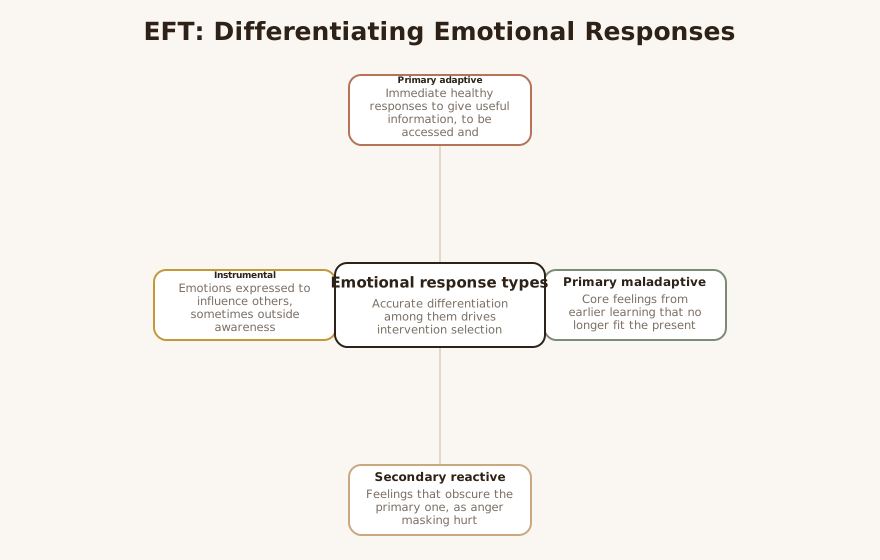
The defining principle of EFT is that emotion is a primary, adaptive signaling system that gives experience its meaning and motivates action 2. Clinically, EFT distinguishes several types of emotional response, and accurate differentiation among them drives intervention selection 4. Primary adaptive emotions are immediate, healthy responses to a situation—anger at violation, sadness at loss—that provide useful information and are to be accessed and trusted 4. Primary maladaptive emotions are core feelings, often rooted in earlier learning, that no longer fit the present, such as a pervasive shame or fear that distorts current relationships 4. Secondary reactive emotions obscure the primary feeling, as when anger masks underlying hurt or anxiety covers anger 4. Instrumental emotions are expressed to influence others, sometimes outside awareness 4.
A second principle is that emotions are best changed not by argument but by other emotions—Greenberg’s formulation of “changing emotion with emotion,” in which a maladaptive feeling is transformed by accessing an alternative adaptive emotion such as healthy anger or self-compassion 2. EFT also distinguishes productive from unproductive emotional processing; merely venting or ruminating is unproductive, whereas processing that moves toward articulating needs and generating new meaning is therapeutic 4. The therapist works as a process guide and emotion coach within a deeply empathic, attuned relationship that is itself considered curative 2.
Interventions & Techniques
EFT is marker-guided: the therapist listens for in-session “markers”—signs that a client is at a particular kind of emotional processing problem—and offers the matching task 4. For a self-evaluative split (harsh self-criticism), the therapist uses two-chair dialogue, having the client enact the critic in one chair and the experiencing self in the other to soften the critic and access underlying needs 4. For unfinished business with a significant other—lingering resentment or grief toward someone absent—the empty-chair dialogue allows the client to express and complete blocked emotion 4. When a client has an unclear, bodily felt sense, the therapist uses focusing to help symbolize what is felt 4. For a problematic reaction point, where a response seems puzzling or excessive, systematic evocative unfolding reconstructs the scene in slow motion to recover its emotional logic 4. Throughout, empathic responding, validation, and heightening of bodily felt experience deepen access to emotion 2.
LLM-generated illustrative example (not a guideline): A client who collapses into self-blame after a missed deadline shows a self-evaluative split; in two-chair work the critic voice (“you’re lazy and worthless”) is enacted directly, the experiencing self is asked what it feels and needs in the face of that attack, and the session moves toward asserting a need for self-acceptance and rest LLM.
The aim of these tasks is not catharsis for its own sake but the arousal, deepening, and ultimately the transformation of emotion into new, more adaptive responses and meanings 2.
Evidence Base
The evidence base for EFT in depression is mature and the maturity of the modality overall is best described as established 1. APA Division 12 lists Emotion-Focused Therapy for depression as a research-supported treatment with strong empirical support, grounded in multiple randomized trials 1. Across those trials, adding EFT’s experiential interventions to a person-centered empathic relationship produced better outcomes and lower relapse rates than the empathic relational condition alone, supporting the specific contribution of the emotion-focused tasks beyond the relationship 1. Clinical synthesis reviews summarize parallel research programs and process-outcome studies linking depth of emotional processing in session to better outcomes 4.
Honest appraisal is warranted about breadth. The strongest, most replicated outcome data sit with depression; evidence for anxiety, trauma, and complex presentations is more emerging and rests on a smaller, though growing, body of trials and case research 4. EFT’s distinctive empirical strength is its process research—decades of fine-grained study of what happens in session and how it relates to change—which exceeds what most modalities can show, even where its outcome literature for a given disorder is still developing 4.
Populations & Indications
EFT was developed and is best validated for adults with depression, and it is applied to people with anxiety disorders, trauma survivors, and individuals carrying unresolved grief 15. It is well suited to people whose distress is organized around self-criticism, shame, chronic emotional avoidance, or unfinished emotional business with attachment figures 4. Greenberg and colleagues extended the experiential principles into couples work, and this couples application overlaps conceptually with the separately developed Johnson model, though Greenberg’s individual EFT remains the focus here 6. Clients who can tolerate and benefit from heightened in-session affect, and who are seeking depth and emotional change rather than purely behavioral skills, tend to be strong candidates LLM.
Problems-for-Work
EFT targets a recognizable set of clinical problems where blocked, avoided, or maladaptive emotion is central 4. Major depressive disorder is the flagship indication, where hopelessness and self-criticism are reworked through chair tasks and emotional deepening 1. Self-criticism and low self-esteem are addressed directly through two-chair dialogues that soften the inner critic 4. Unresolved grief and interpersonal injuries are approached through empty-chair work that completes interrupted emotional expression 4. Childhood maltreatment sequelae, complex trauma, and posttraumatic stress are treated by accessing and transforming core maladaptive shame and fear, with careful attention to pacing 4. Generalized anxiety, emotional dysregulation, and interpersonal conflict are engaged by differentiating secondary reactive emotions from the primary feelings and unmet needs beneath them 4.
LLM-generated illustrative example (not a guideline): A grieving client who avoids visiting a deceased parent’s belongings might, after the relationship is secure, be invited into an empty-chair dialogue to voice what was never said, allowing primary adaptive sadness to surface and the unfinished attachment to find some completion LLM.
Contraindications, Cautions & Cultural Humility
The intensity of EFT’s emotional arousal demands judgment about timing and stabilization LLM. With acutely dysregulated clients, active psychosis, severe dissociation, or current crisis, deepening affect before adequate safety, regulation, and a secure alliance are established can be destabilizing, and chair work may need to be deferred LLM. As with all trauma-relevant work, pacing and titration of emotional exposure are essential to avoid overwhelm 4. Clinicians should also recognize that norms around emotional expression, the meaning of speaking to an absent family member, and comfort with experiential enactment vary substantially across cultures; chair work and overt emotional display are not universally acceptable and should be adapted, explained, or set aside in favor of more congruent methods LLM. The empathic, collaborative, non-pathologizing stance at EFT’s core is itself a vehicle for cultural humility when the therapist holds the client’s own emotional meanings as authoritative rather than imposing a template LLM.
Treatment-Plan Suggestions & SMART Objectives
| Goal | SMART objective (example) | Mechanism |
|---|---|---|
| Reduce harsh self-criticism | Within 8 sessions, complete two-chair dialogues in at least 4 sessions and report a 2-point drop on a self-criticism rating | Softening the inner critic; accessing self-compassion 4 |
| Increase emotional awareness | Within 6 weeks, accurately name the primary emotion beneath a reactive feeling in 3 of 4 sessions | Differentiating secondary from primary emotion via focusing 4 |
| Resolve unfinished business | Within 10 sessions, complete an empty-chair dialogue and report reduced distress recalling the relationship | Expressing and completing interrupted emotion 4 |
| Transform maladaptive shame | Over 12 weeks, access adaptive anger or self-soothing in response to shame in at least 3 sessions | Changing emotion with emotion 2 |
| Improve depressive symptoms | Reduce PHQ-9 score by 5 points over the course of treatment | Emotional deepening and meaning reorganization 1 |
| Tolerate and process grief | Within 8 sessions, express previously avoided sadness about a loss without premature shutdown | Accessing primary adaptive sadness 4 |
| Reduce experiential avoidance | Daily, log one avoided feeling and one moment of staying with it, reviewed weekly | Heightening and staying with bodily felt experience 2 |
Common Misconceptions
The most common error is conflating Greenberg’s individual EFT with Johnson’s Emotionally Focused Therapy for couples; they share initials and an experiential heritage but are different treatments with different evidence bases 6. A second misconception is that EFT is “just venting,” when in fact the model explicitly distinguishes unproductive emotional discharge from productive processing that generates new meaning and adaptive responses 4. A third is that emotions are treated as the problem to be reduced; EFT instead treats many emotions as adaptive guides to be accessed and trusted, transforming only those that are maladaptive 2. Finally, some assume EFT is unstructured because it is humanistic, whereas it is in fact highly process-directive and marker-guided within its empathic frame 4.
Training & Certification
Foundational training in EFT typically combines study of Greenberg’s core texts with experiential workshops and supervised practice, given that competence rests on real-time process skills that are difficult to learn from reading alone 3. The revised core volume from the American Psychological Association serves as a standard reference for the model’s theory and tasks 3. Practitioners commonly pursue graduated levels of training and supervision, with video review of sessions being central to developing the moment-by-moment attunement and marker recognition the approach requires LLM. Clinicians should verify that any training pathway concerns Greenberg’s individual EFT rather than the separately credentialed couples model when their intended application is individual therapy LLM.
Key Terms
Primary adaptive emotion — an immediate, healthy emotional response that provides useful information and orients action 4. Primary maladaptive emotion — a core, often early-learned feeling that no longer fits present reality, such as pervasive shame 4. Secondary reactive emotion — a feeling that obscures the underlying primary emotion, as anger masking hurt 4. Instrumental emotion — an emotion expressed to influence others 4. Marker — an in-session sign of a specific emotional processing difficulty that cues a matching task 4. Two-chair dialogue — enactment of a self-critical split to soften the critic 4. Empty-chair dialogue — addressing an imagined significant other to complete unfinished emotional business 4. Focusing / Focusing-Oriented Psychotherapy — attending to an unclear bodily felt sense to symbolize it 4. Changing emotion with emotion — transforming a maladaptive feeling by accessing an alternative adaptive one 2.
Resources & Further Reading
▶ Watch — a video introduction to this concept:
- Emotion-Focused Therapy for Depression — Society of Clinical Psychology (APA Division 12)
- Greenberg, L. S. (2004). Emotion-focused therapy — Clinical Psychology & Psychotherapy
- Emotion-Focused Therapy, Revised Edition — Leslie S. Greenberg (APA Books)
- Emotion-Focused Therapy: A Clinical Synthesis — FOCUS (Psychiatry Online)
- Emotion-Focused Therapy: Benefits, Techniques & How It Works — GoodTherapy
- Emotionally focused therapy — Wikipedia
Reflective / Supervision Questions
- When a client’s affect intensifies in session, can I distinguish productive emotional processing from unproductive rumination or venting, and how do I respond differently to each? LLM
- Am I reliably differentiating primary, secondary, and instrumental emotions in my case formulations, or am I working at the level of the presenting reactive feeling? LLM
- How do I assess readiness and safety before introducing chair work with a trauma survivor, and what would tell me to defer it? LLM
- How do my own cultural assumptions about emotional expression shape which experiential tasks I offer, and to whom? LLM
- Where am I relying on the empathic relationship alone when an experiential task might reach the emotion more directly—and where am I pushing tasks when relational safety is not yet established? LLM