
Type & Discipline
Hakomi is a mindfulness-centered, body-oriented experiential psychotherapy that sits within the broader discipline of somatic clinical psychology and body psychotherapy 1. It is best understood as a method — an integrated set of principles, an interpersonal stance, and a sequence of techniques — rather than a discrete diagnosis-specific protocol LLM. Its defining feature is the deliberate, therapist-assisted use of mindfulness during the session itself: the client is guided into a state of inwardly turned, present-centered awareness and then helped to study how their own experience spontaneously organizes 1. This is paired with “bottom-up” somatic work, in which physical sensation, posture, gesture, and facial expression are treated as direct gateways to meaning rather than as secondary symptoms 1.
The United States Association for Body Psychotherapy (USABP) lists the Hakomi Institute as one of the recognized body-psychotherapy training organizations, and frames the method as primarily intended for those practicing or studying psychotherapy, counseling, and social work, though it is also applied in coaching and other helping contexts 5. Clinically, the most accurate placement is at the intersection of mindfulness-based, humanistic-experiential, and somatic traditions LLM.
Creators & Lineage
Hakomi was created by Ron Kurtz (1934–2011), who began developing the method in the 1970s 2. Kurtz’s background bridged the sciences and the humanities — he came from a world of science, mathematics, and computer engineering and had a long-standing interest in systems theory, alongside a yoga and meditation practice dating to 1959 2. He synthesized three broad streams into the method: Eastern philosophy (Buddhism and Taoism), psychotherapeutic technique, and General Systems Theory 2. The method also drew on a wide range of body-based and experiential practices, including bioenergetics and Reichian work, the Feldenkrais Method, Rolfing, Gestalt training, Focusing / Focusing-Oriented Psychotherapy, and Ericksonian hypnosis 2.
In the late 1970s Kurtz developed the approach with a founding group that included Pat Ogden, Jon Eisman, Halko Weiss, Greg Johanson, and others, and they established the Hakomi Institute in Boulder, Colorado, in 1981 2. It is worth noting the directionality of these relationships for clinicians mapping the somatic field: Gestalt therapy, Focusing / Focusing-Oriented Psychotherapy, bioenergetics/Reichian work, and Feldenkrais are influences on Hakomi, whereas Sensorimotor Psychotherapy — founded by Hakomi co-developer Pat Ogden — descends from Hakomi, and Somatic Experiencing is best regarded as a parallel, related lineage rather than an ancestor 2LLM. After stepping back from Institute leadership in 1992, Kurtz went on to develop a “Refined Hakomi,” a shorter, simplified version oriented toward assisted self-study and broader accessibility, with an increasing emphasis on the therapist’s quality of presence 2.
Core Principles
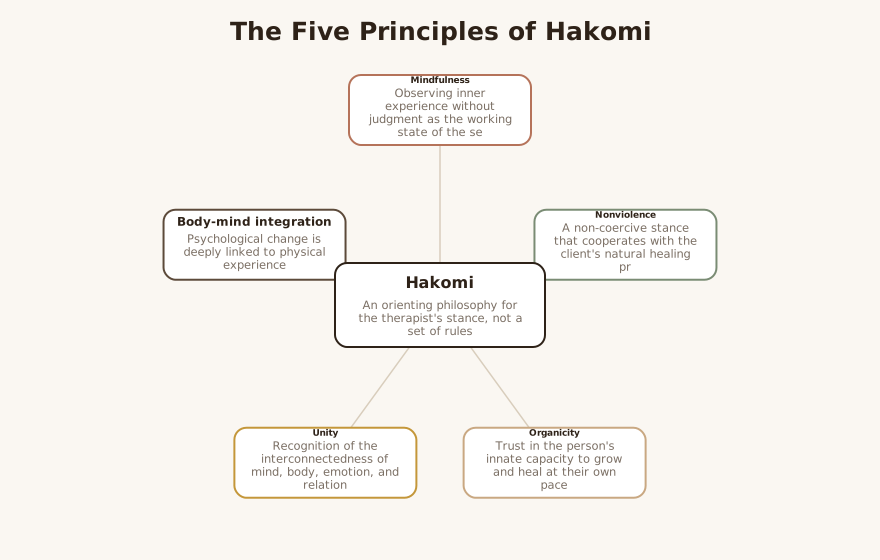
Hakomi is organized around a small set of named principles that function less as rules and more as an orienting philosophy for the therapist’s stance 4. The hakomi.com presentation names five: mindfulness, nonviolence, organicity, unity, and body-mind integration 4.
- Mindfulness — observing inner experience without judgment, cultivated deliberately within the session as the working state of consciousness 4.
- Nonviolence — a respectful, non-coercive approach that honors and cooperates with the client’s natural healing process rather than forcing change 4.
- Organicity — trust in the person’s innate capacity to grow and heal at their own pace, treating the client as a living, self-organizing system 4.
- Unity — recognition of the interconnectedness of mind, body, emotion, and relationship; this is where General Systems Theory enters the model 4.
- Body-mind integration — the understanding that psychological change is deeply linked to physical experience 4.
A practical clinical implication of these principles is that resistance is reframed: rather than something to overcome, “defenses” are respected as protective organization to be cooperated with LLM. The method also rests on Frieda Fromm-Reichmann’s dictum that “the patient needs an experience, not an explanation,” which is why Hakomi privileges direct, in-session experience over interpretation 1.
Interventions & Techniques
In practice, Hakomi follows a broadly three-step arc: first, establish safety and invite mindful curiosity; second, use mindfulness to discover the organizing core material; and third, provide a transformative “missing experience” 1. The everyday work is built from a recognizable toolkit LLM.
Loving presence and tracking. The therapist cultivates an attuned, compassionate “loving presence” and tracks the client closely — noticing somatic indicators such as tension, gesture, posture, and facial expression as data about present-moment organization 14.
Contact and mindfulness. Brief contact statements name what the therapist observes and help the client turn inward, deepening into mindfulness so that the work proceeds from felt experience rather than narrative 1.
Core material. The central aim is to identify the formative experiences, emotional patterns, and beliefs that unconsciously organize a person’s life — what Hakomi calls core material 1. Mindfulness is the route in, because in this state habitual organization becomes observable rather than merely enacted 1.
Somatic experiments. Hakomi uses small, collaborative experiments in mindfulness — for example, repeating an involuntary gesture, physicalizing an emotional state, or “taking over” a chronic tension or a self-statement so the client can study how they respond when something is no longer their job to hold 1. These are designed to evoke, not analyze, core material LLM.
The missing experience. Once a limiting belief or organization surfaces, the therapist offers an individually tailored experience that was absent in early development — a nourishing relational moment the system did not originally receive — to help transform the core material 15.
LLM-generated illustrative example (not a guideline): A client studying the felt sense of “I have to do everything myself” might, in mindfulness, hear the therapist slowly offer a probe such as “You can rest now.” The therapist tracks the body’s spontaneous reaction — a tightening, a sigh, tears — and explores it with curiosity rather than pushing past it LLM.
Evidence Base
Honesty about maturity matters here, and the two halves of the answer point in different directions LLM. As a method and training tradition, Hakomi is well established: it has been practiced and taught for over four decades, the Hakomi Institute has operated since 1981 as the original and most extensive Hakomi training organization worldwide, and there is a recognized professional and certification infrastructure 25. The method has been an early and sustained pioneer of the psychodynamic and clinical use of mindfulness, predating the broader mindfulness wave by decades 15.
As an empirically validated treatment, however, the evidence base is thin LLM. The available Hakomi literature is dominated by theoretical, conceptual, and clinical writing — foundational texts such as Kurtz’s own Body-Centered Psychotherapy — supplemented by a comparatively small number of database-indexed articles, rather than a body of randomized controlled trials demonstrating efficacy for specific disorders 36. Compiled Hakomi bibliographies mix peer-reviewed and professional-organization references with clinical and theoretical material, which is consistent with a method that is mature in practice but under-researched in controlled outcome terms 6. Professional endorsements that circulate around the method should be read as endorsements of the approach, not as outcome data 5. Clinicians should therefore present Hakomi to clients as an established experiential method with limited controlled-trial support, and lean on adjacent, better-studied somatic and mindfulness literatures when an evidence-based rationale is required LLM.
Populations & Indications
Hakomi is primarily an adult, individual-therapy method, and its founders explicitly position it for healing attachment wounds and developmental trauma 1. It is commonly applied with trauma survivors, people carrying attachment injuries, and those seeking personal growth and self-understanding 1. Because the method is attachment-informed — recognizing that relational and attachment themes frequently sit at the center of a person’s core material — it is naturally suited to clients whose presenting difficulties are organized around early relational learning 5.
Beyond individual work, Hakomi principles and skills are applied with couples and are widely used in the training of therapists and helping professionals, both as a clinical method and as a vehicle for the practitioner’s own development of presence and attunement LLM. The good-fit client is generally someone with sufficient capacity for mindful self-observation and enough affect tolerance to study internal experience without becoming overwhelmed LLM.
Problems-for-Work
Hakomi is most often brought to bear on difficulties that are organized by unconscious core beliefs and embodied patterns rather than by discrete external problems 1.
- Limiting core beliefs and low self-esteem — convictions such as “I’m too much” or “I don’t matter” are surfaced through mindfulness and met with a corrective missing experience 1.
- Developmental and attachment trauma — the explicit target population, worked relationally and somatically 1.
- Emotional dysregulation and somatic symptoms — bodily tension, gesture, and sensation are tracked and worked with directly as access points 1.
- Anxiety and depression — addressed by identifying the organizing material beneath the symptom and offering experiences the system did not originally receive 1LLM.
- Relationship difficulties — relational patterns are explored as expressions of attachment-related core material 5.
LLM-generated illustrative example (not a guideline): For a depressed client whose body collapses whenever achievement is discussed, the therapist might track the postural collapse, contact it gently (“something heavy, right there”), and, in mindfulness, explore the belief it expresses before offering a missing experience of being valued apart from performance LLM.
Contraindications, Cautions & Cultural Humility
The deliberate use of inward mindfulness and somatic activation warrants caution with clients who are actively dissociative, in acute crisis, floridly psychotic, or lacking the affect tolerance to observe internal experience safely; for these clients, stabilization and resourcing should precede uncovering work, consistent with the field’s phase-oriented trauma consensus LLM. Although nonviolence and organicity are designed to make the method gentle and to follow the client’s own pace, “going slowly” is not a substitute for adequate window-of-tolerance assessment, and somatic experiments can still evoke intense or traumatic material 4LLM.
Cultural humility is essential when working somatically and with mindfulness LLM. Norms around touch, eye contact, emotional expression, body awareness, and contemplative practice vary across cultures and faith traditions, and a therapist’s read of posture or gesture is interpretive, not objective — it must be checked against the client’s own meaning rather than assumed LLM. Practitioners should obtain informed consent specifically for experiential and any contact-based interventions, and should be transparent that Hakomi is an experiential method with limited controlled-trial evidence 5LLM.
Treatment-Plan Suggestions & SMART Objectives
| Goal | SMART objective (example) | Mechanism |
|---|---|---|
| Build mindful self-observation | Within 4 sessions, client will independently name one present-moment bodily sensation and the belief it carries in 3 of 4 sessions | Assisted mindfulness as the working state of consciousness 1 |
| Surface a limiting core belief | Within 6 sessions, client will identify one organizing core belief (e.g., “I must do everything myself”) and describe its somatic correlate | Tracking and small mindfulness experiments accessing core material 1 |
| Increase affect tolerance | Over 8 sessions, client will stay present with an activating sensation for 60 seconds without dissociating, self-rated, in 75% of attempts | Nonviolence and titrated, paced experiential contact 4 |
| Integrate a corrective experience | Within 8 sessions, client will report and recall one “missing experience” of being soothed/valued and apply it to one real-life situation | Therapist-provided missing experience transforming core material 1 |
| Reduce a chronic protective tension | Over 6 sessions, client will reduce self-rated guarding tension from 8/10 to 4/10 during one identified trigger | “Taking over” defenses so the client can study spontaneous response 1 |
| Reframe relationship pattern | Within 10 sessions, client will articulate one attachment-linked relational pattern and one alternative response, demonstrated in session role-play | Attachment-informed exploration of relational core material 5 |
| Strengthen self-compassion | Over 6 sessions, client will offer one self-compassionate statement during activation in 4 of 6 sessions | Loving presence modeling an internalized compassionate stance 14 |
Common Misconceptions
A frequent misconception is that Hakomi mindfulness is the same as a seated meditation practice; in Hakomi it is an assisted, relational, present-centered state directed toward studying live experience, not a standalone contemplative exercise 1LLM. A second is that “body-centered” implies hands-on bodywork or massage — Hakomi is a psychotherapy that reads and works with the body’s signals, and any physical contact is a consent-based clinical technique, not the defining activity 1LLM. A third is that its gentleness equals weakness or slowness for its own sake; nonviolence and organicity are deliberate strategies for cooperating with, rather than overriding, the client’s defenses 4LLM. Finally, clinicians sometimes assume “established” means empirically validated — Hakomi is established as a method and training tradition but does not have a robust controlled-trial evidence base 26LLM.
Training & Certification
Formal training is delivered chiefly through the Hakomi Institute, established in 1981, which describes itself as the original and most extensive Hakomi training organization worldwide and operates through regional training centers across multiple countries, offering workshops, professional trainings, and advanced supervision 5. Per USABP, the training is primarily designed for individuals practicing or studying in psychotherapy, counseling, and social work, with continuing-education credit available for professional courses 5. Certification as a Hakomi therapist or practitioner is achieved through this comprehensive, multi-level training and supervision structure 5. Clinicians should note that completing Hakomi training is a method credential layered on top of an independent clinical license, not a substitute for one LLM.
Key Terms
- Core material — the formative experiences, emotional patterns, and beliefs that unconsciously organize a person’s life 1.
- Assisted mindfulness — therapist-guided, present-centered self-observation used as the working state in session 1.
- Loving presence — the attuned, compassionate therapeutic stance Kurtz increasingly emphasized 14.
- Tracking — close observation of somatic indicators (tension, gesture, expression) as live data 1.
- Taking over — having the therapist supply a defense, tension, or self-statement so the client can study their spontaneous response 1.
- Missing experience — an individually tailored, originally absent nourishing experience offered to transform core material 1.
- Organicity — trust in the person’s innate, self-organizing capacity to heal at their own pace 4.
- Nonviolence — cooperating with rather than coercing the client’s process and defenses 4.
Resources & Further Reading
▶ Watch — a video introduction to this concept:
- What is Hakomi — Hakomi Institute 1
- Ron Kurtz — Hakomi Institute 2
- Kurtz, R. (1990). Body-Centered Psychotherapy: The Hakomi 3
- Hakomi: Mindfulness & Somatic Therapy — Hakomi.com 4
- Hakomi Institute — United States Association for Body Psychotherapy (USABP) 5
- Articles, Books, Research Related to Hakomi Therapy (bibliography PDF) 6
Reflective / Supervision Questions
- How do I distinguish a client who can safely use assisted mindfulness from one who needs stabilization and resourcing first, and what assessment am I actually doing to decide LLM?
- When I “track” a client’s body, how often do I check my interpretation against their meaning rather than assuming what a posture or gesture signifies LLM?
- How do I describe Hakomi’s evidence base to clients honestly — naming it as an established method with limited controlled-trial support — while still offering a coherent rationale 6LLM?
- Where might my own attachment patterns be shaping the “loving presence” and missing experiences I offer, and how would I notice LLM?
- For clients from cultural or faith backgrounds where contemplative practice, emotional expression, or touch carry different meanings, how am I adapting consent and technique LLM?