
Type & Discipline
Focusing / Focusing-Oriented Psychotherapy is a humanistic-experiential method within clinical psychology and counseling, and Focusing / Focusing-Oriented Psychotherapy (FOT) is its integration into clinical practice 1. It belongs to the experiential lineage that grew out of Carl Rogers’ client-centered work, and it sits alongside emotion-focused therapy and somatic psychology as a body-attentive, process-oriented approach 4. Rather than being a freestanding diagnostic-treatment package, Focusing / Focusing-Oriented Psychotherapy is best understood as a transtheoretical process of change — a way of attending to inner experience that can be layered into many therapeutic frameworks 6. LLM
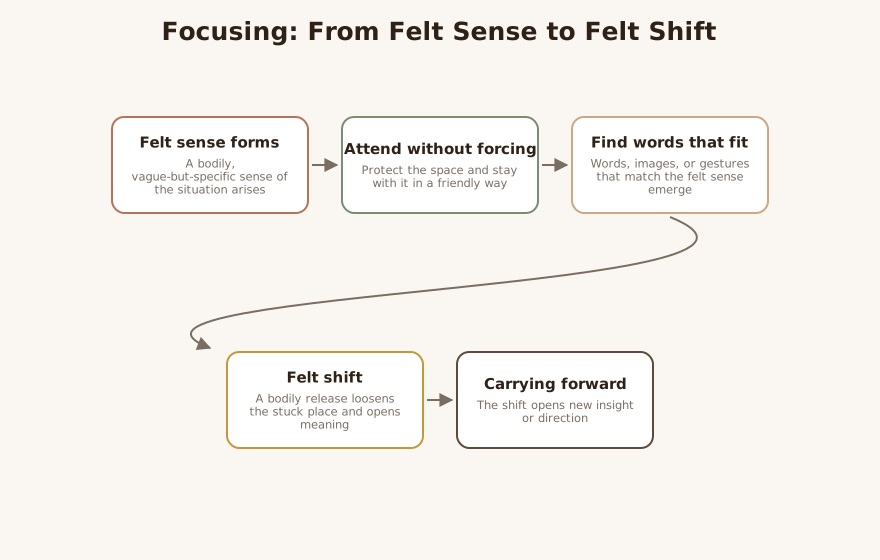
The defining unit of the method is the felt sense: an unclear, pre-verbal, bodily knowing of a situation that is distinct from a named emotion and is “always more than any attempt to express it verbally” 4. The clinical work consists of helping a client form, stay with, and gradually symbolize that felt sense until meaning emerges and the body registers a shift 3. LLM
Creators & Lineage
Focusing / Focusing-Oriented Psychotherapy was developed by the philosopher-psychologist Eugene Gendlin at the University of Chicago, where he worked closely with Carl Rogers beginning in the early 1950s 6. Gendlin and Rogers’ research team recorded hundreds of therapy sessions across orientations and asked why some clients improved and others did not 6. Their central, counterintuitive finding was that outcome was predicted less by the therapist’s technique or the client’s diagnosis than by how the client engaged their own present experience — successful clients “slowed down, became less articulate, and checked their words with how the whole of a situation felt inside their body” 6.
Gendlin was emphatic that he did not invent this process but rather identified and taught it: “I did not invent Focusing / Focusing-Oriented Psychotherapy. I simply made some steps which help people to find Focusing / Focusing-Oriented Psychotherapy” 4. He formalized the natural skill into a teachable set of movements and, after roughly fifteen years of process research, articulated the felt sense and felt shift as its core phenomena 4. In 1996 he published Focusing / Focusing-Oriented Psychotherapy: A Manual of the Experiential Method, the foundational clinical text that brings the process into the consulting room 1. Gendlin’s broader philosophical work — on experiencing, the implicit, and the creation of meaning — is carried forward by the Eugene T. Gendlin Center for Research in Experiential Philosophy and Psychology 2. Among later developers, Ann Weiser Cornell’s Inner Relationship Focusing / Focusing-Oriented Psychotherapy became the most widely adopted adaptation, emphasizing a gentle, non-coercive relationship to inner parts 4.
Core Principles
The felt sense. A felt sense is the body’s holistic, vague-but-specific sense of a situation, problem, or relationship — broader and murkier than a labeled feeling like “angry” or “sad” 4. It is the raw material of the work, and the therapist’s job is to protect the space in which it can form rather than to interpret it 3. LLM
Carrying forward and the felt shift. As the client finds words, images, or gestures that fit the felt sense, there is a perceptible bodily movement — a felt shift — that loosens a stuck place and opens new insight or direction 4. The shift is the body’s signal of accuracy; the work is verified from the inside, not by the therapist’s reasoning 3. LLM
Experiencing as the engine of change. Gendlin and Rogers operationalized depth of inner engagement as an “experiencing level,” and using that scale they could predict therapeutic success “after listening to the very first session” with notable accuracy 6. Change comes from the back-and-forth between noticing bodily experience and finding symbolic expression for it, not from insight or technique alone 6.
Presence and a non-forcing stance. Two factors drove progress in the original research: the therapist’s quality of presence and the client’s quality of contact with present experience 6. The therapist holds an accepting, unhurried attitude so the felt sense can emerge on its own terms rather than being pushed 3. LLM
Process over steps. Although Gendlin described six steps, he insisted “the essence of Focusing / Focusing-Oriented Psychotherapy is not adhering to these steps, but following the organic process” 4.
Interventions & Techniques
The classic six “movements” of Focusing / Focusing-Oriented Psychotherapy give clinicians a flexible map rather than a rigid protocol 4:
- Clearing a space — setting aside the day’s concerns to make room to sense what is there 4.
- Getting a felt sense — letting a bodily sense of a chosen issue form, without analyzing it 4.
- Finding a handle — a word, phrase, or image that captures the quality of the felt sense 4.
- Resonating — checking the handle back against the felt sense to see whether it fits 4.
- Asking — gently inquiring of the felt sense (e.g., “What is the worst of this?”) and waiting 4.
- Receiving — welcoming whatever comes, including small shifts, without forcing more 4.
In FOT, these movements are woven into ordinary clinical dialogue rather than run as a stand-alone exercise 1. The therapist functions partly as a reflective listener who mirrors the client’s verbalized experience back, supporting the focuser to stay with the bodily edge of meaning 4. Practical techniques include inviting somatic attention (“notice where in your body that lives”), offering tentative reflections the client can check against the felt sense, slowing the pace when the client becomes too articulate or analytical, and naming inner experience in a relational, non-coercive way (“something in you feels…”) 34. LLM
LLM-generated illustrative example (not a guideline): A client says, flatly, “I’m fine about the layoff.” The therapist invites, “Could you let yourself notice how ‘the layoff’ sits in your body right now?” After a pause the client puts a hand on the chest and says, “Heavy — like a stone.” The therapist reflects, “A heaviness, like a stone, right there.” The client’s eyes fill: “It’s not the job. It’s that no one fought for me.” Their shoulders drop and breathing eases — a felt shift toward what the situation actually means LLM.
Evidence Base
The maturity of Focusing / Focusing-Oriented Psychotherapy is best described as established as a process variable, with a still-maturing standalone outcome literature LLM. Its strongest empirical foundation is the original Chicago process research: depth of experiencing, measured on the Experiencing Scale, has repeatedly been associated with good therapy outcome across orientations, which is why Focusing / Focusing-Oriented Psychotherapy is framed as an evidence-based process of change rather than a branded treatment 6. Proponents cite more than fifty studies reporting positive associations between Focusing / Focusing-Oriented Psychotherapy and psychotherapy outcomes, with evidence that clients who learn to Focus tend to fare better than those who do not 6.
Clinicians should weigh this honestly. The experiencing-level findings are robust and well replicated as a predictor, but much of the direct outcome evidence for Focusing / Focusing-Oriented Psychotherapy as an intervention is older, smaller, or correlational, and Focusing / Focusing-Oriented Psychotherapy is frequently studied as a component of broader experiential and emotion-focused therapies rather than in large independent randomized trials 46. The 1996 manual codified clinical practice but is a practitioner text rather than a body of controlled trials 1. The defensible summary: the mechanism (deepening experiential contact) is well supported, while Focusing / Focusing-Oriented Psychotherapy as a discrete, manualized standalone therapy has a thinner modern trial base than first-line treatments such as CBT for the same conditions LLM.
Populations & Indications
Focusing / Focusing-Oriented Psychotherapy is used primarily with adults in individual experiential therapy and is taught to clients as a self-help skill as well 14. It is particularly suited to trauma survivors, where the felt-sense process offers a titrated, body-aware path to material that words alone cannot reach, provided pacing and safety are respected 1. It is frequently applied with people who have somatic complaints or chronic illness, helping them relate to bodily experience as meaningful rather than purely symptomatic 4. LLM
It also serves adolescents and clients already engaged in experiential therapy, and contemporary adaptations use journaling, art, and play to make the felt sense accessible to younger or less verbal clients 4. Across populations, the common indication is the same: a client who is stuck, over-intellectualizing, or cut off from inner experience and who could benefit from re-establishing contact with bodily felt meaning 6. LLM
Problems-for-Work
- Anxiety and chronic stress — clearing a space and forming a felt sense can interrupt rumination and let the body name what the worry is “really about” 4. LLM
- Major depressive disorder — Focusing / Focusing-Oriented Psychotherapy supports re-engagement with experience in clients who feel numb, flat, or “fine,” restoring access to felt meaning 6. LLM
- Posttraumatic stress disorder — the felt-sense approach offers a gentle, non-flooding way to approach trauma-related sensation under a non-forcing, receiving stance 1. LLM
- Somatic symptom disorder — relating to bodily sensation as a felt sense (not only as pathology) can shift the client’s relationship to symptoms 4. LLM
- Alexithymia and low self-awareness — the slow, somatic, “handle-and-resonate” sequence builds the very capacity to identify and symbolize inner states 46. LLM
- Emotional dysregulation — pausing to sense and receive, rather than discharge, helps a client stay with affect without being overwhelmed 3. LLM
- Decision-making difficulties — asking the felt sense what “fits” leverages the body’s holistic appraisal when analysis alone leaves a client stuck 4. LLM
LLM-generated illustrative example (not a guideline): A client paralyzed between two job offers has exhausted pro/con lists. The therapist invites them to hold each option and notice the bodily sense. One offer brings tightness and dread; the other a quiet “yes” in the belly even though it pays less. The felt sense surfaces a value — autonomy over status — that the analysis had obscured LLM.
Contraindications, Cautions & Cultural Humility
Focusing / Focusing-Oriented Psychotherapy involves deliberately turning attention inward toward bodily experience, which can be destabilizing for clients prone to dissociation, flooding, or acute psychosis; with trauma survivors the receiving, non-forcing stance and careful pacing are essential, and the therapist should not push for a felt sense the client is not ready to hold 1. LLM It is not a crisis intervention and does not replace risk assessment, stabilization, or evidence-based first-line care where indicated; the absence of large modern outcome trials means it should not be offered as a substitute for an established treatment when one is clearly indicated 46. LLM
Culturally, the meaning of “attending to the body,” emotional expression, and silence varies widely; the felt sense is the client’s own, and the therapist’s reflections must be offered tentatively and checked against the client’s experience rather than imposed 3. The non-coercive, “something in you” framing is itself a humility practice — it keeps interpretation in the client’s hands 4. LLM Clinicians should adapt language, avoid assuming a Western somatic vocabulary, and remain alert to clients for whom interoceptive focus heightens distress LLM.
Treatment-Plan Suggestions & SMART Objectives
| Goal | SMART objective (example) | Mechanism |
|---|---|---|
| Build interoceptive awareness | Client will identify and name a bodily felt sense for a presenting concern in 4 of 5 sessions over 8 weeks | Forming a felt sense; experiencing-level deepening 46 |
| Reduce avoidance of affect | Client will stay with an uncomfortable felt sense for ≥2 minutes without changing the subject, in 3 consecutive sessions | Receiving stance; tolerating present experience 3 |
| Increase emotional granularity (alexithymia) | Client will find an accurate “handle” word or image for inner experience in ≥3 instances per session by week 6 | Finding a handle and resonating 4 |
| Decrease rumination/anxiety | Client will use “clearing a space” before processing and report a 2-point distress reduction (0–10) in 4 of 6 sessions | Clearing a space; symbolizing the felt sense 4 |
| Support trauma processing safely | Client will approach one trauma-linked sensation using a non-forcing, titrated stance without flooding, weekly for 6 weeks | Titration; non-coercive receiving 1 |
| Improve stuck decision-making | Client will check 2 options against the felt sense and articulate which “fits” by session 5 | Asking the felt sense; bodily appraisal 4 |
| Strengthen self-relationship | Client will use “something in me” language for inner states in 4 of 5 sessions over 8 weeks | Inner Relationship Focusing / Focusing-Oriented Psychotherapy stance 4 |
Common Misconceptions
- “Focusing / Focusing-Oriented Psychotherapy is just relaxation or meditation.” It is a structured attentional process aimed at symbolizing a felt sense and producing a felt shift, not generic calming 4. LLM
- “The six steps must be followed in order.” Gendlin explicitly subordinated the steps to “following the organic process” 4.
- “A felt sense is the same as an emotion.” A felt sense is broader, vaguer, and pre-verbal — “always more than any attempt to express it verbally” — and is distinct from a named feeling 4.
- “Gendlin invented a new feeling.” He stated he did not invent Focusing / Focusing-Oriented Psychotherapy but identified steps that help people find a process that already occurs naturally 4.
- “It works through therapist insight or interpretation.” Change is verified by the client’s body via the felt shift, with the therapist supporting presence and contact, not supplying answers 36. LLM
Training & Certification
Training in Focusing / Focusing-Oriented Psychotherapy and FOT is coordinated through the International Focusing / Focusing-Oriented Psychotherapy Institute and affiliated centers and trainers, with pathways for both laypeople learning the self-help skill and clinicians integrating it into therapy 3. The foundational clinical reference for practitioners is Gendlin’s 1996 manual 1, and the research and philosophical tradition is housed at the Gendlin Center 2. A widely used clinician-friendly stream is Ann Weiser Cornell’s Inner Relationship Focusing / Focusing-Oriented Psychotherapy 4. LLM Clinicians should treat Focusing / Focusing-Oriented Psychotherapy training as a skill set layered onto existing licensure and scope of practice, not as a standalone credential to practice psychotherapy LLM.
Key Terms
- Felt sense — an unclear, pre-verbal, bodily knowing of a situation, broader than a named emotion 4.
- Felt shift — the perceptible bodily movement that occurs when words or images accurately fit the felt sense 4.
- Handle — the word, phrase, or image that captures the quality of a felt sense 4.
- Resonating — checking the handle back against the felt sense for fit 4.
- Clearing a space — setting concerns aside to make room to sense inwardly 4.
- Experiencing level / Experiencing Scale — a measure of depth of inner engagement that predicts therapy outcome 6.
- Carrying forward — the way symbolizing experience moves a stuck situation forward 4. LLM
- Focusing / Focusing-Oriented Psychotherapy (FOT) — the integration of the Focusing / Focusing-Oriented Psychotherapy process into clinical psychotherapy 1.
Resources & Further Reading
▶ Watch — a video introduction to this concept:
- Focusing / Focusing-Oriented Psychotherapy: A Manual of the Experiential Method (Gendlin, 1996)
- The Eugene T. Gendlin Center for Research in Experiential Philosophy and Psychology
- What is Focusing / Focusing-Oriented Psychotherapy — International Focusing / Focusing-Oriented Psychotherapy Institute
- Focusing / Focusing-Oriented Psychotherapy (psychotherapy) — Wikipedia
- Focusing / Focusing-Oriented Psychotherapy: The ‘Felt Sense’ of Experience — Eugene T. Gendlin (video)
- How is Focusing / Focusing-Oriented Psychotherapy an evidence-based process of change? — Seattle Focusing / Focusing-Oriented Psychotherapy Institute
Reflective / Supervision Questions
- When my client over-intellectualizes, do I slow the pace to invite a felt sense, or do I unconsciously match their analytic mode? LLM
- How do I tell the difference between a genuine felt shift and a client’s wish to please me or “perform” progress? LLM
- With trauma survivors, how am I titrating interoceptive attention, and what are my concrete signals to pause or ground? LLM
- Whose words are filling the silence — am I offering reflections tentatively for the client to check, or imposing my interpretation? 3 LLM
- For a given client, is Focusing / Focusing-Oriented Psychotherapy the right vehicle, or is an established first-line treatment indicated that I should not displace? 6 LLM
- How does my own comfort (or discomfort) with bodily experience and silence shape what I allow in the room? LLM