
Type & Discipline
Gestalt therapy is an experiential, humanistic psychotherapy situated within clinical psychology and counseling 3. It belongs to the broader experiential/humanistic family alongside person-centered and existential approaches, and is defined by its emphasis on holistic perception, present-moment experience, and the relationship between a person and their environment 3. The name derives from the Gestalt psychology principle that people organize stimuli in their entirety rather than as isolated components, a perceptual stance the therapy translates into a way of attending to the whole person in context 3. In practice it is a process-oriented, relational modality rather than a manualized protocol, which shapes both how it is delivered and how it has (and has not) been studied 1.
Creators & Lineage
Gestalt therapy was developed by Fritz Perls, Laura Perls, and Paul Goodman during the 1940s and 1950s 6. The foundational text, Gestalt Therapy: Excitement and Growth in the Human Personality, was published in 1951 with all three listed as authors 6. Laura Perls held a doctorate in Gestalt psychology and made substantial theoretical contributions, including co-authoring chapters of Fritz Perls’ earlier Ego, Hunger and Aggression (1942/1947), though her work was historically under-recognized 6.
The approach grew out of, and in reaction to, psychoanalysis: Fritz Perls trained as a Freudian analyst, and Gestalt therapy modified core psychoanalytic concepts, for example replacing introjection with the notion of assimilation 6. It absorbed phenomenology and existentialism in its focus on present-moment experience and personal responsibility, and Kurt Lewin’s field theory in how it conceptualizes person-environment interaction 6. Kurt Goldstein’s organismic theory supplied the holistic foundation, which Laura Perls identified as the base of Gestalt therapy 6. A direct descendant worth knowing is Emotion-Focused (process-experiential) therapy, whose empty-chair and two-chair methods carry the Gestalt experiential tradition into a more empirically studied form LLM.
Core Principles
The organizing aim of Gestalt therapy is awareness in the here-and-now: the work concentrates on the client’s immediate experience in the present moment and underscores personal responsibility for that experience 3. A central construct is unfinished business — unexpressed emotions such as anger, pain, and fear that remain incomplete and continue to press on present functioning 3. The therapy assumes the organism naturally moves to complete these open “gestalts,” and that symptoms often reflect interruptions to that completing process LLM.
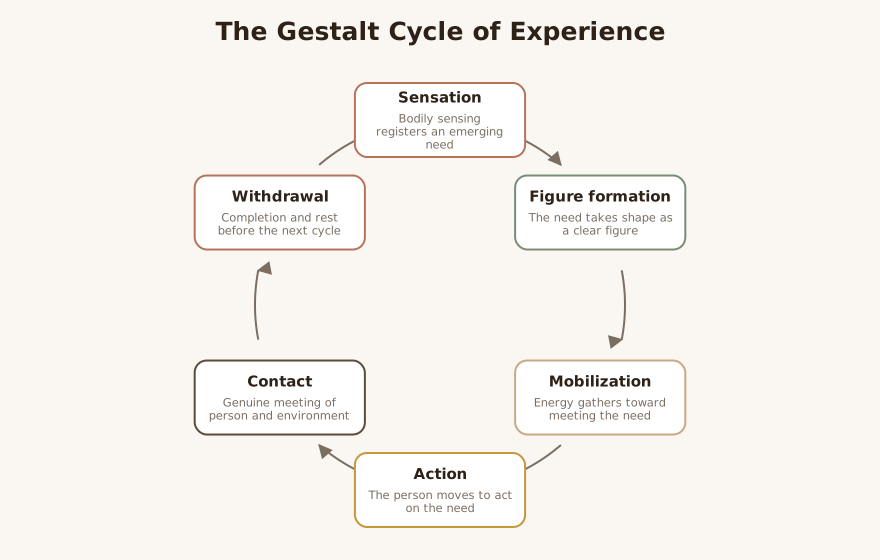
Experience is understood as a cycle moving through sensation, figure formation, mobilization, action, contact, and withdrawal, a sequence the therapist tracks to locate where contact breaks down 3. The quality of contact — genuine meeting between person and environment, and between client and therapist — is treated as both the medium and a target of the work 6. Change is framed by the paradoxical theory of change attributed to Arnold Beisser: change emerges through full acceptance of what is rather than striving to be different, so that the more one attempts to be who one is not, the more one stays the same 6. Methodologically, Gestalt therapy privileges dialogical contact and experiential experiment over interpretation 6.
Interventions & Techniques
Gestalt technique is improvisational and tied to what emerges in the session, but several signature methods recur. The empty-chair dialogue invites the client to address an absent person, a disowned feeling, or a part of themselves seated in an empty chair, and is used to resolve unfinished business and to work with depression and anxiety 3. The two-chair technique extends this into a dialogue between conflicting aspects of the self, a core dialogical method of the approach 3. Exaggeration and experimentation amplify a gesture, phrase, or sensation to bring it into awareness and to encourage creative problem-solving 3. Gestalt-based, sensory dream work treats dream images as projected parts of the self to be re-owned rather than interpreted from the outside 3.
Across these techniques the common mechanism is heightened present-moment awareness through active experiment rather than verbal insight alone 1. The therapist works at the contact boundary, noticing how the client interrupts their own experience and inviting them to stay with what arises LLM.
LLM-generated illustrative example (not a guideline): A client who reports feeling “numb” when describing a parent’s death is invited to speak directly to the parent in an empty chair. As affect surfaces, the therapist slows the pace and directs attention to body sensation (“what do you notice in your chest right now?”), supporting completion of an interrupted grieving process rather than analyzing it. LLM
Evidence Base
Honesty about the evidence is essential here: Gestalt therapy is an established and long-lived tradition whose empirical base is comparatively thin, older, and methodologically uneven 1. The two anchoring quantitative sources are dated. A 1994 meta-analysis aggregated 38 studies conducted between 1970 and 1986 and concluded that Gestalt therapy is an effective treatment that is “not inferior to other comparable methods,” while explicitly cautioning that no definitive statement could be made about differential indication, the individual-therapy setting, or long-term outcomes 2.
A more recent 2019 systematic review located only 11 empirical studies published between 2007 and 2018, and found that Gestalt therapy was as effective as cognitive-behavioral, person-centered, and psychodynamic approaches in those studies 1. That review is candid about the limitations: rigorous empirical research is scarce, the majority of the literature consists of essays rather than controlled studies, sample characteristics and sampling are often poorly reported, and all of the reviewed studies were in group settings — none addressed individual, couples, or family therapy 1. The scarcity of comparable data meant a meta-analysis could not be performed and the authors relied on narrative synthesis 1. The StatPearls clinical reference echoes the headline conclusion that Gestalt therapy was as effective as other therapeutic modalities, citing examples such as reduced anxiety in a sample of anxious parents after four weeks 3. The defensible clinical summary is therefore equivalence rather than superiority, supported by a modest, aging, mostly group-based literature LLM.
Populations & Indications
The clinical literature associates Gestalt therapy with anxiety disorders, depression (particularly grief-related depression), PTSD, sexual dysfunction, substance use disorders, intimate partner violence, and self-esteem enhancement 3. The 2019 review’s studies spanned diverse populations, including students and female students with dysthymic disorder, anxious parents, offenders, divorced women, geriatric patients, psychiatric nurses, and community activists, with particular benefit observed in group therapy settings 1. In everyday practice the approach is applied with adults, couples, groups, and adolescents, and is frequently chosen for clients presenting with unresolved grief, anxiety, low self-awareness, and the after-effects of trauma 4.
It tends to suit clients who are willing to engage experientially — to try something in the room rather than only talk about it — and who have enough affect tolerance and reflective capacity to work with intensified emotion LLM. Its present-centered, body-aware stance can be a good fit for somatic complaints and for clients who intellectualize and stay disconnected from feeling LLM.
Problems-for-Work
Unresolved grief and loss. Empty-chair dialogue with a deceased or absent figure is used to complete interrupted mourning and to give voice to unexpressed emotion 3. The work targets “unfinished business” directly, helping the client say what was never said 3.
LLM-generated illustrative example (not a guideline): A bereaved client stuck in guilt addresses their late sibling in the empty chair, voices an unspoken apology, then switches seats to imagine the sibling’s response — surfacing and metabolizing affect that rumination had kept frozen. LLM
Anxiety and avoidance. Present-moment awareness and exaggeration techniques bring anticipatory worry into contact with current bodily experience, interrupting the avoidance loop 3. Group-format Gestalt work has shown anxiety reduction, as in the anxious-parents example 3.
Self-criticism and internal conflict. Two-chair dialogue externalizes a harsh inner critic against a vulnerable self, making an internal split workable in the room 3.
LLM-generated illustrative example (not a guideline): A self-critical client alternates between a “critic” chair and a “criticized” chair; hearing the critic’s voice aloud and then answering back from the other chair softens the polarization and builds self-compassion. LLM
Low self-awareness and identity confusion. The experience cycle and contact work help the client notice where they interrupt sensation or action, restoring awareness of needs and choices 3.
Interpersonal and relationship problems. Attention to contact in the therapeutic relationship itself becomes a live laboratory for how the client makes and breaks connection with others 6.
Contraindications, Cautions & Cultural Humility
Caution is warranted with clients who have limited affect tolerance, severe dysregulation, or acute psychosis, because emotionally activating experiments such as empty-chair work can overwhelm before stabilization is in place LLM. The evidence base does not establish differential indication, so technique selection rests on clinical judgment and titration rather than on a strong outcome literature telling us who benefits most 2. Experiments should be offered, paced, and titrated with explicit attention to safety and to the client’s window of tolerance, particularly with trauma survivors for whom intensified affect can be retraumatizing LLM.
Cultural humility is integral rather than an add-on: the modality’s own experience cycle is framed as supporting culturally sensitive practice by foregrounding the environmental and social context of a person’s life 3. The therapist-client relationship and the client’s lived context are treated as central clinical factors, which invites attention to how cultural norms shape the expression of emotion, the meaning of direct confrontation, and comfort with experiential methods 3. A directive, emotionally exposing technique that fits one client may feel intrusive or shaming to another, so consent and collaborative framing should precede any experiment LLM.
Treatment-Plan Suggestions & SMART Objectives
| Goal | SMART objective (example) | Mechanism |
|---|---|---|
| Increase present-moment awareness | Within 8 sessions, client will identify and name a bodily sensation linked to emotion in at least 3 of 4 consecutive sessions | Here-and-now attention; awareness of the experience cycle 3 |
| Resolve unfinished business in grief | Over 6 sessions, client will complete an empty-chair dialogue addressing the deceased and report reduced intrusive guilt on a self-rating from 8/10 to 4/10 | Completion of unexpressed emotion (“unfinished business”) 3 |
| Reduce self-criticism | Within 10 sessions, client will use two-chair dialogue to articulate and answer the inner critic, and report one self-compassionate statement per week | Externalizing and integrating polarized self-aspects 3 |
| Decrease anxiety-driven avoidance | Over 8 sessions, client will use an exaggeration/awareness experiment with an avoided situation in-session weekly and approach one avoided situation between sessions | Interrupting avoidance by bringing worry into present contact 3 |
| Improve interpersonal contact | Within 12 sessions, client will name in real time when they withdraw from contact with the therapist in 50% of sessions | Working at the contact boundary in the live relationship 6 |
| Strengthen organismic self-regulation | Over 8 sessions, client will identify an unmet need and one concrete action to meet it in 3 of 4 sessions | Tracking sensation, mobilization, and action in the experience cycle 3 |
| Reduce somatic disconnection | Within 6 sessions, client will link a physical complaint to an emotional state in at least 2 sessions | Holistic, body-aware present-moment focus 3 |
Common Misconceptions
A frequent confusion is between Gestalt therapy and Gestalt psychology; the therapy borrows the perceptual principle of organizing experience into wholes but is a distinct clinical practice, not the academic perception research 3. A second misconception is that Gestalt therapy is just “the empty chair” — the chair work is one well-known experiment, but the approach is fundamentally about awareness, contact, and the paradoxical theory of change, not a single technique 6. Third, the present-moment emphasis is sometimes read as ignoring the past, when in fact unfinished business from the past is core material, worked through in present awareness rather than through historical reconstruction 3. Finally, the emphasis on personal responsibility is not blame; it describes ownership of one’s experience and choices in the here-and-now 3.
Training & Certification
Gestalt therapy is taught as a postgraduate specialization for already-licensed or training mental health clinicians, typically through dedicated Gestalt training institutes rather than a single accrediting authority LLM. Because the work is relational and experiential, training characteristically combines didactics, extensive experiential practice, personal therapy or process work, and supervised clinical hours LLM. Clinicians should obtain Gestalt training as an adjunct to a primary license to practice psychotherapy, and should not present Gestalt certification as a substitute for that license LLM. General clinical introductions such as the StatPearls reference and counseling-education resources provide an accessible orientation before pursuing formal institute training 5.
Key Terms
Here-and-now: the focus on immediate present experience and on taking responsibility for it 3.
Unfinished business: unexpressed emotions (anger, pain, fear) that remain incomplete and intrude on present functioning 3.
Contact / contact boundary: the meeting between person and environment, and between client and therapist, where experience is made or interrupted 6.
Experience cycle: the sequence of sensation, figure formation, mobilization, action, contact, and withdrawal that the therapist tracks 3.
Paradoxical theory of change: change occurs through full acceptance of what is, not through striving to be different (Beisser) 6.
Empty-chair / two-chair work: experiential dialogues used to address absent figures or to engage conflicting parts of the self 3.
Assimilation: the Gestalt reworking of the psychoanalytic concept of introjection, emphasizing taking in and metabolizing experience rather than swallowing it whole 6.
Resources & Further Reading
▶ Watch — a video introduction to this concept:
- Gestalt Therapy Effectiveness: A Systematic Review of Empirical Evidence (Raffagnino, 2019)
- A meta-analysis of the effectiveness of Gestalt therapy (Bretz, Heekerens & Schmitz, 1994) — PubMed
- Gestalt Therapy — StatPearls (NCBI Bookshelf / NIH)
- Gestalt Therapy — Psychology Today
- What is Gestalt Therapy? — Counselling Tutor
- Gestalt therapy — Wikipedia
Reflective / Supervision Questions
- When you propose an experiential experiment, how do you assess the client’s affect tolerance and window of tolerance beforehand, given that the evidence does not specify differential indication? 2
- How do you distinguish a productive moment of heightened affect in chair work from a flood that needs containment, and what do you do at the boundary? LLM
- Where in your own practice do you default to interpretation when a present-moment experiment might serve the client better, and vice versa? LLM
- How do you adapt directive, emotionally exposing techniques for clients whose cultural context shapes the expression of emotion and the meaning of confrontation? 3
- Given that the empirical base is modest, dated, and group-weighted, how do you describe Gestalt therapy’s evidence honestly to clients in informed consent? 1
- What is your “unfinished business” with this approach — where does the modality activate something in you that belongs in your own consultation or personal work? LLM